Bioactive Bacterial Nanocellulose Membranes Enriched With Eucalyptus Globulus Labill. Leaves Aqueous Extract For Anti-Aging Skin Care Applications Part 2
Jun 10, 2022
Please contact oscar.xiao@wecistanche.com for more information
3. Results and Discussion
Bioactive BNC membranes, incorporating different doses of an aqueous extract obtained from the hydro-distillation of E.globulus leaves, were prepared, envisioning their application as anti-aging skin care sheet masks. Four BNCmembranes containing 7.5 mg cm-of glycerol(acting as plasticizer and humectant)[39,48] and different contents of the HDE, namely 1.0 ug cm-2(BNC-G-HDE1),1.5 μg cm-2(BNC-G-HDE1.5),2.0 μg cm-2(BNC-G-HDE2), and 3.0 ug cm-7(BNC-G-HDE3), were prepared(Table 1). A pure BNC membrane (BNC) and a BNC membrane with only glycerol (BNC-G) were also prepared for comparison (Table 1). The BNC-G-HDE membranes were fabricated by the simple impregnation method, based on the diffusion of the HDE aqueous solutions and glycerol into the hydrophilic and highly porous BNC network(Figure 1), according to previous studies that described this process for the incorporation of a mixture of plant extracts [13] and caffeine [23].
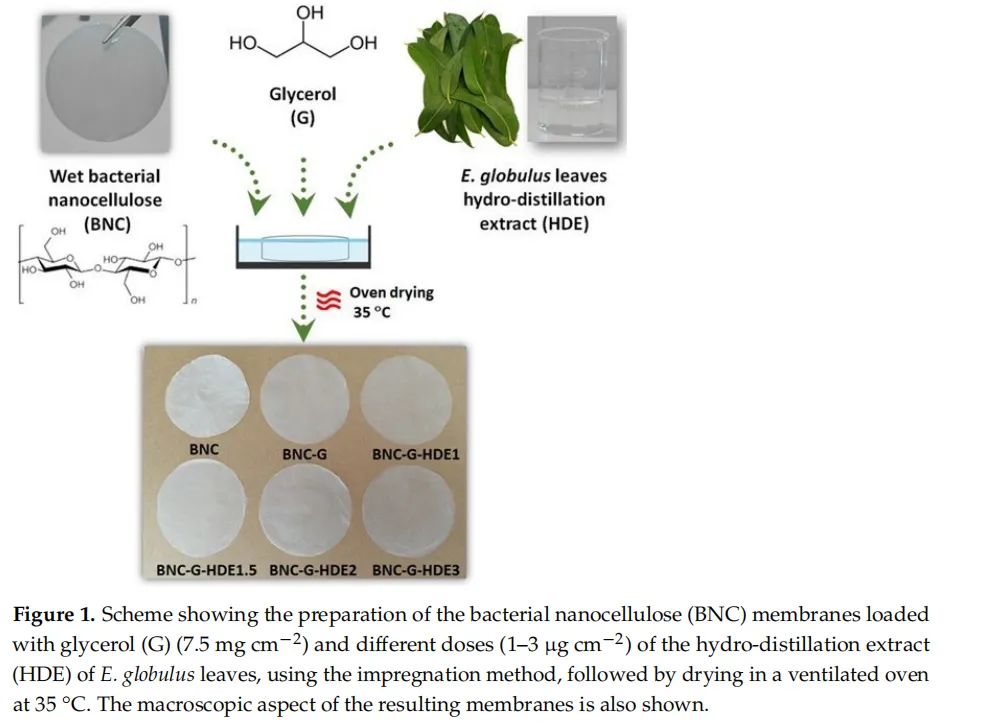
With the addition of the HDE and glycerol, the thickness of the dry BNC membranes increased from 50±1 um for the pure BNC to 87 ±4 um for the BNC-G, and to values in the range of 79±4 um to 98±8 μm for membranes loaded with HDE and glycerol, which indicates the successful incorporation of the components of the extract and glycerol into the 3D structure of BNC. The macroscopic aspect of the obtained membranes (Figure 1)is indicative of a homogeneous distribution of the HDE and glycerol within the nanostructure of BNC. how much cistanche to take It is also evident that the inclusion of glycerol turns the membranes more translucent, as previously described [20]. Moreover, the incorporation of the HDE did not result in visible color alterations of the whitish BNC membranes, which is in line with the colorless appearance of the HDE aqueous solution (Figure 1).

Please click here to know more
All the obtained BNC membranes were characterized in terms of morphology, mechanical performance, thermal stability, and moisture uptake capacity. Furthermore, the antioxidant activity and the in vitro cytotoxicity of the membranes were also assessed. For the BNC-G-HDE2 membrane(2.0 ug cm--), the stability of the antioxidant activity after 3months of storage at 22-25℃C and 52% RH or at 40 ℃C and 75% as well as the in vitro anti-senescence activity were also evaluated.
3.1.Morphology
The morphology of the BNC, BNC-G, and BNC-G-HDE membranes was evaluated by SEM analysis, as depicted in Figure 2. In the surface micrograph of the pure BNC, its characteristic 3D nanofibrillar network is clearly noticeable; however, this microstructure is less perceivable on the BNC-Gand BNC-G-HDE membranes, especially with the increment of the amount of extract, which, together with glycerol, covers the cellulose nanofibrils. This effect was already observed in BNC membranes incorporating only glycerol [49] or glycerol and active pharmaceutical ingredients (e.g., caffeine, diclofenac, and lidocaine) [22]. It can also be seen that these membranes display a less compact structure than the pristine BNC due to the entrapment of glycerol (as well as the extract components) in the BNC network. The incorporation of glycerol molecules between BNC nanofibrils reduces the intermolecular hydrogen bonds between cellulose nanofibrils[49], and consequently, diminishes the collapse of the BNC structure during drying, resulting thereby in membranes with increased flexibility [23]. In the cross-section images, the filling of the lamellar spaces of BNC with glycerol and the extract is also clearly observed. Similar results were also reported for BNC-based materials loaded with an ethanolic solution of propolis extract [50]Scrophularia striata Boiss extract [51], or hyaluronic acid [52]. Thus, these results confirm the successful incorporation of glycerol and HDE into the BNC membranes, with no evident extract agglomerates formation. what is a cistanche This observation is an indication of the good compatibility of the extract components (phenolic compounds)with the cellulose fibrils and glycerol.

3.2. Mechanical Performance
The mechanical performance of all BNC membranes was evaluated by tensile tests and compared with that of a commercial BNC-based facial mask. Considering that a sheet facial mask is typically applied in the wet state, the mechanical performance of the prepared membranes was evaluated in both dry and wet (80% moisture content) states. The evaluation of the resistance and elasticity of a sheet facial mask is fundamental because it must be sufficiently resistant to be handled and, at the same time, elastic enough to enable a perfect fit and tight adherence to the skin, thereby allowing better penetration of the active compounds into the skin [13]. The results of the tensile tests of the dry membranes (Figure 3A)show that the incorporation of glycerol significantly affected the mechanical properties of the BNC membranes by improving, to a high extent, their elasticity. This is evident by the significant increase in the value of the elongation at the break from 3.6±0.6% for BNC to 15.5±1.4% for BNC-G, accompanied by a significant decrease in Young's modulus(from 10.1±1.2 GPa for BNC to 0.5± 0.1 GPa for BNC-G) and in the tensile strength(from 237± 34 MPa for BNC to 40±9 MPa for BNC-G). These results agree with previous studies regarding BNC-based materials incorporating glycerol as a plasticizer [39,49,53]. As explained above, the incorporation of glycerol into the BNC network causes the reduction of the intermolecular forces between the cellulose nanofibrils, thereby increasing the inter-fiber space and their mobility, resulting in more elastic membranes [49]. Regarding the mechanical behavior of the wet membranes(Figure 3B), the effect of the addition of glycerol on the elongation of the membranes is not so obvious. cistanche แอ ม เว ย์ In fact, BNC shows an identical elongation value to that of BNC-G(BNC:15.2±1.3%, BNC-G:20.8± 3.5%), which may be associated with the presence of water molecules in the BNC network that will also weaken the interfibrillar bonds [24], making the wet BNC more stretchable. However, as in the dry membranes, a significant reduction in Young's modulus(BNC:0.3±0.0 GPa vs.BNC-G:0.02±0.01 GPa) and tensile strength (BNC:26±1 MPa vs. BNC-G:2±1 MPa) is observed after glycerol loading.

The incorporation of the HDE into the BNC membranes does not alter, in a significant way, most of the mechanical properties of the dry membranes when compared with the BNC-G counterpart. The exception is the increase of tensile strength and Young's modulus for BNC-G-HDE2 and the increase of the elongation at the break of BNC-G-HDE3. All BNC-G-HDE membranes show high elongations(11-18%) together with small values of Young's modulus(0.7-1.9 GPa) and tensile strength values between 51 and 116 MPa. Similarly, in the wet state, it was also confirmed that the addition of HDE does not significantly influence most of the mechanical properties of BNC-G(Figure 3B). The wet BNC-G-HDE membranes also show high elongations(19-27%), low values of Young's modulus (0.03-0.06 GPa), and tensile strength values between 4 and 5 MPa.

Taken all together, the mechanical properties discussed above confirm that the BNC-G-HDE membranes are pliable enough to be manipulated and moldable to the skin, as is desirable for the intended application. In fact, the results demonstrate that these membranes are really promising, especially considering the comparison with the commercial BNC mask. The dry BNC-G-HDE membranes have identical or even significantly(p<0.05)superior mechanical properties (e.g., elongation at break of dry BNC-G-HDE3) to those of the commercial BNC counterpart When evaluated in a wet state, the commercial BNC shows higher values of elongation at break and tensile strength than those observed in the BNC-G-HDE membranes, whereas values of Young's modulus are identical. Differences in the content of plasticizers and humectants (e.g., glycerol, hyaluronic acid, PEG-450) can explain the increased elasticity of wet commercial BNC compared to the BNC-G-HDE membranes developed in the present study.
3.3. Thermal Stability
For insight into the thermal stability of the BNC-G-HDE dry membranes, thermogravimetric analysis was performed under an inert (N,)atmosphere. The BNC-G membrane was analyzed as a control. The degradation profiles and corresponding derivatives are depicted in Figure 4. All membranes show an initial weight loss below 100°C, credited to the evaporation of adsorbed water from the polymeric matrix, which confirms the hydrophilicity of BNC and the hygroscopic nature of glycerol. Apart from this dehydration step, all mem-branes display a two-step weight loss profile. The thermal profile of the BNC-G membrane shows a step of weight loss with initial and maximum decomposition temperatures of about 125°C and 233°C, respectively, mainly associated with the degradation of glycerol, in good agreement with previous results obtained elsewhere with plasticized BNC [49]. The second weight-loss stage occurs at initial and maximum decomposition temperatures of about 295°C and 355°C, respectively, and is attributed to the decomposition of the cellulose glycosyl units [30].
Regarding the membranes incorporating the HDE, the weight loss step assigned to the decomposition of glycerol exhibits a maximum decomposition temperature at ca. 232°C for BNC-G-HDE1,224°C for BNC-G-HDE1.5,226°C for BNC-G-HDE2, and 213°C for BNC-G-HDE3. Similar to BNC-G, the second weight loss step is observed at maximum decomposition temperatures of about 355℃C for BNC-G-HDE1, 353℃C for BNC-G-HDE1.5, 343°Cfor BNC-G-HDE2, and 350°C for BNC-G-HDE3, owing to the decomposition of the BNCpolymeric chains. cistanche tubulosa dosage reddit From the thermograms, it was not possible to identify the weight loss attributed to the decomposition of the HDE phenolic compounds, which according to the literature may occur in the range of 100-300°C [54,55]. However, given the low ratio (<0.1%, w/w)of the HDE in the BNC membranes, the weight loss associated with the extract components is probably not perceivable.
These results indicate that all membranes are stable up to ca. 125°C, which is comparable with results previously reported for glycerol-plasticized BNC membranes [49] and is adequate for the intended use as a facial mask, considering its use at body temperature.

3.4.Moisture Uptake Capacity
Moisture retention is a highly desirable property of sheet facial masks aiming to avoid the dehydration of the polymeric structure and ensure the adherence of the mask to the skin during the entire time of treatment [24]. At the same time, the swelling of the nanoporous structure of BNC, due to water binding, will also facilitate the delivery of the incorporated active compounds. Thus, the moisture uptake capacity of the prepared dry membranes was determined to evaluate their ability to absorb environmental humidity. Therefore, membranes were placed in a desiccator with controlled humidity (RH ca.52%)at room temperature, and moisture uptake was monitored over time, from 30 min up to 48 h (Figure 5). The RHof about 52% used in the assay is close to the value of 45±5%, indicated as general guidelines to perform hydration studies with moisturizing cosmetics [56].

All the prepared BNC membranes can absorb environmental humidity, showing an incremental uptake over time and reaching a maximum at 48 h, which is in agreement with a previous work with BNC loaded with silk-sericin [24]. As expected, the incorporation of glycerol, a highly hygroscopic compound, resulted in BNC membranes with a higher aptitude to uptake environmental humidity, even for short periods of time, such as 1 h, with BNC-G membranes absorbing 5.3±0.3% of moisture after this time, and pristine BNC absorbing only 1.3±0.2%. Similar behavior was observed for the BNC-Gmembranes loaded with the HDE, presenting a moisture uptake of 4.4± 0.6% for BNC-G-HD,4.4± 0.3% for BNC-G-HDE1.5,4.2±0.3% for BNC-G-HDE2, and 3.9±0.6% for BNC-G-HDE3 after 1 h. The amount of the HDE seems to have no influence on the moisture uptake capacity of the membranes since the differences are not significant(p>0.05). Considering that the time of treatment of a beauty mask is generally between 20 min and 1 h, the capacity of the BNC-G-HDE membranes to rapidly absorb environmental humidity is fundamental to guarantee the adherence of the BNC sheet to the skin during the entire treatment and favor the release of the active compounds. It is also noteworthy that for the short period of 1 h, the moisture uptake capacity of BNC-G-HDE membranes is identical (p>0.05)to that obtained for the commercial BNC mask (3.2± 1.0%).
3.5. In Chemico Antioxidant Activity
The TPC of the E.globulus HDE was determined using the Folin-Ciocalteu method, ac-counted for 329±9 mg of GAEg-I of lyophilized extract. This result confirms the presence of high content of phenolic compounds in this extract, being comparable with TPC values previously reported for phenolic extracts of E.globulus leaves (311± 20 mg GAEg-Iof dry extract) [57].

Phenolic compounds are well known for their antioxidant properties resulting from the scavenging of free radicals, which is one of the mechanisms to prevent cellular oxidative stress [29]. Therefore, the antioxidant activities of the HDE and of the prepared BNC membranes(BNC, BNC-G, BNC-G-HDE1, BNC-G-HDE1.5, BNC-G-HDE2, and BNC-G-HDE3) were assessed by the DPPH free radical scavenging method (Figure 6). The antioxidant activity was monitored up to 2.5 h, based on the usually short duration of application of a facial mask and on procedures described elsewhere [44,58].

The pure BNC membrane does not present considerable antiradical scavenging activity, which agrees with data reported in previous studies [51,59]. Similar results were obtained for the BNC-G membranes since glycerol is not an antioxidant compound. Regarding the HDE aqueous solutions, they show a dose-dependent antioxidant activity, which can be attributed to their content in phenolics, similar to results previously reported for an aqueous E.globulus leaf extract [57]. The maximum DPPH scavenging activity was attained at the end of 2.5h by the HDE3 solution (7.5 ug mL-)(75.1 ±5.8%). This result indicates that the HDE has a higher antioxidant activity when compared to an ethanolic extract of dried commercial E.globulus biomass, which only shows a DPPHscavenging activity of 65%(at 0.5 h incubation) for an extract concentration of 250 μg mL-I【37】. Regarding the BNC-G-HDE membranes, the results revealed that all membranes display antioxidant activity with a dose-dependent response that increases over time. cistanche salsa benefits The maximum DPPH scavenging activities were reached at the end of 2.5 h, with 14.2 ±1.6%, 28.1 ±6.3%,48.9±6.1%, and 53.3± 5.7% for BNC-G-HDE1, BNC-G-HDE1.5, BNC-G-HDE2, and BNC-G-HDE3 membranes, respectively. Therefore, the results clearly show that the incorporation of the HDE into the BNC network successfully imparts the pure BNC with antioxidant activity, similar to what was achieved in previous works with extracts of S.striata Boiss [51]or Epilobium Angustifolia L.[60].

These results also demonstrate that the HDE is gradually released from the membranes, and after 2.5 h, the DPPH scavenging activities obtained for all membranes, except for BNC-G-HD3, are identical (p>0.05) to those achieved for the corresponding HDE solution. The difference (p<0.05)between BNC-G-HDE3 and HDE3 samples may be related to the kinetics of the HDE release from the membrane. These are promising results regarding the use of these membranes for the delivery of the active compounds of the HDE. In particular, the BNC-G-HDE2 membrane seems preferable for further studies, because it shows similar results, in terms of antioxidant activity, to the membrane with the highest dose of HDE, even though a lower dose of HDE is used, which is especially relevant when future scale-up is considered.
3.6.Eoaluation of the Stability of the BNC-G-HDE2 Membrane under Storage
Environmental factors (e.g., temperature, light, and oxygen) are known to have an impact on the structural stability of phenolic compounds and on their antioxidant activity 61. The storage temperature and light are among the most reported factors to be associated with the reduction of antioxidant activity of extracts containing phenolic compounds [62,63]. Hence, based on international guidelines on stability testing of cosmetic products [46], an exploratory stability test was performed to evaluate the changes in the antioxidant activity of the BNC-G-HDE2 membrane under normal storage conditions, namely at 22-25°C and 52% RH (a condition I) and at accelerated conditions (viz. exaggerated storage conditions), namely at 40°C and 75% RH (condition II) for 3 months.
Observation of the macroscopic aspect of the membranes(Figure 7)shows that there are no significant alterations in their homogeneity over the 3 months of storage under both storage conditions.
Results from the antioxidant activity of the BNC-G (control) and BNC-G-HDE2 mem-branes over the 3 months of storage in each condition are depicted in Figure 8. As in the assay of the antioxidant activity of BNC-G-HDE membranes(Section 3.5), the values obtained for the antioxidant activity of BNC-G are not significant. Regarding the BNC-G-HDE2 membrane, when it is stored at 22-25°C and 52% RH (Figure8A), the antioxidant activity is kept unchanged over the entire assay(p>0.05), showing values of 37.0±6.9%in the beginning of the assay and 39.6± 2.4% after 3 months. Similar results were obtained after storage at accelerated conditions(Figure 8B) of 40°C and 75%RH, in which the variation in the antioxidant activity after 1 month (31.7±7.5%)and after 3 months (31.0±5.2%)is not significantly different(p>0.05)from that at the beginning of the assay. Hence, these results indicate that the antioxidant activity of BNC-G-HDE2 is stable for at least 3 months under these storage conditions, meaning that no apparent degradation of the phenolic compounds from the HDE occurs within the membranes. Moreover, with these promising results under accelerated conditions, it is predictable that the stability of membranes will be longer than 3 months under normal storage conditions.


3.7. In Vitro Biological Assays
3.7.1. Cytotoxicity Assay
The evaluation of the safety of the BNC-based membranes is essential for their application as facial masks since this implies their direct contact with skin. Therefore, the cytotoxicity of the BNC-G (for control) and the four BNC-G-HDE membranes was evaluated using the MTT assay, with extracts of the membranes, towards human keratinocytes (HaCaT)and mouse fibroblasts (NIH/3T3) cells. These cell lines were selected for being representative of the two important structural cell types from the skin. Keratinocytes are the main cells of the epidermis (the uppermost skin layer), while fibroblasts are part of the dermis (second skin layer) [64].
The results obtained for the BNC-G membrane(Figure 9) are in line with the well-known non-cytotoxicity of pure BNC towards HaCaT [52,65] and NIH/3T3 [65,66] cells and of BNC plasticized with glycerol on HaCaT cells [39]. Concerning the results of the cytotoxicity of BNC membranes loaded with the HDE, it is noticeable that, independently of the HDE dose, the membranes have no significant effect on the viability of either HaCaT or NIH/3T3 cells. All values of cell viability obtained for BNC-G-HDE membranes are above 70% and are therefore considered non-cytotoxic towards these cell lines, according to the international standard ISO10993-5 for the biological evaluation of medical devices (Part 5: Tests for in vitro cytotoxicity). Thus, these results are a confirmation that the incorporation of these doses of the E.globulus HDE into BNC is completely safe for dermal applications. Indeed, these data are in agreement with results reported elsewhere showing the non-cytotoxicity of an ethanolic extract from E.globulus biomass (1, 10, and 100 μg mL-1) tested on normal humans dermal fibroblasts [37].

3.7.2. Anti-Senescence Activity
The skin aging process has been associated not only with alterations in the composition and structural integrity of the dermal extracellular matrix(ECM) [67] but also with the increase of senescent cells in the dermal layer [68]. The accumulation of senescent dermal fibroblasts is now recognized as playing an active role in the skin aging process, contributing to the decline of tissue functionality [69,70].
In this sense, the anti-senescence activity of the BNC-G-HDE2 membrane was assessed towards mouse fibroblasts(NIH/3T3 cell line). The BNC-G-HDE2 membrane was selected for this evaluation because, together with BNC-G-HDE3, it shows one of the highest antioxidant activities, and since a lower quantity of HDE is used in the BNC-G-HDE2, it is preferable with regard to a future economic application.
Cellular senescence was induced with the genotoxic agent etoposide, and the activity of β-gal, a broadly used biomarker for senescent cells [71], was measured. According to the data presented in Figure 10, neither BNC-G nor BNC-G-HDE2 membranes activate senescence-associated β-gal of NIH/3T3 cells. On the contrary, upon etoposide treatment, the number of senescence-associated β-gal-positive (blue staining) NIH/3T3 cells signifi-cantly increases compared to control(44.1±2.7% versus 8.9±1.0%). This is also visible in the acquired morphology of the NIH/3T3 cells, showing the characteristic senescent phenotype with enlarged and flattened cells(Figure 10A). Noticeably, after 24 h of treatment with the BNC-G-HDE2 extract, there is a significant reduction in the number of senescent NIH/3T3 cells (32.2±4.0%)(Figure 10B). This positive effect is surely credited to the components of the HDE, namely phenolic compounds that are released from the membrane. In fact, phenolic compounds have already been demonstrated to have beneficial effects on preventing cellular senescence by suppressing the senescence-associated β-gal, mostly due to their known role as inhibitors of oxidative damage [72,73]. Other examples in line with the results obtained here are the findings on the effects of the Sonchus oleraceus L. leaf extract (containing caftaric acid, chlorogenic acid, and chicoric acid) on H2O2-induced cell senescence in WI-38 human lung diploid fibroblast cells [74], or of olive phenols(hydroxytyrosol and oleuropein) on pre-senescent human dermal and lung fibroblasts [72]However, as far as we know, this is the first time that this activity has been reported for BNC membranes enriched with plant extracts. Therefore, these are promising results suggesting the considerable potential of the developed BNC-G-HDE membranes for anti-aging skin care applications.

4. Conclusions
Aiming at the development of an entirely bio-based material with bioactive and adequate mechanical properties for potential anti-aging skin care applications, BNC mem-branes loaded with glycerol and different doses (1-3 ug cm-2) of an aqueous E.globulus extract derived from hydro-distillation (HDE)of leaves containing phenolic compounds (329±9 mg GAE g-I of lyophilized extract) were prepared through the impregnation method. All BNC-G-HDE membranes exhibited a resistant but still elastic mechanical behavior, similar(at both dry and wet states) to that of a commercial BNC facial mask. The ability of the BNC-G-HDE membranes to uptake environmental moisture was higher than that of pure BNC and also comparable to that of the commercial BNC mask. BNC-G-HDE membranes were found to be thermally stable up to about 125°C. Moreover, the incorporation of the HDE confers a dose-dependent antioxidant activity (DPPH radical scavenging assay) to BNC. The stability of the antioxidant activity of the membrane with 2 ug cm-2of HDE was proven after storage over 3 months at expected normal(22-25°C/52%RH) and accelerated (40C/75% RH)storage conditions. All BNC-G-HDE membranes were shown to be non-cytotoxic toward HaCaT and NIH/3T3 cell lines. Moreover, the treatment with BNC-G-HDE2 membrane was demonstrated to cause a reduction in the percentage of senescent cells (ca. 32%)compared to that observed in treated cells only with etoposide (ca. 44%). The findings reported here clearly highlight the potential of the prepared HDE-loaded BNC membranes as robust sheet facial masks for anti-aging skin care.
This article is extracted from Materials 2022, 15, 1982. https://doi.org/10.3390/ma15051982 https://www.mdpi.com/journal/materials