Chemical Profile, Cytotoxic Activity And Oxidative Stress Reduction Of Different Syringa Vulgaris L. Extracts Part 1
Mar 24, 2022
Please contact oscar.xiao@wecstanche.com for more information
Abstract: Syringa vulgaris L. (common lilac)is one of the most popular ornamental species, but also a promising not comprehensively studied source of bioactive compounds with important therapeutic potential. Our study was designed to characterize the chemical composition and to assess the antioxidant and cytotoxic properties of ethanolic extracts obtained from S.vulgaris L flowers, leaves, bark, and fruit. The chemical profile of the ethanolic extracts was investigated using chromatographic(HPLC-DAD-ESI+, GC-MS) and spectral (UV-Vis, FT-IR) methods, while the protective effect against free radicals was evaluated in vitro by different chemical assays (DPPH, FRAP, CUPRAC). The cytotoxic activity was tested on two tumoral cell lines, HeLa, B16F10, using the MTT assay. Significant amounts of free or glycosylated chemical components belonging to various therapeutically important structural classes, such as phenylpropanoids (syringin, acetonide, echinacoside), flavonoids(quercetin, kaempferol derivatives), and secoiridoids(secologanoside, oleuropein, 10-hydroxy oleuropein, demethyloleuropein, syringalactone A, nuzhenide, lingstroside)were obtained for the flowers, leaves and bark extracts, respectively. Furthermore, MTT tests pointed out a significant cytotoxic potential expressed in a non-dose-dependent manner toward the tumoral lines. The performed methods underlined that S.vulgaris extracts, in particular belonging to flowers and leaves, represent valuable sources of compounds with antioxidant and antitumoral potential.
Keywords: Syringa vulgaris L. flowers; bark; leaves; fruit; Oleaceae polyphenols; secoiridoids; antioxidant; cytotoxic

Please click here to know more
1. Introduction
The Oleaceae is an important family among flowering plants, comprising 25 genera, with over 600 species that are spread worldwide in a wide variety of habitats, especially in the temperate and subtropical climates[1,2]. The most well-known genera belonging to this family are Olea, Forsythia, Fraxinus, Syringa, Jasminum, and Ligustrum, including species that have economic importance, food and oil plants, perfumed plants, or ornamental species [2]Among these genera, in the European flora few species can be found, especially belonging to the genera Fraxinus(e.g., Fraxinus excelsior L.), Ligustrum (e.g., Ligustrum vulgare L.), Syringa (e.g., Syringa vulgaris L.)and Forsythia [1]. The Syringa genus is one of the most widely known among these genera, being spread in the Western and Eastern part of Eurasia and comprising two species, Syringa vulgaris Land Suringa josikaea I. Jacg.ex Rchb. The two species are differently spread along the European continent: S.vulgaris can be found on the Balkan Peninsula and in the southern part of the Carpathians, S. josikaea in the northern parts of the Carpathians, and both species can be found in the western parts of the continent [3]. The genus comprises more than 40 species distributed around Europe and Asia. Most of these species are deciduous shrubs and trees [4].
The species S. Vulgaris, the common lilac, is the most widely spread of these two species, being cultivated as an ornamental species all across the European continent [1] and for the perfumes industry [5]. In addition, the species has known various uses, especially in traditional medicine. The more frequently used medicinal product is represented by the inflorescences. In Greece, an infusion of the inflorescences is used internally to treat gastro-intestinal troubles (bloating) and externally as a massage for the treatment of gout and rheumatism [6]. Same external use is cited in Serbian traditional medicine for this medicinal product in combination with the fruit of Aesculus hippocastanum, for the treatment of varicose veins and rheumatism [7]. Flowers of the species are also recommended as antipyretics and appetizers as a decoction in Bulgaria, while Italian traditional medicine describes the use of bark, fruit, and leaves also as a decoction for their astringent and antipyretic effect [8]. Leaves of the species are recommended in Hungarian ethnopharmacology for the treatment of bleeding wounds, joint and muscle aches [9]. Similar species belonging to the same genus (e.g., S.oblata Lindl., S.pinnatifolia Hemsl., S.reticulata (Blume)H. Hara var. amurensis(Rupr.)I.S.Pringle, S.pubescens Turcz. and S.pubescens subsp. patula (Palib) M. C. Chang & X. L. Chen.) proved to have similar traditional uses. Thus, Chinese sources cite the traditional use of all these vegetal medicinal products(flowers, leaves, barks), but also of roots, branches, and fruit, especially for the treatment of gastrointestinal disorders, joint inflammations, infections, or asthma [5].

Cistanche can improve immunity
Scientific data on the species support the uses that are cited in traditional medicine, being connected to the antioxidant[10,11], antimicrobial [12], anti-inflammatory[13,14], and antipyretic properties[4,5 and inhibitory effects on blood stasis[15]. Studies were performed on similar species belonging to the genus Syringa, as S.pinnatifolia[12,16], but the vast majority were performed on the S.vulgaris species[1,10,11,13-15]. The compounds that are responsible for these activities are sesquiterpenes[12], hydroxycinnamoyl derivatives and secoiridoids or secoiridoid glycosides[1,13], phenolic compounds [10,11,14,15], lignans [14,16], phenylpropanoids and iridoids [14]. Regarding vegetal medicinal products that were tested, they were represented by flowers [10,13,15], barks [11,14,16, stems[12], fruit [10], leaves[11] or all these [1]. Nevertheless, information on this species, on its medicinal uses, and on the compounds that are responsible for these uses remain scarce [1]. Taking all of this into consideration, the species of the genus Syringa appear to be important sources of compounds, proving at the same time important medicinal uses. These species need further investigation, in order to bring further evidence for their introduction in therapy and for the investigation of their bioactive ingredients and mechanisms of action underlying the pharmacological effects they exhibit, as these data remain scarce 1,4]. Therefore, the novelty and originality of this study are represented exactly on its main purpose, which is represented by evaluating the chemical composition and testing the antioxidant and cytotoxic activities of extracts belonging to different parts of the species: flowers, leaves, bark, and fruit. Moreover, the study aims to perform a comparison between these extracts, regarding their composition and biological activities, with the final purpose of highlighting the potential of flowers, which may represent an important medicinal
the product that has anti-proliferative potential and may be used in the therapy of different forms of cancer.
2. Results and Discussion
2.1.HPLC-DAD-ESI+ Analysis
Results obtained for the HPLC-DAD-ESI+ analysis of phenolic compounds can be found in Table 1.
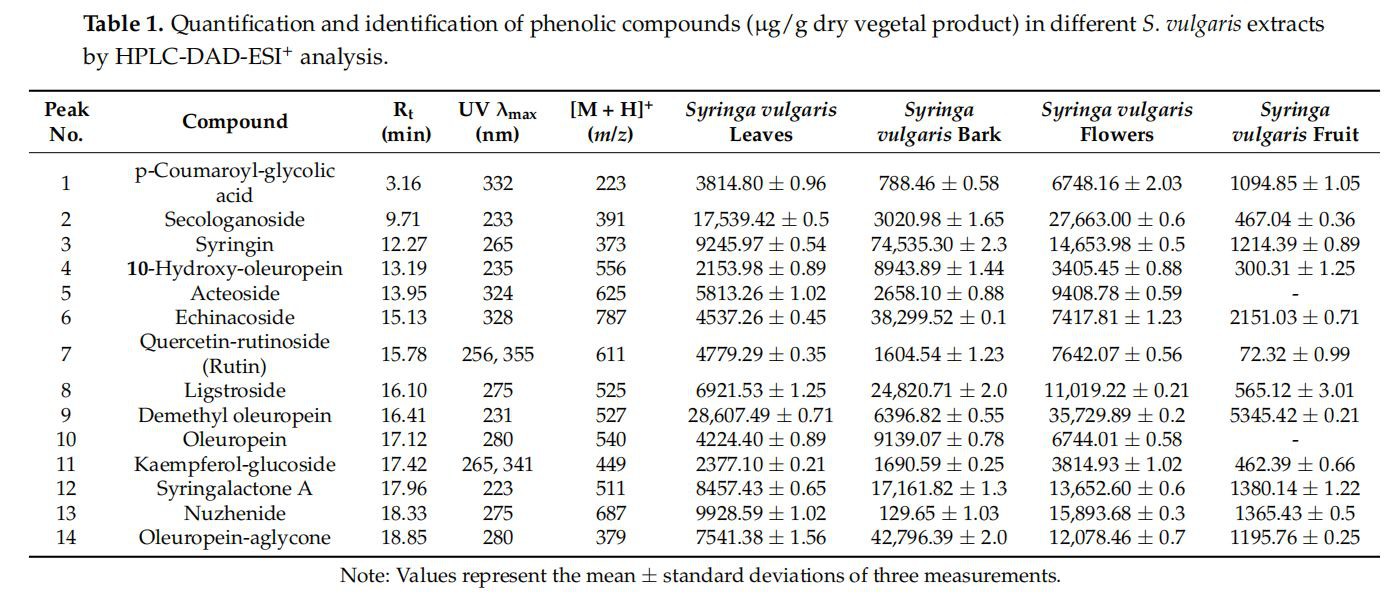
The performed analysis clearly showed significant differences concerning the number of chemical compounds in the S. Vulgaris extracts obtained from leaves, bark, fruit, and flowers. Important amounts of free or glycosylated chemical components belonging to various therapeutically important structural classes, such as phenylpropanoids (syringin, acteoside, echinacoside), flavonoids(quercetin and kaempferol derivatives),secoiridoids (secologanoside, oleuropein, 10-hydroxy oleuropein, demethyloleuropein, syringalactone A, nuzhenide, lingstroside)and p-coumaroyl-glycolic acid were obtained. Twelve out of 14 identified compounds were detected and quantified in all tested extracts, while acetonide and oleuropein were not found in the fruit extract (Table 1). Furthermore, significantly high amounts of certain identified compounds, namely p-coumaroyl-glycolic acid (6748.16 μg/g), secologanoside (27,663.00 μg/g), acetonide (9408.78 μg/g), quercetin-rutinoside (7642.07 ug/g), dimethyl oleuropein (35,729.89 μg/g), kaempferol-glucoside (3814.93 ug/g), nuzhenide(15,893.68 ug/g) were observed in the case of the flower extract (Table 1). Nuzhenide is a secoiridoidic compound with strong antioxidant activity, similar to oleuropein and its derivatives [4,10].
The bark extract possessed the highest concentration in syringin (74,535.30 ug/g), sy-ringalactone A(17,161.82 μg/g), 10-Hydroxy-oleuropein (8943.89 ug/g), echinacoside (38,299.52 ug/g), ligstroside (24,820.71 ug/g), oleuropein (9139.07 ug/g), oleuropein-aglycone(42,796.39 ug/g)(Table 1). These results underlined bark extract rich content in echinacoside, a phenylpropanoid glycoside recognized for immunostimulant and an-tioxidant properties, and syringin, a phenylpropanoid glycoside with immunostimulatory, antioxidant, and antidiabetic properties [17]. Moreover, the bark syringin presence was also highlighted in the other analyzed parts of the plant(14,653.98 μg/g for flowers extract,9245.97 μg/g for leaves extract).
Overall, flowers extract revealed the highest and most balanced content of phenylpropanoid, flavonoid, and secoiridoid compounds, while the fruit extract presented the lowest content of these active compounds.
Although the literature does not document detailed information regarding the chemical profile of ethanolic extracts, the polyphenolic composition was assessed in the case of extracts obtained from lilac flowers [10,15], fruit [10], bark[11,14], and leaves [11,15,18]. Toth et al. performed the HPLC-DAD-ESI-MS analysis of methanolic extracts obtained from lilac flowers and fruit and indicated 34 compounds, including 18secoiridoids, seven phenylpropanoids, four flavonoids, and five low molecular weight phenols. Flowers were found to contain significant amounts of phenylpropanoids(acetonide, 2.48%; echinacoside, 0.75%) and oleuropein (0.95%), while the fruit's major secondary metabolites were identified as secoiridoids oleuropein(1.09%)and nuzhenide (0.42%)[10]. Another study pointed out a complex metabolite profile and the antioxidant potential in the case of Syringa vulgaris bark and leaf methanolic extracts. A total of 33 compounds (15 secoiridoids, 6 phenylpropanoids,3 flavonoids,3 lignans, and 6 low molecular weight phenols) were identified by HPLC-DAD-ESI-TOF and HPLC-DAD-ESI-MS/MS. The main phenolic compounds in bark and leaves were represented by syringin (2.52%)and rutin(1.13%)respectively [11]Filipek et al.reported the identification of 22 compounds: five simple phenolic compounds, four lignans, three phenylethanoids, a phenylethanoid esterified with an oleoside and eight secoiridoids and iridoids. Among these compounds, syringin, acetonide, nuzhenide, echinacoside, oleuropein, and ligstroside were the most important [14].

Taking all of this into consideration, the present study brings novelty and originality, being, to the best of our knowledge, the only one comparing the four different extracts (obtained from flowers, leaves, bark and fruit), reporting large amounts of bioactive compounds in their composition and showing therefore that flowers represent the most important source of active principles.
2.2.Vibrational IR Spectra of Syringa Vulgaris L., Bark and Fruit Extracts
Infrared spectroscopy is an effective and non-targeted analytical method that could non-destructively and cost-effectively detect the intrinsic quality of different plants [19,20]. Based on F-IR results, it is possible to highlight a list of peaks that can be assigned to a different biochemical class of compounds, which could lead to a better correlation between the chemical structure and the spectroscopic features of plants [21]. Therefore, this technique also provides a precise assignment of the functional groups, bonding types, and molecular conformations within plant tissue and cells [20].
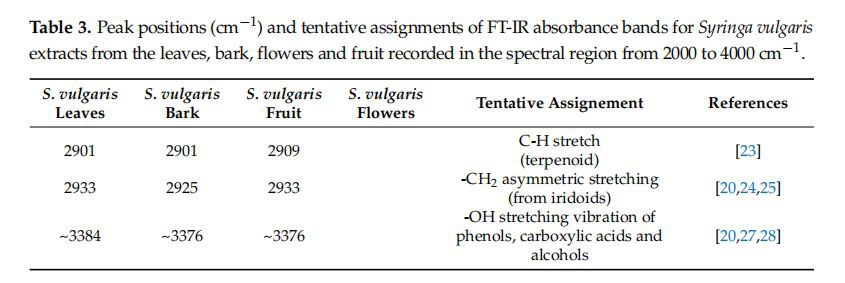
The FTI-IR spectra of analyzed S. Vulgaris extracts showed some spectral changes (Figure 1). Moreover, as it can be observed in Tables 1 and 2, the main functional groups of echinacoside(a phenylpropanoid), rutin(a flavonoid), and iridoids were illustrated in the FT-IR spectra of S.vulgaris extracts. Thus, peaks between 814-816 cm-1,1513-1515 cm-1 were characteristic to phenylpropanoid-associated signals of echinacoside [21,22]. Within a similar range, terpene-associated stretching vibrations of C=O had contributed to the band from 1694-1702 cm-I[23]. Another terpene-associated peak was observed in the range 2901-2909 cm-1 and was caused by the C-H stretching vibration [20,23-25]. Furthermore, the peaks found between 885-890 cm-Iand 2925-2933 cm-were associated with the presence of CH, functional group, while the peak between 1256-1268 cm-1 could be attributed to C-O stretching vibration from both terpene and iridoids [23]. A strong peak in the range 1076-1079 cm-1was caused by iridoids stretching vibration of-C-OH [24-26]. The presence of flavonols in the S.vulgaris analyzed extracts could also be confirmed. Therefore, the peak occurring within the range 1596-1608 cm-I could be attributed to C=C stretching vibrations from the structure of both flavonols and iridoids [24,26-28]. Similarly, in the FT-IR spectra of S.vulgaris analyzed extracts, flavonols possess C-O-C, C=Cand CH; functional groups which display peaks between 924-930 cm-1,1159-1162 cm-Iand 1385-1404 cm-1 respectively [20,23,27-29](Tables2and 3.
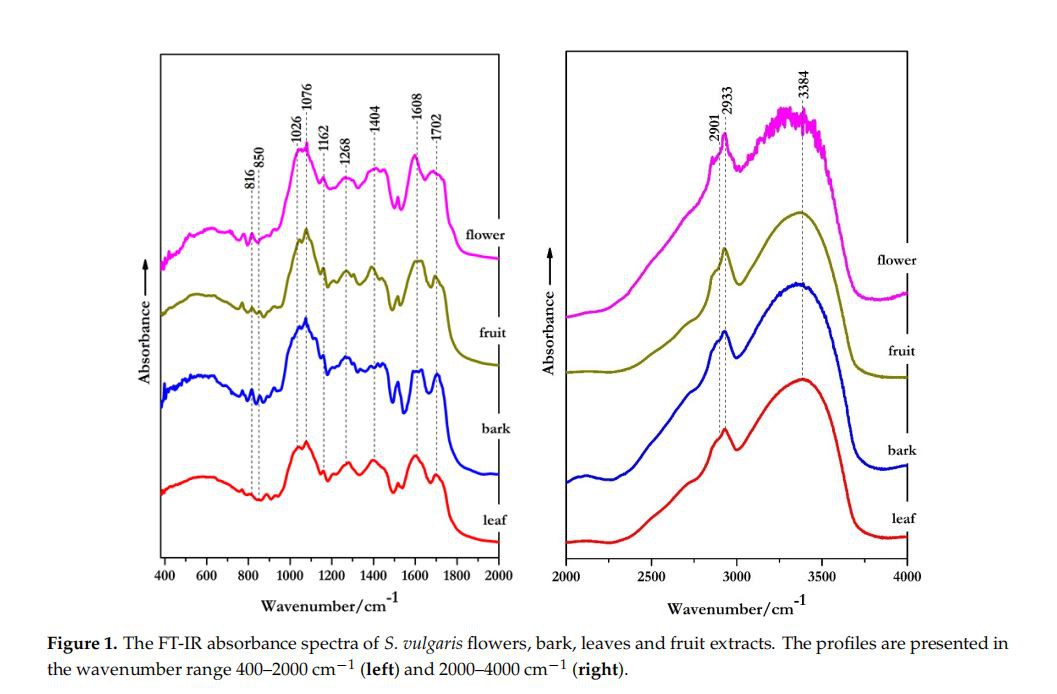
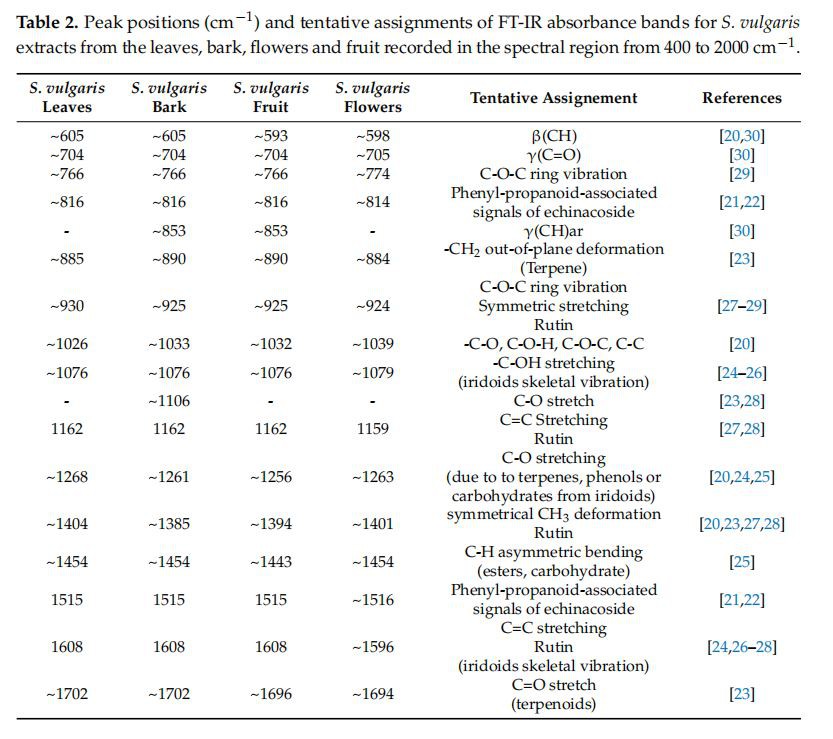
Another observation is that the bands in the region 1000-1800 cm-1are of much higher intensity compared to the bands below 1000 cm-. Additionally, in the same region, one can observe that some bands are shifted to lower or higher wavenumber.
2.3.Quantification of Total Polyphenolic (TPC),Flaconoids (TFC) and Phenolic Acids Content(TPA)
The total polyphenols, flavonoids, and phenolic acids content of the S.vulgaris tested extracts showed significant amounts of all these compounds that could be corroborated with the results obtained for the assessment of the biological activities (Table 4).
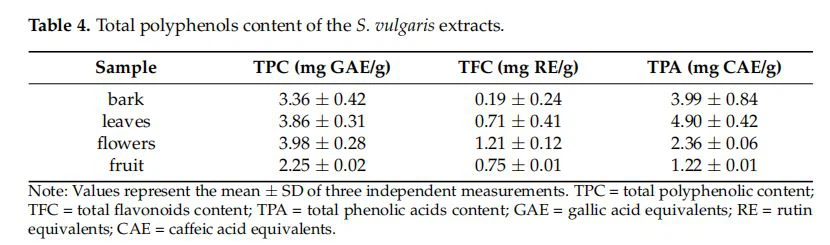
Quantification of TPC, TFC, and TPA are reported hereby for the first time in the scientific literature for the S.vulgaris species, representing a further reason that sustains the originality of this study and offering important arguments in order to support the biological activities that are tested.
2.4. GC-MS Analysis
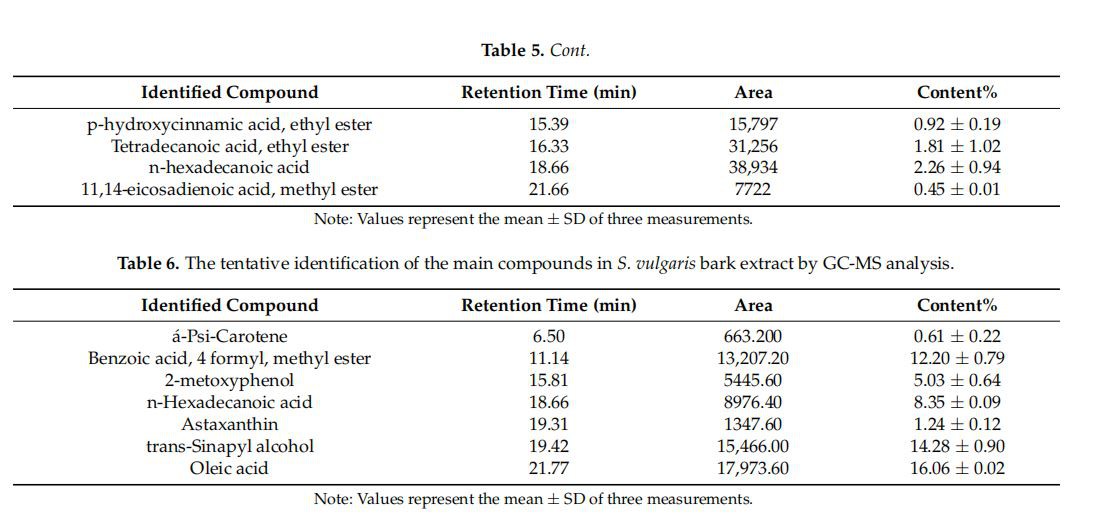
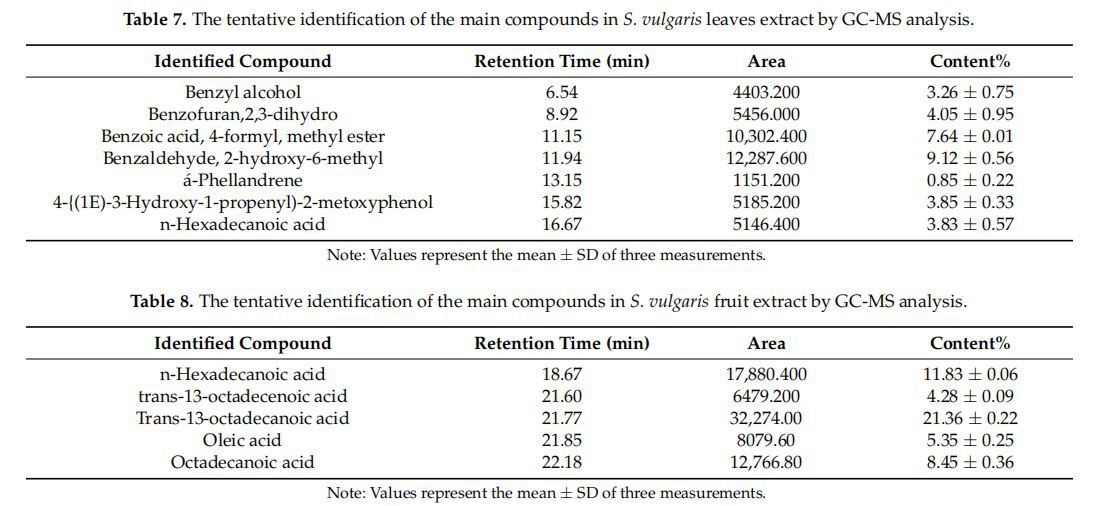
Results obtained for the GC-MS analysis of different S.vulgaris extracts can be found in Tables 5-8.

The GC-MS analysis allowed to identify of the main volatile compounds in the S, Vulgaris flowers extract that are the two stereoisomers of the lilac alcohols, lilac alcohol C and lilac alcohol D. Together with these, other aromatic compounds, phenols and acids, fatty acids could be identified in the composition of the flowers (Table 5).
Twenty compounds were identified and among these, the ones that were found in the highest amounts are the lilac alcohols and the benzyl alcohol, with matching factors higher than 80. Furane derivatives were also identified in high amounts, being related to lilac alcohols. The specific compounds, lilac alcohols, as furane alcohols, represented more than 40% of the identified compounds. The two compounds are two different stereoisomers with similar MS spectra (Figure2)that correspond with those of standard data from PubChem. They have a major signal at m/z of 55 and other important signals at m/z of67,93 and 111.

Together with lilac alcohols, another important compound that is responsible for the aromatic smell of lilac flowers is the benzyl alcohol, found in the high amounts 1.77% of the identified compounds are furane derivatives, compounds that are related to lilac alcohols.
Another compound that was identified in a significant amount is methyl eugenol, a phenylpropanoids compound with important antioxidant activity. The phenolic compounds percentage is at 1.74% and they are being represented, moreover, methyl eugenol, by the ester of p-hydroxycinnamic acid fatty acid esters and free fatty acids were also identified that represents 4.52% of the identified compounds.
For the other tested extracts, GC-MS analysis was performed in the same conditions, and different compounds were identified (Tables 6-8). The common compound identified in all these extracts is the n-hexadecanoic acid, a saturated fatty acid, named also palmitic acid. The fruit extract is rich in fatty acids, the main being the trans-13-octadecanoic acid. The leaves extract contains benzoic acid derivatives and also phellandrene. The bark extract contains carotenes: astaxanthin and psi-carotene respectively more than 12%trans-sinapyl alcohol.
The GC-MS analysis of these extracts is reported hereby for the first time, representing an important tool for the identification of the main compounds found in the composition of different extracts obtained from different parts of the species that are responsible for the biological activities.
This is extracted from Molecules 2021, 26, 3104. https://doi.org/10.3390/molecules26113104 https://www.mdpi.com/journal/molecules