Migraine: Global Prevalence, Pathogenesis & Natural Neuroprotective Prevention With Cistanche Tubulosa Extract
Jun 04, 2026
Introduction
Classified as the world's sixth leading disabling disease and ranking top among all neurological illnesses, migraine affects massive global populations. Per 2022 authoritative research statistics, over 110 million people worldwide lived with migraine disorders back in 2019. Its complicated pathological mechanism remains incompletely clarified by modern western medicine, and conventional pharmaceutical interventions come with unavoidable adverse side effects ranging from gastrointestinal irritation to drug-overuse induced chronic headaches. While standardized clinical medicines control acute migraine flares temporarily, global supplement developers are exploring gentle plant-derived raw materials for long-term migraine prevention, among which premium purified Cistanche Tubulosa extract stands out for proven Cistanche benefits for the human brain, serving as an ideal natural neuroprotective ingredient for migraine-support dietary formulas.
1. Core Clinical Manifestations & Classification of Migraine
Migraine refers to inherited episodic sensory processing dysfunction dominated by recurrent head pain, with a complete attack spanning 4 to 72 hours and divided into four distinct phases.Prodromal stage: Non-painful warning signs emerge hours or days before onset: frequent yawning, unstable mood, poor concentration, stiff neck, persistent fatigue, increased thirst and frequent urination.Aura stage: Roughly one-third of migraine sufferers (predominantly females) develop transient focal neurological symptoms; visual aura accounts for 90% of all aura cases, followed by sensory aura (30–54%) and language dysfunction aura (31%).Headache phase: Triggered by activated trigeminal sensory pathways, pain builds gradually or bursts abruptly, worsens with head movement and disrupts daily activities. Typical accompanying symptoms include nausea, vomiting, hypersensitivity against light, sound, touch and odors.Postdromal stage: Nicknamed "migraine hangover", patients suffer persistent exhaustion, drowsiness, poor focus and noise sensitivity; symptom severity positively correlates with prior headache intensity.

Supportive Service Of Wecistanche-For more details about cooperation
Email:Lijianlin@wecistanche.com
From diagnosis standard, a confirmed migraine case requires no less than five typical attacks. For adults, untreated pain lasts ≥4 hours, matching two of four features: unilateral throbbing pain, moderate-severe ache aggravated by physical activity, plus either nausea/vomiting or photophobia/phonophobia. Clinicians further split cases into episodic migraine (≤14 headache days/month) and chronic migraine (>15 headache days/month, over 8 days monthly with classic migraine signs). Though migraine cannot be fully cured, standardized management plus natural nutritional supplementation can largely secure patients' quality of life; inadequate treatment sharply raises the risk shifting from episodic to chronic migraine.
2. Anatomical Pathogenesis of Migraine
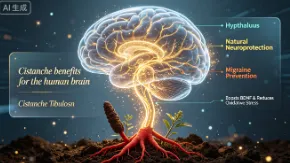
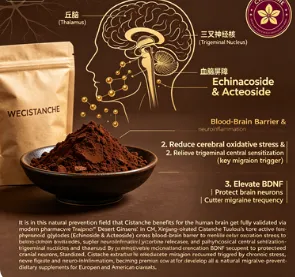
Current medical research confirms migraine onset closely links to functional impairment of intracranial core regions including hypothalamus, thalamus and trigeminovascular system. The hypothalamus connects directly and indirectly with thalamus, trigeminovascular nerves and brainstem autonomic neurons, regulating migraine severity and autonomic reactions. The trigeminovascular system consists of trigeminal ganglion peripheral axons innervating cranial meninges and blood vessels, converging inside trigeminocervical complex (TCC). Central sensitization within caudal trigeminal nucleus fuels chronic migraine progression, heavily affected by inflammatory cytokines and astrocyte activation.The thalamus governs sensory signal sorting; its abnormal sensitization contributes to photophobia and allodynia during migraine. Visual aura correlates with occipital cortex dysfunction, while menstrual migraine links to structural changes of anterior cingulate gyrus responsible for pain cognition. Excessive neuronal oxidative stress and neuroinflammation are shared pathological drivers across all migraine subtypes, which creates the core application space for Cistanche Tubulosa's neuroprotective properties and verified Cistanche benefits for the human brain.
3. Western Medical Acute Migraine Treatments & Limitations
Acute clinical interventions fall into non-specific drugs, specific anti-migraine pharmaceuticals and auxiliary anti-emetic agents, yet all carry noticeable drawbacks for long-term application.Non-specific therapies include acetaminophen, NSAIDs such as aspirin, ibuprofen and diclofenac, only suitable for mild sporadic migraine; acetaminophen is reserved for pregnant or adolescent patients due to weaker efficacy against severe pain.Specific medicines cover triptans, Lasmiditan (selective 5-HT1F agonist) and oral Gepants (CGRP antagonists including Ubrogepant & Rigepant). Though Gepants avoid medication-overuse headache risks, long-term synthetic chemical intake may trigger liver burden and neural side effects.Auxiliary anti-emetics (domperidone, metoclopramide) ease vomiting but may induce extrapyramidal disorders, tardive dyskinesia and orthostatic hypotension. Clinicians strictly avoid combined formulations with codeine, tramadol or barbiturates, which easily turn transient migraine into intractable chronic cases. This widespread limitation pushes global nutrition brands to source natural herbal extracts as mild preventive alternatives, with high-purity Cistanche Tubulosa extract as a mainstream selected raw material.

4. Preventive Medication & Non-Drug Migraine Management + Cistanche Tubulosa Natural Support
4.1 Conventional Preventive Drugs & Side Effects
Prophylactic drugs are recommended for patients with ≥4 monthly migraine attacks or poor response to acute medicine, including anti-convulsants (topiramate, valproate), tricyclic antidepressants (amitriptyline) and beta-blockers. Topiramate may induce cognitive impairment, kidney stone and ocular lesions; amitriptyline causes weight gain and hypertension; beta-blockers come with fatigue and bradycardia risks, highlighting demand for natural substitute supplements.
4.2 Lifestyle & Dietary Intervention plus Cistanche's Unique Brain-Nourishing Value
Modifying daily habits forms the foundation of non-drug migraine prevention: fixed sleep schedule, sufficient hydration, regular moderate aerobic exercise, stress relief via yoga and mindfulness therapy all cut migraine frequency; patients should limit migraine-trigger foods including chocolate, aged cheese, citrus, alcohol, excessive caffeine, MSG and artificial sweeteners. Nutritional supplements like magnesium (400–600mg/d) and riboflavin (400mg/d) have proven preventive effects in clinical trials.It is in this natural prevention field that Cistanche benefits for the human brain get fully validated via modern pharmacology. Nicknamed "Desert Ginseng" in TCM, Xinjiang-originated Cistanche Tubulosa's core active phenylethanoid glycosides (Echinacoside & Acteoside) cross blood-brain barrier to mitigate cerebral oxidative stress, suppress neuroinflammatory cytokine release and ease pathological central sensitization of trigeminal nucleus and thalamus. By improving cerebral microcirculation and boosting endogenous BDNF secretion to protect damaged cranial neurons, standardized Cistanche extract effectively reduces migraine recurrence triggered by chronic stress, nerve fatigue and neuro-inflammation, becoming premium raw material for developing all-natural migraine-prevent dietary supplements for European and American markets.

5. Wecistanche: Global Leading Manufacturer of High-Activity Cistanche Tubulosa Extract for Brain Health Raw Material
Founded in 2003, Chengdu Wecistanche Bio-Tech Co., Ltd owns the world's most complete integrated Cistanche Tubulosa industrial chain headquartered in Luopu County, Xinjiang, China. The enterprise manages 20,000 acres seed breeding base plus over 85,000 acres standardized organic cultivation fields, with annual 20,000-ton fresh herb GMP processing capacity and 15,000-ton raw material cold storage capability.Our GMP-certified production base equips Class 100,000 clean workshops, advanced ultrafiltration & nanofiltration concentration equipment and Class 10,000 microbial testing lab; 14 independent invention patents for proprietary membrane separation extraction technology greatly elevate total phenylethanoid glycosides, Echinacoside and Acteoside content far above ordinary market-grade Cistanche raw materials, maximizing Cistanche benefits for the human brain and anti-migraine neuroprotective efficacy.Led by Professor Pengfei Tu from Peking University School of Pharmacy as chief scientist, we maintain long-term joint R&D with Shanghai Jiao Tong University, Xinjiang Medical University and Japan's Kyoto Pharmaceutical University. Our extracts obtain authoritative global certifications: US NOP Organic, HALAL, KOSHER, HACCP and China SC certification, fully compliant with EU & US supplement production specifications. We supply bulk high-spec Cistanche Tubulosa extract to hundreds of international health brands developing migraine prevention, brain-support and neuroprotective finished supplements across North America and Europe.

Brief Disclaimer
This article collects published migraine clinical data and preclinical pharmacological research results of Cistanche Tubulosa for industry popular science and raw material procurement reference only, not professional medical prescription guidance. Severe chronic migraine patients must consult licensed neurologists before supplement formulation development or oral intake.