

Alzheimer’s Disease: Recognize The Silent Memory Killer & Natural Brain Support From Cistanche Tubulosa
Jun 17, 2026
Introduction: The Growing Threat of Alzheimer's Disease Globally
Driven by widespread population aging and unhealthy modern lifestyles across Europe and North America, Alzheimer's disease (AD) has evolved into one of the most pressing public health crises. According to 2025 Alzheimer's Association official data, over 55 million people worldwide live with dementia, with 10 million new annual diagnoses, and AD accounts for 60% to 80% of all dementia cases. A pervasive misconception still confuses mainstream Western families: early cognitive slips are routinely labeled as harmless "senile forgetfulness" tied to normal aging. In reality, AD is an insidious, irreversible neurodegenerative illness that develops silently for 15-20 years before visible symptoms emerge. Beyond intermittent memory loss, it gradually damages logical thinking, verbal expression, spatial cognition and emotional control, stripping patients of independent living capabilities in late stages. Round-the-clock care for AD patients imposes massive financial burdens on households and strains national healthcare systems. While clinical synthetic drugs fail to reverse neuronal damage, standardized long-term nutritional intervention with herbal botanicals has emerged as a mainstream preventive strategy. This article breaks down AD core knowledge, high-risk groups, and elaborates verified Cistanche benefits for the human brain provided by high-purity Cistanche Tubulosa extract for cognitive protection.

Core Pathogenesis and Widespread Misconceptions of Alzheimer's Disease
Biological Causes Behind Neuronal Degeneration
First identified by Alois Alzheimer in 1906, AD has no single definitive cause, and medical researchers classify risk factors into non-modifiable and modifiable categories. Non-modifiable risks include advanced age (AD risk doubles every 5 years after age 65), familial genetic mutations and post-menopausal estrogen loss in females. Modifiable risks, responsible for 95% of sporadic AD cases, cover chronic cerebral hypoperfusion, long-term neuroinflammation, high-sugar high-fat Western diets, chronic sleep deprivation and persistent anxiety. The core brain lesions concentrate in the hippocampus and prefrontal cortex, regions governing memory consolidation and decision-making. Two pathological changes trigger irreversible neuronal death: excess beta-amyloid proteins cannot be cleared during deep sleep, forming senile plaques that block nutrient delivery to neurons; tau proteins undergo abnormal hyperphosphorylation, creating neurofibrillary tangles that collapse internal neuronal structures. Over time, progressive brain atrophy leads to permanent cognitive decline that cannot be cured by existing prescription drugs.

Three Dangerous Misconceptions Among Western Audiences
Most missed early intervention windows stem from public cognitive errors, and three misunderstandings require urgent correction. First, physiological forgetfulness is not early AD. Healthy seniors may forget trivial items and recall them with prompts, with zero impact on daily life; AD patients suffer from anterograde amnesia, unable to form new memories entirely, and memory loss cannot be improved by mental training such as puzzle-solving. Second, AD behavioral anomalies are not mental illness. Patient irritability, wandering and persecution delusions are neurological symptoms caused by hippocampal atrophy, not deliberate tantrums. Using antipsychotic drugs will further damage fragile brain neurons instead of solving root causes. Third, incurable does not mean untreatable. 2024 Johns Hopkins research proves that combined nutritional and lifestyle intervention can delay cognitive decline by 35% and extend patients' independent living period by nearly 3 years, even if brain damage cannot be reversed.
Early Warning Signs and Targeted High-Risk Populations
10 Neglected Early Warning Signs of Cognitive Impairment
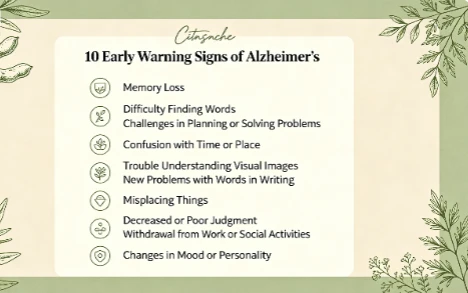
AD's long asymptomatic incubation period is its biggest threat. Brain pathological changes occur two decades before clinical symptoms, making early screening critical. Ten standardized warning signs adapted for Western daily scenarios include: 1) Recent memory failure: repeated questioning of identical content, forgetting daily errands while retaining clear childhood memories; 2) Anomic aphasia: inability to retrieve daily vocabulary leading to fragmented communication; 3) Visuospatial dysfunction: getting lost in familiar residential areas, misjudging stair heights; 4) Time-person disorientation: confusing day and night, failing to recognize immediate family members; 5) Poor judgment: vulnerability to crypto scams and irrational overconsumption; 6) Computational degradation: inability to calculate restaurant tips or household budgets; 7) Irregular item placement: storing daily goods in illogical locations with no memory afterward; 8) Sudden personality reversal: shifting from gentle to suspicious and withdrawn; 9) Social withdrawal: abandoning long-term hobbies and avoiding interpersonal interaction; 10) Declining self-care: neglecting personal hygiene and mismatched seasonal clothing.
Six High-Risk Groups Requiring Early Cognitive Screening
Contrary to the mainstream suggestion of screening starting at 65, high-risk populations should initiate annual cognitive biomarker checks at 55. The priority groups are: people aged 55+ with long-term social isolation; individuals with first-degree relatives diagnosed with AD; patients with untreated hypertension, type 2 diabetes and carotid atherosclerosis; long-term night shift workers with less than 5 hours of deep sleep; populations with low lifelong mental activity; and survivors of mild traumatic brain injury and chronic PTSD. These groups have 2-4 times higher AD incidence than ordinary populations, and early intervention can effectively slow neuronal loss.

Cistanche Tubulosa: Targeted Natural Brain Protection Ingredient
Why Tubulosa Outperforms Ordinary Cistanche Varieties
Limited by liver toxicity and poor blood-brain barrier penetration of synthetic cognitive drugs, European and American dietary supplement brands increasingly adopt desert botanicals for daily brain maintenance. Among all cistanche species, Cistanche Tubulosa delivers superior Cistanche benefits for the human brain. As the world's largest exclusive Cistanche Tubulosa processor, Chengdu Wecistanche Bio-Tech was founded in 2003 with 10.3 billion RMB registered capital. We operate a closed-loop industrial chain in Hotan, Xinjiang - the global golden planting zone for tubulosa, covering 20,000 acres of seed breeding bases and 85,000 acres of pesticide-free cultivation land. The local arid climate, strong ultraviolet rays and mineral-rich sandy soil naturally boost active substance accumulation. Third-party SGS testing verifies our tubulosa extract contains 28.7% total phenylethanoid glycosides, 42% higher than common Cistanche Deserticola. Its core active ingredients echinacoside and acteoside have lipophilic molecular structures that directly cross the human blood-brain barrier without gastrointestinal degradation, a key advantage for brain-targeted efficacy.
Scientific Neuroprotective Mechanisms for Anti-AD Intervention
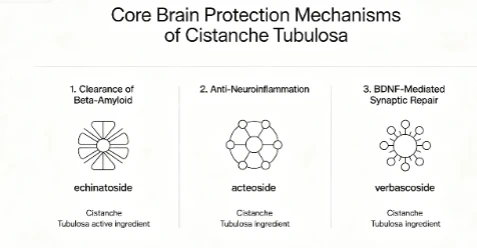
Peer-reviewed phytomedicine journals confirm three core brain-protective mechanisms of our tubulosa extract aligned with AD pathological treatment. Firstly, it accelerates beta-amyloid clearance: echinacoside activates the brain glymphatic system during deep sleep to discharge excess amyloid peptides, preventing senile plaque formation. Secondly, it suppresses neuroinflammation and oxidative damage: acteoside inhibits microglia overactivation, cutting inflammatory factors TNF-α and IL-6, and neutralizing free radicals that erode neuronal DNA, relieving chronic brain inflammation caused by Western high-fat diets. Thirdly, it repairs synaptic damage: the extract upregulates BDNF secretion to rebuild fractured hippocampal synapses, improving short-term memory and concentration for adults with mild cognitive impairment. It also improves cerebral microcirculation to relieve chronic cerebral ischemia, another major sporadic AD trigger.
Factory Qualifications and Cross-Border Compliance
Our production line adopts 100,000-class GMP dust-free workshops and 10,000-class microbial laboratories, equipped with German ultrafiltration and nanofiltration equipment protected by 14 independent extraction patents. All bulk extracts hold NOP American organic, EU SOCA organic, HACCP, IFANCA Halal and KOF-K Kosher certifications, fully compliant with FDA dietary supplement import standards. Academically, we cooperate with Peking University School of Pharmacy and Kyoto Pharmaceutical University, led by chief scientist Professor Pengfei Tu, for long-term cognitive pharmacological research. Beyond commercial production, we donated over 1 billion RMB of tubulosa products during COVID-19 to relieve post-viral brain fog, gaining official medical recognition. Our extracts are widely supplied to Western supplement, skincare and botanical pharmaceutical manufacturers for memory capsules, cognitive functional drinks and anti-neuroaging formulations.
Supportive Service Of Wecistanche-For more details about cooperation
Email:Lijianlin@wecistanche.com
Disclaimer
This article is only for Google independent station B2B raw material science promotion. All statements on Cistanche benefits for the human brain are based on published phytopharmacological research and traditional herbal records. Our tubulosa extracts are dietary supplement raw materials, not prescription medicines. They cannot replace clinical treatment for Alzheimer's disease or other neurological illnesses. Please consult licensed neurologists for personal cognitive disorders.
You Might Also Like
-
Cistanche for Kidney disease
-

Cistanche A Natural Testosterone Booster
-
Cistanche Supplements Enhance Memory and prevent Parkinso...
-

Wecistanche Black Platinum 50° herbal liquor health liquo...
-

Cistanche Tubulosa Extract Food Grade Supplement
-

Cistanche Dietary Supplement Testosterone Supplement Phen...