Screen Time Killing Your Eyes? How Cistanche Tubulosa Protects Vision Naturally
Jul 08, 2026
You squint at the screen, rub your temples, and reach for artificial tears. By evening, the world looks slightly blurred. You chalk it up to tiredness, but your eyes are sending a deeper message. The retina, a delicate tissue at the back of the eye, is under constant siege from high-energy blue light, oxidative stress, and the simple wear of modern life. Vision loss rarely happens overnight-it accumulates silently, cell by cell. While lutein and zeaxanthin are well known for filtering blue light, a desert botanical is emerging as a retinal protectant from the inside out: Cistanche tubulosa.
The Invisible Assault on Your Retina
The retina is an extension of the brain, containing photoreceptor cells (rods and cones) that convert light into electrical signals. Just beneath them lies the retinal pigment epithelium (RPE), a monolayer of cells that nourishes the photoreceptors, recycles visual pigment, and forms the outer blood-retinal barrier. RPE cells are exceptionally vulnerable to oxidative stress because they consume enormous amounts of oxygen and are exposed to focused light.
Blue light (400–500 nm wavelength) penetrates deeper than UV, reaching the RPE. When absorbed by the visual cycle's lipofuscin, it generates singlet oxygen and other reactive oxygen species (ROS). These free radicals attack the mitochondria-rich RPE cells, triggering apoptosis and releasing inflammatory signals that degrade the overlying photoreceptors. Age-related macular degeneration (AMD), the leading cause of irreversible blindness in adults over 50, begins with this oxidative RPE damage. Even in younger screen users, chronic oxidative stress can contribute to eye fatigue, dry eye inflammation, and accelerated retinal aging.
Standard eye supplements provide antioxidant carotenoids that sit in the macula and filter blue light. But an ideal retinal protectant would go further: it would directly quench the ROS generated inside RPE cells, bolster the cells' own enzymatic defenses, and support the microcirculation that delivers oxygen and nutrients to the retina. This is where the phenylethanoid glycosides in Cistanche tubulosa show remarkable promise.

How Cistanche Tubulosa Shields the Retina
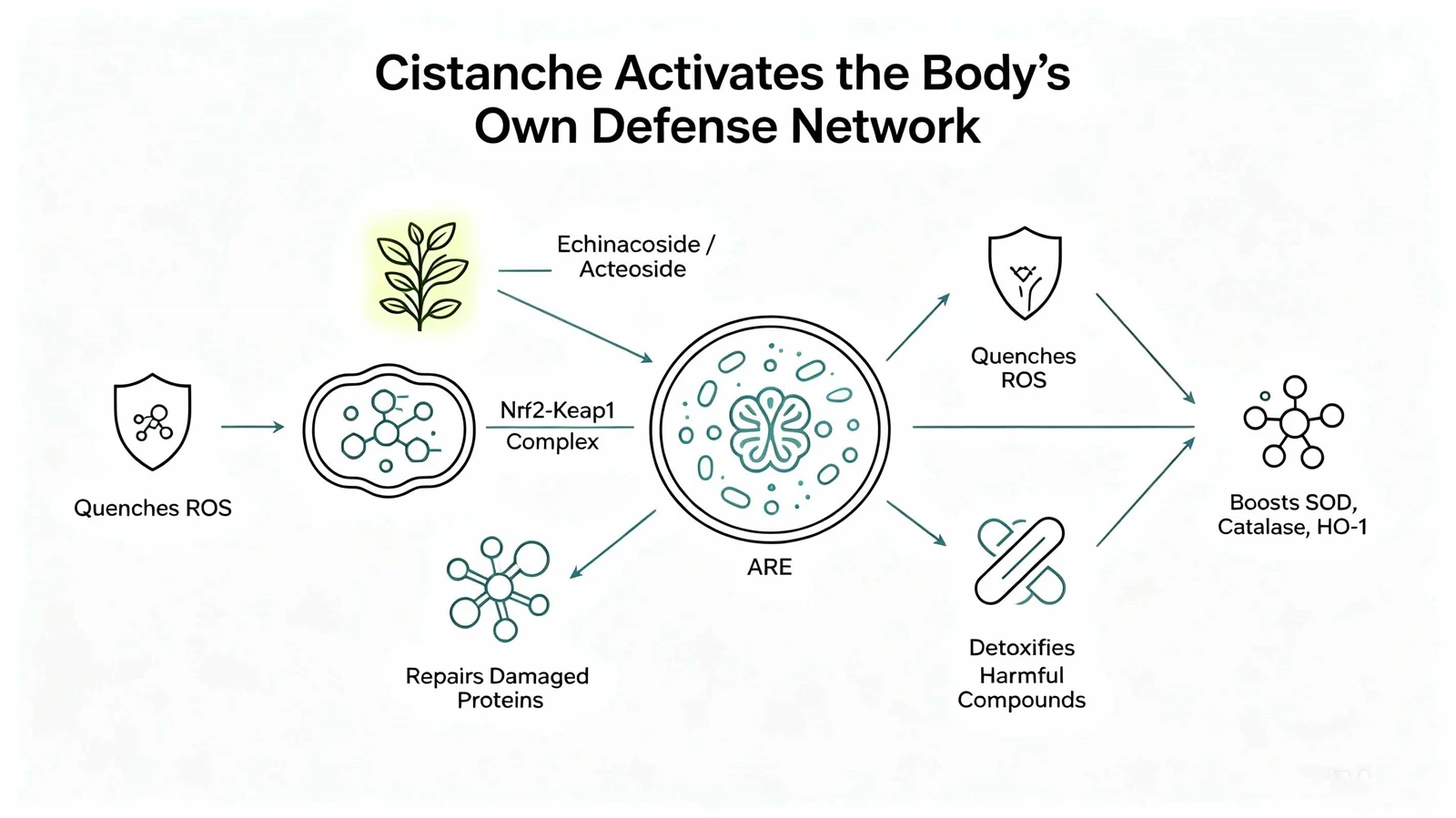
Cistanche tubulosa extract is rich in acteoside (verbascoside) and echinacoside, compounds with a strong affinity for neural and ocular tissues. A pivotal in vitro study published in International Journal of Molecular Sciences investigated the effect of acteoside on ARPE-19 cells, a well-established human RPE cell line. When these cells were exposed to hydrogen peroxide (H₂O₂) to simulate oxidative stress, acteoside pretreatment significantly reduced cell death, preserved mitochondrial membrane potential, and slashed intracellular ROS levels. The mechanism involved upregulation of the Nrf2 pathway, the master regulator of the body's antioxidant defense, which in turn boosted superoxide dismutase (SOD) and heme oxygenase-1 (HO-1) activity within the cells. In simple terms, acteoside taught the retinal cells to defend themselves better.
Beyond directly protecting RPE cells, acteoside and related phenylethanoid glycosides have been studied in preclinical models for their ability to stabilize microvasculature and reduce pathological vascular leakage, mechanisms that are highly relevant to retinal health. By suppressing oxidative stress and inflammatory signals within endothelial cells, these compounds may help maintain the integrity of the fine blood vessels that feed the retina. The 2022 comprehensive review in Frontiers in Pharmacology cataloged the neuroprotective and vasoprotective properties of Cistanche tubulosa, noting its potential relevance for degenerative conditions of the central nervous system and its extensions-which include the retina.
Traditional Wisdom of "Nourishing the Essence to Reach the Eyes"
In traditional Chinese medicine, visual clarity is governed by the Liver and Kidney systems. The Liver "opens into the eyes," and the Kidney's essence is believed to ascend and nourish the retina and optic nerve. Cistanche, as a premier Kidney-tonifying herb, was frequently prescribed by later generations of practitioners for blurred vision, diminished eyesight, and floaters associated with aging or depletion. This clinical application stems from the foundational principle that enriching Kidney essence can brighten the eyes-a rationale supported by the herb's high concentration of neuroprotective glycosides. While classical texts such as the Shennong Bencao Jing extol Cistanche's ability to "prolong life and strengthen the body," its specific use for vision is a logical extension of its restorative properties. What was once described as "nourishing Kidney essence to reach the eyes" can now be partially understood as the systemic delivery of phenylethanoid glycosides to the chorioretinal complex.
Integrating Cistanche into an Eye Health Protocol
Vision protection is a long game. For those with heavy screen exposure or a family history of AMD, a daily dose of 400–600 mg of a standardized Cistanche tubulosa extract provides systemic antioxidant coverage that reaches the retina through the dense choroidal vasculature. It pairs synergistically with the classic eye-health trio of lutein, zeaxanthin, and meso-zeaxanthin, which form the macular pigment that filters blue light before it hits the RPE. Cistanche acts behind that filter-cleaning up the ROS that still get through.
The extract can be taken with a meal in the morning or early afternoon, aligning with the retina's peak metabolic activity during daylight hours. It does not cause photosensitivity or ocular side effects. Users often report a subtle reduction in the gritty, tired-eye sensation at the end of a long screen day, though the real benefit is cumulative and microscopic-preserving the precious RPE and photoreceptor cells that you'll need for a lifetime of sharp sight.
At [our store], our VisionGuard Cistanche Extract is manufactured from authentic Cistanche tubulosa and standardized for a high concentration of acteoside and echinacoside. Every batch is third-party tested to ensure you are providing your eyes with research-grade antioxidant support, not empty filler.
Safety and Realistic Expectations
Cistanche tubulosa is well tolerated and historically consumed as a food-grade tonic. There are no known ocular toxicities. However, it is not a cure for established macular degeneration, glaucoma, or diabetic retinopathy. Anyone experiencing sudden vision changes, floaters, or flashes should seek immediate ophthalmologic evaluation. For the millions who spend their days bathed in screen light and worry about what their eyesight will look like in twenty years, Cistanche offers a scientifically grounded, gentle addition to their daily defense.
Supportive Service Of Wecistanche-For more details about cooperation
Business contact: goujinsong@wecistanche.com