Desert Hyacinths: An Obscure Solution To A Global Problem?
Nov 07, 2022
Abstract
‘Desert hyacinths’ (Cistanche) are a remarkable genus of parasitic plants, some of which are traded widely for herbal medicine or have historical local importance as food. Despite their importance, little or nothing is known about the biology of most species and their taxonomy remains confused, hindering identification. A growing body of research into the cultivation of pharmacologically well-characterised Cistanche taxa has enabled regional supply of traditional herbal medicine at low-level cost and intervention. In the context of a global desertification crisis, there is significant potential to expand cultivation of Cistanche beyond China, as an ancillary crop alongside vegetation planted to halt land degradation. However, to realise this potential and to monitor trade to control any possible unsustainable harvesting of threatened wild populations, robust taxonomy informed by both morphological and molecular data is needed.

‘Desert hyacinths’ (Cistanche)
1 INTRODUCTION
The genus Cistanche Hoffmanns. & Link (Orobanchaceae) includes some 20–30 accepted species native to the Old World, spanning Macaronesia in the west, to north and northwestern China in the east. Typically, the plants occur in deserts, and occasionally coastal dunes or salt marshes, where they are parasitic on the roots of various halophytic shrubs. As nonphotosynthetic holoparasites, all are completely devoid of chlorophyll and functional leaves. They are remarkable in appearance, comprising imposing, brightly coloured flowering spikes that sprout seemingly from bare earth, which has earned them their common name ‘desert hyacinths’. Unsurprisingly, these curious plants have long-intrigued botanists and herbalists alike.
Despite their realised value and great potential, the species limits in the genus remain poorly understood. The family Orobanchaceae is a model for studying the evolution of parasitism in plants (Westwood et al., 2010), yet like other holoparasitic genera in the family, Cistanche suffers significant taxonomic confusion. This has arisen from their reduced morphological features, poor preservation and mislabelling in herbaria and more broadly, a lack of research focus. Many of the plants’ key diagnostic characters (such as stigma and corolla colour) preserve inadequately in herbaria, and without detailed notes from fresh specimens, accurate diagnosis can be all but impossible. Moreover, pubescence, one of the few reliable diagnostics that remains upon drying, appears to have been widely overlooked or perhaps confused with mildew deposits (Aldughayman, M., pers. obs.). The only monograph of the genus Cistanche was published nearly a century ago (Beck-Mannagetta, 1930). Its four long-standing taxonomic sections (Eucistanche, Subcistanche, Heterocalyx and Cistanchella) based on morphology have been refuted recently by the first phylogenetic assessment of the genus (Ataei et al., 2020). This phylogeny, based on plastid and nuclear markers, identified three geographically differentiated clades from East Asia, Northwest Africa, Southwest Asia and a further ‘widespread clade’, reinforcing the view that morphology alone is problematic in delineating species in holoparasitic Orobanchaceae. Other authors have examined the diversity of closely related Cistanche taxa, for example, using chemical markers (Wang et al., 2019) and an LC–MS-based targeted metabolomics approach (Liu et al., 2019). Whilst these studies take us a step forward in understanding the broad-scale evolution of this poorly understood genus, many species are confused or poorly resolved, and our understanding of species limits and diversity at a regional level remains rudimentary. This is concerning where species may be rare even or threatened with extinction. Cistanche deserticola Ma, for example, is endangered (Qin et al., 2017; Song et al., 2021) and listed in the appendix II of the Convention on International Trade in Endangered Species of Wild Fauna and Flora (CITES).
Here we provide a brief review of the traditional use, ecology and evolution of this extraordinary yet neglected genus and assert that it is a candidate ripe for further research in the context of addressing global challenges. Specifically, we suggest that (1) understanding species limits in this taxonomically difficult genus will inform conservation focus, for example, where endangered species may be traded illegally, and (2) the proven value of Cistanche as a desert crop in China points to untapped potential as a subsistence crop in a global context of climate change land degradation.
2 USE IN TRADITIONAL HERBAL MEDICINE
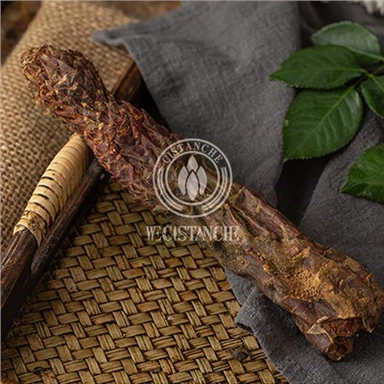
Cistanche has long been a source of traditional herbal medicine or food across its range, particularly linked to the large, fleshy underground stem (Figure 1a–c). In Traditional Chinese Medicine (TCM), as ‘Rou Cong Rong’ (Figure 1a,d) and ‘Guan Hua Rou Cong Rong’ (Figure 1b), Cistanche has been used for more than 2000 years and is recorded in the earliest pharmaceutical monograph, the Shennong Bencao Jing (Fu et al., 2018; Li et al., 2016; Shi et al., 2009). Today, it is listed in the Chinese Pharmacopoeia as ‘Cistanches Herba’. The plant is used as a tonic herb (a functional healthfood), a TCM medicinal ingredient, and it is also prized for its perceived ‘trophy’ attributes (bestowing longevity, stamina and sexual vigour). Since the advent of clinical research on the plant in the 1980s (Kobayashi et al., 1984), extensive pharmacological and chemical reports have been published, amongst the most comprehensive of which identified some 100 phytochemical compounds including phenylethanoid glycosides (PhGs), lignans, alditols and iridoids that together have a range of pharmacological properties (Fu et al., 2018). Cistanches Herba's numerous benefits, including antiaging, antioxidation and neuroprotective properties, have earnt it the popular epithet ‘desert ginseng’ (Gemejiyeva & Karzhaubekova, 2015; Gu et al., 2016; Shi et al., 2009; Yan et al., 2017). Several species of Cistanche are reported in TCM, particularly C. deserticola (Figures 1e, 2b and 3d) and C. tubulosa s.l. (Schenk) Wight ex Hook.f. (Figures 2h and 3c). Cultivation of highly prized C. deserticola (Rou Cong Rong) and the more affordable alternative C. tubulosa s.l. (Guan Hua Rou Cong Rong) in particular is well-established now in China. Indeed, it has been estimated that Cistanche cultivation in China now covers an area as vast as 1.26 million mu (84,000 ha) with an annual output of 6000 tons and a value of over 20 billion China Yuan (Song et al., 2021). Despite the large-scale cultivation of C. deserticola and C. tubulosa in China, other plants, for example, C. salsa (C.A.Mey.) Beck (Figures 2a and 3a) and C. sinensis Beck (Figures 2c,d and 3b) are wild-harvested and enter trade; meanwhile, others still (possibly C. salsa) are harvested in Kazakhstan and imported into the region (Egamberdieva & Öztürk, 2018; Eisenman et al., 2012).

(a) Cistanche ‘Rou Cong Rong’ used for herbal medicine at a festival in Alxa League, China. (b) Fresh stems of Cistanche ‘Tamarisk’ (identified locally as C. tubulosa), or ‘Guan Hua Rou Cong Rong’, sourced from plants grown commercially in Xinjiang. (c) C. deserticola harvesting, showing the long subterranean stem that is prized in herbal medicine; (d) the dried product traded as Rou Cong Rong; (e) colour morphs of putative C. deserticola in cultivation in China

3 TAXONOMIC CONFUSION
Despite the importance of Cistanche, there exists considerable confusion over the taxa found across the genus’ range. For example, we have observed C. deserticola and putative C. salsa growing side by side commercially in China (Figure 2a,b), where they are harvested and sold as a single crop under the name of Rou Cong Rong. This is because C. salsa is allegedly easier to grow than the official and more expensive C. deserticola and traders are aware that, once harvested and processed, they are indistinguishable (C. Leon, pers. obs.). Wang et al. (2019) differentiated these two taxa using a chemical marker (2′-acetylacteoside); however, from our own field experience, the morphological distinction between C. deserticola and C. salsa is unclear. Although plants identified as the latter are often shorter and more strongly purple-tinted, this may be an artefact of the host parasitized (a range of different host species can be parasitized). Stable features useful for discrimination of taxa (e.g. calyx characters and pubescence) are continuously variable in living material, and distinguishing features seen upon drying, such as the blue pigment of C. sinensis (Figure 2d), are absent. Therefore, we suggest that a rigorous approach combining extensive sampling, careful examination of holotypes and molecular data is required to tease apart these complicated taxa. Until this is in place, identification of the various species used in China is likely to remain confused and problematic (Leon & Lin, 2017); this is concerning if wild populations of certain taxa are dwindling.
A similar challenge exists in the Middle East, exemplified by the plethora of common names applied across Classical Arabic, Modern Standard Arabic and Colloquial Arabic. The plant is often described as ‘dhanun’ in the region; however, this classical Arabic name may also be used colloquially for other root parasites of similar appearance (Lakhdari et al., 2016; Mandaville, 2011; Nicolaisen, 1963). Presumably, the species most common in the Middle East is C. tubulosa (Figure 2f) which is widespread across the region; however, most reports are anecdotal and reliable identification remains uncertain. We note that Moreno et al. (2018) considered the type of ‘Orobanche tinctoria’ collected in Yemen to equate with what is treated across the Middle East and adjacent parts of Africa as C. tubulosa. The authors suggest that name Cistanche tinctoria (Forssk.) would take priority unless C. tubulosa is retained as the nomen conservandum (Moreno et al., 2018); here we refer to the plant as C. tubulosa consistent with other authors, to avoid further confusion.

Use in the Middle East was described as long ago as the 9th century as famine food and for medicine (Diab, 2001). Cistanche also features prominently in herbal medicine in the North African Sahara, most notably C. tubulosa and C. violacea (Desf.) Hoffmanns. & Link (Figure 2e; Bougandoura et al., 2016). Furthermore, ethnobotanical surveys of the Oued Righ region of the Algerian Sahara report the use of C. tinctoria (=C. tubulosa) Beck to treat multiple diseases including diarrhoea, indigestion, skin diseases and diabetes (Lakhdari et al., 2016); however, supporting imagery depicts C. violacea, and in any case, C. tinctoria is considered to pertain to C. tubulosa (as discussed above). Similarly, Volpato et al. (2015) report the use of C. phelypaea (L.) Cout. (Figure 2g) by Sahrawi pastoralists in the Sahara to treat Sarcoptic Mange; this is (primarily) a coastal Atlantic and Mediterranean species, confirmed by molecular work (Ataei et al., 2020) that has been much-confused with desert-dwelling C. tubulosa in much of Africa and the Middle East. Further work is required to discriminate these ecologically and genetically distinct species that are morphologically cryptic.
Regional taxonomic ambiguities in China, the Middle East and North Africa are further compounded by pan-regional challenges; for example, plants we have observed purported to be C. tubulosa in China are morphologically very different to those corresponding to C. tubulosa (=C. tinctoria) in the Middle East (where the holotype was collected), notwithstanding the inherent variability of this widespread taxon. According to the observations of Gilbert and Leon (pers. obs. 2016), some crops described as C. tubulosa (the source of Guan Hua Rou Cong Rong) that are cultivated commercially for medicine in the Xinjiang province of northwest China do not match verified herbarium specimens of C. tubulosa from Africa and the Middle East. Therefore, the species cultivated in parts of Xinjiang (to which the Chinese Pharmacopoeia refers) appears to be a potentially undescribed taxon for which Gilbert and Leon coined the provisional name Cistanche ‘Tamarisk’ (Leon & Lin, 2017). We note that DNA sequence data indicate a close relationship between accessions identified as C. tubulosa from China with C. laxiflora from Iran and Afghanistan (Ataei et al., 2020). Cistanche laxiflora is a poorly known taxon differentiated by its lax flower spikes and high filament insertion point (Beck-Mannagetta, 1930). Further research is needed to confirm the identity of material identified as C. tubulosa from China with certainty and its relationship with C. laxiflora. This will inform how commercially grown Guan Hua Rou Cong Rong in Xinjiang should be named in the literature to differentiate these plants in China from those in the Middle East. This may in turn necessitate a change to the Chinese Pharmacopoeia so that the correct name is used for this much-valued plant.
Taken together, it is clear that despite the widespread use of Cistanche in herbal medicine across its range, identification of the various species used is subject to considerable confusion throughout. This is of concern if rare or endangered species are harvested or traded improperly or illegally. Furthermore, taxonomic confusion will impede comparative analyses of perceived medicinal properties across the various species. We suggest that a combined approach is required to addressing this confusion. This could combine advanced technologies such as a hyb-seqNGS-based approach together with extensive sampling across the genus’ range, along with careful observation of morphological and ecological traits such as host range.

4 ECOLOGY, LIFE HISTORY AND EVOLUTION
Like the taxonomy, aspects of ecology, life history and evolution of most species in the genus Cistanche have eluded research focus and remain obscure. Despite large-scale commercial cultivation across parts of China for herbal medicine, like most holoparaites, Cistanche has been neglected from botanic garden collections and conservation efforts due to a perceived intractability to cultivation (Thorogood & Carlos Santos, 2020). Because of the absence of the vast majority of species of Cistanche from cultivation, little or nothing is known about their natural history.
Host specialisation is an established evolutionary force in holoparasitic Orobanchaceae (Thorogood et al., 2008, 2009). Cistanche is reputedly an exception because multiple species parasitize families (and species) in common, especially those of Amaranthaceae (incl. Chenopodiaceae) and Polygonaceae, as well as Fabaceae, Zygophyllaceae, Tamaricaceae, Rosaceae, Nitrariaceae and Salvadoraceae (Ataei et al., 2020). Nevertheless, associated host data in herbarium specimens are often absent or unreliable; furthermore, in mixed plant communities, reliable host identification can be all but impossible because excavation reveals that the host may be several metres away from the parasite itself (Thorogood. C.J., pers. obs.). In summary, there are insufficient data to understand whether host specificity may be a driver of speciation in the genus Cistanche, as it is established to be elsewhere in the family (Thorogood et al., 2008, 2009). A combined approach that examines morphology, ecology and phylogenetics may be required to tease apart closely related species in the genus Cistanche, as proposed for the similarly difficult genus Orobanche (Thorogood & Rumsey, 2020).
5 THE POTENTIAL OF CISTANCHE AS A GLOBAL CROP
It has been estimated that 74% of the world's poor are affected directly by land degradation and that a ‘degradation-neutral’ planet must be achieved by 2030 (Mohieldin & Caballero, 2015). But how to feed over a billion people who live in these ecologically fragile areas remains a significant global challenge (Balmford et al., 2002; Feng et al., 2019). The propagation of stabilising ‘shelter forests’ is proposed as a possible solution to the global desertification crisis and often involves the plantation of drought-tolerant small trees and shrubs such as saxaul (Haloxylon; Orlovsky & Birnbaum, 2002) and tamarisk (Tamarix) specifically (Ning et al., 2021)—both of which happen to be ideal hosts of Cistanche. Cistanche is already established as an ancillary crop in China's provinces of Xinjiang, Ningxia, Gansu and Inner Mongolia (Song et al., 2021) which demonstrates the potential for cultivation elsewhere; it may well be a neglected and underutilised crop on a global scale (Xu et al., 2009). Banks of tamarisk and other halophytic trees and shrubs have been planted recently in southern Iran to mitigate the impact of dust storms. It has been suggested that C. tubulosa, which is reported to grow on a wide range of halophytes in the country, could be cultivated in these new plantations as a medicinal crop (Salehi et al., 2019).
If ‘shelter forests’ are to be planted widely to halt land degradation, the incorporation of Cistanche cultivation could be (1) of significant economic value globally and (2) an underutilised crop that supports communities reliant on plants for food and herbal medicine locally. This would relieve pressure from unsustainable harvesting of rare wild populations. The incorporation of several species of Cistanche in such a regime may be feasible, based on modelling that predicts potential target regions based on climate; these may even extend to the southern United States and the southwest of South America where the plant is unknown currently (Wang et al., 2019). Indeed, cultivation of Cistanche in China is now so successful; supply may now even outstrip current demand, which promises great promise for commercial scale-up. Now is the time to refine the taxonomic framework for the identification of candidate species and quantify the potential benefits of Cistanche (plus their host plants) as ancillary crops in areas subject to severe desertification.

6 CONCLUDING REMARKS
Cistanche is a remarkable genus of parasitic plants that remains poorly understood, particularly from the perspectives of taxonomy and life history. Of the 20–30 species known to science, none exists in commercial cultivation at scale outside of China, where the plants’ widespread successful farming indicates significant untapped global potential. In the context of a growing desertification crisis, Cistanche could be grown alongside ‘shelter forest’ vegetation as an ancillary crop, requiring little or no intervention in the form of irrigation or fertilisers and meeting existing local requirements for food and herbal medicine. We suggest that future work to refine our understanding of the taxonomy and diversity of host plants in the genus Cistanche will support the identification of candidate species to help address urgent global challenges such as land degradation and sustainable harvesting.
Support:
wallence.suen@wecistanche.com 0015292862950