Detailed Explanation Of The Quality Standards For Authentic Cistanche,Taking Xinjiang Producing Areas As The Core To Establish The Bottom Line For Premium Tonic Products
Mar 13, 2026
Authentic medicinal materials are the essence of traditional Chinese medicine (TCM) culture. They refer to medicinal materials that grow in specific regions and ecological environments, and have been proven through long-term practice to be superior in quality and efficacy to those from other producing areas. As a precious medicinal and edible tonic known as the "Desert Ginseng", Cistanche has particularly strict standards for its authenticity. Across China, Xinjiang, with its unique natural endowments and mature standardization system, has become the core producing area of authentic Cistanche. Its quality standards not only lead the industry norms but also serve as the core yardstick for measuring the quality of Cistanche. The standards for authentic Cistanche are not a single-dimensional judgment, but a comprehensive system covering four core dimensions, among which the practice in Xinjiang producing areas has pushed this standard to the extreme.

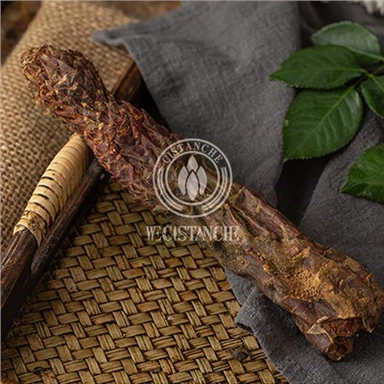
desert living cistanche
1. Exclusive Producing Area Ecology and Pure Varieties
This is the fundamental prerequisite for Xinjiang Cistanche to stand out. The core characteristic of authentic medicinal materials is "regional dependence". As a parasitic plant, Cistanche has extremely strict requirements for its growing environment, which must simultaneously meet five conditions: aridity and little rainfall, abundant sunlight, a large temperature difference between day and night, breathable soil rich in minerals, and sufficient host plants. Xinjiang perfectly meets these needs, making it a "natural breeding ground" for Cistanche growth.
According to the relevant group standards for authentic medicinal materials and the protection requirements for geographical indication products, the producing areas of authentic Cistanche must have clear regional boundaries. The three major producing area clusters in Xinjiang-the circum-Tarim Basin, Turpan Basin, and Junggar Basin-are exactly the core distribution areas of authentic Cistanche. Among them, Hotan Prefecture is listed as a protected area for national geographical indication products, and its producing area is clearly defined as the current administrative areas of 8 counties and 1 city, including Hotan City, Hotan County, and Pishan County, locking the growth foundation of authentic Cistanche from the source.

Abundant harvest of Cistanche tubulosa
In terms of varieties, the *Pharmacopoeia of the People's Republic of China* stipulates that the Cistanche usable for medicinal purposes are mainly the dried scaly fleshy stems of Cistanche deserticola and Cistanche tubulosa of the Orobanchaceae family. Xinjiang producing areas exactly cover these two wide mainstream authentic varieties, forming a differentiated quality system. The sandy areas of the Junggar Basin are dominated by Cistanche deserticola, which parasitizes on the roots of Haloxylon ammodendron and has a growth cycle of 4 to 6 years, with high polysaccharide content and a sweet taste. The circum-Tarim Basin and Turpan Basin are dominated by Cistanche tubulosa, which parasitizes on the roots of Tamarix chinensis. Especially, Hotan Prefecture, as the core producing area of Cistanche tubulosa, has solved the problem of artificial inoculation, eliminating the hidden dangers of variety mixing and quality problems from the source.
2. Up-to-Standard and Stable Content of Active Ingredients
This is the core embodiment of the medicinal and tonic value of Cistanche. The core efficacy of Cistanche comes from its active ingredients such as phenylethanoid glycosides (echinacoside, acteoside, etc.), polysaccharides, and amino acids. Among them, the total content of echinacoside and acteoside is the core detection index clearly specified in the *Pharmacopoeia of the People's Republic of China* and the key yardstick for measuring the quality of Cistanche.
According to the pharmacopoeia, the total content of echinacoside and acteoside in Cistanche tubulosa shall not be less than 1.5%, and that in Cistanche deserticola shall not be less than 0.30%. However, the content of active ingredients in Cistanche from Xinjiang producing areas is generally much higher than this standard. Especially the authentic Hotan Cistanche, as a national geographical indication product, has an echinacoside content of ≥5.0% and acteoside content of ≥1.2% for its first-grade products, with a total content stable above 2.5%. Top-grade products even reach 4% to 5%, more than three times the pharmacopoeial standard, demonstrating the quality advantage of authentic Xinjiang Cistanche.

Main Chemical Constituents of Cistanche tubulosa
Click here to view Cistanche Tubulosa Extract Natural Supplement Powder
【Ask for more】Email:cindy.xue@wecistanche.com / WhatsApp: 0086 18599088692 / Wechat: 18599088692
This high content of active ingredients is inseparable from Xinjiang's unique ecological conditions and scientific control. By cooperating with scientific research institutes, Xinjiang producing areas have established a complete component detection system, using detection methods specified in the pharmacopoeia such as thin-layer chromatography and high-performance liquid chromatography to test the content of active ingredients in each batch of Cistanche raw materials, and at the same time screen for harmful substances such as heavy metals and pesticide residues to ensure that products meet the safety standards for medicinal and edible use. Data show that the area of artificially inoculated Cistanche in Xinjiang is about 1 million mu, with an annual output of more than 6,000 tons of dried products, accounting for 80% of China's total output. Among them, the planting area of the Hotan producing area exceeds 500,000 mu, with an annual output of more than 15,000 tons of fresh products. The stability and superiority of its active ingredient content have become the core competitiveness of authentic Xinjiang Cistanche.
3. Standardized Harvesting and Processing Techniques
This is the key link to lock in quality and ensure efficacy. The quality of authentic medicinal materials not only depends on "good planting" but also on "correct harvesting and proper processing". Xinjiang producing areas have formed a set of strict norms in the harvesting and processing links, which have become an important part of the authentic standards.

Harvest of Cistanche tubulosa
In the harvesting link, the principle of "maturity control" is strictly followed. Cistanche is excavated when the seedlings just emerge in spring or before the soil freezes in autumn, and the stem tips are removed to ensure that the fleshy stems of Cistanche are plump and full of nutrients. Hotan Prefecture further specifies that it takes 10-15 days from harvesting to drying in spring, 20-30 days in autumn, and drying measures are adopted for harvesting in late autumn to avoid the loss or deterioration of active ingredients due to improper processing.
In the processing link, authentic Xinjiang Cistanche adheres to the core technology of "low-temperature drying and cleaning slicing", abandoning methods that damage active ingredients such as high-temperature drying. It adopts a combination of natural drying and low-temperature drying to ensure that the dried fleshy stems are compact, free from mold and insect infestation. In the slicing link, the thickness is strictly controlled to ensure that the active ingredients can be fully leached, and impurities are removed to ensure cleanliness. Among them, the impurity content of authentic Hotan Cistanche (first-grade products) is ≤3.0%, which is much lower than the industry average. Today, Xinjiang has formed a complete industrial chain layout covering planting, harvesting, processing, testing, and sales. Many enterprises have established modern processing centers with independent patented technologies, further standardizing the processing process and making the quality of authentic Cistanche controllable from planting to finished products.
Across China, although Cistanche is also produced in regions such as Inner Mongolia and Gansu, none of them can match Xinjiang in terms of compliance with authentic standards. Although Cistanche deserticola in Inner Mongolia has high polysaccharide content, its output is limited, and wild resources are under strict protection, with insufficient large-scale and standardized levels. The planting area in Gansu and other producing areas is small, and there is a gap in ecological conditions compared with Xinjiang, with insufficient stability in the content of active ingredients, making it difficult to meet the core standards of authentic Cistanche.

The villagers of Hetian Village in Xinjiang are digging and harvesting Cistanche tubulosa
The standards for authentic Cistanche are never a single "producing area label", but a combination of natural endowments and human ingenuity. As the core producing area of authentic Cistanche, Xinjiang has perfectly interpreted the quality connotation of authentic medicinal materials with its unique ecological environment, standardized planting management, strict component testing, and standard processing technology, and has also set a benchmark for the national Cistanche industry. For consumers, recognizing authentic Cistanche means focusing on products from Xinjiang producing areas, especially those from protected geographical indication areas such as Hotan, which is not only a guarantee of quality but also an inheritance of the "authenticity" concept in traditional Chinese medicine culture.