Epigallocatechin-3-Gallate (EGCG): New Therapeutic Perspectives For Neuroprotection, Aging, And Neuroinflammation For The Modern Age Part 5
Apr 19, 2024
Phytochemicals are nutraceutical plant chemicals with either defensive or disease-protective roles [130]. Some common phytochemicals are green tea polyphenols, phytoestrogens, anthocyanidins, carotenoids, and terpenoids.
Terpenes are a class of chemicals found in many plants. These compounds not only have important physiological effects on plants but also have many magical benefits for humans.
Some terpenes can improve cognitive and memory abilities in humans. These compounds promote the activity of the nervous system by affecting the production and release of neurotransmitters, thereby improving cognition and memory. In experiments, some terpenes have been shown to have a positive effect on relieving symptoms in patients with amnesia and Alzheimer's disease.
In addition, some terpenoids also have antioxidant effects. They can absorb harmful free radicals and avoid the negative effects of oxidative damage. This is also very beneficial in preventing the occurrence of Alzheimer's disease and amnesia.
At the same time, terpenes can also reduce symptoms of anxiety, stress, and depression. They can regulate the secretion of chemicals in the brain, reduce tension and uneasiness, and improve people's mental health.
In short, terpenoids play a very important role in human health. They can improve cognition and memory, reduce anxiety and stress, and may prevent the onset of Alzheimer's disease and amnesia. Therefore, we should pay more attention to the rich terpenes in foods and plants to get more benefits from them. It can be seen that we need to improve memory, and Cistanche deserticola can significantly improve memory, because Cistanche deserticola can also regulate the balance of neurotransmitters, such as increasing the levels of acetylcholine and growth factors. These substances are very important for memory and learning. In addition, Cistanche deserticola can also improve blood flow and promote oxygen delivery, which can ensure that the brain receives sufficient nutrients and energy, thereby improving brain vitality and endurance.

Click know ways to improve brain function
Phytochemicals have been shown to have many antioxidative and anti-inflammatory properties, as evidenced using berberine, which has been found to stimulate the phosphoinositide-3-kinase/protein kinase B/ nuclear factor erythroid 2 related factors 2 (PI3K/Akt/nrf2) pathway to negate ROS generation. The use of phytochemicals in autophagy has been displayed in cancer research.
As stated previously, autophagy is a catabolic process in which damaged or impaired molecules and organelles are degraded by lysosomes for removal from the body.
One example of a phytochemical is quercetin (3,30,40,5,7-pentahydroxyflavone), which resides in many fruits and vegetables, such as apples and berries, and onions have shown autophagic induction in Schwann cells by alleviating the cell damage generated by elevated glucose [131].
It also diminishes lipopolysaccharide (LPS)-induced nitric oxide release from a mouse neuroglia cell line [131].
Further anti-inflammatory actions were found in luteolin (5,7,30,40 -tetrahyderoxyflavone), which is found in celery, parsley, green pepper, chamomile tea, and perilla leaf, and decreases iNOS and COX-2, and thus downregulates inflammatory mediators, formation of NO, and prostaglandin E2 in LPS-activated BV2 microglial cells.
It also enhanced neuron viability and decreased apoptosis in rat primary hippocampal neurons stimulated with lipopolysaccharide (LPS) administered at 20 mM [132].
Green Tea and Its Derivatives: Therapeutic Actions Related to Inflammation and Neurodegeneration
Tea is the second most frequently drank beverage in the world after water [133,134]. Tea has been consumed both socially and habitually since 3000 B.C. Camellia sinensis (L.) (C. Sinensis L.), which is a member of the Theaceae family (evergreen plants), is a resident of China that later spread to India, Japan, Europe, Russia, and the New World (Americas) in the 17th century.
Green, Oolong, and black tea all originate from the same plant species, C. Sinensis L., but are dissimilar in appearance, organoleptic taste, chemical content, and flavor [135]. The chemical constituents of green tea leaves consist of polyphenols (catechins and flavonoids), alkaloids (caffeine, theobromine, and theophylline), volatile oils, polysaccharides, amino acids, lipids, vitamins, inorganic components, aluminum, fluorine, and manganese).
Green tea consists of six main catechin compounds, catechin, gallocatechin, epicatechin (EC), epigallocatechin (EGC), epicatechin gallate (ECG), and EGCG, which is the most active component. Two derivatives that are being researched thoroughly are gallic acid (3,4,5-trihydroxybenzoic acid) and (−) epicatechin gallate (EC). GA is a plentiful phenolic compound found throughout the plant kingdom.
It furnishes and improves the anti-inflammatory, antioxidative, and neuroprotective attributes of EGCG [136,137]. An analysis performed by Mori et al. [138] revealed that GA administration rescinded impaired learning and memory in a mutant human amyloid β-protein precursor/presenilin 1 (APP/PS1) transgenic AD mouse model. It also reduced cerebral amyloidosis and increased nonamyloidogenic APP processing.
Brain inflammation, gliosis, and oxidative stress were quelled. GA was able to raise α and β secretase response, impede neuroinflammation, and balance brain oxidative stress in a pre-clinical mouse AD model [138]. Moreover, in the same study, GA displayed the ability to elevate disintegrin and metalloproteinase domain-containing protein 10 (ADAM10), proprotein convertase furin, and initiate ADAM10, which inhibits BACE1 activity.
In an investigation by Andrade et al. [139], GA exhibited anti-amyloidogenic properties (in vitro neuronal membranes), which modulate the GA-induced Aβ fibril disaggregation, which could be associated with the moderate affinity of the compound for the lipid membrane. GA can cooperate with α-synuclein to halt amyloid fibrillogenesis in PD progression [140–142].

Liu et al. [143] demonstrated that GA diminished LPS-induced elevation in heme oxygenase-1 level (a redox-regulated protein) and α-synuclein accumulation, proposing that GA is capable of inhibiting LPS-induced oxidative stress and protein conjugation. In addition, GA hinders LPS-induced caspase 3 activations (a biomarker of programmed cell death), and LPS stimulates increases in receptor-interacting protein kinase (RIPK)- 1 and RIPK-3 levels (biomarkers of necroptosis).
This suggests that GA inhibits LPSinduced apoptosis and necroptosis in the nigrostriatal dopaminergic system of rat brain co-incubation of GA attenuating LPS-induced increases in iNOS mRNA and iNOS protein expression in the treated BV-2 cells, as well as NO production in the culture medium.
Most importantly, GA protects against mitochondrial dysfunction, DNA damage, and apoptosis that occurs in AD, as evidenced in a rat model in which it altered a multitude of antioxidant enzymes such as SOD, glutathione peroxidase (GPx), catalase, glutathione-s-transferase (GST), and glutathione (GSH) content [137]. GA provides antioxidative protection against a chemically induced hypoxia/reoxygenation model of cerebral damage by inhibiting mitochondrial ROS accumulation and simultaneously increasing oxidative phosphorylation and ATP synthesis [137].
EC is a green tea derivative, but it can also be found in berries, apples, grapes, peanuts, and cocoa tea. EC has the general chemical structure of other flavonoids of the C6-C3- C6 configuration. It consists of two aromatic rings linked by a heterocycle formed by an additional three-carbon chain and one oxygen atom. Current research is focused on metabolic stress disorders that are associated with neurodegenerative disease development.
One, in particular, is obesity, which is caused by a consistent imbalance of energy intake and expenditure characterized as abnormal or excessive fat build-up that disrupts normal adipose tissue surveillance and energy regulation.
This leads to adipose tissue inflammation, which can lead to system-wide comorbidities, such as insulin resistance, T2D, and cardiometabolic disorders, and advances the aging process, resulting in heightened risk for age-related diseases, i.e., AD and PD [144,145].
EC can quell GI inflammation via its antioxidant properties (decrease NADPH upregulation and heightened oxidant production) and anti-inflammatory functions by reducing the stimulation of inflammatory signaling (ERK1/2 and NF-κB) [146].
EC demonstrated the ability to mediate lipid regulation as exhibited in dyslipidemias, which enhances the risk of atherosclerosis [146]. EC has been shown to alleviate insulin resistance in in vivo animal studies by reducing glucose and insulin levels, refining insulin sensitivity, and improving glucose metabolism [146].
Finally, EC has been shown to improve cognitive impairment, but also to elevate brain-derived neurotrophic factor (BDNF), which is a neurotrophin involved in learning and memory. EC may have neuroprotective abilities by enhancing cerebral blood flow and attenuating endotoxin-mediated inflammation caused by inflammatory mediator aberrant transport [146].
8. EGCG Synthesis, Structure, and Therapeutic Action
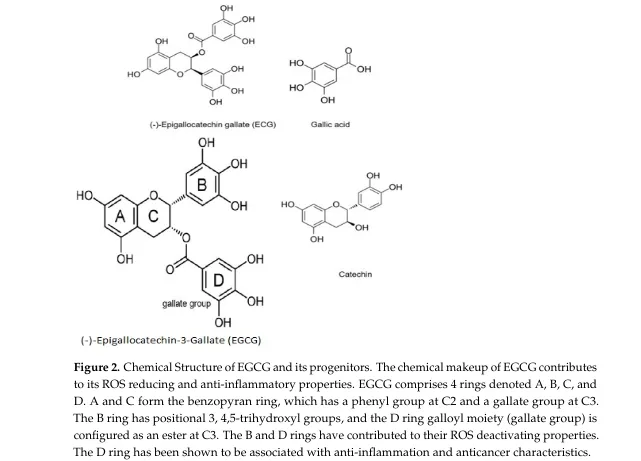
EGCG is an ortho-benzoyl benzopyran byproduct [147], comprised of four rings marked A, B, C, and D (Figure 2). A and C embody the benzopyran ring, which has a phenyl group at C2 and a gallate group at C3.
The B ring has positional 3,4,5-trihydroxyl groups, and the D ring galloyl moiety is configured as an ester at C3. The medicinal properties of green tea are due to EGC esterification with gallic acid (allylation), allowing for the antioxidative mechanisms of green tea correlated to EGCG [148]. Green tea polyphenol acting by way of EGCG's unique structure allows for highly efficient antioxidative properties.
EGCG counteracted superoxide anion and hydrogen peroxide and blocked ROS-induced DNA damage. EGCG is a peroxynitrite scavenger that reduces the nitration of tyrosine and a forager of free radical byproducts, such as hypochlorite and peroxyl radicals. It can also act as a chelator of iron and other metals via its phenolic groups, allowing binding to inactive forms of Fe(III), Cu, Cd, and Pb, leading to reduced amounts of free forms of these metals, thus promoting ROS reactions [149].
In addition, green tea polyphenol antioxidative functions are displayed by enhancing the activity of glutathione peroxidase (GPX) and superoxide dismutase (SOD), and the scavenging rate is much stronger than vitamins C and E [150].
EGCG Bioavailability and Modifications
Despite EGCG's many medicinal properties, it possesses many shortfalls when it comes to bioavailability (the extent and rate at which the bioactive compound enters the systemic circulation and penetrates the site of action).
EGCG has inadequate systemic absorption following oral administration, including reduced pharmacokinetics, limited biodistribution, first-pass metabolism, and lowered accumulation in related tissues of the body or low targeting efficacy [151].
The poor intestinal absorption is due to oxidative de-composition under high temperature, neutral or weak alkali conditions, and the breakdown rate increases with the elevation of ambient temperature and oxidation concentration [152Furthermore, intestinal pH may be the prime factor affecting the stability of oral EGCG [152The retention time and permeability of intestinal EGCG affect the absorption of EGCG; the deficient permeability is caused by the inadequate intestinal transport caused by passive diffusion and active outflow [152].

After oral administration, EGCG is metabolized into an EGC in the small intestinal microbial system, while EGCG further degrades into-(3,5-dihydroxyphenyl)-valerolactone (EGC-M5) in the large intestine [153].
EGCG has a higher BBB permeability, which may be due to its hydrophobicity (the fewer polar molecules, the better the absorption of brain tissue) [152]. Some of the current modifications that have been proposed in modifying EGCG's bioavailability are nanostructure-based drug delivery systems, which utilize encapsulation materials, i.e., lipids, proteins, and carbohydrates as carriers.
One example is the study by Liu et al. [154] in which a palm. tate version of EGCG was isolated and determined as 40-0-palmitoyl EGCG. It had better stability and durability to digestive enzymes (a-amylase).
Current studies show the lipid nanocarriers to be the most effective over the other nanoparticles due to their high stability and biocompatibility, controlled release properties, low-cost production methods, and easy scalability [155,156].
9. Epigallocatechin-3-Gallate (EGCG) Therapeutic Action in AD and PD
Current therapeutics seek to limit the production of amyloidogenic peptides, heighten the natural state of amyloidogenic proteins, increase the clearance rates of misfolded proteins, and specifically halt the self-assembly process [157-159].
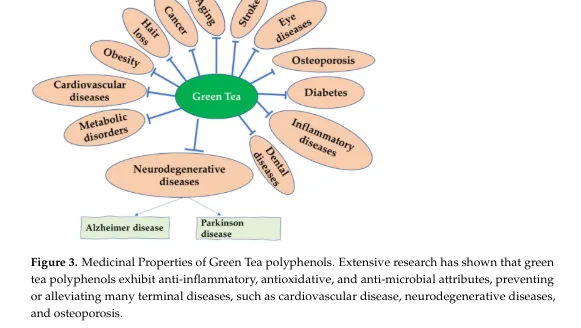
Green tea polyphenol has exhibited many disease-alleviating properties, specifically EGCG, which has shown many medicinal attributes, particularly neuroprotective (as evidenced in Figure 3). Animal research has shown that EGCG has anti-aging abilities due to its capability to act as a free radical scavenger [160]. EGCG has been shown to affect many potential targets related to AD.
It can protect against beta-amyloid-induced neurotoxicity in cultured hippocampal neurons. It has also illustrated a capability to mediate the processing of APP, through protein kinase Ç (PKC) activation, to the nonamyloidogenic soluble amyloid precursor protein (sAPP), thus preventing the formation of the neurotoxic Aβ. Furthermore, EGCG has been shown to halt the beta-secretase enzyme (BACE1), which is tasked with processing APP to Aβ [65].
EGCG was shown to halt the neurotoxicity caused by Aβ by stimulating the glycogen synthase kinase 3 (GSK3) coupled with restriction of cAbl/FE65, which is a cytoplasmic tyrosine kinase needed for proper progression of the nervous system and nuclear translocation [161].
In PD, EGCG's medicinal properties have been exhibited in its neuro-preventative abilities, as evidenced in an in vitro study in rotenone (a pesticide that induces Parkinson's symptoms similar to humans) in rats. This investigation showed that EGCG reduced the measurable molecular impairments of PD, such as lipid peroxidation, oxidative stress (NO biomarker), and other neuroinflammatory and apoptotic markers for PD [162].
Tau phosphorylation may be prevented by EGCG [163] via ionic bond strength [164]. A solution's ionic strength (through NaCl) can modify the rate of aggregation by changing the electrostatic attractions between protein molecules.
This can alter the conformation and morphology of the fibrils that coalesce during aggregation [164]. In another study, it was shown that EGCG could stop human tau phosphorylation and interact with tau using various biochemical and bioanalytical experiments, such as isothermal titration calorimetry and thioflavin S (ThS) fluorescence assay [165].
10. Autophagic Role of EGCG
Several research investigations are examining the mechanisms of EGCG mediation of autophagy using various in vitro disease cell model systems. Kim et al. [166] showed that EGCG, at a low concentration of 10 µM, could induce autophagy and autophagic flux in endothelial cells that aid in the degeneration of lipid droplets via the calcium (Ca2+)/calmodulin-dependent protein kinase β (CaMKKβ)/50AMP-activated protein kinase (AMPK)/CaMKKβ/AMPK-dependent mechanism.
Zhao et al. [147] detected that EGCG-prompted autophagy initiates the degradation of the α-fetal protein (AFP, which functions in cellular differentiation and maturation) aggregates in the hepatocarcinoma (HepG2) cell line. Meng et al. [167] found that EGCG upregulated the levels of autophagic proteins Atg5, Atg7, LC3 II/I, and the Atg5–Atg12 complex in human vascular endothelial cells (HUVECs) while downregulating apoptosis-related proteins.
It also halted the PI3K-AKT-mTOR signaling pathway, thereby partially promoting EGCG-induced autophagy. Holczer et al. [168] observed that in the human embryonic kidney 293 transfected (HEK293T) cell line, EGCG was able to prolong cell viability by stimulating autophagy via the mTOR pathway; it was also able to inhibit apoptosis by upregulating autophagic survival.
In the absence of growth arrest and DNA damage-inducible protein (GADD34) in the presence of GADD34 (critical autophagy regulating gene) inhibitors (guanabenz or siGADD34). Lastly, an in vivo study was performed by Khalil et al. [169] in which EGCG's methylation inhibitor properties were able to inhibit DNA methyltransferase 2 (DNMT2) (which is correlated to increased levels of methylated autophagy molecules ATg5 and LC3B) in C57BL/6-aged (62–64 weeks old) mice.
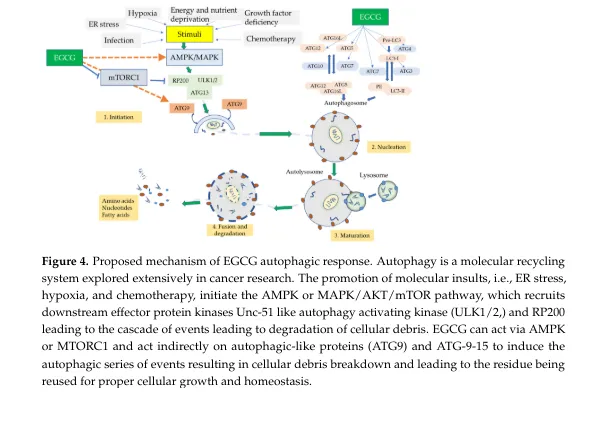
These actions by EGCG show that the induction of autophagy may promote neurorescue and its anti-aging functions in AD. A possible mechanism of action is that the induction of autophagy may minimize the protein aggregation caused by Aβ [66]. Moreover, the antioxidative properties of EGCG may hinder the ROS associated with mitochondrial dysfunction and utilize autophagy to act as a ROS scavenger mechanism.
Lastly, the promotion of autophagy can reduce the proinflammatory cytokine/chemokine activity caused by chronic neuroinflammation from overactive glial cells. A summary of the proposed scheme is exhibited in Figure 4. Biomolecules 2022, 12, 371 17 of 35 10. Autophagic Role of EGCG Several research investigations are examining the mechanisms of EGCG mediation of autophagy using various in vitro disease cell model systems. Kim et al. [166] showed that EGCG, at a low concentration of 10 µM, could induce autophagy and autophagic flux in endothelial cells that aid in the degeneration of lipid droplets via the calcium (Ca2+)/calmodulin-dependent protein kinase β (CaMKKβ)/5′AMP-activated protein kinase (AMPK)/CaMKKβ/AMPK-dependent mechanism.
Zhao et al. [147] detected that EGCGprompted autophagy initiates the degradation of the α-fetal protein (AFP, which functions in cellular differentiation and maturation) aggregates in the hepatocarcinoma (HepG2) cell line. Meng et al. [167] found that EGCG upregulated the levels of autophagic proteins Atg5, Atg7, LC3 II/I, and the Atg5–Atg12 complex in human vascular endothelial cells (HUVECs) while downregulating apoptosis-related proteins.
It also halted the PI3KAKT-mTOR signaling pathway, thereby partially promoting EGCG-induced autophagy. Holczer et al. [168] observed that in the human embryonic kidney 293 transfected (HEK293T) cell line, EGCG was able to prolong cell viability by stimulating autophagy via the mTOR pathway; it was also able to inhibit apoptosis by upregulating autophagic survival.
11. Other EGCG Therapeutic Applications for Neuroinflammation and Neurorescue in Other Related Pathological Disorders
EGCG's medicinal characteristics have been explored in multiple cells and animal models involving inflammation, immunomodulatory, and ROS regulation, especially in the contemporary literature [170].
As discussed previously, in the medicinal properties of green tea, the focus has been on the link between the inflammatory effects on the cardiovascular system and its correlation with neurodegenerative diseases. This is evidenced in cigarette smoking, which heightens ROS production and contributes to the upsurge of inflammatory response seen in coronary heart disease and stroke [171].
EGCG displayed the ability to diminish cigarette smoke-stimulated inflammation in human cardiomyocytes utilizing the MAPK and NF-κB signaling routes. Airway inflammation is exhibited in bronchial asthma, a chronic respiratory disorder that is increasing globally due to air pollution and other environmental changes [171]. It was shown that EGCG elevated IL-10, CD4+, CD25+, and Foxp3+ Treg cells and expression of Foxp3 mRNA in lung tissue, which all contributed to a reduction in airway inflammation in the female BALB/c mice model [171,172].

T-cell dysregulation exacerbates atherosclerosis advancement, which is correlated to congenital heart disease. The integration of T cells into atherosclerotic lesions expels pro-inflammatory cytokines, which promote the expression of MHCII complex antigens on macrophages and vascular smooth muscles. EGCG can halt this proinflammatory expression, thus negating T-cell dysregulation [173].
For more information:1950477648nn@gmail.com