High P16INK4a, A Marker Of Cellular Senescence, Is Associated With Renal Injury, Impairment And Outcome in Lupus Nephritis
Mar 24, 2022

CISTANCHE WILL IMPROVE KIDNEY/RENAL DISEASE
INTRODUCTION Lupus nephritis (LN) is a severe complication of systemic lupus erythematosus (SLE), initiated by deposition of immune complexes or autoantibodies in the glomerular basal membrane, followed by recruitment of inflammatory cells.' Renal injury leads to irreversible fibrosis, resulting in loss of kidney function. LN is treated with high-dose corticosteroids and other immunosuppressive agents. One-third of patients nevertheless show a decline in renal function, with 5%-10% developing the end-stage renal disease within 10 years."Prognostic markers that would allow for timely treatment escalation or modification are hence eagerly sought, as are novel therapeutic targets. Cellular senescence, triggered by stimuli such as telomere erosion, oxidative stress, and chronic inflammation, ultimately leads to irreversible growth arrest through the accumulation of cyclin-dependent kinase (CDK) inhibitors including pl6Na protein (CDKN2A):a major hallmark of cellularsenes science. Senescent cells remain metabolically active and undergo a number of morphological and physiological changes including the upregulation of β-galactosidase activity and acquisition of a proinflammatory, profibrotic senescence-associated secretory phenotype (SASP)." While essential in tissue repair and remodeling (e.g., during embryogenesis), cellular senescence can exert adverse effects in aging-related and chronic disease as well as cancer.' pl6Nk or β-galactosidase positive cells have been observed in renal aging and certain kidney diseases, and were associated with histological lesions and renal impairment. The presence of β-galactosidase positive cells correlated with proteinuria in MRL/lprlupus-prone mice°; however, cellular senescence is yet to be clearly demonstrated in-positive LN. Here, we report the occurrence of pl6ka. cells in kidney biopsies from (n=40) patients with active LN, and its association with renal injury and functional impairment.
Keywords: kidney function; kidney diseases; kidney biopsies; renal injury; renal

CISTANCHE WILL IMPROVE KIDNEY/RENAL DIALYSIS
METHODS: Patients and kidney biopsies Patients were recruited at the Department of Rheumatology, Cliniques Universitaires Saint-Luc (Brussels, Belgium). All met the 1982 revised ACR classification criteria for SLE and had biopsy-proven LN. Formalin-fixed paraffin-embedded (FFPE) renal biopsies were residual corporal material collected for diagnostic purposes between January 1996 and November 2019. Estimated glomerular filtration rate(eGFR) values were calculated using the Chronic Kidney Disease Epidemiology Collaboration(CKD-EPI) formula. Patient consent was not required for the use of residual corporal material, in agreement with Belgian regulations on human studies.
Histology and immunohistochemistry ISN/RPS 2003 classification of SLE renal biopsies, semi-quantitative sclerosis scores, and National Institutes of Health(NH)activity index (AI)and chronicity index (C) were retrieved from medical records. Immunos training with anti-CD8(C8/144B, Dako)and anti-p16INK4 (E6H4, Roche Ventana CINtec Histology)and Picrosirius Red (PSR) staining were performed on 5μm FFPE serial sections. Slides were digitalized on an SCN400 scanner (Leica Biosystems, Germany)or a Pannoramic Confocal slide scanner (3DHistech, Hungary)at×20magnification. Computer-assisted quantification of the entire surface of sections was performed using Author V2017.2(Visi Biopharm, Denmark). The results shown are the number of pl6K or CD8-positive cells per μm² of tissue. Semi-quantitative PSR scores(scale:2-6) are median (glomerular +interstitial fibrosis) scores from three (blinded)scorers. Further details are provided in online supple-mental methods 1, online supplemental figure 1. Statistical analyses Statistical analyses were performed on GraphPad Prism V.9.1.0: Mann-Whitney or Wilcoxon matched-pair signed-rank tests for two-group comparisons, Kruskal-Wallis for multigroup comparisons and Spearman's rank-order correlation coefficient.
RESULTS: p16k4-positive cells in kidney biopsies from patients with active LN We evaluated p16Nk protein by immunohistochemistry on renal biopsies taken at diagnosis from 40 patients with active LN, including incident nephritis (n=31)and relapse (n=9). Demographic, biological, and clinical data are summarised in online supplemental table 1.p16INkA. positive cells were detected in all, but with considerable variability between samples: from virtually none to occasional scattered cells, to strongly positive areas(figure lA, online supplemental figure 2A-D). Quantification of pl6staining confirmed the heterogeneity ofLN biopsies (range:1.76×10~-260×10~,median:14.7×10-cells/μm)(figure 1B,C). Stained cells included mesangial cells, endothelial cells or podocytes in glomeruli, parietal epithelial cells in Bowman's capsules, proximal or distal tubular cells, and interstitial cells(figure ID). Although the density of pl6-positive cells(per μm)was significantly higher in glomeruli than in interstitia(figure 1C), these values(per sample)showed a significant positive correlation(r=0.7591, p<0.0001)(online supplemental figure 3). Importantly, pl6Ka accumulation was not associated with patient age, gender, or ethnicity (online supplemental figure 4A-C).

CISTANCHE WILL IMPROVE KIDNEY/RENAL INFECTION
p16"K4 is associated with renal impairment at baseline and 5years post-treatment p16INKEa positivity was significantly associated with impaired renal function: biopsies from patients with eGFR<60 at the time of sampling had significantly higher pl6INf-positive cells/μm², and conversely, samples with high(>75th percentile)p16a were associated with significantly lower baseline eGFR(figure 2AB). The association with eGFR was true for both glomerular and interstitial pl6a(online supplemental figure 5A,B). Interestingly, whereas high glomerular p16 was also associated with significantly higher proteinuria (urinary protein/creatinine ratio), which mainly reflects glamour-was not (online suppleular injury, interstitial pl6ka mental figure 5C,D). In contrast to its association with was not associated with poor renal function,pl6NK4a parameters of systemic disease such as serum anti-double-stranded DNA antibody or C3 levels, or with ISN/RPS classification(online supplemental figure 6A-D). Slightly (non-significantly)higher pl6k was observed in biopsies from patients with a longer duration between SLE and LN diagnosis, and in relapse compared with incident nephritis (online supplemental figure 7A,B). Importantly, analysis of only the incident LN cases upheld the association between pl6 and eGFR(online supple-mental figure 7C), suggesting it is not solely dependent on kidney disease duration. Finally, high p16Nkia in baseline biopsies was also associated with lower eGFR at 5 years post-treatment(but not at the year), suggesting it may be predictive of poor long-term renal evolution (figure 2C,D).
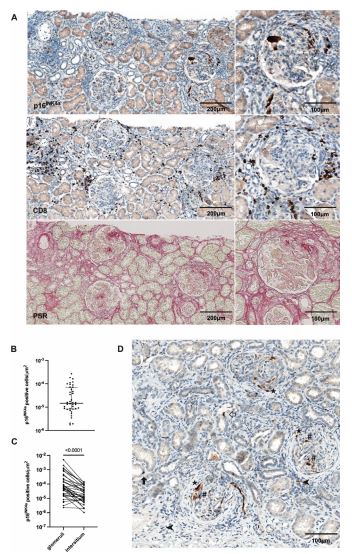
Figure 1 p16NK43-positive cells in kidney biopsies from patients with active LN.(A) p16, CD8 and PSR staining of FFPE serial sections from an LN kidney baseline biopsy. Overview (left panels), close-up (right)showing p16 positive cells within a glomerulus, periglomerular CD8-positive cells, and collagen deposits in and around Bowman's capsule of the same glomerulus. (B) Quantification of p16xa (positive cells/μm²showing degree of heterogeneity among samples. (C) Quantification of p16< (positive cells/um²) in glomerular vs interstitial areas of the same samples.p-value: Wilcoxon matched-pair signed-rank test. (D) Representative image from a sample showing p16-positive cells within glomeruli (#), in Bowman's capsules (filled star), proximal tubules(filled arrow), distal tubules(arrow) and dispersed in the interstitium (arrowhead).FFPE, formalin-fixed paraffin-embedded; LN, lupus nephritis; PSR, picrosirius red.
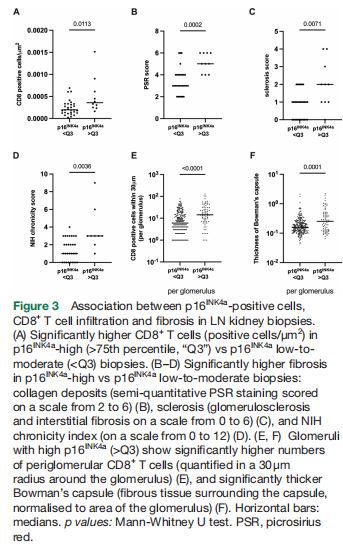
p16NK43 is associated with renal CD8* T cell infiltration and p16Ma fibrosis It has been shown that CD8tTlymphocytes are the predominant immune cell type infiltrating the LN kidney and that their presence is associated with renal disease severity We found that pl6-high biopsies displayed significantly higher CD8t T cell infiltration (figure 3A). They were also significantly associated with increased fibrosis: collagen

deposition as reflected by semi-quantitative scores of PSR staining, and sclerosis and NH CI scores provided by a neuropathologist (figure 3B-D). NIH AI scores, in contrast, were not significantly different between the p16INK4a s groups(data not shown). Intriguingly, in examining tissue sections, we noticed what seemed to be a spatial co-distribution between strong pl6k staining (that tended to be glomerular) and clustered CD8-positive cells (most often periglomerular)in certain LN biopsies (figure IA, online supplemental figure 2). We, therefore. quantified the number of CD8* T cells located within a 30μm radius around each glomerulus, the thickness of its Bowman's capsule, and the number of pl6k-positive cells within it(online supplemental figure 1). This was done on all glomeruli visible on the three serial sections, across all samples. Glomeruli with high pl6K4-positive cell accumulation displayed significantly higher Perigo-macular CD8 T cells(figure 3E),as well as increased thickness of Bowman's capsules, reflecting glomerular fibrosis (figure 3F).
DISCUSSION This is the first demonstration, in a large series of patients, that pl6Na, a major hallmark of cellular senescence, is associated with disease severity in LN. IHC for pl16 protein is widely used to assess for senescence ex vivo, and has been associated with severity of other renal diseases.'Selective elimination of pl6-positive cells in mouse models of aging and induced nephropathy has moreover been shown to relieve fibrotic lesions and improve renal function,' suggesting a key role in renal pathogenesis. Why cellular senescence may occur in LN is unknown. The inflammatory, oxidative environment of the LN kidney may be a source of cell stress. Several proinflammatory factors have been implicated in senescence induction,14inchuding interferon-B3that has been linked to the senescent phenotype of bone marrow mesenchymal stem cells from patients with SLE15 While our study highlights a significant association between the abundance of pl6-positive cells and LN severity, the use of additional markers of cellular senescence, in a larger cohort, will be essential to confirm its relevance in LN. If and how cellular senescence contributes to disease progression (or whether it simply reflects tissue injury) remains to be investigated. A detrimental effect may be exerted through the profibrotic,proinflam-matory secretome (SASP) typical of senescent cells. In keeping with this hypothesis, we describe a tight spatial co-distribution between pl6Nk positive cells, fibrosis and CD8* T cell infiltration in LN kidneys. Another pathogenic mechanism may involve the accumulation of functionally incompetent cells, for instance, renal progenitor cells(RPC,a subset of parietal epithelial cells located in the Bowman's capsule of glomeruli).'" While healthy RPCs regenerate glomerular and tubular struc-tures thanks to their capacity to proliferate and differ-entiate into renal cell subsets,'"senescent RPCs could hamper tissue repair."Finally, while the SASP is partic-ularly suited to engaging the immume system (including CD8t T lymphocytes)'8for the clearance of senescent cells,the latter can upend the process by inhibiting cyto lyic celk." It has been suggested that persistence of senescent cells(due to the overwhelming or inhibition of the immume response)tips the balance from a positive to a negative impact."Further in vitro experiments will be required in order to dissect the role of pl6Nk-positive cells in the pathogenesis of LN. This may have important implications for therapy, the first open-label pilot study using the senolytic drugs dasatinib plus quercetin (DQ)having shown promising results in idiopathic pulmonary fibrosis and diabetic kidney disease. Finally the association of high baseline pl6INk4 with impaired renal function 5years post-treatment initia tion suggests it may be a promising predictor of disease severity. It would be of interest to assess for pl6 and its associated markers (fibrosis and CD8 T cell infiltra tion)in 1-year follow-up biopsies as well as in a larger cohort,as the evolution of these markers from baseline to lyear may better reflect treatment response than either time point alone.