How A Metabolite Of The Desert Ginseng May Protect Dopamine Neurons: The Story Of DOPAC And Parkinson's Disease
Oct 27, 2026
A careful, science-based look at a master's thesis exploring whether a small molecule produced when Cistanche is digested - called DOPAC - can protect the brain cells that die in Parkinson's disease, and why we must read these findings with patience and honesty
Introduction: A Desert Plant, a Small Molecule, and a Hard Question
Some of the most promising ideas in natural-product science begin with a puzzle. Consider the "desert ginseng" - Cistanche, a parasitic plant that thrives in harsh desert conditions and has been treasured in traditional Chinese medicine for centuries.
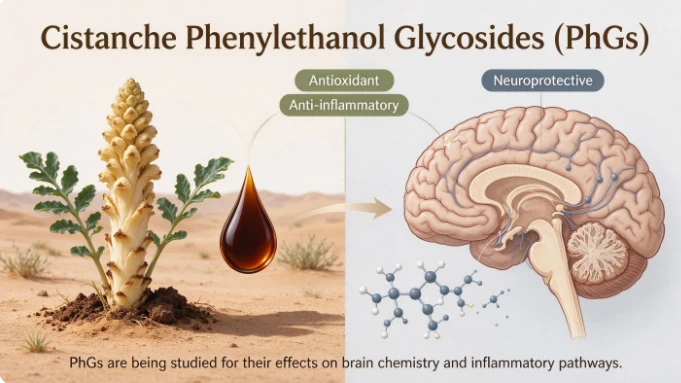
Here's the puzzle: scientists know that certain compounds in Cistanche - called phenylethanol glycosides - appear to have neuroprotective properties. Yet when people (or animals) actually consume them, these large molecules are very poorly absorbed into the bloodstream. So how could they possibly work?
The answer, researchers increasingly believe, lies in something unexpected: the plant's compounds are not the real actors - their metabolic products are. When Cistanche is digested, its large glycoside molecules are broken down into smaller pieces. And one of those pieces - a molecule called 3,4-dihydroxyphenylacetic acid, or DOPAC for short - is now the focus of serious scientific attention.
This article tells the story of a research thesis that investigated whether DOPAC could protect the brain cells that die in Parkinson's disease (PD) - and through what mechanism. It's a story about a protein-folding factory inside our cells, a stress response called the "unfolded protein response," and a carefully designed set of experiments that moved from laboratory cells to living mice.
Before we go further, an important and honest note: this is research conducted in cells and in mice, not in humans. As we'll see, that distinction matters enormously. But understanding what the study found - and what it doesn't yet prove - is exactly how we should approach any exciting scientific claim.
Let's begin with the disease itself.
1. Parkinson's Disease: When the Brain's "Movement Command Center" Falters
Parkinson's disease is one of the most common neurodegenerative disorders in the world - second only to Alzheimer's disease. It is a chronic, progressive condition that affects how people move, and it touches not just their bodies but their quality of life.
At its core, Parkinson's disease is caused by the gradual loss of a specific group of brain cells: dopamine-producing neurons located in a region of the midbrain called the substantia nigra (literally, the "black substance" of the brain). These neurons produce dopamine, a neurotransmitter that is essential for coordinating smooth, voluntary movement.
As these neurons degenerate and dopamine levels fall, the brain loses its ability to control movement properly. The classic symptoms of Parkinson's disease include:
Tremor - involuntary shaking, often in the hands.
Muscle rigidity - stiffness and resistance in the limbs and trunk.
Bradykinesia - slowness of movement, a hallmark of the disease.
Postural instability - problems with balance and coordination.
As the disease progresses, symptoms extend beyond movement. Many people experience cognitive difficulties, and some eventually develop a form of dementia known as PD dementia. The disease also brings a heavy emotional and practical burden - to patients, families, and entire healthcare systems.
Parkinson's disease is a multifactorial condition. In more than 90% of cases, it is what scientists call "sporadic" - there is no single inherited cause. Instead, a complex mix of genetic susceptibility, environmental exposures (such as long-term contact with certain heavy metals and pesticides), and lifestyle factors appears to contribute. Many of these factors, researchers believe, converge on a common set of cellular problems - including oxidative stress, protein mishandling, and chronic inflammation - that ultimately damage and kill dopamine neurons.
This brings us to a key biological player in the disease: a cellular structure called the endoplasmic reticulum.

2. The "Protein Factory": Endoplasmic Reticulum and Its Stress Response
To understand the study, we first need to understand a structure inside every cell - the endoplasmic reticulum (ER).
Think of the ER as the cell's protein factory and quality-control department. It is responsible for:
Synthesizing proteins,
Folding them into their correct three-dimensional shapes,
Modifying and preparing them for transport,
And shipping them where they need to go.
This is delicate work. A protein that folds incorrectly cannot do its job - and, worse, misfolded proteins can clump together and become toxic.
The ER is constantly balancing how many proteins need to be folded against its capacity to fold them. When this balance is disturbed - by oxidative stress, calcium imbalances, nutrient problems, or an overload of misfolded proteins - the ER sends out an alarm. This alarm system is called the unfolded protein response (UPR).
The UPR is, in principle, a protective response. It tries to restore order by:
Slowing down overall protein production to reduce the load on the factory,
Boosting the production of proteins that help with folding and cleanup,
And, if the problem persists, triggering cell death (apoptosis) to remove the damaged cell.
This last option is the dangerous one. If ER stress becomes chronic or excessive, the protective UPR flips into a pro-death program. One of the key executioners of this program is a transcription factor called CHOP, which turns on a cascade of cell-death signals.
In neurodegenerative diseases like Parkinson's, researchers have found that chronic ER stress is a recurring theme. Misfolded proteins - including a key player in Parkinson's called α-synuclein - accumulate, trigger ER stress, and contribute to the death of dopamine neurons. This makes the ER stress pathway a promising target for intervention.
3. Current Treatments: Real Help, Real Limits
So how is Parkinson's disease currently treated?
The mainstay of treatment has long been dopamine-based strategies. Because the disease is fundamentally a problem of too little dopamine, many medications work by trying to restore dopamine levels or mimic its effects:
Dopamine receptor agonists (like pramipexole and ropinirole) directly stimulate dopamine receptors, mimicking the neurotransmitter's action.
Monoamine oxidase-B inhibitors (like selegiline and rasagiline) slow the breakdown of dopamine, making the existing dopamine last longer.
COMT inhibitors (like entacapone) help extend the effect of levodopa, the precursor of dopamine.
Anticholinergic drugs help rebalance the overactive cholinergic system that Parkinson's disease disrupts.
Amantadine and other agents play various supportive roles.
The most famous treatment is levodopa (L-DOPA), which the brain converts into dopamine. Levodopa is genuinely transformative for many patients, especially early in the disease.
But these treatments have well-documented limitations:
They mainly address motor symptoms. They do much less for the non-motor symptoms - anxiety, depression, sleep problems, cognitive decline - that profoundly affect quality of life.
Long-term complications. Levodopa and other drugs can cause side effects over time, including motor fluctuations ("wearing off" and "on-off" phenomena) and dyskinesias (involuntary movements).
Efficacy fades. Late-stage treatment becomes less effective.
Narrow targeting. Most drugs focus on a single target (dopamine), which limits both their effectiveness and the range of treatment options.
Partly because of these limitations, the field has been searching for disease-modifying strategies - treatments that don't just manage symptoms but actually slow or stop the underlying neurodegeneration. And this is where natural-product research, and Cistanche specifically, comes into the picture.

4. Why Traditional Medicine and Cistanche
Traditional Chinese medicine approaches disease very differently from a single-target drug. It emphasizes holistic balance and treating the individual as a whole. Herbal formulas typically work through multiple active components acting on multiple targets - an approach that is increasingly attractive as scientists recognize how complex diseases like Parkinson's actually are.
Compared to conventional drugs, well-managed herbal approaches are often associated with fewer side effects, less drug resistance, and greater flexibility in formulation - though it is crucial to note that herbal medicine should always be used under professional guidance.
Among the many herbs studied for Parkinson's disease, Cistanche stands out. Let's look at why.
Cistanche deserticola (and its close relative Cistanche tubulosa) is a parasitic desert plant that attaches to the roots of host shrubs. In traditional Chinese medicine, it has been used for centuries to support kidney health, vitality, and digestive function. Modern pharmacology has revealed that it is rich in bioactive compounds, including:
Phenylethanol glycosides - the signature active compounds, most notably echinacoside and verbascoside (acteoside).
Polysaccharides - complex carbohydrates with various biological activities.
Terpenoids, flavonoids, and other components.
Research has linked these compounds to a range of activities relevant to neurological health:
Antioxidant activity - neutralizing the free radicals that damage neurons.
Anti-inflammatory activity - calming neuroinflammation.
Neuroprotective effects - helping protect neurons from damage and supporting their survival.
Modulation of dopamine - influencing the synthesis and release of this crucial neurotransmitter.
Cistanche's phenylethanol glycosides have been studied in models relevant to several neurological conditions, and the field's enthusiasm is understandable. But there was always a nagging problem: these large molecules don't absorb well when taken orally.
5. The Key Insight: Maybe It's the Metabolites, Not the Plant Itself
This is where the study's story takes its most interesting turn.
Researchers had observed that phenylethanol glycosides appear neuroprotective - yet when these compounds are consumed, most of the intact molecules pass through the digestive tract and end up in the feces. Only tiny amounts reach the bloodstream directly.
So how could they have effects in the brain?
The answer lies in a concept called a prodrug. Some natural compounds don't act on their own - they act through the molecules they get broken down into. When Cistanche's glycosides are digested, enzymes in the gut and liver cleave them into smaller pieces. Among the degradation products are hydroxytyrosol, caffeic acid, and - critically for this study - 3,4-dihydroxyphenylacetic acid, or DOPAC.
DOPAC is a small, simple molecule. And here's a delightful twist: DOPAC is also a well-known compound in neuroscience - it is actually the main metabolite of dopamine itself. When dopamine is broken down by enzymes in the brain, one of its primary byproducts is DOPAC. In fact, measuring DOPAC in cerebrospinal fluid is a standard way to assess central dopamine activity.
So the researchers reasoned: if the phenylethanol glycosides in Cistanche are acting as prodrugs, then their metabolic products - especially DOPAC - might be the real players. And they set out to test this hypothesis rigorously.

6. The Research Design: From Cells to Mice
The study used a two-stage approach: first testing DOPAC in isolated cells, then confirming its effects in living mice.
Stage One: Cell Models
To mimic the condition of Parkinson's disease in a dish, the researchers used a chemical called rotenone (Rot). Rotenone is a naturally occurring compound that, at certain doses, damages mitochondria and kills dopamine-like neurons - making it a widely used tool to model Parkinson's-related neurodegeneration in the laboratory.
They applied rotenone to two types of cells:
PC12 cells - a rat cell line derived from the adrenal gland that behaves somewhat like neurons and produces dopamine-related compounds.
SH-SY5Y cells - a human neuroblastoma cell line commonly used in neurodegenerative disease research.
The goal was to screen various metabolic products of Cistanche's phenylethanol glycosides and find which, if any, could protect these cells from rotenone's damage.
The standout candidate was DOPAC. When the cells were exposed to rotenone, they showed clear signs of damage. But when DOPAC was added, it significantly reduced rotenone-induced cell injury and cell death.
To understand how DOPAC worked, the researchers used a staining technique (Hoechst staining) to visualize apoptosis - the programmed cell death that rotenone triggered. DOPAC clearly reduced the number of dying cells.
They then dug into the molecular machinery. Rotenone was found to activate apoptosis by increasing the cleavage of caspase-3, a central executioner enzyme in the cell-death program. But the deeper question was: what was turning on the death program in the first place?
The answer pointed to the endoplasmic reticulum. Rotenone was found to trigger persistent ER stress - the "protein factory alarm" we discussed earlier. And DOPAC appeared to intervene exactly at this point, calming ER stress and thereby blocking the downstream death signal.
To confirm this mechanism, the researchers used a second tool: tunicamycin (Tm), a compound that directly and strongly activates ER stress. Even when ER stress was artificially forced on by tunicamycin, DOPAC still suppressed the stress response and reduced cell death. The same protective effect was confirmed in the human SH-SY5Y cells.
Stage Two: Mouse Models
Encouraged by the cell results, the researchers moved to a more realistic system: living mice. They created a Parkinson's-like condition in C57BL/6J mice using rotenone, then treated some of the mice with DOPAC (at doses of 30 and 60 mg/kg).
The results were consistent with the cell studies:
Body weight: Rotenone caused weight loss in the mice; DOPAC treatment helped mitigate this.
Motor function: Using standard behavioral tests - the open-field test, pole-climbing test, hanging test, and adhesive-removal test - the researchers found that rotenone impaired the mice's movement, and DOPAC treatment significantly restored motor function.
Brain tissue: Examination of the brain tissue (using H&E staining, immunofluorescence, and electron microscopy) revealed that rotenone caused structural damage - including damaged neurons, swollen endoplasmic reticulum, and signs of activated ER stress. DOPAC treatment restored the brain tissue's appearance.
Molecular markers: At the protein level, rotenone increased the expression and activation of ER-stress-related proteins and apoptosis proteins. DOPAC treatment suppressed these - specifically reducing levels of Bip, eIF2α, ATF4, CHOP, and cleaved caspase-3.
Put simply: the molecule that protected cells in a dish also protected dopamine-like neurons in living mice, and it did so through the same pathway.

7. The Mechanism in Focus: The Perk/eIF2α/ATF4/CHOP Pathway
Let's now look more closely at the molecular mechanism - because this is what gives the study its scientific depth.
When ER stress occurs, three main signaling branches can be activated. One of the most important is the Perk pathway:
Bip/GRP78 is a "chaperone" protein that normally keeps several ER stress sensors inactive. When misfolded proteins accumulate, Bip lets go, and the sensor Perk becomes active.
Active Perk phosphorylates eIF2α - a protein involved in starting protein synthesis. This generally slows down protein production (to relieve the ER's workload).
But in a twist, this same step selectively increases the translation of certain transcription factors - most notably ATF4.
ATF4 then drives the expression of CHOP, a transcription factor that is a major pro-apoptotic player - it turns on genes that lead the cell toward death.
This is the Perk/eIF2α/ATF4/CHOP cascade. Under mild, transient stress, it's protective. But when stress is chronic or severe - as in Parkinson's disease - the pathway goes too far, and CHOP drives neurons to their death.
The study's central finding is that DOPAC acts on precisely this pathway. By suppressing this cascade - reducing the expression of Bip, eIF2α, ATF4, and CHOP, and limiting the activation of cleaved caspase-3 - DOPAC calms the ER stress response before it can push the neuron over the edge into apoptosis.
In plain terms: DOPAC appears to act like a "circuit breaker" on one of the brain's most important stress-to-death pathways, protecting dopamine neurons from the very mechanism that Parkinson's disease exploits.
8. DOPAC: A Familiar Molecule with Diverse Known Activities
One reason DOPAC is scientifically attractive is that it isn't a mysterious unknown. Because it is a natural metabolite of dopamine, and because it can also arise from the metabolism of plant compounds like the flavonoid quercetin, researchers already know quite a bit about its biology.
Studies have attributed several pharmacological activities to DOPAC:
Liver protection (hepatoprotection): In a model of acetaminophen-induced liver toxicity, DOPAC helped normalize markers of oxidative damage (like GSH and MDA), restore antioxidant enzyme activity, and protect liver cells - partly through the Nrf2 pathway, a master regulator of antioxidant defense.
Blood pressure reduction: In experiments with rat blood vessels, DOPAC caused vessel relaxation, and in hypertensive rats it dose-dependently lowered blood pressure without much effect on heart rate.
Anxiety-reducing effects: Interestingly, some research suggests that flavonoid compounds may act as prodrugs here too - with their metabolite DOPAC showing anxiolytic (anxiety-reducing) activity.
Antioxidant activity: DOPAC can scavenge free radicals and protect cells from oxidative damage to lipids and proteins.
These findings make DOPAC a compound with a broad, if early-stage, pharmacological profile - and add plausibility to the idea that it could be neuroprotective.
But - and this is essential - these are all preclinical findings. None of them establish DOPAC as a treatment for any condition in humans.
9. What This Study Adds Up To
Let's bring all the pieces together.
The study's contribution is a coherent and carefully tested hypothesis:
The premise: Cistanche's phenylethanol glycosides act as prodrugs - their real neuroprotective effects come from their metabolic products, because the intact molecules absorb poorly.
The candidate: Among these products, DOPAC is identified as a key active metabolite.
The effect: In both rat and human neuronal-like cells, and in living mice, DOPAC protects against rotenone-induced damage - reducing cell death, restoring motor function, and preserving brain tissue structure.
The mechanism: DOPAC works by suppressing the Perk/eIF2α/ATF4/CHOP ER-stress pathway, thereby blocking the apoptosis of dopamine neurons - the very cells lost in Parkinson's disease.
This is genuinely interesting science. It offers a mechanistic explanation for why a desert plant might matter for a brain disease, and it points to a specific, testable molecular target. It also elegantly reframes our understanding: sometimes it's not the herb itself, but the journey it takes through our body, that creates the medicine.

10. Reading This Honestly: What It Does and Doesn't Tell Us
Now, the most important part of this article - the honest reading.
What this research provides: A rigorous, well-designed set of experiments showing that DOPAC, a metabolite of Cistanche's phenylethanol glycosides, protects neurons and improves motor function in cellular and mouse models of Parkinson's disease, through a clearly identified mechanism.
What this research does not provide: Proof that DOPAC, Cistanche, or any natural product treats or slows Parkinson's disease in humans. Here's why the gap matters:
Mice are not humans. The mouse brain, while valuable for research, is not a human brain. Human Parkinson's disease develops over decades and involves genetics, environment, and aging in ways a few-week mouse model cannot fully capture.
Doses don't translate directly. The doses of DOPAC used in mice don't automatically scale to a supplement a person might take. We don't know what dose, if any, would be safe and effective in humans.
Human clinical trials are the gold standard. None of this has yet been confirmed in rigorous human studies. Until that happens, any claim that DOPAC or Cistanche "treats Parkinson's disease" is premature and irresponsible.
It's a starting point, not an answer. What this study does is strengthen the case for further investigation - it tells researchers where to look next, not what to prescribe.
I also want to say something directly and without ambiguity:
If you or someone you love has Parkinson's disease, please continue under the care of qualified medical professionals. Parkinson's disease is a serious medical condition with established treatments that genuinely help. Do not start, stop, or change any medication based on this article, and do not replace prescribed treatment with an herbal supplement. Natural compounds are not a substitute for evidence-based medical care, and any complementary use should be discussed with a doctor who knows your full health picture.
The honest takeaway is hopeful but humble: this research suggests that a small molecule derived from a traditional plant may one day contribute to the toolkit for protecting dopamine neurons - but that day is far off, and the path there is paved with human clinical trials, not enthusiasm.
11. Conclusion: A Desert Plant, a Cellular Alarm, and a Careful Next Step
The story of DOPAC and Parkinson's disease is a story about how scientific discovery often works - not in dramatic leaps, but in careful, cumulative steps.
It begins with a desert plant, treasured for centuries, whose compounds seem promising but don't absorb well. It continues with an insight: perhaps the plant's true effects come through its metabolic products. It identifies one such product - DOPAC, a small molecule with a familiar name in neuroscience. And it tests that molecule rigorously, in cells and in mice, finding that it protects dopamine neurons by calming a specific stress-to-death pathway in the cell's protein factory.
This is genuinely valuable science. It deepens our understanding of why Cistanche might matter for the brain, and it names a specific, testable target for future work.
But it is also, by its own nature, an early chapter. The distance from a mouse brain to a human brain is long and demanding, paved with clinical trials, safety studies, and careful dose-finding. Whether DOPAC - or Cistanche - will one day become part of real Parkinson's care is a question that only more and better science can answer.
For now, the message is one of measured hope and honest patience. The "desert ginseng" has, in the laboratory, revealed a metabolic path that touches the very mechanisms underlying Parkinson's disease. That is a real contribution. Whether it grows into something more is for science - not marketing - to decide.
And that, perhaps, is the most honest and most hopeful thing we can say.
References & Further Reading
This article is an English popular-science adaptation of the master's thesis: Gao Yun. "Research on the pharmacological mechanisms of Cistanche phenylethanol glycosides in vivo metabolites in improving Parkinson's disease." Beijing University of Chinese Medicine, Master's thesis, June 2025. All experimental designs, findings, and proposed mechanisms described above are drawn from that thesis and the primary literature it cites.
Important disclaimer: This article is for general informational and educational purposes only. It is not medical advice, and it does not claim that DOPAC, Cistanche, or any natural product treats, cures, or prevents Parkinson's disease or any other medical condition. The research described was conducted in cells and mice, not humans, and its results have not been confirmed in human clinical trials. If you or someone you know has Parkinson's disease or any neurological condition, please remain under the care of a qualified medical professional and follow your prescribed treatment. Never start, stop, or alter any medication or supplement without consulting a licensed healthcare provider.