Kidney Epithelial Targeted Mitochondrial Transcription Factor A Deficiency Results in Progressive Mitochondrial Depletion Associated With Severe Cystic Disease
Mar 23, 2022
Contact: joanna.jia@wecistanche.com / WhatsApp: 008618081934791
Ken Ishii, Hanako Kobayashi, Kensei Taguchi & et al.
INTRODUCTION
Mitochondrial (mt) dysfunction is a well-recognized pathologic feature of common kidney diseases and can trigger cellular injury, inflammation, and fibrosis. In the kidney, tubular epithelial cells are highly dependent on adenosine triphosphate(ATP)generated from oxidative phosphorylation(OXPHOS)because they perform multiple energy-consuming epithelial transport functions. Therefore, sustenance of efficient mt ATP production is essential for normal kidney function and systemic electrolyte homeostasis. In addition, recent evidence indicates that mitochondria have a major role in gene regulation, cellular signaling, and cell differentiation via the generation of intermediary metabolites and reactive oxygen species (ROS).2 Despite these advances, the role of mt signaling in the pathogenesis of common kidney diseases is not well understood.
To investigate mt function in renal homeostasis and pathogenesis, we targeted mitochondrial transcription factor A (TFAM). TFAM(targeted mitochondrial transcription factor A) is a nuclear-encoded factor essential for mt function, maintenance of mt copy number, and structural stability of mt DNA because it regulates replication and transcription of the mt genome by bending promoter DNA.3 Mammalian mt DNA contains 37 genes,13 of which encode protein subunits of the respiratory chain complex, 22 encode transfer RNAs, and 2 ribosomal RNAs. Thus, TFAM(targeted mitochondrial transcription factor A) is directly involved in the regulation of mt electron transport and ATP synthesis via the transcription of genes such as mitochondrially encoded cytochrome b(MT-CYB), mitochondrially encoded cytochrome c oxidase subunit 1(MT-CO1), and mitochondrially encoded ATP synthase membrane subunit 6 (MT-ATP6).3Without TFAM(targeted mitochondrial transcription factor A), cells lose their ability to produce ATP via OXPHOS, cannot generate significant amounts of mt ROS, and become progressively depleted of mitochondria.-Genetic studies have shown that TFAM(targeted mitochondrial transcription factor A) is essential for normal embryogenesis because global homozygous TFAM(targeted mitochondrial transcription factor A) inactivation resulted in intrauterine lethality by embryonic day 10.5, whereas heterozygous deficiency, although it reduced mt copy number by ~40% and led to respiratory chain deficiency, did not lead to embryonic lethality. Thus, genetic targeting of TFAM(targeted mitochondrial transcription factor A) is a useful experimental strategy for examining the role of progressive mt dysfunction in cellular differentiation and tissue homeostasis. Cell-type-specific conditional inactivation of TFAM(targeted mitochondrial transcription factor A) suggested that OXPHOS and/or mt ROS generation is critical for cellular differentiation, function, and normal physiology.-1o
Primary mt disorders due to nuclear or mt gene mutations may present with kidney disease most commonly manifested as tubulointerstitial injury or isolated tubular dysfunction.1,12 Although implicated in the pathogenesis of certain human diseases such as neurodegenerative disorders, specific mutations in TFAM(targeted mitochondrial transcription factor A) causing renal disease have not been reported. More recently, reduced TFAM(targeted mitochondrial transcription factor A) expression has been linked to chronic kidney disease. Loss of mt integrity due to TFAM(targeted mitochondrial transcription factor A) inactivation caused tubulointerstitial disease and renal failure in mice, which was partly due to activation of mt DNA stress-induced cyclic GMP-AMP synthase(cGAS)-stimulator of interferon genes (STING)-dependent inflammatory responses.
Here we report that mice with conditional TFAM(targeted mitochondrial transcription factor A) inactivation in sine oculis-related homeobox 2(SIX2)-expressing nephron progenitor cells develop severe cystic disease and die prematurely from renal failure as young juvenile mice. TFAM(targeted mitochondrial transcription factor A)-/-mice were characterized by defects in nephron maturation, which was associated with mt depletion, a reduction in OXPHOS, and a metabolic shift toward glycolysis in TFAM(targeted mitochondrial transcription factor A)-7-renal epithelium. Given the severity of cystic disease in TFAM(targeted mitochondrial transcription factor A)-7-mice, we analyzed 2 mouse models of polycystic kidney disease(PKD), which result from mutations in either polycystin-1 (Pkd1)or cystine-1 (Cys1), as well as human tissues from patients with autosomal dominant polycystic kidney disease(ADPKD). We establish that TFAM(targeted mitochondrial transcription factor A) is dysregulated in cysts from both murine and human PKD tissues. Taken together, our studies suggest that TFAM(targeted mitochondrial transcription factor A) dysregulation and mt depletion are characteristic features of renal cystic diseases and may have a contributory role in their pathogenesis.

RESULTS
TFAM(targeted mitochondrial transcription factor A) inactivation in SIX2 lineage cells causes severe cystic disease resulting in renal failure
In order to investigate mt function in the renal epithelium, we inactivated TFAM(targeted mitochondrial transcription factor A) in SIX2-expressing progenitor cells, which give rise to all nephron segments, except the collecting duct (CD).15For this, we crossed the TFAM(targeted mitochondrial transcription factor A) floxed allele with bacterial artificial chromosome transgenic mice that express an enhanced green fluorescent protein/Cre recombinase fusion protein (eGFP/Cre)under transcriptional control of the Six2 promoter(Figure la)."Mice homozygous for the TFAM(targeted mitochondrial transcription factor A) floxed allele and heterozygous for the eGFP/Cre trans-gene(Six2-eGFP/Cre+; T fam) are from here on referred to as Six2-Tfam-/- mutants. Six2-Tfam-/- mice were born at expected Mendelian ratios and were not distinguishable from Cre- littermate controls by visual inspection at birth. However, differences in body weight between Six2-TFAM(targeted mitochondrial transcription factor A)--mutants and Cre- littermate controls became apparent by postnatal day(P)14(5.7±0.3g for mutants vs.7.5± 0.3g for controls,n=4 each, P=0.004; Supplementary Table S1). Six2-TFAM(targeted mitochondrial transcription factor A) mutant mice were characterized by enlarged kidneys compared with controls(kidney/body weight ratio of 1.45%± 0.19% for mutants vs.0.60%±0.02% for control, n=4 each, P<0.001; Figure lb, Supplementary Table S1)and died between age P20 and P30(Figure lb). Juvenile lethality in the mutant cohort was associated with renal failure from severe cystic disease with blood urea nitrogen levels of 68.40±5.32 mg/dl for mutant mice versus 16.8±2.0mg dl for controls(n = 6 and 7, respectively; P<0.0001; Figure lb and c). Furthermore, Six2-TFAM(targeted mitochondrial transcription factor A)-7- mutants developed significant albuminuria (urine albumin/creatinine ratio = 362.4 ± 75.18 mg/g in Six2-TFAM(targeted mitochondrial transcription factor A)--mutants vs. 43.58±3.39 mg/g in controls at P14, n=6 and 10 respectively;P<0.0001). This is consistent with the expression pattern of Cre recombinase in SIX2 nephron progenitor cells, which give rise to cap mesenchyme-derived renal tubules and podocytes. In contrast to Sixc2-TFAM(targeted mitochondrial transcription factor A)-'mutants, mice with heterozygous TFAM(targeted mitochondrial transcription factor A) deficiency in SIX2 progenitor cells developed normally were fertile and did not develop overt kidney disease (Supplementary Figure S1).

Figure 1 | Tfam inactivation in SIX2 lineage cells results in severe cystic disease and renal failure. (a) A schematic illustrating the experimental approach and location of targeted sequences within the Tfam floxed allele. Polymerase chain reaction analysis of total genomic kidney DNA isolated from littermate control (Cre ) and Six2-Tfammice at age postnatal day (P) 7; the nonrecombining Tfam floxed allele is denoted by 2-lox (2); the recombined allele by 1-lox, the wild type allele by wt; þ or - indicate the presence or absence of the Six2-eGFP/Cre transgene. (b) Left panels, photographs of kidneys from Cre control and Six2-Tfam mice at age P20. Kidney weights (KWs) are expressed as a percentage of body weight (BW) (n ¼ 4–14). Right panels, blood urea nitrogen (BUN) levels in Cre littermate control (co) and Six2-Tfam mice at age P7 (n ¼ 7 and 6, respectively) and Kaplan-Meier survival curves for Cre control and Six2-Tfam mice compared with the log-rank test (n ¼ 10–13). (c) Representative images of formalin-fixed, paraffin-embedded kidney sections from Cre control and Six2-Tfam mice at age P7 and P29 stained with hematoxylin and eosin (H&E) and analyzed by immunohistochemistry for a-smooth muscle actin (ACTA2) and cluster differentiation (CD) antigen 31. Number signs depict cystic structures and asterisks depict glomeruli. Bars ¼ 1 mm for whole kidney cross-sections, 100 mm for high-power H&E images, and 50 mm for IHC images. Data are expressed as mean SEM and were analyzed by the 2-tailed Student’s t-test. ***P < 0.001. To optimize viewing of this image, please see the online version of this article at www.kidney-international.org.

cistanche male benefits
The analysis of Six2-TFAM(targeted mitochondrial transcription factor A)-/-mice, which also expressed the ROSA26-ACTB-tdTomato,-eGFP Cre reporter allele, herein referred to as Six2-mT/mG; TFAM(targeted mitochondrial transcription factor A)-7 mice, indicating that the vast majority of cystic structures in TFAM(targeted mitochondrial transcription factor A)-/-kidneys (Supplementary Figure S3). These findings are consistent with increased phosphorylated extracellular signal-regulated kinase (p-ERK) and β-catenin levels in Six2-TFAM(targeted mitochondrial transcription factor A)-/- kidney tissue(Supplementary Figure S3). Taken together, our data indicate that Six2-TFAM(targeted mitochondrial transcription factor A)-/ kidneys exhibit molecular features that are frequently associated with renal cystic diseases.
Nephron maturation is defective in Six2-TFAM(targeted mitochondrial transcription factor A)-/mice Because it can take up to several weeks before mice with tissue-specific TFAM(targeted mitochondrial transcription factor A) inactivation develop pathology, we next examined the time course of renal disease development in Six2-TFAM(targeted mitochondrial transcription factor A)-7mice. We collected kidneys from control and mutant mice at ages P0, P7, and P14 and used histologic methods, immunofluorescence (IF) staining, and gene expression analysis in whole kidney extracts for assessment. IF staining for SIX2 and E-cadherin at age P0 demonstrated that kidneys from control and Sic2-TFAM(targeted mitochondrial transcription factor A)-/-were histologically similar. The formation of cortical nephrogenic zone structures, such as SIX2+ cap mesenchyme, E-cadherin-expressing ureteric tips, and nascent nephron structures such as renal vesicles and comma-shaped and S-shaped bodies, was not blocked in Six2-TFAM(targeted mitochondrial transcription factor A)-7- kidneys (Figure 2a). These histologic findings were consistent with the expression levels of genes encoding nephrogenic markers. Six2, paired box 2 (Pax2), LIM homeobox protein 1 (Lhx1), and spalt-like transcription factor 1(Sall)mRNA levels were not significantly different between control and Six2-TFAM(targeted mitochondrial transcription factor A)-/mice in total kidney homogenates from P0 kidneys(Figure 2b). This suggested that TFAM(targeted mitochondrial transcription factor A) inactivation in SIX2 nephron pro-genitors did not significantly impact the formation of nephrogenic structures.

Figure 2|Nephron maturation is defective in Six2-Tfam-7mice. (a)Representative images of formalin-fixed, paraffin-embedded sections from Cre~ control and Six2-Tfam-/kidneys at age postnatal day (P) 0. Kidney sections were stained with toluidine blue and analyzed by immunofluorescence for sine oculis-related homeobox 2(SIX2) and E-cadherin (ECAD) expression. Ureteric trees are outlined by dashed white lines. Cap mesenchyme (CM), comma-shaped body(CSB), S-shaped body (SSB), and ureteric tip (UT) are annotated. (b)Left panel, relative mRNA expression levels of developmental markers by a quantitative polymerase chain reaction in total kidney homogenates from Six2-Tfam-/mutants at age PO compared with Cre littermate controls (n =6 each). Right panel, relative glomerular (glom) and nephron segment-specific gene expression in total kidney homogenates from Six2-Tfam7mutants at age P7 compared with Cre-littermate controls (n =4 each). PT, proximal tubule; mTAL, thick ascending limb of Henle; DT, distal tubule; CD, collecting duct. (c) Alcian blue/periodic acid-Schiff (AB-PAS)stained kidney sections at age P0, P7, and P14. Arrows indicate PAS-positive tubules with brush border, asterisks depict glomeruli, and number signs depict cystic tubules, Bars = 100 um for AB-PAS images and 50 um for toluidine blue-stained images and IF images. Data are expressed as mean± SEM;2-tailed Student's t-test;*P<0.05,**P<0.01,and***P<0.001.Agp1,aquaporin 1;Agp2,aquaporin 2;Lhx1,LIM homeobox1;NaPi2a, sodium-phosphate cotransporter 2A; Ncc, thiazide-sensitive sodium-chloride cotransporter; Nkcc2, sodium-potassium-chloride cotransporter 2;Pax2, paired box 2; Sall1, spalt like transcription factor 1; Scnn1a, epithelial sodium channel 1 alpha subunit; Trpv5, transient receptor potential cation channel subfamily V member 5; Umod, uromodulin. To optimize viewing of this image, please see the online version of this article at www.kidney-international.org.

cistanche reviews
Although nascent nephron structure formation was not inhibited, staining with alcian blue/periodic acid-Schiff and lotus tetragonolobus lectin indicated defective terminal nephron maturation in Six2-TFAM(targeted mitochondrial transcription factor A)-7~mice at age P0. Alcian blue/periodic acid-Schiff, which stains tubular basement membranes and brush border, and lotus tetragonolobus lectin, which identifies specific oligosaccharides in the brush border of proximal tubule cells, were both decreased in mutant kidneys. Figure 2c shows alcian blue/periodic acid-Schiff staining at the P0, P7, and P14 time points. Lotus tetragonolobus lectin histochemistry and IF staining for Wilms tumor 1 protein at the P0, P7, and P14 time points are shown in Supplementary Figure S4. At age PO, the relative area that stained positively with lotus tetragonolobus lectin was 2.10% ±0.51% and 0.39% ± 0.1% at age P7 versus 6.25%± 0.28% and 6.2% ±1.1% for controls, respectively (n = 3-4,P = 0.0004 and 0.0007,respectively;Supplementary Figure S4). Consistent with these histologic findings is the significant decrease in the expression of genes encoding glomerular and nephron segment-specific markers podocin, nephrin, aquaporin 1 (Agp1), sodium-phosphate cotransporter 2a(NaPi2a), uromodulin, sodium-potassium-chloride cotransporter 2(Nkcc2), and thiazide-sensitive sodium chloride cotransporter (Ncc)in Six2-TFAM(targeted mitochondrial transcription factor A)-/ mice (Figure 2b). Taken together, these data suggest that Six2-TFAM(targeted mitochondrial transcription factor A)-/- kidneys exhibit a progressive reduction in the number of mature proximal nephron segments and glomeruli.
Because Six2-eGFP/Cre activity results in TFAM(targeted mitochondrial transcription factor A)-deficient cap mesenchyme-derived nephron segments, we predicted the maturation of CD epithelial cells, which are ureteric bud-derived, would not be affected in Six2-TFAM(targeted mitochondrial transcription factor A)-/ kidneys. Consistent with this notion is that staining with Dolichos biflorus agglutinin, which reacts with N-acetyl-D-galactose in distal tubule and CD, indicated a relative overrepresentation of Dolichos biflorus agglutinin-positive structures in Six2-TFAM(targeted mitochondrial transcription factor A)-/- kidneys. At age P7, positively stained areas for Dolichos biflorus agglutinin comprised 13.91%±0.9% of the total area for mutants versus 1.93%± 0.1% for the control (n = 3, P = 0.0002; Supplementary Figure S4).mRNA expression of sodium channel epithelial 1 alpha subunit (Scnnla) or aquaporin 2(Agp2), which are both expressed in CD epithelial cells, was not significantly decreased compared with the control(Figure 2b).In contrast to Six2-TFAM(targeted mitochondrial transcription factor A)-/-kidneys, TFAM(targeted mitochondrial transcription factor A) inactivation in homeobox B7(HOXB7)progenitor cells, which give rise to CD epithelial cells, resulting in the loss of CD nephron marker expression and mild tubular dilatation but not cystogenesis(Supplementary Figure S5). Taken together, our data indicate that the loss of TFAM(targeted mitochondrial transcription factor A) function in SIX2 progenitor cells does not block the development of nascent nephron structures but inhibits terminal nephron maturation.
TFAM(targeted mitochondrial transcription factor A)-/-cysts are deficient in common nephron segment markers
To characterize the histogenetic origin of TFAM(targeted mitochondrial transcription factor A)-7renal cysts, we performed IF analyses of TFAM(targeted mitochondrial transcription factor A)-/kidneys at age P14 and examined the expression of nephron segment markers megalin (proximal tubule), uromodulin (medullary thick ascending limb of Henle), thiazide-sensitive sodium chloride cotransporter(distal tubule), and aquaporin 2(CD). The majority of cysts with a maximal diameter of>50 um did not express these segment-specific markers, indicating a lack of cellular differentiation(Figure 3a, Supplementary Figure S6). Furthermore, approximately 50% of cysts with a maximal diameter of >50 um were characterized by intraluminal deposits of uromodulin, which suggested origination from nephron segments distal to the proximal tubule and the descending loop of Henle(Figure 3b).

Figure 3ITfam-/cysts do not express common nephron segment-specific markers. (a)Representative images of formalin-fixed, paraffin-embedded kidney sections from Six2-mT/mG; Tfam-mice at age postnatal day (P) 14 stained for enhanced green fluorescent protein (eGFP), megalin, uromodulin, thiazide-sensitive sodium chloride cotransporter (NCC), and aquaporin 2(AQP2)by immunofluorescence (IF). 4'6-diamidino-2-phenylindole was used for nuclear staining (blue fluorescence). Arrows depict tubular structures expressing respective nephron segment-specific markers. Nephron segment marker expression was assessed in cysts with a maximal diameter of >50 um. (b)Representative images of formalin-fixed, paraffin-embedded kidney sections from Six2-mT/mG; Tfam-7mice at age P14 stained for eGFP and uromodulin by IF. Asterisks depict cysts with intraluminal uromodulin. The presence of intraluminal uromodulin was examined in cysts with a maximal diameter of either 50-100 um or in cysts larger than 100 um in maximal diameter. Bars =(a,b)100 um. To optimize viewing of this image, please see the online version of this article at www kidney-international.org.
Progressive abnormalities in mt function and morphology in TFAM(targeted mitochondrial transcription factor A)-7-epithelial cells
To characterize the time course of the metabolic consequences of TFAM(targeted mitochondrial transcription factor A) deletion, we first examined mRNA levels of TFAM(targeted mitochondrial transcription factor A) and TFAM(targeted mitochondrial transcription factor A)-regulated mt-Col,mt-Cyb, and mt-Atp6 in TFAM(targeted mitochondrial transcription factor A)-/-kidneys at age PO, P7, and P14. As expected, TFAM(targeted mitochondrial transcription factor A), mt-Col, mt-Cyb, and nt-Atp6 mRNA levels were significantly reduced (Figure 4a). T fam-7- epithelial cells tagged with eGFP(Six2-mT/mG; Tfam-7mice)exhibited a significant reduction in MT-CO1 protein expression(Supplementary Figure S7). The mt DNA copy number was reduced by 63%, which is consistent with mt depletion, a hallmark of TFAM(targeted mitochondrial transcription factor A) deficiency(Figure 4a). In contrast, the expression of nuclear genes encoding nicotinamide adenine dinucleotide: ubiquinone oxidoreductase core subunit 3(Ndufs3)and succinate dehydrogenase complex flavoprotein subunit A (Sdha)was not affected at age P0 but was reduced at age P7 and P14(Figure 4a). These findings from the mt gene and protein analysis are consistent with the progressive loss of mt copy number in Tfam-/-epithelium.
We next investigated the metabolic effects of TFAM(targeted mitochondrial transcription factor A) inactivation in primary proximal tubule epithelial cells (PTECs)isolated at age P7. TFAM(targeted mitochondrial transcription factor A)-7 PTECs exhibited significant reductions in basal oxygen consumption rates (40.77 ± 4.10 for mutants vs.61.75± 5.18 pmol/min/10 cells for controls,n = 3 each,P= 0.034),ATP-linked respiration(33.11 ± 3.91 for mutants vs.46.92 ± 4.91 pmol/min/10* cells for controls, n = 3 each,P = 0.093), maximal respiration(116.8 ± 14.19 for mutants vs.225.5 ± 13.55 pmol/min/10* cells for controls, n= 3 each,P=0.005), and spare respiratory capacity(76.05 ± 10.18 for mutants vs. 163.7 ± 8.61 pmol/min/10* cells for controls, n = 3 each,P= 0.003; Figure 4b).

cistanche reddit
To further characterize the degree of mt depletion and damage, we examined TFAM(targeted mitochondrial transcription factor A)-/- kidneys by transmission electron microscopy and 3-dimensional structured illumination microscopy(3D SIM). At age P7, mitochondria exhibited irregular shapes and ballooning, which are consistent with previous findings in TFAM(targeted mitochondrial transcription factor A) knockout mice. Transmission electron microscopic analysis indicated that structural abnormalities of mitochondria, such as increased size and abnormal cristae, progressed postnatally because the morphologic differences between mutants and the control were less apparent at age P0 and became more severe with age (Figure 4c).3D SIM was used to examine mt volume and network size in Six2-mT/mG; TFAM(targeted mitochondrial transcription factor A)-/ mutants compared with Six2-mT/mG control mice at age P7; mt volume was measured in cross-sections of 5 to 8 tubules per section, examining 25 to 40 eGFP-positive cortical epithelial cells stained for voltage-dependent anion-selective channel 1 by IF staining. We found that the total mt volume per eGFP-positive cell was significantly decreased(62.66 ± 16.46 um/cell for mutants vs.177.4±30.17 μm'/cell for controls,n=3 each, P= 0.0289) and was associated with a change in the ratio of total mt volume per total cell volume from 0.230 ±0.01 in controls to 0.089 ± 0.016 in Six2-TFAM(targeted mitochondrial transcription factor A)-7 mutants (n= 3 each, P=0.0017; Figure 4c). The maximal mt network size, which measures the largest mt network encountered in all eGFP-positive cells examined, was decreased in Six2-TFAM(targeted mitochondrial transcription factor A)-/ kidneys(143.2 ± 23.2 μm²for mutants vs.318.3 ± 49.45 um²for controls, n= 3 each, P= 0.0327). Taken together, ultrastructural and SIM findings and the findings from mt gene and protein analysis are consistent with progressive loss of mt copy number in TFAM(targeted mitochondrial transcription factor A)-7~epithelium.
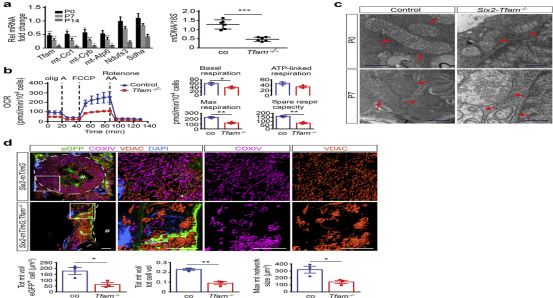
Figure 4| Tfam-/renal epithelium is characterized by progressive mitochondrial depletion. (a) Mitochondrial (mt) gene expression by quantitative polymerase chain reaction at age postnatal day (P)0,P7, and P14(fold change over control, n =6 each) and mt DNA content (P7)in total kidney homogenates from Cre~ littermate control (co) and Six2-Tfam-/mice. (b) Oxygen consumption rate (OCR) in primary proximal tubular epithelial cells (PTECs) isolated from Cre littermate control and Six2-7fam- kidneys at age P7 on a Seahorse XFe24 platform. Representative OCR measurements in control and Tfam-7PTECs treated with oligomycin A (oligo A, adenosine triphosphate [ATP] synthase inhibition), carbonyl cyanide-p-trifluoro methoxyphenyl hydrazone (FCCP, uncoupler), and inhibitors of oxidative phosphorylation rotenone and antimycin A(AA). Also shown are calculated basal and maximal respiration, ATP-linked respiration, and spare respiratory capacity (n =3 each). (c) Ultrastructural analysis of mitochondria by transmission electron microscopy. Representative transmission electron microscopic images of kidney sections from Cre- control and Six2-Tfam-7mice at age P0 and P7, Red arrows depict mitochondria. Bar = 500 nm. (d) Three-dimensional structured illumination microscopy images of kidney sections from Six2-mT/mG (co) and Six2-mT/mG; Tfam-/-mice at age P7. Enhanced green fluorescent protein (eGFP), cytochrome c oxidase subunit 4(COXⅣ), and voltage-dependent anion-selective channel 1(VDAC were detected by immunofluorescence.4',6-diamidino-2-phenylindole (DAP) was used for nuclear staining (blue fluorescence). White dashed lines outline renal tubule in control and cyst lumen in the mutant kidney, and number signs depict tubular lumen in control or cyst lumen in the mutant kidney. The mt area was quantified with Imaris software (Oxford Instruments, Abingdon,UK; n =3 each). Total (tot) mt volume (vol) per eGFP-positive cell (25-40 cells/sample analyzed), the ratio of total mt volume per total cell volume, and the maximal (max) size of the mt network per cell. The mt network size was determined in a tubular cross-section with 5 cells per cross-section. Bars =4 um. Data are represented as mean± SEM and were analyzed by Student's t-test. *P<0.05,"*P<0.01,and***P<0.001, mt-Atp6, mitochondrially encoded ATP synthase membrane subunit 6; mt-Co1, mitochondrially encoded cytochrome c oxidase 1; mt-Cytb, mitochondrially encoded cytochrome B; Ndufs3, NADH: ubiquinone oxidoreductase core subunit S3; Sdha, succinate dehydrogenase complex flavoprotein subunit A; Tfam, mitochondrial transcription factor A. To optimize viewing of this image, please see the online version of this article at www.kidney-international.org.
TFAM(targeted mitochondrial transcription factor A) deficiency shifts renal epithelial metabolism toward glycolysis
PTECs in the kidney use fatty acid β-oxidation and OXPHOS for ATP generation and are gluconeogenetic.'°To gain additional insights into metabolic alterations associated with Tam inactivation, we performed RNA sequencing analysis of kid-neys from Six2-TFAM(targeted mitochondrial transcription factor A)-/~and Cre~ littermate control mice at age P7. We found that key regulatory genes involved in glycolysis, such as hexokinase 2(Hk2)and enolase 2(Eno2), were upregulated. In contrast, the expression of most genes involved in the tricarboxylic acid cycle was decreased (e.g, isocitrate dehydrogenase 1[Idh1), as was the expression of genes involved in fatty acid β-oxidation, such as acetyl coenzyme A acyltransferase 1B(Acaalb), medium-chain acyl-coenzyme A dehydrogenase(Acadm)(Figure 5a and b, Supplementary Figure S8). Consistent with decreased expression of genes involved in the tricarboxylic acid cycle control and mutant kidneys at age P7 using a Seahorse XFe24 platform(Agilent, Santa Clara, CA). Mutant PTECs were characterized by a significant increase in basal glycolysis (proton efflux rate = 117.4 ± 12.07 pmol/min for mutants and 73.34 ± 6.33 pmol/min for control, n=3, P = 0.0032) and a decrease in the ratio of mt oxygen consumption rate over glycolytic proton efflux rate from 0.73 ± 0.08 in the control to 0.34 ± 0.02 in mutant PTECs(n = 3,P = 0.0074). Taken together, these data indicate that TFAM(targeted mitochondrial transcription factor A)-/- epithelial cells had undergone a metabolic shift from OXPHOS and fatty acid β-oxidation toward glycolysis(Figure 5d).

Figure 5]Renal epithelial mitochondrial transcription factor A (TFAM) deficiency is associated with increased glycolysis and abnormal fatty acid metabolism. (a) Analysis of metabolic gene expression by RNA sequencing of whole-kidney cortex isolated from Six2-Tfam-/- and Cre-littermate control (co) mice at age postnatal day(P) 7 (n = 4 each). Shown are differentially regulated metabolic genes involved in glycolysis and the tricarboxylic acid cycle. Genes with a statistically significant increase in mRNA expression are shown in red, and genes with decreased expression are shown in green.(b) mRNA expression levels of selected differentially regulated genes by quantitative polymerase chain reaction (n = 4-6). (c) Altered fatty acid metabolism in Six2-7Tfam-7mutant mice. Representative images of oil red O stained kidney sections from Six2-Tfam-7and Cre- littermate control mice at age P14. Arrows point to oil red O-positive cells and number sian depicts cost. Bar = 10 um.(d) Glycolytic flux analysis of primary proximal tubular epithelial cells (PTECs)isolated from Cre littermate control and Six2-Tfam-/kidneys at age P7 (n = 4 each) on a Seahorse XFe24 platform. Shown are representative measurements of glycolytic proton efflux rate (glyco PER) in control and Tfam-7PTECs treated with 2-deoxyglucose (2-DG) and oxidative phosphorylation inhibitors rotenone and antimycin A(AA). Also shown are average glyco PER at baseline and the ratio of mitochondrial (mt) oxygen consumption rate(OCR) over glyco PER. Data are represented as mean ± SEM and were analyzed using the Student's t-test. (Continued)
Reduced TFAM(targeted mitochondrial transcription factor A) expression in murine and human PKD tissues is associated with mt depletion
Because Six2-TFAM(targeted mitochondrial transcription factor A)-/ kidneys bore a strong resemblance to PKD kidneys, we next assessed whether TFAM(targeted mitochondrial transcription factor A) was dysregulated in PKD tissues. We first examined TFAM(targeted mitochondrial transcription factor A) and TFAM-regulated gene expression in 2 well-established genetic PKD mouse models. TFAM(targeted mitochondrial transcription factor A) mRNA levels were significantly reduced in whole-kidney homogenates from Pkd1-/- and Cyspk/pk mice, which carry mutations in either Pkd1 or Cys1. This was associated with a decrease in the expression of mitochondrially and nuclear-encoded mt genes as well as dysregulated glycolytic gene expression. Similar to Six2-TFAM(targeted mitochondrial transcription factor A)-/kidneys, Pkd1-7 and CysPkpk kidneys were characterized by elevated Eno2 and Hk2 and significantly decreased phosphoglycerate kinase (Pkg)1, pyruvate dehydrogenase kinase(Pdk)1, and Pdk4 transcript levels(Figure 6a). TFAM(targeted mitochondrial transcription factor A) protein expression, as assessed by IF staining, was reduced in cyst lining epithelial cells compared with epithelial cells from adjacent non-cystic tubules(Figure 6b). This was associated with reduced mt-Co1 and mt-Atp6 expression by RNA fluorescence in situ hybridization(Figure 6b, Supplementary Figure S9); mt volume, as determined by 3D SIM, was reduced by 55% compared with either epithelial cells from adjacent, non-cystic tubules or PTECs from normal control kidneys. Differences in mt vol-ume between normal control PTECs and PTECs from non-cystic tubules were not found (Figure 6c).

Figure 6| Mitochondrial transcription factor A (TFAM) expression is reduced in Pkd1-7-and CysPkepk renal cysts. (a)Relative mRNA expression levels (fold change over Cre littermate control) of mitochondrially and nuclear-encoded mitochondrial and glycolytic genes in Pkd1-7and Cyskidneys (n = 3-5).(b)Representative images of kidney sections from Pkd1-7and littermate control mice analyzed at age postnatal day (P)22. Shown are immunofluorescence (IF)staining for TFAM and RNA fluorescent in situ hybridization (RNA-FISH) for mitochondrially encoded cytochrome c oxidase 1(mt-Co1) and mitochondrially encoded ATP synthase membrane subunit 6 (mt-Atp6)transcripts. White arrows identify cyst lining epithelial cells with strongly reduced TFAM, mt-Co1, or mt-Atp6 expression. Glomeruli are marked by gl. TFAM-expressing tubular structures are identified by red fluorescence. Asterisks depict tubular epithelial cells with detectable mt-Co1 and mt-Atp6 transcripts.4',6-diamidino-2-phenyindole (DAPI) was used for nuclear staining (blue fluorescence). Bars = 25 um for IF images and 10 μm for RNA-FISH images. (c) Three-dimensional structured illumination microscopy. Shown are images of kidney sections from Pkd1-7-kidneys analyzed by histochemistry with lotus tetragonolobus lectin (LTL) and IF for cytochrome c oxidase subunit 4 (COXIV) and voltage-dependent anion-selective channel 1(VDAC) expression. Mitochondrial (mt) volume was quantified with Imaris software based on COXIV staining. Arrows depict cyst lining epithelial cells, number signs depict cyst lumina, and asterisks depict non-cystic tubules. Cyst lining epithelial cells are outlined by dashed lines. Bars = 10 μm for the left panel and 3 μum for the right panel. Data are represented as mean ± SEM and were analyzed using the Student's t-test *P<0.05,**P<0.01, and **P<0.001.Eno2, enolase 2; Hk2, hexokinase 2; mt-Cytb, mitochondrially encoded cytochrome B: Ndufs3. NADHubiguinone oxidoreductase core subunit S3; Pdk1, pyruvate dehydrogenase kinase 1; Pdk4.pyruvate dehydrogenase kinase 4; Ppargc1a, peroxisome proliferator-activated receptor gamma coactivator 1-alpha: Pgk1, phosphoglycerate kinase 1: PTEC, proximal tubule epithelial cell; Sudha, succinate dehydrogenase complex flavoprotein subunit A. To optimize viewing of this image, please see the online version of this article at www.kidney-international.org.
To examine whether the loss of TFAM(targeted mitochondrial transcription factor A) expression is a common molecular feature of human PKD, we analyzed nephrectomy specimens from 5 ADPKD patients by immunohistochemistry, IF staining, RNA fluorescence in situ hybridization, and 3D SIM. Reduced TFAM(targeted mitochondrial transcription factor A) expression was observed in 75.2% ± 7.5% of renal cysts analyzed by immunohistochemistry. This was associated with a decreased expression of MT-CO1 and MT-ATP6 by RNA fluorescence in situ hybridization(Figure 7a, Supplementary Figure S10); mt volume in cyst lining epithelial cells was diminished by approximately 70% as assessed by 3D SIM(Figure 7b). Taken together, the analysis of 2 PKD mouse models and human ADPKD tissues suggested that TFAM(targeted mitochondrial transcription factor A) deficiency and mt depletion are common findings in PKD tissues and are likely to impact the pathogenesis of the renal cystic disease.

Figure 7| Mitochondrial transcription factor A (TFAM) expression in renal cysts from patients with polycystic kidney disease is reduced. (a)Representative images of formalin-fixed paraffin-embedded sections from normal human kidneys and kidneys from polycystic kidney disease(PKD)patients analyzed by immunohistochemistry for TFAM expression, by immunofluorescence (IF) for voltage-dependent anion-selective channel 1(VDAC) expression, and by RNA fluorescent in situ hybridization for mitochondrially encoded cytochrome c oxidase 1(MT-CO1) and mitochondrially encoded ATP synthase membrane subunit 6(MT-ATP6) mRNA expression, Arrows identify cyst lining epithelial cells, number signs depict cyst lumina, and asterisks depict glomeruli. Bar = 100 μm for low-magnification images and 10 um for high-magnification images (b)Representative 3-dimensional structured illumination microscopic images of human PKD kidney sections analyzed with IF for VDAC expression.4',6-diamidino-2-phenylindole (DAPl) was used for nuclear staining (blue fluorescence). Dashed lines mark tubules, and number signs depict tubular or cyst lumina. Mitochondrial (mt) volume was quantified using Imaris software (n = 5). Bar =4 μm.Data are represented as mean ± SEM and were analyzed using the Student's t test.*P<0.05. To optimize viewing of this image, please see the online version of this article at www.kidney-international.org.