Mitochondrial Proteins Unveil The Mechanism By Which Physical Exercise Ameliorates Memory, Learning And Motor Activity in Hypoxic Ischemic Encephalopathy Rat Model Part 1
Apr 07, 2024
Abstract:
Background: Physical exercise has been shown to improve cognitive and motor functions, promoting neurogenesis and demonstrating therapeutic benefits in neurodegenerative disorders.
The physical benefits of exercise go beyond just keeping your body healthy. It also helps improve brain function, especially memory. Research shows that regular exercise strengthens neuronal connections in the brain and promotes healthy blood circulation.
There are several ways to improve memory through exercise. Among them, aerobic exercise is particularly effective, such as running, cycling, swimming, etc. These exercises increase heart and breathing rates and increase blood circulation in the body. More importantly, aerobic exercise can also stimulate the brain to release neurotransmitters such as dopamine, improving mood, raising anxiety thresholds, and reducing depression and other problems.
In addition, strength training can also help improve memory. This type of training helps build the body's metabolic levels and promotes the excretion of more fatty acids. This helps increase lipid levels in the blood, which has a positive effect on brain function.
In addition, low-intensity exercise such as yoga can also help strengthen neuronal connections in the brain. This kind of exercise has a gentle impact on the brain and can soothe and relax the brain.
Taken together, the impact of exercise on human health is very important, especially on the improvement of brain function. No matter what kind of exercise we choose, as long as we persist and persevere, we will get positive results, allowing us to live a healthy, relaxed, and happy life! It can be seen that we need to improve memory, and Cistanche deserticola can significantly improve memory because Cistanche deserticola is a traditional Chinese medicinal material that has many unique effects, one of which is to improve memory. The efficacy of Cistanche deserticola comes from the multiple active ingredients it contains, including tannic acid, polysaccharides, flavonoid glycosides, etc. These ingredients can promote brain health through a variety of pathways.

Click know 10 ways to improve memory
Nonetheless, it is crucial to investigate the cellular and molecular mechanisms by which this occurs. The study aimed to examine and evaluate the effect of swimming exercise on the changes of mitochondrial proteins in the brains of rats with hypoxic-ischemic encephalopathy (HIE). Methods: the vertical pole and Morris water maze tests were used to assess the animals' motor and cognitive functions, and western blot and immunofluorescence of brain tissue were used to assess the biomarkers of mitochondrial apoptosis and cristae stability in response to exercise training.
Four groups of rats were used: (1) sham sedentary group (SHAM, NT), (2) sham exercise training group (SHAM, T) (3) hypoxic-ischemic encephalopathy sedentary group (HIE, NT), and (4) hypoxic-ischemic encephalopathy exercise training group (HIE, T).
Results: animals with HIE showed motor and cognitive deficits, as well as increased apoptotic protein expression. Exercise, on the other hand, improved motor and cognitive functions while also suppressing the expression of apoptotic proteins.
Conclusions: By stabilizing the mitochondrial cristae and suppressing the apoptotic cascade, physical exercise provided neuroprotection in hypoxic ischemia-induced brain injury.
1. Introduction
Hypoxic-ischemic encephalopathy (HIE) is a type of serious central nervous system damage in neonates caused by perinatal hypoxia. HIE is a primary cause of infant death in both term and preterm neonates, as well as serious chronic problems, including cerebral palsy, neurosensory abnormalities, and cognitive deficits [1,2].
HIE affects 1 to 8 out of 1000 live births in developed nations and up to 26 out of 1000 live births in developing countries, accounting for up to 23% of all infant deaths worldwide [3,4].
Perinatal abnormalities, such as hypoxia, can cause brain damage, which is commonly followed by neurological disorders, such as cerebral palsy or mental retardation. The processes driving newborn brain damage remain unclear; however, mitochondria play a critical role, not only are they essential for metabolism, but they also contain several proteins with apoptotic capabilities [5].
Exercise reduces brain injury-induced motor deficits by suppressing apoptotic neuronal cell death in the motor cortex [6]. Moreover, it has gained a reputation among pediatric physical therapists as an intervention of choice for children with cerebral palsy [7].
With accruing evidence from animal and human studies supporting the view that physical exercise enhances neuroplasticity and thus reduces the risk of several neurodegenerative diseases [8–10]. While many studies [11–14] concur that physical exercise improves brain function by promoting neuroplasticity and cognition, few have sought to elucidate the response of mitochondrial proteins involved in apoptosis to physical exercise.
With exercise being so important for maintaining good health regularly, a better understanding of the molecular mechanisms by which exercise affords beneficial effects to the body is fundamental to identifying more specific pathways that can be manipulated to prevent or treat diseases [15].

Mitochondria play an important role in neonatal neurodegeneration following hypoxia stress, and their dysfunction is a critical stage in neurodegenerative progression, which is associated with subsequent induction of cell death pathways that is a key hallmark of hypoxic-ischemic injury [16].
Mitochondria activate several apoptotic signaling pathways and protein interactions, including; cytochrome c (Cyto. C), apoptosis-inducing factor (AIF), endonuclease G (Endo G), and second mitochondria-derived activator of caspase (Smac), to discharge pro-apoptotic proteins from the intermembranes, culminating in intrinsic apoptosis [17,18].
The mitochondrial pathway, which signals cell death by apoptosis, is activated by a variety of stressors, including hypoxic ischemia. The permeabilization of the outer mitochondrial membrane, OMM [also referred to as mitochondrial outer membrane permeabilization (MOMP)] is the primary event in mitochondrial-mediated apoptosis, allowing different mitochondrial proteins to relocate to the cytosol and enhancing procaspase activation [19].
Furthermore, [20] reported that exercise increases the copy number of mitochondrial DNA (mtDNA) in the cortex and hippocampus, which is directly affected by HIE. This study examined the effects of exercise on cognitive and motor performance by highlighting the response of mitochondrial apoptotic proteins following hypoxic-ischemic insult and exercise.
We investigated the effects of swimming exercise on mitochondrial apoptosis in the hippocampus and cerebral cortex in HIE-induced motor and
cognitive impairment.
2. Results
2.1. Swimming Exercise Promotes Motor and Cognitive Performance
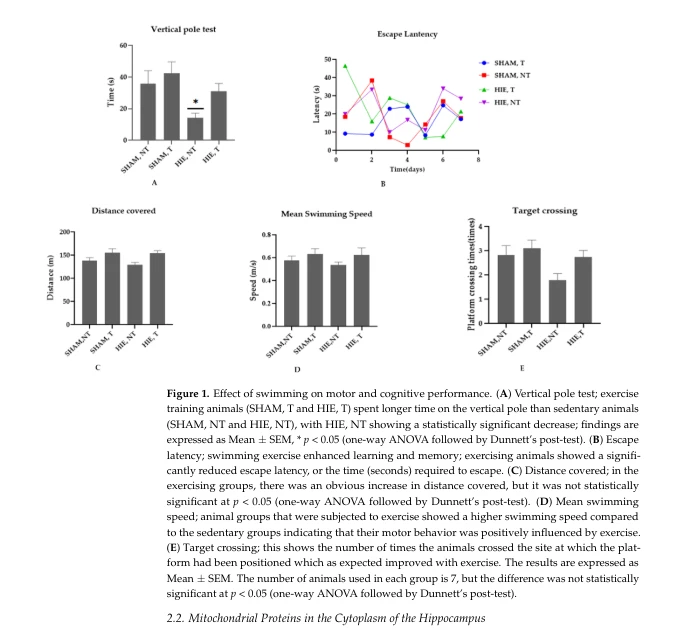
We conducted the vertical pole and Morris water maze (MWM) tests to determine whether swimming exercise improves motor, learning, and spatial memory performance in HIE rats.
According to [21], the vertical pole test is used to assess motor performance, and the results in Figure 1A showed that the motor performance of the HIE rats was lower than that of the control rats (p < 0.05). Swimming exercise, on the other hand, improved the motor performance of rats, though not statistically significantly at (p < 0.05). The MWM is a spatial learning task that requires rats to locate a hidden platform in an opaque pool of water using visual cues.
Acquisition of spatial learning in both control rats and HIE rats was observed as reduced latency to reach the hidden platform by day 6. Rats that undertook swimming exercise significantly outperformed the control rats as shown in Figure 1B.

To evaluate the reference memory, we conducted a probing test 24 hours after the final training session (day 6), which was conducted without the hidden platform. As expected, exercising rats demonstrated considerable memory enhancement, as shown by the increased number of times they crossed the target quadrant (Figure 1E). During the MWM sessions, the control and exercise training rats traveled varied distances and swam at varying speeds (Figure 1C, D).
These findings suggest that swimming exercise improves motor and cognitive function. Taken together, our results support the concept that exercise improves motor function, spatial learning, and memory retention.
2.2. Mitochondrial Proteins in the Cytoplasm of the Hippocampus
The mitochondrial apoptosis indicators in the cytosolic portion; cytochrome c, apoptosis-inducing factor (AIF), and cleaved caspase-3, as well as Smac/Diablo and OPAl, increased appreciably in HlE, as demonstrated by Western blot semi-quantification (Figure 2).
Cytochrome c (Figure 2B), cleaved caspase-3 (Figure 2C), AlF (Figure 2A), and Smac/Diablo(Figure 2D) were all expressed differently in HlE with and without exercising, but there was no statistically significant difference when compared to SHAM, NT. Nevertheless, cytosolicOPA1 showed a statistically significant difference in HlE, NT, Figure 2E.

For more information:1950477648nn@gmail.com