Part 1: The prevalence of Pain among patients with Chronic Kidney Disease using systematic review and meta-analysis
Mar 10, 2022
Contact: joanna.jia@wecistanche.com / WhatsApp: 008618081934791
Emilie Lambourg1, Lesley Colvin1, Greg Guthrie2, Kiruthikka Murugan2, Michelle Lim1, Heather Walker1,2, Georgia Boon2, and Samira Bell1,2
1Division of Population Health and Genomics, Medical Research Institute, University of Dundee, Dundee, UK; and 2Renal Unit, Ninewells Hospital, Dundee, UK
Pain is a common but often undertreated symptom in patients with chronic kidney disease with a much higher prevalence than in the general population.
This systematic review aimed to synthesize all available quantitative evidence, to gain a better understanding of pain prevalence and pain types in patients with chronic kidney disease. Four databases and the grey literature were searched until 15th January 2021. Random-effect meta-analyses were conducted with multiple subgroup analyses and meta-regressions to further explore the between-study heterogeneity.
The quality of studies included was assessed using the Newcastle-Ottawa Scale and the level of evidence was determined using the GRADE approach. One hundred sixteen studies reported data on 40,678 individuals.
Results from meta-analyses yielded an overall prevalence of 60% (95% confidence interval 56-64) for pain, 48%
(42-55) for chronic pain and 10% (6-15) for neuropathic pain. The prevalence of pain was lower among kidney transplant recipients 46% (37-56) compared with patients undergoing dialysis 63% (57-68) and those with non-dialysis chronic kidney disease 63% (55-70). Musculoskeletal pain appeared to be the most common pain symptom among patients with chronic kidney disease managed conservatively 42% (28-56) or receiving dialysis 45% (36-55) whilst abdominal pain was most prevalent in kidney transplant recipients 41% (7-86). Thus, all subgroups of patients with chronic kidney disease suffer from a high burden of pain. Hence, greater awareness and recognition of this issue is vital to inform policy and service provision in this area.
KEYWORDS: cistanche, chronic kidney disease, pain, dialysis.
Copyright ª 2021, International Society of Nephrology. Published by Elsevier Inc. This is an open-access article under the CC BY-NC-ND license.

cistanche can treat kidney disease improve renal function
There is a growing body of evidence showing that pain is among the most common symptoms experienced by individuals with chronic kidney disease, but little is known about the specific types of pain in this population.1 Moreover, in clinical practice, there is a lack of recognition by health care providers leading to under-reporting and undertreatment of pain in this population.2 Chronic pain results in a further reduction in the quality of life3 with associated insomnia, depression,4 decreases in daily activities and social interactions, isolation, reduced survival, and higher use of other medical resources leading to major health care costs and risk of dialysis withdrawal. Overall, the prevalence of pain in patients undergoing kidney replacement therapy is thought to range between 40% and 60%.5 However, there are currently no reliable overall prevalence estimates of the different types of pain in the various chronic kidney disease subgroups as quantitative syntheses of chronic pain are scarce, especially among kidney transplant recipients (KTRs) and patients managed conservatively. Moreover, the recently increasing number of publications in this field report highly variable pain prevalence measures.6 Almutary et al.7 reviewed the burden of symptoms experienced by patients with chronic kidney disease grades 4 and 5, including dialysis and conservative management. They identified pain as one of the most common symptoms along with fatigue, pruritus, dry skin, and drowsiness, with prevalence measures ranging from 38% to 90% and a weighted mean of 65%. Brkovic et al.6 examined the prevalence and severity of pain in a systematic review of patients undergoing hemodialysis, with measurements ranging between 33% and 82% for chronic pain and 21% and 92% for acute pain. However, neither meta-analysis nor metaregression was conducted.6 They acknowledged important heterogeneity in their results, recommending further exploration of the factors underlying this diversity. These inconclusive findings are likely to be explained by the large variation in pain types and sites studied, the lack of standardization in pain definitions and assessment scales, and the heterogeneity of the chronic kidney disease population about their treatment options (conservative management with or without palliative care, dialysis, kidney transplantation).
This systematic review aims to obtain up-to-date population-based estimates of the prevalence of various pain types in the different subgroups constituting the population of patients with chronic kidney disease (non-dialysis, dialysis, KTRs, palliative care) and to better understand the heterogeneity reported in previous systematic reviews, via stratified meta-analyses and meta-regressions.

Pain is the most common symptom of kidney disease symptoms. Cistanche can release the pain.
METHODS
This study was conducted following the Preferred Reporting Items for Systematic Reviews and Meta-Analyses (PRISMA) guidelines. The protocol was registered and published on PROSPERO (CRD42019156491).8 This article reports the first outcome out of the 3 stated in the protocol.
Data sources and searches
Electronic searches (from inception to January 15, 2021) of MED- LINE/PubMed, Embase, Cochrane Register for Controlled Trials (CENTRAL), and Cumulative Index of Nursing and Allied Health (CINAHL) were conducted. The search strategies combined free text words and medical subject heading (MeSH) terms (Supplementary Table S1). Only articles available in French or English languages were considered. Reference lists of systematic reviews and short-listed studies were manually searched to identify additional citations that could have been missed. The gray literature also supplemented the results to cover the topic as extensively as possible. Contact was made with the authors when additional details were required to ensure the suitability of the study or to gather supplementary data.
Study selection
All records were screened based on their title and abstract by 2 different reviewers (EL and GB) who were blinded to each other, using the online platform Rayyan.9 Conflict was resolved by a third author (SB). Reviewers then proceeded to the full-text assessment of potentially relevant articles against the following predefined inclusion/exclusion criteria.
Inclusion criteria. Studies in French or English language that reported (or allowed for calculation of) a prevalence of general or site-specific pain in participants with chronic kidney disease aged 18 years or older were included. Patients with chronic kidney disease were defined as individuals with an estimated glomerular filtration rate (eGFR) < 60 ml/min per 1.73 m2 (or eGFR categories G3 to G5 in the CGA staging [i.e., identify the cause of chronic kidney disease {C}, assign GFR category {G}, assign albuminuria category {A}]) for over 3 months or more, irrespective of cause, by the National Kidney Foundation Kidney Disease Outcomes Quality Initiative (NKF K/DOQI) definition.10,11 Studies investigating pain among KTRs, irrespective of their eGFR measurement, and patients undergoing dialysis (hemodialysis or peritoneal dialysis) were also included. Observational studies were included without any restriction on their design (cross-sectional, case-control, or cohort studies). Clinical trials were also included if a baseline prevalence of pain in the sample before the implementation of any intervention could be retrieved. Data from the gray literature such as conference abstracts and posters were also included to limit the risk of publication bias.
Exclusion criteria.
Studies were excluded if they met any of the following criteria: studies investigating acute pain related to specific procedures, such as postoperative or intradialytic pain; studies reporting on individuals <18 years old; and those including patients with an eGFR > 60 ml/min per 1.73 m2. Case reports, case series, book chapters, reviews, and personal opinions were also systematically excluded.
Pain definitions.
Studies reporting a prevalence of pain without any specification (not qualified as chronic, neuropathic, or site-specific) were included in the “pain” category, independently of the recall period assessed (e.g., current pain, pain over the past 3 days, past week, past month). Studies labeling their outcome “chronic pain” or investigating pain lasting >3 months were categorized as “chronic pain,” by the new International Classification of Diseases–11th Revision classification. 12 Studies labeled their outcome “neuropathic pain,” “neuralgia,” “neuropathic cause of pain,” or “painful peripheral neuropathy” were classified in the neuropathic pain category. Studies on peripheral neuropathy such as diabetic neuropathy were excluded if it was not specified as painful. The musculoskeletal pain category included studies reporting pain affecting the bones, joints, muscles, or related soft tissues. The headache category included pain in the head but also in the back of the upper neck. Abdominal pain and chest pain were differentiated and reported in 2 different categories. Abdominal pain included upper and lower abdominal pain, uncomfortable bloating, stomach pain, pain or burning sensations related to gastroesophageal reflux disease, and discomfort related to constipation or diarrhea. Chest pain included pain related to pulmonary or cardiovascular conditions such as angina but also benign musculoskeletal pain localized specifically in the chest wall area.
Data extraction
Data were extracted on a standardized Microsoft Excel spreadsheet specifically designed for the study and piloted beforehand on a small sample of the selected studies. The spreadsheet contained key characteristics of studies, selected according to the Population Intervention Comparison Outcome Study type (PICOS) principle.13,14 The detailed list of relevant items collected in the data extraction spreadsheet is available in Supplementary Material S1.
Data were fully extracted by 1 author (EL). However, for outcome data, an independent duplicate extraction was performed by another reviewer (KM), as recommended in the Cochrane handbook.15 Disagreement was resolved by discussion and consensus with a third reviewer (SB).

Cistanche can release the pain.
Risk of bias assessment
Two reviewers (EL and KM) working independently evaluated the risk of bias at the study level using the Newcastle-Ottawa scale,16 a tool specifically designed to assess the quality of nonrandomized studies. Its “star system” enables us to assign an overall study quality (low, moderate, or high) after evaluating the risk of bias across 3 domains: selection bias, confounding, and outcome measurement bias. Before performing a quality appraisal, the scale was customized to specifically assess studies measuring the prevalence of pain in the chronic kidney disease population. This adaptation was based on the team's knowledge in the fields of pain and nephrology, as well as on published guidelines for prevalence studies evaluation.17 Details of the scale are provided in Supplementary Material S2. Exclusion of low-quality studies only took place when performing sensitivity analyses to explore the result's heterogeneity. Otherwise, following Glass's approach,18 all studies were retained, independently of their quality.
Publication bias
Funnel plots specifically adapted to proportion data were built to detect “small-study effect.” They represent the logit-transformed prevalence, for its better statistical properties, against a measure of precision chosen here as the standard error. Their asymmetry was tested using Egger's (linear regression method) and Begg's (rank correlation method) tests. However, it should be kept in mind that traditional publication bias assessment tools are designed for comparative studies reporting effect size results along with a significance level and not for observational studies reporting single proportions.19
Data synthesis and analysis
Multiple meta-analyses were conducted according to pain types with 3 different outcomes for general pain—pain, chronic pain, neuro- pathic pain—and 5 supplementary outcomes for pain affecting specific body sites—headache, chest pain, musculoskeletal pain, abdominal pain, and fibromyalgia. Meta-regressions investigating the role of patients' baseline characteristics and meta-analyses stratified by chronic kidney disease management strategies, risk of bias, and geographic location were planned a priori. Meta-analyses stratified by pain assessment scales, dialysis modality, and chronic kidney disease stages were data-driven.
When a single study simultaneously reported a prevalence of pain in groups of patients characterized by different chronic kidney disease management strategies, they were included in the same stratified meta-analysis as separate estimates. Between-study heterogeneity was assessed by Higgin and Thompson I2. I2 can compare the heterogeneity between sub-groups and between meta-analyses of different sizes, suiting the strat- ified design of our analyses. It is considered that an I2 value above the 75% threshold describes a high level of heterogeneity.20 To explore the heterogeneity, uni-and multivariate meta-regression were conducted with various patients' baseline characteristics as predictors. Specifically, the influence of sex, age, ethnicity, body mass index (BMI), diabetes, and hypertension were investigated on prevalence estimates.
Sensitivity analyses
Several sensitivity analyses were also performed to further investigate the observed heterogeneity in results. Specifically, we explored the influence of geographic area and pain assessment scales. The methods and results of those analyses are described in Supplementary Material S3.
Statistical analysis
All statistical analyses were conducted using R software version 3.5.2 (R Foundation). Meta-analyses pooling prevalence data were performed using the meta prop function from R package “meta”21 and the results obtained were displayed in forest plots. All meta-analyses were undertaken using random-effect models, as the assumption was made that pain prevalence would vary between sample populations arising from different countries, health care centers, and socioeconomic areas. A generalized linear mixed model approach was adopted. This method, considered a promising alternative to the Freeman-Tukey double arcsine transformation, has recently been recommended for meta-analyses of single proportions.22 The model was built with a maximum likelihood estimator and the Q-profile to estimate tau and its confidence interval (CI), as recommended by Veronika. The Hartung-Knapp method was systematically implemented to adjust the confidence interval of the overall estimate.23
Level of evidence
As recommended by Cochrane, the certainty of available evidence was evaluated according to the Grading of Recommendations Assessment, Development and Evaluation (GRADE) criteria. Using the online software GradePro,24 the assessment was based on study design, consistency, directness, risk of bias, precision, and publication bias. For each outcome, the level of evidence was characterized as high, moderate, low, or very low.

Pain is a common symptom in patients with chronic kidney disease, cistanche can avoid the pain.
RESULTS
Characteristics of studies included
Our electronic search of MEDLINE, Embase, CENTRAL, and CINAHL yielded 7754 articles, complemented by 34 records from the gray literature. A total of 116 studies met our inclusion criteria, including a total of 40,678 participants in 38 different countries across the 5 continents. The United States and the United Kingdom were the highest data providers with 30 articles arising from those 2 countries (United States: n 18; United Kingdom: n 12). Overall, there were 30% (n 35) investigating pain on <100 patients and only 9% (n 10) assessing pain on >1000 patients. A flow diagram details the selection process (Figure 1) while the precise number of studies and participants by the outcome is available in Supplementary Table S2. Baseline characteristics of the 71 studies investigating pain, chronic pain, or neuropathic pain are presented in Supplementary Tables S3, S4, and S5, respectively. Supplementary Tables S6–S10 present the main characteristics of the 45 additional studies focusing on the pain in specific body sites.

Pain
Figure 2 displays the forest-plot pooling 57 studies reporting a prevalence of pain among a total of nearly 20,000 participants, stratified by chronic kidney disease management strategy. Fifty-eight studies were eligible, but 1 was excluded from meta-ana-lyses25 due to the high threshold chosen by the authors to determine a clinically significant pain (score ≤50 on the 36- Item Short Form Survey), excluding all patients experiencing mild pain and a large part of those with moderate pain. Prevalence estimates ranged from 29% in a sample of KTRs in the United Kingdom to 90% among patients with chronic kidney disease G5 treated conservatively in a palliative care unit. The mean prevalence of pain was 60% (95% CI: 56%–64%), I2 96%. The dialysis group was the most widely investigated and dis- played the highest prevalence of pain, estimated at 63% (95% CI: 57%–68%). Although the burden of pain remained substantial among KTRs.

There are many specific types of pain in the chronic kidney disease stages. Cistanche is a Chinese traditional medicine to relieve pain.
we observed a significantly lower prevalence (46%; 95% CI: 37%–56%) compared with patients with chronic kidney disease non-dialysis (63%; 95% CI: 55%–70%) and those undergoing dialysis (63%; 95% CI: 57%–68%), c2 test for subgroup differences P < 0.01.


Prevalence of pain was further stratified by dialysis modality (hemodialysis or peritoneal dialysis) in the dialysis subgroup and by chronic kidney disease stage (3, 4, or 5) in the chronic kidney disease non-dialysis subgroup.
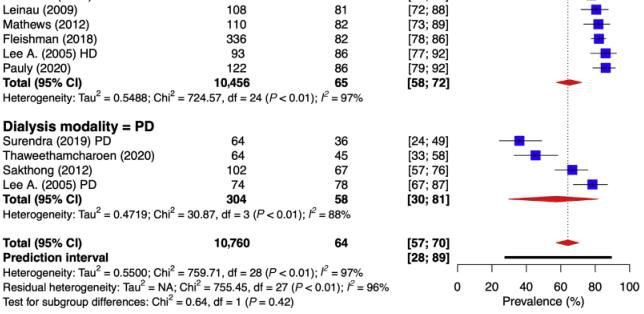
Our random-effect pooled estimates showed a similar prevalence of pain (c2 test for subgroup difference: P 0.42) among patients undergoing hemodialysis (65%; 95% CI: 58%–72%) or peritoneal dialysis (58%; 95% CI: 30%–81%) (Figure 3). Among patients with chronic kidney disease managed conservatively, the forest plot stratified by chronic kidney disease stages considerably decreased the between-study heterogeneity with an I2 down to 0% in the chronic kidney disease stage 3 and chronic kidney disease stage 4 subgroups, and to 17% in the chronic kidney disease stages 4–5 subgroup. Surprisingly, a lower prevalence of pain was associated with later chronic kidney disease stages (Figure 4a). However, we hypothesized that this could be related to the fact that the chronic kidney disease stage 5 subgroup was mainly constituted of studies conducted in palliative care settings where the pain is the main focus and its symptoms are more likely to be treated. Confirming our hypotheses, after removing palliative care studies of the chronic kidney disease stage 5 subgroup, the pain prevalence increased from 58% to 70% with no more difference across the various chronic kidney disease stages (Figure 4b). However, this suggests that patients with chronic kidney disease stage 3 or 4 are just as likely to suffer from pain as those with kidney failure managed conservatively.


Meta-regression models were fitted to further explore the heterogeneity. None of the tested covariates showed significance in the univariate analysis. However, age became sig- nificant (P 0.018; I2 89%) in the multivariate model accounting for sex, ethnicity, and the geographical area the study was from (Supplementary Table S11).


Chronic pain
Nineteen studies including 3859 participants were pooled (Figure 5), resulting in an overall random-effect prevalence of 48% (95% CI: 42%–55%). Once again, the largest number of studies (n 14) was in the dialysis subgroup, while the chronic kidney disease nondialysis and palliative care subgroups only composed a single study. Four studies assessed pain prevalence among KTRs, with estimates showing a relatively good consistency (I2 53%).



Two outlying studies were identified: a particularly low prevalence of chronic pain (21%) was reported in the only study conducted in palliative care settings.26 However, this is unsurprising as palliative care teams are likely to focus more on pain issues and their management. The other outlying prevalence measurement driving part of the heterogeneity was found in the dialysis subgroup.27 This study, conducted in a single clinic in Brazil, reported a very low prevalence of chronic pain (16%) among a sample of relatively young patients (mean age: 46.6, 12.3 years). As age was found to be significantly associated with pain in our multivariate model (see the previous section), the exclusion of patients >65 years old could explain the lower prevalence of pain obtained by the authors. The I2 value was down to 77% in the dialysis subgroup and 89% overall, after the exclusion of this study (Supplementary Figure S1). Metaregression analyses did not uncover any significant association with the covariates tested (Supplementary Table S11).
Click HERE for Part 2