Part 2:Atorvastatin Has A Dose-Dependent Beneficial Effect On Kidney Function And Associated Cardiovascular Outcomes: Post Hoc Analysis Of 6 Double-Blind Randomized Controlled Trials
Mar 16, 2022
Contact: joanna.jia@wecistanche.com / WhatsApp: 008618081934791
Discussion
This large-scale post hoc analysis including individual data from 6 long-term cardiovascular outcome trials demonstrates that in patients at risk or with CVD, atorvastatin modestly improves kidney function over time in a dose-dependent manner. In addition, this analysis shows that kidney function improvement is strongly associated with lower cardiovascular risk independent of treatment, whereas a decrease in kidney function is associated with worse cardiovascular outcomes. For each SD increment of the slope of kidney function, we observed a 13% to 14% reduction in major cardiovascular events and cardiovascular mortality while being treated with atorvastatin (either 10 or 80 mg daily).

Our data, therefore, indicate that efficacy of cardiovascular protection over the long term obtained with atorvastatin is reflected by effects on the course of kidney function over time. In addition, our results emphasize the bidirectional connection between the cardiovascular system and the kidneys (ie, the cardiorenal axis) in treating cardiovascular disease. This implies that both CVD reduction and renoprotection are achieved by treating patients at risk or with CVD with atorvastatin. Vice versa, a renoprotective strategy, as represented by atorvastatin treatment according to our data, translates into better cardiovascular risk management. In daily clinical practice, one may therefore consider incorporating kidney function trajectories as a readout for the success of cardiovascular risk management regimens, in addition to control of traditional cardiovascular risk factors such as BP and lipid goals. So far, no adequately powered RCTs have tested the hypothesis that targeting the kidney function change over time may represent a cardiovascular risk factor subject to treatment.
Our results confirm the observations in other cohorts, where kidney function was also found to display a linear relationship over time. Somewhat surprisingly, the slopes in all 3 cohorts had a positive direction. It is known from other cardioprotective agents such as RAAS inhibitors that these drugs protect against kidney function decline, but these agents do not usually improve kidney function.6 Previous post

Figure 3. Effect of kidney function slope on cardiovascular (CV) outcomes and all-cause mortality (adjusted analysis). BMI indicates body mass index; DBP, diastolic blood pressure; HR, hazard ratio; LDL, low-density lipoprotein; RAAS, renin-angiotensin-aldosterone system; SBP, systolic blood pressure.
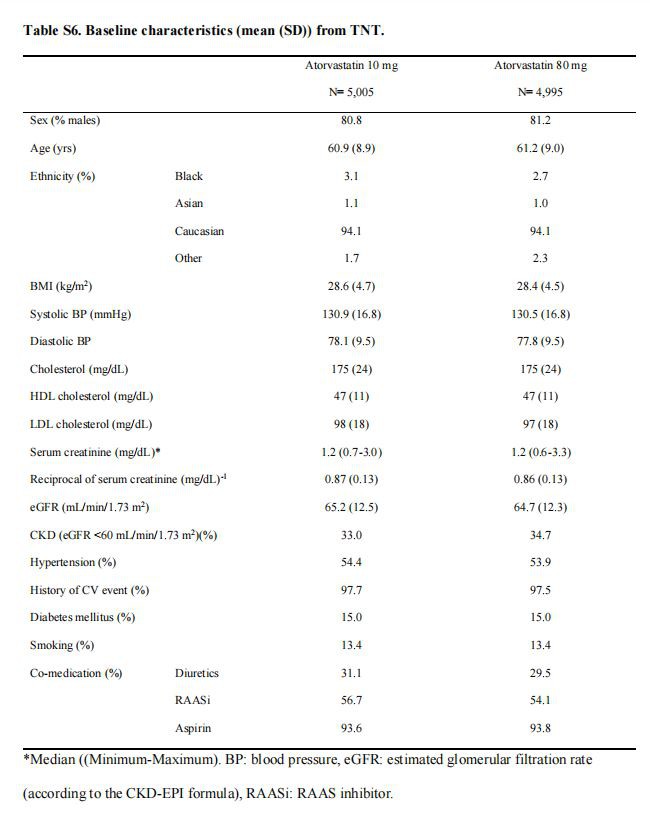
hot analyses of 2 RCTs (TNT and SPARCL, which were also included in the current analysis) have demonstrated that the average of eGFR increased during follow-up under atorvastatin treatment both in CKD and non-CKD patients.14,15 A limitation of these 2 analyses was that during follow-up the number of subjects declined, particularly in SPARCL.14 Therefore, non-random effects might have explained the overall eGFR increase, meaning that only the patients with better out-come—those randomized to the most effective treatment arm —remained in the trial, and those patients with worse eGFR were dropouts. In keeping with this, a closer look at the data from the post hoc analysis of SPARCL revealed that the eGFR change from baseline was less exaggerated when the “last observation carried forward” analysis, including all subjects (ie, a total of 4393 instead of 2169 subjects with complete eGFR data after 60-month follow-up), was performed.14 According to this analysis, eGFR remained stable in the high-dose atorvastatin arm while eGFR declined in the placebo group. 14 Our study was able to test the robustness of the renal results from the 2 previous post hoc analyses by combining all 6 outcome RCTs in which patients were randomized to atorvastatin or control treatment and by analyzing slopes of kidney function (using both reciprocal serum creatinine and eGFR values) instead of mean eGFR values at follow-up visits.
Because of the presumed linearity of slopes when an adequate number of creatinine values are used, the effect of atorvastatin on kidney function decline is subject to differences in follow-up duration and drop-out of patients to a much lesser extent. Yet, in our analysis, nonrandom effects related to the protective effect of atorvastatin might have accounted for eGFR improvement. We, therefore, performed additional sensitivity analyses by including only serum creatinine data while patients were still receiving the study drug, which gave very similar results to the main analysis. The possibility that nonrandom effects may have importantly influenced our results seems therefore unlikely, particularly in regard to comparisons among the 3 groups. Nonrandom effects may, however, have been responsible for the positive slopes observed in the patient group randomized to placebo.

Another explanation for improvement of kidney function over time might relate to changes in muscle mass because serum creatinine and eGFR (calculated by using serum creatinine) depend on muscle mass. Reduction of muscle mass, reflecting protein wasting, will lead to higher reciprocal creatinine values and higher eGFR. Yet, loss of muscle mass is usually associated with worse outcomes, which is in contrast to our observation that positive slopes were associated with a beneficial effect on cardiovascular outcomes.
Finally, the dose-dependent increase of slopes during atorvastatin therapy might relate to increments of creatine kinase activity associated with statin use. High creatine kinase activity may result in lower serum creatinine, higher eGFR, and higher urinary creatinine excretion—parameters that usually reflect increased muscle wasting. However, a recent cohort study in 1801 CKD patients demonstrated that high serum creatine kinase was not associated with more rapid progression to ESRD.27 In this study high serum creatine kinase was associated with more frequent use of statins, and correction for this potential confounder did influence the results. Therefore, both this study and our finding that a positive slope was also present in the placebo group indicate that muscle wasting does not seem not to be responsible for the unexpected changes in reciprocal serum creatinine slopes.
If changes in creatinine metabolism do not explain our findings, the question arises as to what the slope increment represents? CKD is associated with ventricular and vascular remodeling. The remodeling effects can be reversed by statin use, and that might, in turn, translate into better kidney function. Progressive kidney function decline has been related to subclinical atherosclerosis as well as to increased arterial inflammation.28 Atorvastatin has been shown to reverse these vascular alterations that contribute to elevated cardiovascular risk.29 As a consequence, further decline of kidney function might be prevented. Other possible mediators are oxidative stress and renal microvascular changes, which contribute to renal impairment but are beneficially influenced by statin treatment.30 Of note, these direct effects, beyond lipid-lowering efficacy, on the vasculature and the kidney, might not be present after treatment with all statins. The PLANET studies showed a distinct effect of atorvastatin versus rosuvastatin treatment. 11 Whereas atorvastatin 80 mg induced reduction of albuminuria and stabilization of eGFR, rosuvastatin led to higher albuminuria and decrement of eGFR.

Limitations
A number of limitations of our study need to be addressed. First, ideally, the presence of all 3 groups in an RCT would have reduced the large heterogeneity of the baseline characteristics, which was observed in our study due to the use of different sets of studies. Heterogeneous effects across studies on kidney function slope were observed, but the slopes were all in the same direction, indicating that the effect on kidney function was robust. Despite adjustments for baseline characteristics in our analyses, differences in patient characteristics among the trials might still explain to some extent why the size of the effect on slope differed. Second, the studies in this analysis included patients with preserved kidney function and a low risk of development of ESRD. Therefore, the changes in kidney function over time were very small and, thus, of limited value in daily clinical practice. Third, albuminuria is an important risk marker for progressive kidney function decline, but in our analysis, we could not evaluate albuminuria effects over time because this was not systemically assessed within the included trials. Finally, for the same reason, we were not able to handle time-varying covariates that influence slopes such as improvement of BP control or the introduction of RAS inhibitors in the follow-up of the 6 RCTs. In conclusion, our analysis shows that atorvastatin improves kidney function over time in a dose-dependent manner (ie, 80- mg versus 10-mg dose). In each of the treatment groups, it was shown that kidney function improvement is strongly associated with lower cardiovascular risk. These data support the notion that both the cardio- and vasculoprotective efficacies of a pharmacological agent are reflected by the course of kidney function over time. Although the changes were small, our data also suggest that this kidney-related parameter, and not only
LDL-cholesterol lowering might represent a surrogate endpoint for long-term outcomes in cardiovascular risk patients.
Acknowledgments
No assistance with content development or writing was provided, but support in preparing the figures was provided by Jon Edwards at Engage Scientific Solutions and was funded by Pfizer. The corresponding author had full access to all the data in the study and had final responsibility for the decision to submit for publication. None of the academic authors received any compensation for the work on this article.
Sources of Funding
This work includes 6 clinical trials (CARDS [ClinicalTrials.gov [NCT00327418]; SPARCL [NCT00147602]; TNT [NCT003 27691]; ASCOT; ASPEN; and SAGE) was sponsored by Pfizer.
Disclosures
Drs Fayyad, Laskey, and DeMicco are employees of Pfizer Inc (New York, NY). Dr. Waters has received honoraria for lectures and remuneration for participating in clinical trial committees from Merck Schering-Plough (Whitehouse Station, NJ) and Pfizer Inc. The remaining authors have no disclosures to report.

References
1. Go AS, Chertow GM, Fan D, McCulloch CE, Hsu CY. Chronic kidney disease and the risks of death, cardiovascular events, and hospitalization. N Engl J Med. 2004;351:1296– 1305.
2. Mitch WE, Walser M, Buffington GA, Lemann J Jr. A simple method of estimating progression of chronic renal failure. Lancet. 1976;2:1326– 1328.
3. Matsushita K, Selvin E, Bash LD, Franceschini N, Astor BC, Coresh J. Change in estimated GFR associates with coronary heart disease and mortality. J Am Soc Nephrol. 2009;20:2617–2624.Atorvastatin and Kidney Function Vogt et al
4. Coresh J, Turin TC, Matsushita K, Sang Y, Ballew SH, Appel LJ, Arima H, Chadban SJ, Cirillo M, Djurdjev O, Green JA, Heine GH, Inker LA, Irie F, Ishani A, Ix JH, Kovesdy CP, Marks A, Ohkubo T, Shalev V, Shankar A, Wen CP, de Jong PE, Iseki K, Stengel B, Gansevoort RT, Levey AS; For the CKD Prognosis Consortium. The decline in estimated glomerular filtration rate and subsequent risk of end-stage renal disease and mortality. JAMA. 2014;311:2518–2531.
5. Flack JM, Neaton JD, Daniels B, Esunge P. Ethnicity and renal disease: lessons from the Multiple Risk Factor Intervention Trial and the Treatment of Mild Hypertension Study. Am J Kidney Dis. 1993;21:31–40.
6. Holtkamp FA, de Zeeuw D, Thomas MC, Cooper ME, de Graeff PA, Hillege HJ, Parving HH, Brenner BM, Shahinfar S, Lambers Heerspink HJ. An acute fall in the estimated glomerular filtration rate during treatment with losartan predicts a slower decrease in long-term renal function. Kidney Int. 2011;80:282–287.
7. Baigent C, Landray MJ, Reith C, Emberson J, Wheeler DC, Tomson C, Wanner C, Krane V, Cass A, Craig J, Neal B, Jiang L, Hooi LS, Levin A, Agodoa L, Gaziano M, Kasiske B, Walker R, Massy ZA, Feldt-Rasmussen B, Krairittichai U, Ophascharoensuk V, Fellstrom B, Holdaas H, Tesar V, Wiecek A, Grobbee D, de Zeeuw D, Gronhagen-Riska C, Dasgupta T, Lewis D, Herrington W, Mafham M, Majoni W, Wallendszus K, Grimm R, Pedersen T, Tobert J, Armitage J, Baxter A, Bray C, Chen Y, Chen Z, Hill M, Knott C, Parish S, Simpson D, Sleight P, Young A, Collins R; SHARP Investigators. The effects of lowering LDL cholesterol with simvastatin plus ezetimibe in patients with chronic kidney disease (Study of Heart and Renal Protection): a randomized placebo-controlled trial. Lancet. 2011;377:2181–2192.
8. Waters DD. LDL-cholesterol lowering and renal outcomes. Curr Opin Lipidol. 2015;26:195– 199.
9. Sandhu S, Wiebe N, Fried LF, Tonelli M. Statins for improving renal outcomes: a meta-analysis. J Am Soc Nephrol. 2006;17:2006–2016.
10. Fassett RG, Robertson IK, Ball MJ, Geraghty DP, Cardinal JW, Coombes JS. Effects of atorvastatin on NGAL and cystatin C in chronic kidney disease: a post hoc analysis of the LORD trial. Nephrol Dial Transplant. 2012;27:182– 189.
11. de Zeeuw D, Anzalone DA, Cain VA, Cressman MD, Heerspink HJ, Molitoris BA, Monyak JT, Parving HH, Remuzzi G, Sowers JR, Vidt DG. Renal effects of atorvastatin and rosuvastatin in patients with diabetes who have progressive renal disease (PLANET I): a randomized clinical trial. Lancet Diabetes Endocrinol. 2015;3:181– 190.
12. Fassett RG, Robertson IK, Ball MJ, Geraghty DP, Coombes JS. Effect of atorvastatin on kidney function in chronic kidney disease: a randomized double-blind placebo-controlled trial. Atherosclerosis. 2010;213:218–224.
13. Tonelli M, Isles C, Craven T, Tonkin A, Pfeffer MA, Shepherd J, Sacks FM, Furberg C, Cobbe SM, Simes J, West M, Packard C, Curhan GC. Effect of pravastatin on the rate of kidney function loss in people with or at risk for coronary disease. Circulation. 2005;112:171– 178.
14. Amarenco P, Callahan A III, Campese VM, Goldstein LB, Hennerici MG, Messig M, Sillesen H, Welch KM, Wilson DJ, Zivin JA. Effect of high-dose atorvastatin on renal function in subjects with stroke or transient ischemic attack in the SPARCL trial. Stroke. 2014;45:2974–2982.
15. Shepherd J, Kastelein JJ, Bittner V, Deedwania P, Breazna A, Dobson S, Wilson DJ, Zuckerman A, Wenger NK; Treating to New Targets Investigators. Effect of intensive lipid-lowering with atorvastatin on renal function in patients with coronary heart disease: the Treating to New Targets (TNT) study. Clin J Am Soc Nephrol. 2007;2:1131– 1139.
16. Colhoun HM, Betteridge DJ, Durrington PN, Hitman GA, Neil HA, Livingstone SJ, Charlton-Menys V, DeMicco DA, Fuller JH; CARDS Investigators. Effects of atorvastatin on kidney outcomes and cardiovascular disease in patients with diabetes: an analysis from the Collaborative Atorvastatin Diabetes Study (CARDS). Am J Kidney Dis. 2009;54:810–819.
17. Amarenco P, Bogousslavsky J, Callahan A III, Goldstein LB, Hennerici M, Rudolph AE, Sillesen H, Simunovic L, Szarek M, Welch KM, Zivin JA; Stroke Prevention by Aggressive Reduction in Cholesterol Levels (SPARCL) Investigators. High-dose atorvastatin after stroke or transient ischemic attack. N Engl J Med. 2006;355:549–559.
18. Knopp RH, d’Emden M, Smilde JG, Pocock SJ. Efficacy and safety of atorvastatin in the prevention of cardiovascular endpoints in subjects with type 2 diabetes: the Atorvastatin Study for Prevention of Coronary Heart Disease Endpoints in Non-insulin-dependent diabetes mellitus (ASPEN). Diabetes Care. 2006;29:1478– 1485.
19. Colhoun HM, Betteridge DJ, Durrington PN, Hitman GA, Neil HA, Livingstone SJ, Thomason MJ, Mackness MI, Charlton-Menys V, Fuller JH; CARDS Investigators. Primary prevention of cardiovascular disease with atorvastatin in type 2 diabetes in the Collaborative Atorvastatin Diabetes Study (CARDS): a multicentre randomized placebo-controlled trial. Lancet. 2004;364: 685–696.
20. LaRosa JC, Grundy SM, Waters DD, Shear C, Barter P, Fruchart JC, Gotto AM, Greten H, Kastelein JJ, Shepherd J, Wenger NK; Treating to New Targets (TNT) Investigators. Intensive lipid lowering with atorvastatin in patients with stable coronary disease. N Engl J Med. 2005;352:1425– 1435.
21. Pedersen TR, Faergeman O, Kastelein JJ, Olsson AG, Tikkanen MJ, Holme I, Larsen ML, Bendiksen FS, Lindahl C, Szarek M, Tsai J; Incremental Decrease in End Points Through Aggressive Lipid Lowering Study Group. High-dose atorvastatin vs usual-dose simvastatin for secondary prevention after myocardial infarction: the IDEAL study: a randomized controlled trial. JAMA. 2005;294:2437–2445.
22. Sever PS, Dahlof B, Poulter NR, Wedel H, Beevers G, Caulfield M, Collins R, Kjeldsen SE, Kristinsson A, McInnes GT, Mehlsen J, Nieminen M, O’Brien E, Ostergren J; ASCOT Investigators. Prevention of coronary and stroke events with atorvastatin in hypertensive patients who have average or lower-than-average cholesterol concentrations, in the Anglo-Scandinavian Cardiac Outcomes Trial– Lipid Lowering Arm (ASCOT-LLA): a multicentre randomized controlled trial. Lancet. 2003;361:1149– 1158.
23. Deedwania P, Stone PH, Bairey Merz CN, Cosin-Aguilar J, Koylan N, Luo D, Ouyang P, Piotrowicz R, Schenck-Gustafsson K, Sellier P, Stein JH, Thompson PL, Tzivoni D. Effects of intensive versus moderate lipid-lowering therapy on myocardial ischemia in older patients with coronary heart disease: results of the Study Assessing Goals in the Elderly (SAGE). Circulation. 2007;115:700– 707.
24. Wanner C, Krane V, Marz W, Olschewski M, Mann JF, Ruf G, Ritz E; German Diabetes and Dialysis Study Investigators. Atorvastatin in patients with type2 diabetes mellitus undergoing hemodialysis. N Engl J Med. 2005;353:238– 248.
25. Koren MJ, Hunninghake DB; ALLIANCE Investigators. Clinical outcomes in managed-care patients with coronary heart disease treated aggressively in lipid-lowering disease management clinics: the ALLIANCE study. J Am Coll Cardiol. 2004;44:1772– 1779.
26. Torres VE, Chapman AB, Devuyst O, Gansevoort RT, Grantham JJ, Higashihara E, Perrone RD, Krasa HB, Ouyang J, Czerwiec FS; TEMPO 3:4 Trial Investigators. Tolvaptan in patients with autosomal dominant polycystic kidney disease. N Engl J Med. 2012;367:2407–2418.
27. Flahault A, Metzger M, Chasse JF, Haymann JP, Boffa JJ, Flamant M, Vrtovsnik F, Houllier P, Stengel B, Thervet E, Pallet N. Low serum creatine kinase level predicts mortality in patients with chronic kidney disease. PLoS One. 2016;11:e0156433.
28. Bernelot Moens SJ, Verweij SL, van der Valk FM, van Capelleveen JC, Kroon J, Versloot M, Verberne HJ, Marquering HA, Duivenvoorden R, Vogt L, Stroes ES. Arterial and cellular inflammation in patients with CKD. J Am Soc Nephrol. 2017;28:1278– 1285.
29. Tawakol A, Fayad ZA, Mogg R, Alon A, Klimas MT, Dansky H, Subramanian SS, Abdelbaky A, Rudd JH, Farkouh ME, Nunes IO, Beals CR, Shankar SS. Intensification of statin therapy results in a rapid reduction in atherosclerotic inflammation: results of a multicenter fluorodeoxyglucose-positron emission tomography/computed tomography feasibility study. J Am Coll Cardiol. 2013;62:909–917.
30. Chade AR, Zhu X, Mushin OP, Napoli C, Lerman A, Lerman LO. Simvastatin promotes angiogenesis and prevents microvascular remodeling in chronic renal ischemia. FASEB J. 2006;20:1706– 1708.
SUPPLEMENTAL MATERIAL