PART Ⅱ: Evaluations Of The Curative Efficacy Of G. Fruticosus On Nephrolithiatic Wistar Male Rats
Mar 22, 2022
Contact: Audrey Hu Whatsapp/hp: 0086 13880143964 Email: audrey.hu@wecistanche.com
Tilahun Alelign, Tesfaye Sisay Tessema, Asfaw Debella and Beyene Petros
Abstract
Background: In Ethiopian folk medicine, there is a claim that medicinal plants can treat urolithiasis although there is insufficient scientific evidence. The objective of this study was to evaluate the curative efficacy of Gomphocarpus fruticosus extracts in experimentally induced nephrolithiatic rats.
Methods: Urolithiasis was induced in male Wistar rats by feeding ethylene glycol in drinking water for 28 days. The curative effects were evaluated after oral administrations of 200 mg/kg of the extracts from 15 to 28 days. Urine samples were collected 1 day before sacrificing the rats. Blood, liver, and kidney samples were gathered under the anesthetic condition on day 28. Crystals in the urine were also analyzed by light microscopy.
Results: G. fruticosus EtOAc extract reduced significantly the level of sodium (P<0.001), whereas it was significantly elevated the levels of magnesium and citrate (P<0.01)compared to lithiatic control. G. fruticosus BuOH extract lowered the levels of potassium (P<0.01), calcium, and phosphate in urolithiatic rats. It was also observed that G. fruticosus EtOAc extract decreased the level of oxalate in the urine (P<0.001), whereas it was increased the levels of magnesium (P<0.05) and citrate (P<0.01) in serum analysis after exposure to BuOH extract. In the kidneys, CaOx crystal deposits were reduced significantly by G. fruticosus EtOAc extract (P< 0.01).
Conclusion: It has been noted that G. fruticosus EtOAc extract was potent in treating urolithiasis. However, further study is required to assess the efficacy of the active compounds against urolithiasis. Keywords: Efficacy, Gomphocarpus fruticosus, In vivo, Urolithiasis
CLICK HERE TO PART Ⅰ Ⅱ
Results
Curative efficacy of G. fruticosus extracts
In the curative(therapeutic)studies, the dose of the selected extract was 200 mg/kg body weight of rats, which was one-tenth of the maximum tolerated dose of 2000 mg/kg b.w [32]. This was chosen based on prior acute and/or sub-acute toxicity studies revealing its safety up to dose 2000 mg/kg. The induction of kidney stones by the administration of 0.75% EG combined with ammonium chloride (1%) in drinking water was confirmed in Wistar male rats.
Urine (24 h) photomicroscopic analysis
The analysis of urine samples showed variations in crystal density and size. Among the G. fruticosus successive solvent extracts, G. fruticosus EtOAc extracts (Fig. 1k)and G. fruticosus BuOH extracts(Fig.1l) also reduced crystal numbers and sizes(Fig. 1).


Fig. 1 Urine photomicrographs of CaOx crystals following Curative treatment at 200 mg/kg extracts dose. The calcium oxalate crystal morphology and number viewed under a light microscope (40x), in morning urine from male Wistar rats a Normal control/vehicle; b Lithiatic control; treatment with c Potassium citrate (K-Cit); d Cystone; I G. fruticosus PET extract; j G. fruticosus Chl. extract; k G. fruticosus EtOAc extract; l G. fruticosus BuOH extract; and m G. fruticosus aqueous fraction.
Urine and serum analysis for electrolytes and renal function test
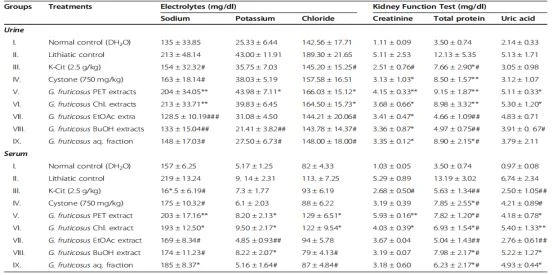
In experimental rats, G. fruticosus EtOAc extract has reduced the level of sodium significantly compared to lithiatic control (P<0.001). The level of potassium was reduced by G. fruticosus BuOH extract (P<0.010). Treatment with the aqueous extract of EtOAc and BuOH extracts of G. fruticosus showed a significant reduction in urinary protein excretions(P<0.011) in relation to lithiatic control. Sodium concentration was also reduced very significantly with the treatment of EtOAc extract of G. fruticosus (P<0.001). Treatment by the extract of G. fruticosus BuOH lowered the level of uric acid compared to the lithiatic group (P<0.050). However, lithogenic induction may cause impairments of renal function as evidenced by raising the levels of creatinine, proteins, and uric acids. In the serum analysis, the level of potassium was reduced by G. fruticosus EtOAc extract in comparison to lithiatic control(P<0.010). It was also found that the effects of G. fruticosus BuOH extract on the level of chloride were close to the normal control. The level of creatinine was raised by G. fruticosus crude extract and PET extract(P<0.01)compared to the normal control (Table 2).

cistanche tubulosa
Table 2 Urinary (24 h) excretions and serum analysis of kidney stone-forming electrolytes and kidney function markers in experimental male Wistar rats treated with selected plant extracts at 200 mg/kg dose on 28th-day post-treatment. The mixed extract = the combination of A. Aspera, S. punctata, and R. abyssinicus extracts (1:1:1 ratio), Aqueous (aq.), Ethyl acetate (EtOAc), Butanol (BuOH), Chloroform (Chl), and Petroleum ether (PET). The data were presented the mean ± SD for 6 rats in each group (n = 6). Comparisons between means were made against Group I (vehicle control) and Group II (lithiatic control). *p < 0.05, **p < 0.01, ***p < 0.001 indicate significant changes in comparison with Group I (vehicle control), #p < 0.05, ##p < 0.01, ###p < 0.001 indicate a significant change in comparison with Group II (lithiatic control)
Urine and serum analysis of crystal formation inhibitors and promoters
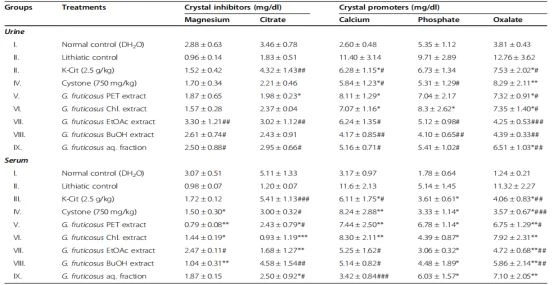
As indicated in Table 3, the level of magnesium was significantly elevated by supplementation of G. fruticosus EtOAc extract compared to lithiatic control (P<0.010). Similar to K-Cit, the effects of G. fruticosus EtOAc extract increased the level of citrate significantly (P<0.010).G. fruticosus BuOH extract lowered the elevated levels of calcium and phosphate significantly in the urine compared to the diseased (lithiatic)control (Group I rats)(P<0.010). It was also observed that G.fruticosus EtOAc extract decreased the level of oxalate in the rine compared to lithiatic control (P<0.001). In the serum analysis, the excretions of calcium, oxalate, and phosphate were grossly increased in lithiatic induced male Wistar rats. The EtOAc extract of G. fruticosus increased the concentration of magnesium(P<0.052). The serum level of citrate was increased after exposure to BuOH extract of G. fruticosus(P<0.011), suggesting similar effects to potassium citrate(P<0.001). G. fruticosus Chl. extract significantly reduced the cit-rate level compared to the normal control (P<0.001)(Table 3).
Table 3 Effects of plant extracts at 200 mg/kg dose on changes in urinary excretion (24 h) and serum crystal inhibitors and promoters in male Wistar rats on the 28th day post-treatment. The mixed extract = the combination of A. aspera, S. punctata and R. abyssinicus extracts (1: 1:1 ratio). The data were presented as mean ± SD for 6 rats in each group (n = 6). Comparisons between means were made against Group I (vehicle control) and Group II (lithiatic control). *p < 0.05, **p < 0.01,***p < 0.001 indicate significant changes in comparison with Group-I (vehicle control), #p < 0.05, ##p < 0.01, ###p < 0.001 indicate significant changes in comparison with Group II (lithiatic control).
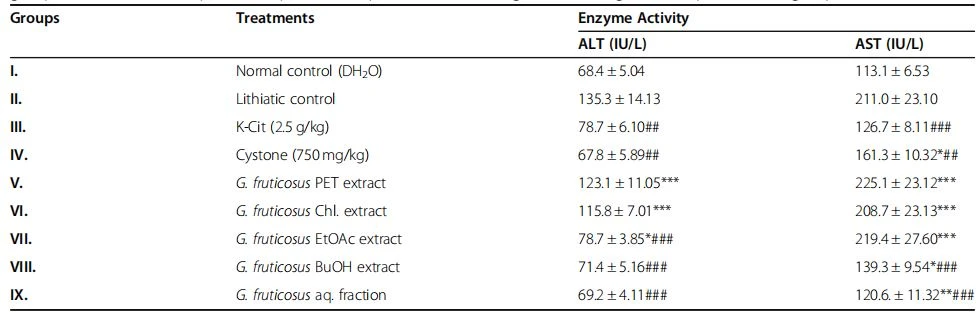
The serum level of alanine aminotransferase (ALT), and aspartate aminotransferase(AST) increased in the lithiatic control compared to the normal(healthy) control (P<0.050). G. fruticosus PET extract increased serum AST level significantly(P<0.001)compared to the healthy control. BuOH extract of G.fruticosus lowered significantly the level of AST similar to K-Cit(P<0.001) compared to lithiatic control (Table 4).
Table 4 Effects of plant extracts on the serum enzyme activity in relation to kidney stone treatment at 200 mg/kg extract dose on the 28th day post-treatment. The mixed extract = the combination of A. aspera, S. punctata and R. abyssinicus extracts (1:1:1 ratio). Data were presented as mean ± SD for 6 rats in each group (n = 6). Comparisons between means were made against Group I (vehicle control) and Group II (lithiatic control). *p < 0.05, **p < 0.01,***p < 0.001 indicate significant changes in comparison with group I (vehicle control), #p < 0.05, ##p < 0.01, ###p < 0.001 indicate significant changes in comparison with group II (lithiatic control).
Kidney homogenate analysis
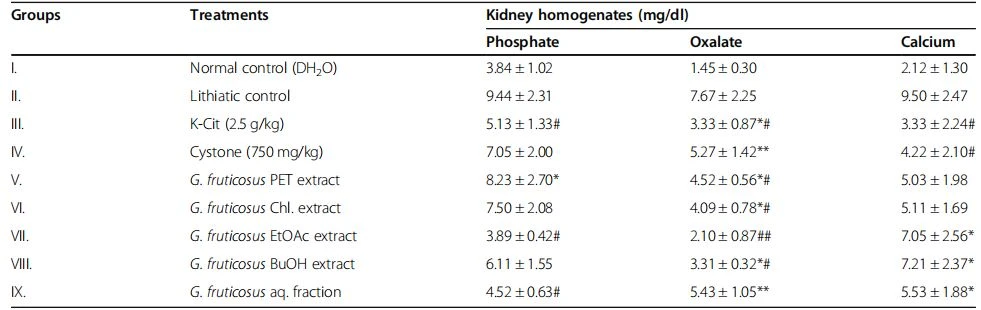
The concentrations of calcium, phosphorus and oxalate levels were increased in the lithiatic group (Group II)compared to the normal control (Group I). All treatments showed significant reductions in the level of phosphate (P<0.050), except treatment with BuOH and Chl. extracts of G.fruticosus. The administration of the aqueous mixed extract and G. fruticosus EtOAc extract reduced the level of oxalate significantly compared to the untreated lithiatic groups(P<0.011)(Table 5).
Table 5 Effect of plant extracts on kidney homogenate constituents of phosphate, oxalate and calcium following the administrations of curative test on the 28th day at 200 mg/kg dose. The mixed extract = the combination of A. aspera, S. punctata and R. abyssinicus extracts (1: 1:1 ratio). Data were presented as mean ± SD for 6 rats in each group (n = 6). Comparisons between means were made against Group I (vehicle control) and Group II (lithiatic control). *p < 0.05, **p < 0.01,***p < 0.001 indicate significant changes in comparison with the group I (vehicle control), #p < 0.05, ##p < 0.01, ###p < 0.001 indicate significant changes in comparison with group II (lithiatic control).
Evaluations of kidneys against CaOx crystal depositions Light microscopic examination for CaOx crystals in kidney histologic sections revealed CaOx crystals in the tubular lumen. The size and amount of CaOx deposits decreased among treated groups in comparison with lithiatic controls. The effect of G. fruticosus EtOAc extract(G), and its BuOH fraction (H) reduced the number of crystals compared to lithiatic control (B), but do not reduce for aqueous extracts of G. fruticosus (I)(Fig. 2).
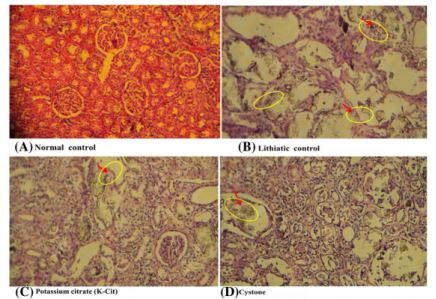

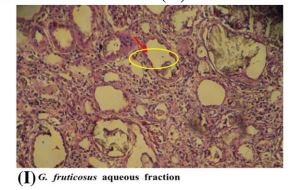
Fig. 2 Representative photomicroscopic (100x) images of kidney sections of test male Wistar rats in plant extracts for anti-CaOx crystal deposition effect (dose of extracts 200 mg/kg). Histopathology of kidney tissues a Normal control/vehicle, b Lithiatic control, treatment with c K-Cit, d Cystone, e G. fruticosus PET extract, f G. fruticosus Chl. extract, g G. fruticosus EtOAc extract, h G. fruticosus BuOH extract, and i G. fruticosus aq. fraction. The mixed extracts (the combination of A. aspera, S. punctata, and R. abyssinicus extracts in 1:1:1 ratio). Polymorphic irregular CaOx crystals in the renal tubules (yellow circle/arrows). Images were 5 μm thick paraffin sections with Hematoxylin-Eosin stain.
cistanche tubulosa extract benefit: clear free radicals
Effects of G.fruticosus extracts on CaOx deposition in the kidneys
The number of crystal deposits was counted from the cortex, medulla, and papilla by taking the mean of 4 microscopic fields. In comparison with lithogenic groups, CaOx crystal deposits in the kidneys were reduced significantly by G.fruticosus EtOAc extract p<0.010). The number of crystal deposits was counted via a sagittal section or longitudinal plane of each renal tissue specimen divided into 4 equal-sized regions(two virtual lines)and taking the mean of all fields(Fig. 3). It has been noted that G. fruticosus EtOAc extract was the most potent agent in treating urolithiasis followed by BuOH extract.
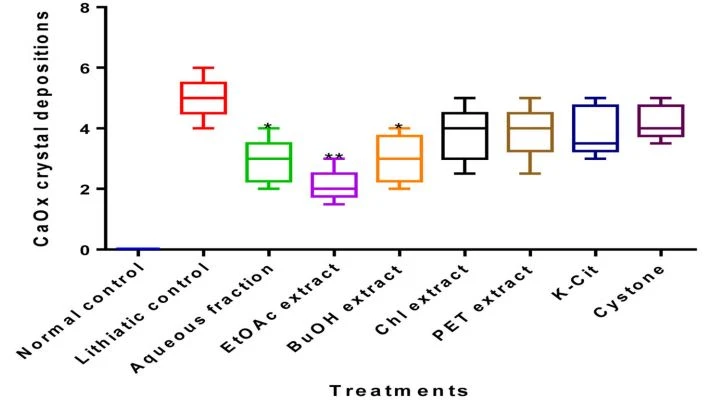
Fig. 3 CaOx crystal deposition scores in the curative study after treatment with various successive extracts of G. fruticosus (dose of extracts:200 mg/kg). Data were expressed as mean ± SD of n = 6 rats per group. *p < 0.05, **p < 0.01, and ***p < 0.001 indicates a significant change in comparison with lithiatic control (hyperoxaluric group)

cistanche tubulosa extract benefit:anti-bacterial
Discussion
The kidneys filter waste products from the blood and void them into the urine, this is not possible if waste materials do not dissolve completely in the urine, leading to kidney stone formation [59]. The biomineralization processes involve successive physicochemical changes such as supersaturation, nucleation, growth, aggregation, and retention within renal tubules [60,61]. Hyperoxaluria is the main risk factor for kidney stone formation than hypercalciuria [62].
Urinary excretions of oxalate, phosphate, and calcium were increased, while the levels of magnesium and citrate levels reduced in the urine compared to the treated group at dose 200mg/kg b.w, which were similar to the studies reported by Lemann et al. [63] and Sathish et al. [39]. The increment of mineral constituents in the urine could be due to defective renal tubular reabsorption. Similarly, electrolytes(sodium, potassium, and chloride)are used to screen renal acidosis that facilitates renal stone formations [64]. In the curative study, sodium level was reduced significantly by G. fruticosus EtOAc extract (P<0.001).In contrast, previous studies reported that excessive excretions of sodium and chloride in the urine indicate the diuretic activity of the test extract [65, 66], with increasing urinary output, which inhibits stone developments [67].
Magnesium binds with oxalate ions to form soluble oxalate complexes in the urine and decreases the oxal-ate availability, which binds with calcium leading to CaOx formation [68,69]. Hence, it could be suggested that CaOx stones are most likely to be formed by people who are magnesium deficient. This was supported by the fact that G. fruticosus EtOAc extract elevated the levels of magnesium and citrate (P<0.010) similar to K-Cit in the curative test. The EtOAc extract of G. fruticosus decreased the levels of oxalate in the urine (P<0.001) compared to lithiatic control in the curative study. In the curative test, a significant(P<0.01) reduction in urinary levels of calcium and phosphate following G.fruticosus BuOH extract administration indicates the presence of CaOx inhibitory constituents, which interfere with crystal nucleation and aggregations. Moreover, an increase in calcium concentrations is a favoring environment for nucleation, and precipitation of calcium oxalate or calcium phosphate with subsequent crystal growth [32,39]. Similarly, increased urinary phosphate and oxalate excretions also provide a favorable environment for the formation of calcium phosphate, in turn, leading to calcium oxalate crystal depositions in the renal tubules [18, 70].
In the curative study, G. fruticosus EtOAc extract (P<0.010) reduced serum levels of potassium. In addition, the effects of G. fruticosus BuOH extract on the level of chloride were found to be close to the normal control during the curative study. The serum level of sodium was significantly reduced by G. fruticosus BuOH extracts (P<0.050) compared to lithiatic control in the curative study. There was a decrease in serum oxalate excretions by EtOAc and BuOH extracts of G.fruticosus compared to lithiatic control. This might be either due to the inhibitions of oxalate formation, or interference with ox-alate metabolism. Similarly, G. fruticosus EtOAc and BuOH extracts(p<0.050) decreased calcium levels compared to lithiatic control in the curative test. The ability of these extracts to alter calcium and oxalate excretions may be due to the disintegration of mucoproteins, which are promoters of crystallization as reported by Doddola et al. [34]. In the present study, the level of citrate in the serum was increased by G. fruticosus BuOH extracts (P<0.011), suggesting a possible curative effect close to K-Cit treated group (P<0.001). The presence of tannins and flavonoids can lead to the relaxation of smooth muscles of the urinary tract, which could facilitate the expulsion of kidney stones as studied in rats [54], which were confirmed their presence in the phytochemical analysis of G. fruticosus extracts in the present study. In the present therapeutic study, it was also evidently proved that the G. fruticosus BuOH extracts lowered AST levels very significantly (P<0.001), which was close to K-Cit compared to the lithiatic control in the curative studies. This can be attributed to the fact that abnormal levels of liver enzymes, particularly aminotransferases including alanine aminotransferase(ALT), and aspartate aminotransferase (AST) are prognostic features (indicators)of the damages of liver cells, and the cellular integrity of the kidneys [71, 72].
Experimentally induced CaOx crystal deposition in the kidneys is also associated with localized inflammation as evidenced by infiltration of monocyte and macrophages to the site [73]. G.fruticosus EtOAc extract(P<0.051)and its BuOH extract (P<0.051) treated groups, the severity of CaOx crystal depositions reduced the kidneys compared to lithiatic control, which was similar to a study on the other herbal extract [74]. In the curative study, EtOAc extract of G.fruticosus reduced the level of phosphate significantly (P<0.051)compared to the lithiatic control. Tissue injury could be caused by exposures to phosphate and calcium phosphate crystals, leading to the generation of oxidative stress, lipid peroxidation, and depletion of antioxidant enzymes [75]. Consequently, the renal epithelial injury promotes crystal retention, as epithelial injury exposes a variety of crystal adhesion molecules on epithelial surfaces and promotes stone formation [73, 76]. COM accumulates in the kidneys by attaching to tubular cell membranes, followed by internalization by endocytosis, leading to cell death [75]. The precipitation of oxalate as COM in the tubular lumen has been linked with renal toxicity and inflammation, damaging the structures of mitochondria, inhibiting mitochondrial respiratory functions in proximal tubular cells, altering cellular permeability, and leading to renal cell death [77].
A major limitation of the study is the inability to use a polarized light microscope that magnifies and better re-solve in vivo crystallizations to differentiate between COM and COD crystals which would have improved data quality. The effects of test extracts on urinary diuretic activities were not assessed. Despite these limitations, the strength of the present study was the use of standard experimental designs and procedures to test the potential efficacy of the traditional medicinal plants used in the study.

cistanche can anti-inflammation
Conclusions
The present study has provided some evidence for the traditional use of G. fruticosus extracts in urolithiasis management. In vivo/animal tests confirmed the curative efficacies of G. fruticosus extracts, which were evidenced from biochemical and histopathological findings. The present findings demonstrated the CaOx curative efficacy of G. fruticosus EtOAc extract. Further research is necessary to identify the active compounds responsible for the treatment of urolithiasis.
References
1. Chauhan CK, Joshi MJ,Vaidya ADB.Growth inhibition of struvite crystals in the presence of herbal extract Commiphora weight. J Mater Sdi.2008;20(1):85-92.
2. Buchholz NP,Abbas F,Afzal M, Khan R, Rizvil, TalatiJ.The prevalence of silent kidney stones: an ultrasonographic screening study.J Pak Med Assoc. 2003;53(1):24-5.
3. Indridason OS, Birgisson S,Edvardsson VO, Sigvaldason H, Sigfusson N,Palsson R. Epidemiology of kidney stones in Iceland: a population-based study.Scand J Urol Nephrol. 2006;40(3):215-20.https://doiorg/10.1080/003 65590600589898.
4. Al-Eisa AA, Al-Hunayyan A, Gupta R. Pediatric urolithiasis in Kuwait. Int Urol Nephrol.2002;33(1):3-6.https://doi.org/10.1023/A:1014419830292.
5. Romero V, Akpinar H, Assimos DG.Kidney stones: a global picture of prevalence, incidence, and associated risk factors. Rev Urol.2010;12(2-3):e86-96.
6. Edvardsson VO, Indridason OS, Haraldsson G, Kjartansson O, Palsson R. 6. Temporal trends in the incidence of kidney stone disease. Kidney Int. 2013;83(1):146-52. https//doi.org/10.1038/ki.2012.320.
7. Aggarwal KP, Narula S, Kakkar M, Tandon C.Nephrolithiasis: molecular. mechanism of renal stone formation and the critical role played by modulators. BioMed Res Int. 2013;2013:292953 21 pages.
8. Singh KB, Sailo S.Understanding epidemiology and etiologic factors of urolithiasis: an overview. Sci Vis. 2013;13(4):169-74.
9. Chhiber N, Sharma M, Kaur T, Singla S.Mineralization in health and mechanism of kidney stone formation. IntJPharm Sci Invent. 2014;3:25-31.
10. Cunningham P, Noble H, Al-Modhefer A-K, Walsh I. Kidney stones: pathophysiology, diagnosis, and management. Br J Nurs. 2016;25(20):1112-6. https://doi.org/10.12968/bjon.2016.25.20.1112.
11. Lieske JC, Huang E, Toback FG. Regulation of renal epithelial cell affinity for calcium oxalate monohydrate crystals. Am J Physiol Renal Physiol.2000278:130-7.