Part1: Interactions Of Ascorbic Acid, 5-Caffeoylquinic Acid, And Quercetin-3-Rutinoside in The Presence And Absence Of Iron During Thermal Processing And The Influence On Antioxidant Activity
Mar 15, 2022
For more information contact tina.xiang@wecistanche.com
Abstract: Bioactive compounds in fruit and vegetables influence each other's antioxidant activity. Pure standards, and mixtures of the common plant compounds, namely ascorbic acid, 5-caffeoylquinic acid, and quercetin-3-rutinoside (sum 0.3 mM), in the presence and absence of iron, were analyzed pre- and post-thermal processing in an aqueous solution. Antioxidant activity was measured by total phenolic content (TPC), 1,1-diphenyl-2-picrylhydrazyl (DPPH), and 2,2'-azino-bis (3-ethylbenzothiazoline-6-sulfonic acid) (TEAC) radical-scavenging assays. Ionic ferrous iron (Fe2+)and ferric iron (Fe)were measured photometrically. For the qualification and quantification of reaction products, HPLC was used. Results showed that thermal processing does not necessarily lead to a decreased antioxidant activity, even if the compound concentrations decreased, as then degradation products themselves have antioxidant activity. In all used antioxidant assays the 2:1 ratio of ascorbic acid and 5-caffeoylquinic acid in the presence of iron had strong synergistic effects, while the 1:2 ratio had strong antagonistic effects. The pro-oxidant iron positively influenced the antioxidant activity in combination with the used antioxidants, while ferrous iron itself interacted with common in vitro assays for total antioxidant activity. These results indicate that the antioxidant activity of compounds is influenced by factors such as interaction with other molecules, temperature, and the minerals present.
Keywords: ABTS; antagonism;ascorbic acid;bioactive compounds;5-caffeoylquinic acid; chelating complexes; ferrous iron; ferric iron;HPLC; quercetin-3-rutinoside synergism; TPC
Click here to get more information

1. Introduction
In the human diet, many different plant-based products are consumed throughout the day, even within the same meal. Fruit and vegetables are associated with various health benefits, due to their variety of bioactive compounds, i.e., vitamins, minerals, and secondary plant metabolites |1]. In comparison to vitamins and minerals, secondary plant metabolites, such as phenolics, are not regarded as essential for human health by today's knowledge[2]. However, many secondary plant metabolites are potent antioxidants, which help to protect biological systems from reactive oxygen species (ROS) and reactive nitrogen species (RNS)[3]. These bioactive compounds can interact with each other before consumption, resulting in numerous subsequent reaction products or complexes. Consequently, their contribution to consumers' health and their antioxidant activity (AOA)may be altered 4| or lost before food intake. Different molecular structures of compounds and their diverse combinations can lead to additional, synergistic, or even antagonistic effects through interactions. The effects of interactions between plant components on their radical-scavenging ability are not fully understood yet, especially because of the many different oxidation stages and their ability to build complexes. A major bioactive compound, found in numerous plant species, is 5-caffeoylquinic acid (chlorogenic acid), a hydroxycinnamic acid ester of caffeic acid and quinic acid. It can form ferric iron complexes, which are generally associated with reduced absorption of non-heme iron in humans[5,6]. Iron, as a component of hemoglobin, is an essential mineral for the human body, while an excess of iron can cause oxidative stress in cells [7]. Interactions with other nutrients can increase or decrease the absorption of iron, for example, by forming complexes. Furthermore, iron has the capacity to accept and donate electrons readily.
Another interesting bioactive compound in plants is quercetin-3-rutinoside (rutin), a flavonoid glycoside, which is mainly synthesized by plants to protect themselves from UV radiation [8,9]. It has a low aqueous solubility [10] and cannot enter human blood circulation directly, so its bioactive activity does not begin until six to nine hours after consumption when it passes through the gut microbiome. In food supplementals, quercetin-3-rutinoside is often combined with ascorbic acid [11]. Ascorbic acid is an essential vitamin to the human body and is needed in many metabolic processes. It is also a powerful water-soluble antioxidant, but can also act as a pro-oxidant, which is due to its ability to reduce ferric iron via chelate complex formation, followed by the transformation of ferrous iron and an ascorbic radical[12]. Increased absorption in the human body of the bioactive compounds quercetin-3-rutinoside, 5-caffeoylquinic acid, or iron was found by adding ascorbic acid [12], while 5-caffeoylquinic acid reduced the iron absorption by complexation [6]. To predict the health benefits of different products, in regard to bioactive compounds, in vitro antioxidant assays are commonly used. This prediction of health effects is limited due to the variable bioavailability of compounds, metabolization, and different antioxidant mechanisms|13]. However, these assays are still useful to test for bioactive compounds, such as polyphenols, or, as in this study, to assess the AOA of single compounds and their interactions. Fruit and vegetables contain a diverse set of bioactive compounds, which can form complexes with other compounds and proteins that can interact with them. These interactions can influence the behavior of the compounds and the resulting AOA. However, this work is intended to contribute to the knowledge of how bioactive compounds interact with each other and their impact on the AOA. The novelty of this study is the interactions of common phenolic compounds, namely ascorbic acid, 5-caffeoylquinic acid, quercetin-3-rutinoside, with each other and the mineral iron pre-and post-thermal processing. Prior to this study, these factors were evaluated separately, not in combination. The focus was set on the AOA and its ability to build complexes. The hypotheses were (1) thermal processing influences the AOA negatively due to degradation of the antioxidants, (2) mixtures in different ratios of ascorbic acid, 5-caffeoylquinic acid, and quercetin-3-rutinoside lead to a synergistic effect regarding the AOA, and (3) addition of the mineral and pro-oxidant iron will decrease the antioxidant activity of the antioxidants alone or in mixtures.
2. Results
2.1.Influence of Thermal Processing on Antioxidant Activity of Ascorbic Acid,5-Caffeoylquinic Acid, and Quercetin-3-Rutinoside Standards and the Mineral Iron
In none of the pure samples of ascorbic acid, 5-caffeoylquinic acid, or quercetin-3-rutinoside(Figure 1)or mixtures of them (Figures 2 and 3,)was an effect of cooking times between 0 and 40 min on AOA observed, except in the combination of ascorbic acid and iron. AOA was lower in TEAC and DPPH assays after 40 min of cooking when compared to uncooked samples(Figure 1). Samples containing ascorbic acid tend to decrease in their AOA, while samples containing quercetin-3-rutinoside tend to increase their AOA with prolonged cooking time (Figures 1-3).


2.2.Influence of Iron and Different Combinations of Ascorbic Acid,5-Caffeoylquinic Acid, and Quercetin-3-Rutinoside Standards on Antioxidant Activity
Analyses with a TEAC assay (Figure la) showed that the AOA of pure ascorbic acid was lower than the AOA of quercetin-3-rutinoside. In the presence of iron, the AOA of ascorbic acid was even lower than the AOA of quercetin-3-rutinoside and5-caffeoylquinic acid. Adding iron increased the AOA of quercetin-3-rutinoside and 5-caffeoylquinic acid. At a cooking time of 0min, only the AOA of 5-caffeoylquinic acid was higher in the presence and absence of iron. The DPPH assay(Figure 1b) detected higher AOA of quercetin-3-rutinoside in the absence of iron compared to 5-caffeoylquinic acid and ascorbic acid. The presence of iron led to an AOA increase for 5-caffeoylquinic acid, and an AOA decreases for quercetin-3-rutinoside samples. At 0 min cooking time only quercetin-3-rutinoside was higher in the absence of iron than in the presence of iron. Only in the TPC assay(Figure lc), iron did not influence the AOA, and the order of the three substances stayed the same.
In binary mixtures, detected by the TEAC assay (Figure 2a-c), iron led to a significant or trending increase in AOA. Among samples without iron, no differences between AOA of mixtures or ratios were found. In the presence of iron at a cooking time of 0 min, the ratios 1:1 and 1:2 of ascorbic acid and 5-caffeoylquinic acid, and a 2:1 ratio of the 5-caffeoylquinic acid and quercetin-3-rutinoside mixture, were higher in their AOA than their iron-free counterparts. In the DPPH assay(Figure 2d-f), the combination of ascorbic acid with 5-caffeoylquinic acid, as well as with quercetin-3-rutinoside, showed in the presence of iron in all ratios a higher AOA than the AOA of pure ascorbic acid. However, ascorbic acid combined with quercetin-3-rutinoside showed a higher AOA in the absence of iron, being comparable to pure quercetin-3-rutinoside. In the TPC assay (Figure 2g-i), the AOA of all three binary mixtures showed identical patterns. There was no influence of iron or cooking time on AOA. These results correspond with previous findings in pure substances (Figure 1): the lowest AOA was detected in ascorbic acid and 5-caffeoylquinic acid mixtures, followed by ascorbic acid with quercetin-3-rutinoside, and the highest AOA was found in the combination of 5-caffeoylquinic acid and quercetin-3-rutinoside.
In all ternary mixtures, no differences between ratios, regardless of the presence of iron, in TEAC and DPPH assays were found (Figure 3a-f). Higher AOAs were found in the TEAC assay (Figure 3a-c) in the presence of iron. At 0min cooking time the AOAs of the equimolar mixture and the 1:2:1 ratio of ascorbic acid,5-caffeoylquinic acid, and quercetin-3-rutinoside were higher in the presence of iron. The DPPH assay revealed higher AOA in samples with iron for the 1:2:1 ratio (Figure 3e).In accordance with binary mixtures, the TPC assay was neither influenced by iron nor by cooking time (Figure 3g-i). Furthermore, the equimolar mixture in the absence of iron had a lower AOA than the 1:2:2 ratio. In non-equimolar mixtures with one doubled compound, the 1:1:2 ratio was higher in AOA compared to the 2:1:1 ratio(Figure 3h) and in the non-equimolar with two doubled compounds, the 1:2:2 ratio was higher in AOA compared to the 2:1:2 and 2:2:1 ratio (Figure 3i) in the presence and absence of iron.


2.3. Synergistic and Antagonistic Effects of Antioxidant Activity
All test assays showed mainly weak synergistic and antagonistic effects with inter-actions below 10%(Figure 4). Noteworthily, among all used test assays, the 2:1 ratio of ascorbic acid and 5-caffeoylquinic acid in the presence of iron had strong synergistic effects, while the 1:2 ratio of ascorbic acid and 5-caffeoylquinic acid had strong antagonistic effects. In the TPC assay, these phenomena also appeared in mixtures without iron. In the DPPH assay, another strong antagonistic effect was detected in all ratios of binary mixtures without iron-containing 5-caffeoylquinic acid and quercetin-3-rutinoside(Figure 4b). For ternary ascorbic acid, 5-caffeoylquinic acid, and quercetin-3-rutinoside mixtures, the TEAC assay showed strong antagonistic effects for the 2:2:1 ratio with iron (Figure 4a). In ternary mixtures with iron the DPPH assay revealed strong antagonistic effects in cooked samples in ratios of 1:2:1,1:1:2,2:1:1, and 2:2:1, as well as in mixtures without iron in the ratios1:1:2, 1:2:2,and 2:1:1 (Figure 4b).The TPC assay displayed strong synergistic effects in mixtures without iron in the 1:2:1 ratio (Figure 4c).

2.4.Total and logic iron
Ionic iron was added as an equimolar mixture of 50% ferric iron (Fe3+)and 50% ferrous iron (Fe2+) to the aforementioned pure, binary, and ternary mixtures. In all samples, the ratio of ferric iron shifted towards ferrous iron compared to the initially added equimolar ratio. Whenever ascorbic acid was present in samples, bound iron decreased with cooking time and subsequently vanished or stabilized (Table 1). A Pearson correlation on the TEAC assay data revealed a strong negative correlation(-0.641,p ≤2.2*10-16)between the AOA and ferrous iron ions, and a positive correlation between AOA and ferric iron (0.377,p<4.1*10-)over all samples. Furthermore, the DPPH assay showed a negative correlation (-0.429,p≤1.3*10-1l) between AOA and ferrous iron ions. Meanwhile, AOA and ferric iron ions were only weakly correlated(0.225,p<0.0006).In the TPCassay, AOA and ferrous iron ions were strongly negatively correlated (-0.772, p <2.2*10-16), and AOA and ferric iron ions were strongly positively correlated (0.685, p<2.2*10-16).

In pure ascorbic acid samples, only traces of ferric iron were detectable, regardless of their cooking time. Additionally, the amount of ferrous iron increased, while bound iron decreased in all ascorbic acid samples after cooking. In 5-caffeoylquinic acid samples, ferric iron decreased by 13.3% after 40 min of thermal processing, while at the same time ferrous iron slightly increased.Quercetin-3-rutinoside samples with iron resulted in an almost stable amount of ferrous iron. Bound iron increased with prolonged cooking time, while ferric iron decreased by 20.49% after 40 min of cooking (Table 1).
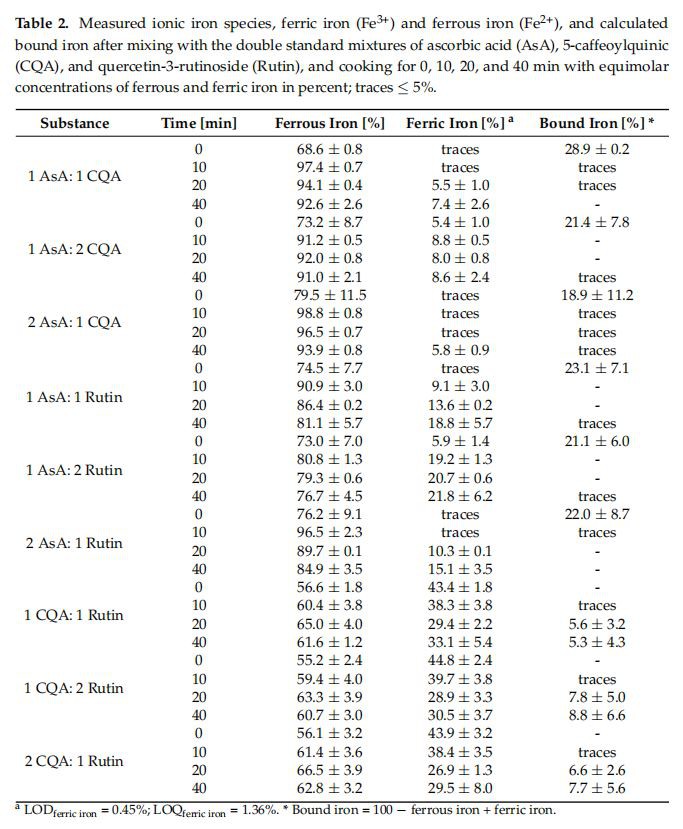
In the presence of ascorbic acid, 0 min cooked binary samples contained between 18.9% and 28.9%bound iron, which was disbound by cooking. Bound iron was found in binary mixtures after 20 and 40 min of cooking only when ascorbic acid was absent. Mixtures of ascorbic acid and 5-caffeoylquinic acid contained a higher amount of ferrous iron than combinations of ascorbic acid and quercetin-3-rutinoside. The combination of 5-caffeoylquinic acid and quercetin-3-rutinoside in all ratios showed similar patterns, ferrous iron increased slightly, and ferric iron decreased with prolonged cooking time. Bound iron was found in this mixture only after 20 and 40 min of cooking (Table 2).
In ternary mixtures, the amount of ferrous iron was higher, and the amount of ferric iron lower, than initially spiked equimolar concentrations of each. The overall highest content of ferrous iron was found in samples when the concentration of ascorbic acid was doubled (ratios 2:1:1, 2:1:1, 2:2:1). The cooking process further increased the amount of ferrous iron and ferric iron, while bound iron decreased (Table 3).

2.5.Qualitatioe and Quantitative Analysis of the Substance Mixtures by HPLC
HPLC data showed that in all 0 min cooked samples, in the presence and absence of iron, only the initially inserted substances of ascorbic acid, 5-caffeoylquinic acid, and quercetin-3-rutinoside were present (data not shown). After cooking for 40 min two additional peaks(peaks 3 and 4) were derived from ascorbic acid, regardless of the presence of iron (Figure 5).In the presence of iron, two new products of 5-caffeoylquinic acid (peaks 6 and 7) and one from quercetin-3-rutinoside (peak 8) were detected (Figure 5b).
In the absence of iron, ascorbic acid concentrations decreased in all mixtures in a dose-response relation from an initial concentration of 0.3 mM after 40 min of cooking to 26.79% of the initial concentration and with an initial 0.2 mM between 44.08% and 51.67%, with an initial 0.15 mM between 60.49% and 65.47%, with an initial 0.1 mM 77.84% and 86.41% and increasing up to 90.05% with an initial 0.06 mM (Table S1).
In the presence of iron, only in pure ascorbic acid samples, a decrease in concentration was found after 40 min of cooking, being higher compared to the ascorbic acid sample without iron (Table S1). Contrary to the ascorbic acid samples without iron, higher ascorbic acid concentrations led to higher degradation ratios (Table S1). In all binary mixtures, only ascorbic acid concentrations decreased in 0 min cooked samples. After 40 min of cooking, a decrease in 5-caffeoylquinic acid or quercetin-3-rutinoside concentration was found when combined with ascorbic acid. Both substances minimize the decrease in ascorbic acid concentration. Higher 5-caffeoylquinic acid concentrations led to minimizing the ascorbic acid degradation. In binary mixtures of 5-caffeoylquinic acid and quercetin-3-rutinoside, 5-caffeoylquinic acid decreased in its concentration, while quercetin-3-rutinoside stayed stable after 40min of cooking. In ternary mixtures, quercetin-3-rutinoside stayed stable after 40 min of cooking, while ascorbic acid and 5-caffeoylquinic acid concentrations decreased.


For further information, click the below link for part 2:
https://www.xjcistanche.com/news/part2-interactions-of-ascorbic-acid-5-caffeo-54918073.html