Quercetin With Lycopene Modulates Enzymic Antioxidant Genes Pathway in Isoproterenol Cardiotoxicity in Rats Part 2
Mar 22, 2022
Please contact oscar.xiao@wecistanche.com for more information
13. Results
13.1. Effect of QL on the heart weight to body weight ratio in experimental rats
The ratio of the heart weight to body weight (Hw/Bw)is shown in Table 1. As depicted, the ratio of Hw/Bw was comparable in all experimental groups. No significant alterations were noticed in the Hw/Bw ratio between group I(control) and the group I (QL). However, a significant decrease(P<0.05) in the Hw/Bw ratio in group l (ISO) was noticed in comparison to group l. Upon treatment with QL(group IM) in ISO intoxicated rats, a significant Hw/Bw ratio recovery was noticed. This confirmed a preliminary cardioprotective effect of QL in ISO toxicities in rats.

Please click here to know more
14. Effect of QL on the cardiac biomarkers in experimental rats
Serum cardiac marker levels such as creatine kinase-MB(CK-MB) and cardiac troponin T (TROP) were summarized in Figure 1A and Figure 2B respectively. QL group showed almost normal levels of both cardiac marker enzymes (CK-MB and TROP) when compared with group I(control) rats. Group, I(ISO)showed a significant (p<0.05) increase in CK-MB and TROP levels as compared with group I. Treatment with QL (group IV) during ISO intoxication decreased the elevated CK-MB and TROP levels to near normal. This result revealed the potential ameliorative effect of QL in ISO toxicities in rats.
15. Effect of QL on marker enzymes in experimental rats
Oral administration of QL on marker enzymes in ISO-induced rats was shown in Figures 1B and 1C. Administration of QL alone (group Il)showed no significant alteration on marker enzymes(ALT and AST)in serum when compared with group I(control) rats. Intoxication of ISO in the group causes a significant (P< 0.05) elevation of ALT and AST levels when compared with the control group of rats. QL treatment (group V)significantly prevented the elevation of


serum activities of ALT and AST that depicted the cardioprotection of QL in ISO intoxicated rats.
16. Effect of QL on serum LDH activity in experimental rats
Activities of LDH in experimental rats were shown in Figure 1D. Results signify that the administration of QL alone in group ll did not cause any alterations in the activities of serum LDH compared with group I(control) rats. ISO intoxication in rats showed a significant elevation (P< 0.05)in LDH activities (group III) and treatment with QL(group M) significantly controlled the elevation. These results indicated that the cardiotoxicity produced by ISO was efficiently nullified with QL treatment.

17. Effect of QL on MYO level in experimental rats
Alterations of MYO levels in the serum of normal and experimental rats were shown in Figure 2A. Rats intoxicated with ISO (group II) presented a significant increase(p<0.05) in the level of MYO compared to the control (groupI) rats. QL treatment significantly reversed the abnormal levels of MYO in group IV rats. Hence ISO induced myoglobin abnormality towards cardiac injury was effectively suppressed by QL treatment.
18. Effect of QL on oxidative stress markers in experimental rats
Lipid peroxidation alterations in heart tissue and serum of normal and experimental rats were shown in Table 2 and Figure 2C respectively. Rats induced with ISO (group II)presented a significant increase (p< 0.05) in the levels of MDA and GSSG when compared to the control (group I) rats. No significant alterations in these levels were noticed with QL alone administration.QL treatment significantly reversed the elevated levels of lipid peroxidation products in ISO intoxication in group IⅣ. Hence, lipid peroxidation products were significantly suppressed during QL treatment.

Cistanche can improve immunity
19. Effect of QL on enzymic and non-enzymic antioxidants in experimental rats
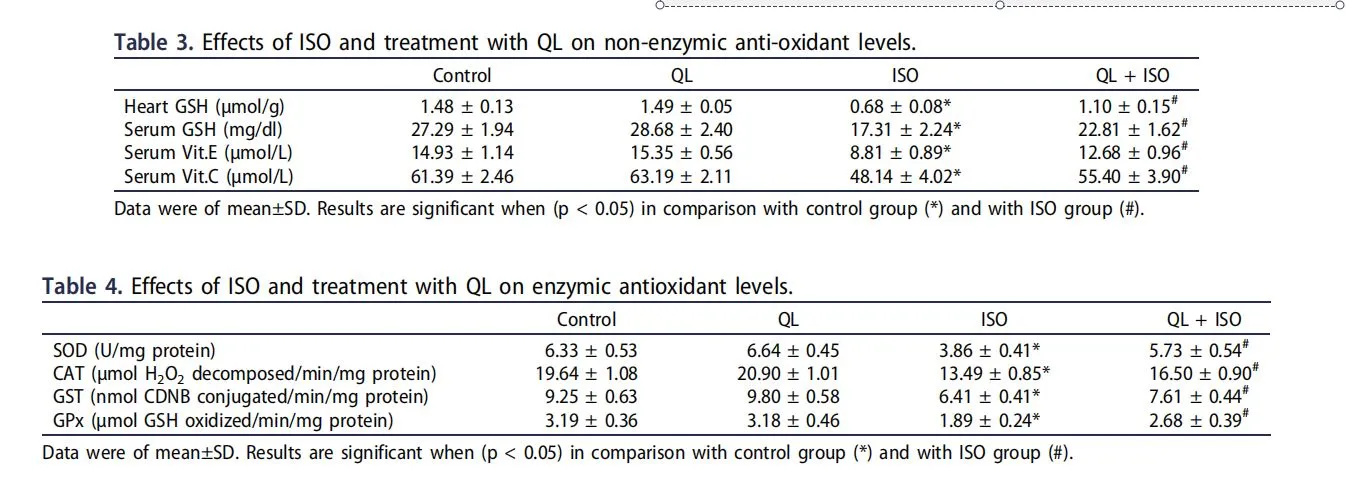
Levels of non-enzymic antioxidant (GSH, Vit-C, and Vit-E) and antioxidant enzyme (SOD, CAT, GPx, and GST activities of experimental rats were depicted in Tables 3 and 4 respectively. All were significantly reduced (P<0.05)in ISO intoxicated animals (group l) with significant normalization during QL treatment in group IV.QL administration alone showed no significant alterations. From these results, it was evident that QL was effective in improving the tissue antioxidant status against ISO intoxication in rats.
20. Effect of QL on histopathological injuries in experimental rats
Evidence of cardiac injury was depicted via histopathological studies in Figure 3. Histopathological results of the control (group I) rats and QL alone administered (group Il)showed normal cardiac tissue architecture. Following ISO intoxication in group I rats, areas of infarction with intense damage in cardiac tissues and increased inflammatory spots were identified. Treatment with QL in group IV rats showed a significant decrease in the degree of the histopatho-logical damage as compared to ISO intoxicated (group III) rats. This result showed that QL proved significant protection against ISO-induced cardiac injuries in rats.
21. Effect of QL on gene expressions in experimental rats
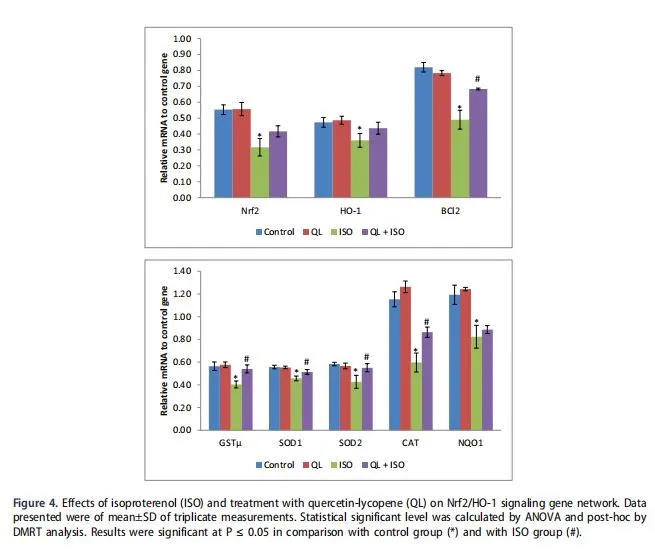
Expression of genes (Nf2, HO-1, BCL-2, GST, SOD1, SOD2, CAT, and NQO1) in control and experimental rats are shown in Figure 4A and 4B.Data depicted no alterations in Nrf2, HO-1,GSTμ, SOD1,SOD2, CAT,NQO1 and BCl-2 mRNA expression levels of group Il when compared with control (group I) rats. However, there was a significant decrease in the entire target mRNA levels in ISO intoxicated rats (group III)Remarkably, QL treatment in ISO intoxicated rats (group I) restored the activities of GSTμ, SOD1,

SOD2,CAT, and BCL2 genes. However, a noticeable increase in the expression levels of Nrf2, HO-1, and NQO1 were noticed without significance. These results suggest that QL treatment could significantly modify the expression levels of enzymic antioxidants through up-regulation of its mRNA levels.
22. Discussion
isoproterenol (ISO) is a potent β-adrenergic receptor agonist, metabolized in the human body by an enzyme known as catechol-O-methyltransferase. In higher dose, metabolic products of ISO causes cardiac toxicity by producing an excessive amount of free radicals, increased intracellular Ca2, mitochondrial dysfunction due to the insufficient blood supply, and eventually leading to severe cardiac infarction and necrotic damage (Wong et al, 2017). The higher dose of ISO intoxication animal models depicts injuries similar to ischemic cardiovascular disease in humans. Hence, ISO was used by many researchers as a preferred model of ischemic cardiovascular disease to explore the effects of various treatment drugs. ISO rat model has advantages of higher efficiency, consistency, reduced mortality, and morbidity rate during the experimental period(Brindha and Rajasekapandiyan, 2015). ISO intoxication showed a significant elevation on Hw/Bw ratio that could be due to accumulation of water in edematous intramuscular space and inflammatory cells infiltration to damaged areas in the cardiac tissue(Ibrahim et al,2015). Previous reports documented that 10% of cardiac function could be impaired with a 1% increase in water content and ISO cardiotoxicity could alter the cardiac membrane permeability, which is the key contributing factor to cardiac injury(Ibrahim et al.,2015). In the present study, improvement in the Hw/Bw might be due to the control of water accumulation and alteration in the cardiac membrane permeability, thereby leading to the prevention of cardiac damage.

Cistanche can improve immunity
Exposure to toxic agents such as ISO or other synthetic drugs could elicit pathological changes causing membrane leakage of marker enzymes, ALT, and AST into the bloodstream. Earlier studies documented that elevation in the activities of serum marker enzymes was an important indicator of tissue damage (Sidahmed et al,2016; Boarescu et al.,2019). Increased activities of serum AST and ALT evidently confirmed the ISO cardiotoxicity and eventual decrease in the activities of these enzymes during QL treatment probably due to the protective effect of QL towards cardiomyocytes.
ISO cardiac injury could increase the cell membrane permeability of cardiac cells which could allow the leakage of cytosolic enzymes into the bloodstream. CK-MB, LDH, and TROP were the vital enzymes/proteins in the heart that could support ATP levels (a phosphate energy storage form), while MYO facilitates the gas exchange in the cardiac cells (Volker et al.,2010). Hence, cardiac cells become permeable, and leakage to CK-MB, LDH, TROP, and MYO.a valuable diagnostic tool for myocardial injury (Serra et al, 2010). In the present study, significant elevation of CK-MB, LDH, TROP, and MYO in ISO intoxication indicated the damage/injury to the cardiac cells. However, treatment with QL decreased the elevation of these parameters in serum, probably by maintaining the integrity of the cardiac cellular mem-brane against ISO injuries. Hence, it was reasoned that the presence of QL might exert protection against cardiac cell injury and avoided leakage from the cardiac cells.
Excessive production of oxidative stress may lead to proteins and lipids oxidative damage that could interfere with the normal functioning of the cardiac tissue. Consequently, it could affect the permeability of mitochondrial and cytoplasmic membranes and release oxidative products into circulation. TBARS is a well-established index of MDA content, an oxidative stress marker for lipid peroxidation in tissues(Kang et al., 2018). Also, GSSG is an important oxidative tripeptide thiol that depicts the oxidative stress status in various inflammation-related disorders (Shahsavani et al., 2010). Augmented production of MDA and GSSG in ISO intoxication was efficiently controlled during treatment with QL led to significant cardioprotective efficiency. Therefore, it was convincing that constituents of QL inhibit and/or scavenge oxidative stress products related to ISO toxicity and exert protection against cardiac injuries.
Production of free radicals in ISO intoxication initiates oxidative stress, thereby damaging cardiac cellular architecture. Endogenous antioxidants defense systems disrupt the process of free radical production within the cells and protect the cells from free radical assault (Rajesh et al., 2010). Hence, the balance between free radicals and antioxidant is vital, because an inequity would result in the free radicals stimulated toxic accumulation which obviously leads to cell damage(Prakash et al.,2013). The presence of enzymic and non-enzymic antioxidants provides endogenous defense against oxidants causing cardiac tissue injuries. As expected, activities of SOD, CAT, GST, and GPx and levels of GSH, Vit-C, and Vit-E depleted in ISO toxicity was suggestive of oxidative stress in the cardiac tissue, which was efficiently normalized with QL treatment. Hence, these data backed the scavenging efficiency of QL in cardiac injuries. Also, it was justified with histopathological analysis that avoided the pathological architecture change of the cardiac tissues that supported the cardioprotective role of QL in oxidative stress-induced cardiac injuries.

Nuclear factor erythroid 2-related factor 2(Nrf2)was known as a vital transcription factor of heme oxygenase-1 (HO-1), where upregulation of HO-1 upon nuclear translocation was demonstrated to activate antioxidant genes(GST, SOD1, SOD2.CAT, NOO1)against oxidative stress(Lim et al., 2015). In addition, cardiovascular disease demonstrated a loss of cardio-myocyte through the apoptosis pathway. Hence, in the process of apoptosis, BCl-2 plays an important role to prevent cell death by maintaining the integrity of the mitochondrial membrane, which is essential in averting intrinsic apoptotic pathways (Khadrawy et al., 2019). Consistent with the report, ISO intoxication significantly decreased the expression of Nrf2, HO-1, BCl-2, GSTμ, SOD1, SOD2, CAT, and NQO1 and signify-ant restoration of BCl-2, GSTμ, SOD1, SOD2, and CAT gene expressions during QL treatment. However, a non-significant increase in the expressions of Nrf2, HO-1, and NQO1 was also considered worth in depicting the protective efficacy of QL. Consistent with our reports, a study conducted by Jeong et al,2019, demonstrated a similar protective effect of baicalein towards Nrf2/HO-1 signaling against oxidative stress-induced DNA damage in HEl193 Schwann cells. To summarize, the cardioprotective effect of QL was attributed to its efficient activation of enzymic antioxidant gene expression pathways and its antioxidant activities.
23. Conclusion
In summary, this study reveals for the first time that the administration of QL combination was effective in ameliorating the extent of myocardial injuries and significantly counteracted the oxidative stress in ISO-induced cardiac damage in rats through activation of enzymic antioxidant defense gene expression path-ways. Therefore, a combination of quercetin and lycopene is considered more advantageous and warrants more studies in the future, which can be developed as a potential natural cardioprotective agent in clinical practice.
This article is extracted from LIBYAN JOURNAL OF MEDICINE2021, VOL. 16, 1943924https://doi.org/10.1080/19932820.2021.1943924