Research Progress On The Protective Effects Of Cistanche Deserticola And Its Active Ingredients On Brain Injury
Jun 03, 2024
Summary
Cistanche deserticola is a commonly used tonic in traditional Chinese medicine. With the research of domestic and foreign scholars on its effective ingredients and mechanism of action, it has been found that its main components, such as total glycosides of Cistanche deserticola, have protective effects such as antioxidant and anti-apoptotic effects. This article provides a review of the research progress in this area both domestically and internationally.
[Keywords] Cistanche deserticola; Antioxidant; Resist mourning for the elderly; Memory; cerebral injury

Main Chemical Constituents of Cistanche deserticola
Herba Cistanches, a traditional Chinese medicine, is a plant in the family Araceae C. Ma's dry fleshy stem with scaly leaves, also known as golden bamboo shoots or goblins, commonly known as Dayun. Warm in nature, sweet in taste, and salty. Gui Kidney and Intestine Meridian. Essential medicine for tonifying the kidney and strengthening the yang, moistening the intestines, and promoting bowel movements. It was first recorded in the "Shennong Bencao Jing" and is listed as a top grade. It has the effects of tonifying kidney yang, nourishing menstrual blood, moistening intestines, and promoting bowel movements. It is one of the most commonly used traditional Chinese medicines in clinical practice, mainly used for treating impotence, infertility, soreness and weakness of the waist and knees, weakness of muscles and bones, and constipation caused by intestinal dryness.
At present, the effective components isolated from Cistanche deserticola mainly include phenylethanosides, cycloene terpenes, lignans, polysaccharides, alkaloids, etc. [2]. Current research indicates that Cistanche deserticola has antioxidant, anti-aging, anti-apoptotic, anti-radiation, and improved learning functions, and also has a certain protective effect on cerebral ischemia/reperfusion. This article provides a review of recent research on the neuroprotective effects of Cistanche deserticola both domestically and internationally, providing a reference for its clinical application.
1. Antioxidant effect

Desert living cistanche-Antioxidant
The production and clearance of oxygen-free radicals in a normal group are in a dynamic balance. When cerebral ischemia occurs, the defense system is damaged, and the generation of oxygen free radicals increases, attacking the biofilm and causing lipid peroxidation reactions, producing lipid peroxide malondialdehyde (MDA), reducing membrane fluidity, leading to cell degeneration and impaired function. Wuliya Yiming et al. [3] studied the protective effect of total glycosides of Cistanche deserticola (GCs) on brain hypoxia in mice. By using sodium nitrite and potassium cyanide to create an acute brain hypoxia model, they found that GCs can significantly prolong the survival time of sodium nitrite-induced brain hypoxia mice, increase the activity of free radical scavenging enzymes such as superoxide dismutase (SOD) in the brain tissue of mice with brain hypoxia, and reduce the content of lipid peroxide malondialdehyde (MDA). Detection of O-2 · by GCs using chemiluminescence method [4], The scavenging effects of free radicals such as OH ·, H2O2, and 1O2 were observed, and it was found that GCs have a significant scavenging effect on these free radicals and have a significant protective effect on DNA oxidative damage caused by OH ·. Muhebuli, Abulizi, et al. [5] used human HL-60 cells as an in vitro antioxidant experimental model, and Ginkgo biloba extract standard EGB 761 as a positive control. They found that GCs could inhibit the concentration of free radicals induced by the intracellular MPO/HClO/H2O2 oxidation system by 56% at a concentration of 0.25 g · L-1. When the concentration of GCs increased to 0.50 and 0.75 g · L-1, they could inhibit the concentration of free radicals in the system by 62% and 67%, respectively. The intensity of its free radical inhibitory activity is similar to that of the positive control group EGB 761.
2. Anti-aging effect

Benefits of cistanche tubulosa-inhibit tyrosinase expression
Aging is not only an important aspect of degenerative changes in the human nervous system function but also the initial stage of many neurological diseases. Aging is a normal physiological process in the human body, but its physiological changes involve the multifunctional system of the whole body, causing metabolic disorders in the body. Gulinur Mutlev et al. [6] used a D-galactose-induced subacute aging model in mice, and continuous 6 weeks of administration of Echinacetin (ECH) could significantly repair damage to reactive oxygen species (ROS) in the heart, liver, kidney, and brain tissues of aging model mice, reduce MDA content in liver tissue, increase whole blood glutathione peroxidase (GSH Px) and serum SOD activity while inhibiting brain tissue MAO activity and improving memory ability. Result, ECH can slow down the aging process in the body by clearing ROS, inhibiting ROS accumulation, and reducing ROS damage to tissue cells. Research has shown that polysaccharides and total glycosides of Cistanche deserticola [7-9] also have the function of regulating the oxidative/antioxidant balance in aging mice, eliminating the increase in free radical production caused by D-galactose, and having antioxidant and anti-aging effects. Its mechanism of action may protect the ultrastructure of hippocampal CA1 neurons by clearing free radicals or enhancing the activity of free radical scavenging enzymes, inhibiting membrane lipid peroxidation mechanism [10].
3. Anti-apoptotic effect
Apoptosis is a programmed cell death caused by various pathogenic factors, playing a major role in nervous system development, neurodegenerative diseases, and excitatory neuronal damage. Pu Xiaoping et al. [11] used MTT LDH, Immunohistochemical staining of tyrosine hydroxylase (TH) and Caspase-3, detection of apoptotic cells using in situ TUNEL assay Western blot and RT-RCR analysis methods revealed that phenylethanolamide from Cistanche deserticola can counteract MPP+induced apoptosis in midbrain neurons by inhibiting the activity of Caspase-3. Caspase-3 plays a crucial role in the apoptosis process of midbrain neurons and provides a good research direction for the treatment of Parkinson's disease. Campneoside I Campneoside II and campneoside are both phenylethanol glycosides. Studies have found that campneoside II, a component of Cistanche deserticola, has a stronger anti-apoptotic effect on MPP+induced rat cerebellar granulosa cells [12]. Deng Min et al. [13] found that ECH can also effectively alleviate the occurrence of TNF-induced cell apoptosis. In the dose range of 1-100 mg · L-1, its neuroprotective effect shows a certain dose-dependent relationship, which may be related to inhibiting the generation of intracellular reactive oxygen species and the increase of Caspase-3 activity, while maintaining the normal state of mitochondrial membrane potential.
4. Improve learning and memory

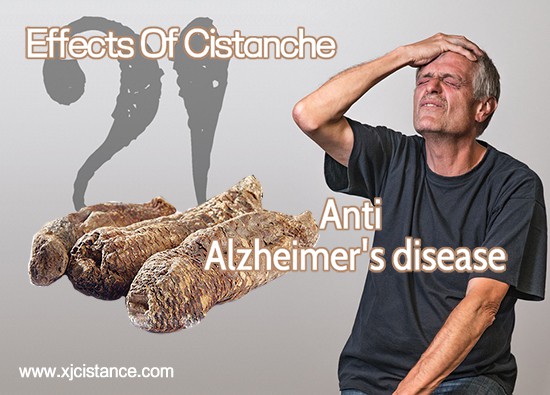
Benefits of cistanche tubulosa-Anti Alzheimer's disease
GCs have a certain protective effect on learning and memory ability, which can increase the total protein content and total antioxidant capacity of brain tissue in SAM-P/8 mice, and reduce acetylcholinesterase activity and serum interleukin II content [14]. Liu Fengxia et al. [15, 16] found that GCs can respectively increase β- Amyloid peptide( β- AP and quinolinic acid (QA) induced learning and memory abilities in AD mice. Its mechanism may be related to its enhancement of free radical scavenging enzyme activity, reduction of lipid peroxidation reaction, reduction of brain tissue calcium content, and inhibition of cell apoptosis. Roland [17] also found that GCs have a protective effect on learning and memory impairment in a mouse model of AD induced by subcutaneous injection of aluminum chloride (AlCl3) (SC). GCs can inhibit platelet aggregation in the body, thereby achieving the effect of preventing vascular dementia (VD) [18]. Studies have found that GCs can inhibit AChE activity and maintain normal levels of acetylcholine (ACh) in the brain [19].
The protective effect of 5 on cerebral ischemia-reperfusion injury
Desert living cistanche-Anti Alzheimer's disease
After cerebral ischemia and cerebral ischemia-reperfusion, the activity of NOS increases, and the activity of oxygen-free radical scavenging enzymes decreases, especially after cerebral ischemia-reperfusion. Three doses of GCs, 62.5125250 mg/kg, can significantly inhibit the activity of NOS in brain tissue, indicating that GCs have a protective effect on cerebral ischemia-reperfusion injury [20]. Zhan Heqin et al. [21] observed indicators such as electroencephalogram (EEG) and cerebral cortex tissue Ca2+, Na+, and water content in gerbils, and found that Tianma Xingnao Capsule, a drug containing Cistanche deserticola, can reduce the Ca2+concentration in the cortex of gerbils after cerebral ischemia-reperfusion injury. This suggests that the drug can protect neurons from damage caused by ischemia and hypoxia by preventing calcium overload. Wang Xiaowen et al. [22] studied the pathological changes of hippocampal CA1 neurons, which are most sensitive to ischemia, after cerebral ischemia and ischemia-reperfusion. The results showed that the percentage of cerebral infarction in the GCs group was significantly reduced, significantly improving the pathological morphological changes of brain tissue in the hippocampal CA1 region of mice with cerebral ischemia and ischemia-reperfusion, and reducing apoptotic cells.

Click here to view Cistanche Improving Memory and Prevent Alzheimer's Disease products
【Ask for more】 Email:cindy.xue@wecistanche.com / Whats App: 0086 18599088692 / Wechat: 18599088692
Brain injury is an irreversible physiological process, and the neuroprotective effect of Cistanche deserticola has received increasing attention from scholars. It is urgent to develop an effective drug to treat brain injury. However, the metabolism of Cistanche deserticola in the body and the study of its metabolites have not been reported yet, and further research is needed.