Risk Factors For Acute Kidney Injury And Death in Patients Infected With The Yellow Fever Virus During The 2018 Outbreak in Sao Paulo, Brazil
Jun 08, 2022
For more info. contact tina.xiang@wecistanche.com
Introduction: There have been few studies investigating acute kidney injury(AKI) in patients with yellow fever(YF). The objective of this study was to identify the risk factors for AKI and death in such patients. Methods: We evaluated 95 consecutive critically ill adult patients with the sylvatic form of YF, as confirmed by reverse-transcriptase polymerase chain reaction, in Brazil, The outcome measures were AKI(as defined by Kidney Disease: Improving Global Outcomes [KDIGO] criteria) and in-hospital death.
Results: Of the 95 patients,73(76.8%)had AKI, and 59(62.1%) died from it. A total of70 patients (73.7%)required dialysis because of AKI. After adjusting for age, sex, and the Simplified Acute Physiology Score 3 (SAPS 3), we found that elevated fractional excretion of sodium and requiring dialysis were independent risk factors for in-hospital mortality and that proteinuria correlated with AKI-associated mortality.
Conclusion: Our findings indicate that, in patients with sylvatic YF, AKl is common and is associated with significant mortality. The data presented here could prove useful for improving understanding of the pathogenesis of AKI in YF and informing decisions regarding the care of the affected patients.
YF is an epidemic-prone mosquito-borne disease that typically manifests as an influenza-like illness, being self-limited in most cases. Up to 25% of individuals infected with the YF virus (YFV) develop severe or fulminant multisystem YF owing to an imbalance between the immune and inflammatory responses, the reported lethality of that form of the disease is 60%.1 AKI has been identified as a major risk factor for YF-related mortality. Nevertheless, there have been few studies evaluating the frequency of, risk factors for, and clinical course of YF-associated AKI. Most of the existing information on YF-associated AKI is from case reports, small case series, or small experimental studies.
A number of risk factors have been implicated in the development of AKI in critically ill patients with YF, such factors including hemodynamic instability/shock, glomerular/vascular deposition of fibrin, an unbalanced inflammatory response, direct effects of YF viruses on the kidney tissue, and bilirubin-induced tubular toxicity. Histologic studies of patients with YF have revealed that the disease results in mild proliferation of mesangial cells, swelling of the endothelial cells, fibrinogen deposition in the glomerular capillary loops, interstitial/tubular cell edema, bile staining, and granular/hyaline casts in the distal tubules. In patients who died from YF, the YFV-specific antigen has been detected by immunohistochemistry in the kidneys, which is suggestive of direct viral injury. Acute tubular necrosis, interstitial nephritis, and glomerular injury, including viral mRNA in the kidney tissue, have also been observed in necropsy studies of YFV-infected monkeys. Here, we present the clinical and biochemical characteristics of AKI in critically ill patients infected with YFV during the 2018 outbreak in the city of Sao Paulo, Brazil. We also address aspects of dialysis therapy and outcomes among those patients.

Click here to learn what is cistanche used for
METHODS
In Sao Paulo, Brazil, the largest city in Latin America, there was an outbreak of sylvatic YF from December 2017 to May 2018. During that period, a referral system was established, in which critically ill patients with suspected or confirmed YF were admitted to the Hospital das Clinicas of the University of Sao Paulo School of Medicine. To be transferred to one of the intensive care units (ICUs)of the hospital, patients needed to be≥18 years of age and to have developed sudden-onset high fever accompanied by jaundice or bleeding, with at least one of the following features: serum aspartate aminotransferase or alanine aminotransferase level >3000 U/l; prothrombin international normalized ratio >1.5; platelet count <90,000/mm; AKI; encephalopathy; or hemodynamic instability.
After admission, YFV infection was confirmed by reverse-transcriptase polymerase chain reaction, serology, or both, in blood samples. The diagnosis of AKI, as defined in the KDIGO clinical practice guideline, was based solely on an increase in serum creatinine(SCreat) level from baseline to 72 hours after ICU admission. Urine output was measured on the first day of dialysis.
To reduce delays in management and improve treatment efficacy, renal replacement therapy was used if the SCreat level was ≥2.0 mg/dl or urine volume was <0.5 ml/kg per hour in an 8-hour period, in the presence of at least one of the following: vasoactive drug use; mechanical ventilation; noninvasive ventilation with a fraction of inspired oxygen >40%; pulmonary congestion; bleeding; positive fluid balance; encephalopathy; ammonia level ≥100 μmol/l; and bi-carbonate level ≤15 mEq/l. This protocol was created by our AKI group.
The choice between sustained low-efficiency dialysis and continuous venovenous hemodialysis (CVVHD) as the initial renal replacement therapy modality was based on the clinical profile of the patient, with special attention being paid to the hemodynamic status, and presence of encephalopathy, and correction of acidosis. Complete recovery of renal function was defined as a postdischarge SCreat level≤10% higher than baseline. If there was no reliable baseline SCreat level on record, we used the lowest SCreat level obtained during hospitalization or we estimated the baseline SCreat level using the Modification of Diet in Renal Disease formula with an assumed glomerular filtration rate of 75 ml/min per 1.73 m² for all patients. The SCreat level was used to diagnose and stage AKI on the basis of the KDIGO criteria. We also evaluated SCreat levels at 3,6, 9, and 12 months after hospital discharge. All dialysis sessions were analyzed in terms of the renal replacement therapy method (CVVHD or sustained low-efficiency dialysis), catheter insertion site, duration, electrolyte concentration, and volume removed. We also calculated the SAPS3, as a predictor of in-hospital mortality, including the Sequential Organ Failure Assessment score, the Model for End-Stage Liver Disease score, and the Acute Physiology and Chronic Health Evaluation II SCOre.
The study protocol (reference number 3.401.962)was approved by the local institutional review board. al (noninterventional), Because of the observational retrospective nature of the study, with guaranteed confidentiality, the requirement for informed consent was waived. All analyses were based on the laboratory tests performed at admission or within the first 48 hours after admission.
Statistical Analysis
Continuous variables were described as mean and SD if they followed a normal distribution and as median and interquartile range (IQR)if they had an asymmetric distribution. The Shapiro-Wilk test was used to test for normality of the data distribution. Comparisons between groups, namely survivors versus non-survivors and AKI versus no AKI, were made with a Student t-test or the Mann-Whitney U test for continuous variables and with the test or Fisher exact test for categorical variables.
Multivariable logistic regression analyses were performed to evaluate the association of clinical and biochemical variables with the outcome of in-hospital death. Results are displayed as odds ratios (ORs) and 95%CIs. The level of statistical significance was established at P<0.05. We constructed a Kaplan-Meier curve for survival since hospital admission. Statistical analyses were performed with R software (version 3.2.5; R Foundation for Statistical Computing, Vienna, Austria) and the Predictive Analytics Software package, version 18.0 (SPSS Inc., Chicago, IL).

RESULTS
From 2017 to 2018, a total of 1470 suspected cases of YF were reported in the Metropolitan Area of Sao Paulo. Among those 1470 cases, YFV infection was confirmed in 571 (38.8%).Among the 513 patients (89.8%)who
were residents of the Metropolitan Area of Sao Paulo, there were 192 deaths, translating to a mortality rate of 37.4%.
Our sample comprised 15 women (2 of whom were pregnant) and 80 men. The median age was 42.0 years (IQR: 31.0-55.0 years).In all the patients, YFV infection was confirmed by reverse-transcriptase polymerase chain reaction, serology, or both, in blood samples. Comorbidities were present in 25 patients: hypertension, in 12; diabetes mellitus, in 3; hypertension plus diabetes mellitus, in 3; immunosuppression, in 2;
obesity in l; and cardiovascular disease, in 4. There were 21 patients who had a history of alcohol use disorders.
The clinical and biochemical characteristics of the patients admitted to the ICU with severe YF are found in Table l, which also reveals a comparison between the survivors and nonsurvivors. The median time from the onset of symptoms to hospital admission was 5 days (IQR:4-7 days), and the median time from onset of symptoms to death among the nonsurvivors was 9.0 days (IQR: 7-12 days).

The univariate analysis revealed that in-hospital mortality correlated with the following variables(P<0.001 for all):SAPS3(OR=1.01;95% CI:1.005-1.019);mechanical ventilation(OR = 6.44; 95%CI:3.19-13.006);amylase (OR = 1.006; 95% CI:1.003-1.009);ammonia(OR=1.014;95%CT:1.008-1.020); aspartate aminotransferase(OR = 1;95% CT:1.000-1.000);alanine aminotransferase(OR = 1; 95%CI:1.000-1.000); lactate(OR = 1.038;95% CI:1.019-1.057);lactate dehydrogenase (OR = 1;95%1.000-1.000);potassium(OR=1.27;95%CI:1.14-1.41); and phos-phorus (OR = 1.26;95%CI:1.14-1.39).
In the multivariate analysis, requiring dialysis was associated with in-hospital mortality (crude OR=29.3;95%CI:8.69-137.13, P<0.001). After adjusting for the SAPS 3, age, and sex, we found that requiring dialysis was still clearly an independent risk factor for in-hospital mortality(OR=15.58;95% CI:4.23-76.57, P<0.001), as was the fractional excretion of sodium (Table 2).

AKI Characteristics
A nephrology consultation was requested for 73 (76.8%)of the 95 patients evaluated. Of those patients, 70 presented AKI at ICU admission and the 3 remaining patients had developed AKI during the ICU stay.
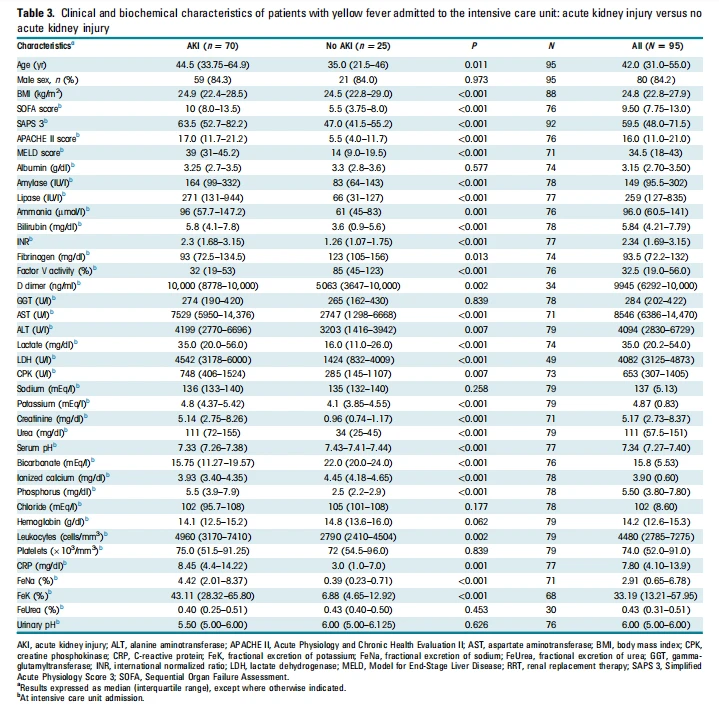
The median hospital stay was longer for patients with AKI than for those with normal renal function—29 days(IQR:11-184 days) versus 7 days (IQR:3-13 days)—and the difference was statistically significant (P=0.005). The clinical and biochemical characteristics of the AKI and non-AKI groups are found in Table3. Urinalysis was performed in 57 (78.1%) of the 73 patients in the AKI group and in 19(86%)of the 22 patients in the non-AKI group. Proteinuria level>lg/g urinary creatinine was more common in the AKI group than in the non-AKI group(85.7%vs.52.4%;P=0.005). In the AKI group, the mean proteinuria level was 4.7±6.2 g (range: 0-60 g)protein/g urinary
creatinine. Of the 57 patients in the AKI group who submitted to urinalysis,25(43.8%) presented with nephrotic proteinuria. Granular casts were identified in 47.4% of the patients in the AKI group, compared with only 27.3%of those in the non-AKI group(P=0.095). For all 73 patients followed by the nephrology team, the KDIGO criteria were used at ICU admission, the AKI thus being classified as stage 0 in 8 patients(11.0%), stage in 9(12.3%), stage 2in6(8.2%), and stage3in 50 (68.5%).
There were 7 patients who underwent liver transplantation, and 4(57.1%)of those patients died during the postoperative period. The molecular adsorbent recirculating system was used, as a bridge to liver transplantation, in 4 patients.

AKI-Associated Mortality
Of the 73 patients with AKI,58 (79.5%) died. Among those patients, in-hospital mortality was found to be associated with mechanical ventilation, a high Sequential Organ Failure Assessment score, vasopressor use, and a high international normalized ratio, together with low factor V activity, low bicarbonate level, low ionized calcium level, low urine output, and high levels of ammonia, amylase, aspartate aminotransferase, alanine aminotransferase, potassium, phosphorus, lactate, and lactate dehydrogenase (Table 4). We found that proteinuria level >2.6 mg/g creatinine at ICU admission and a KDIGO stage of 2 or 3 were associated with higher mortality. Dialysis Of the 95 patients evaluated, 70 (74%)required dial-ysis, corresponding to 95% of the 73 YFV-infected patients followed by the nephrology team. Furthermore,1 pregnant woman died from AKI before the nephrology consultation, and another patient died before starting dialysis. Applying the KDIGO criteria on the day of the first dialysis session, we classified the AKI as stage 0in 3 patients(4.1%), stage line 1(1.4%), stage 2in 2(2.7%), and stage 3in 64(87.7%). Dialysis for patients with AKI classified as stage 0 or l was due to severe metabolic acidosis and elevated serum ammonia levels.

The initial dialysis method was CVVHD in 47 of the 70 patients (67.2%)dialyzed. Because of the increased risks of blood dyscrasia and liver failure associated with the use of heparin and citrate, dialysis was performed without anticoagulation. Temporary catheters were used in all 70 patients, with the main insertion sites being a femoral vein in 39(55.7%)and the right jugular vein in 28 (40.0%).
There were 3 patients who had severe acidemia and therefore required dialysis that was started at a higher concentration of bicarbonate—mean of 38±6 mEq/l; median of 35 mEq/l (IQR: 35-50 mEq/). Because the patients in our sample were in liver failure and some had cerebral edema, sodium concentration in the dialysate was a major concern. Nevertheless, because most had low serum sodium concentrations at admission, the increase in sodium during dialysis was slow and gradual. Therefore, the sodium concentration in the dialysate was typical—mean of 141.0 ± 4.4 mEq/l;median of 139.5 mEq/l (IQR:131.0-150.0 mEq/l).
Dialysis was initiated within the first 12 hours after hospital admission in 34(48.6%)of the 70 patients dialyzed, and only 6(8.6%)underwent dialysis >48 hours after admission. The dialysis method was changed in 30(42.9%)of the cases, with 19(63.3%)being switched from sustained low-efficiency dialysis to CVVHD because of rapid clinical worsening.
The median duration of the CVVHD sessions was 42 hours (IQR: 17-127 hours), and the median volume removed was 43 ml/h (IQR:12-82 ml/h), translating to final hourly ultrafiltration values ranging from 0.00 ml/kg to 1.50ml/kg of the admission body weight.Table5 compares the survivors and nonsurvivors among the patients on dialysis. Supplementary Figure Sl reveals the Kaplan-Meier curve for survival since a hospital admission, comparing the patients who required dial-ysis with those who did not.

Renal Function Recovery
Of the 15 patients who survived, 14 required dialyzes during hospitalization but not after discharge. There was only one who progressed to end-stage renal dis-ease, and, at this writing, that patient is undergoing dialysis 3 times a week at our dialysis facility. We followed 12 of the 15 patients after hospital discharge. The median time to AKI recovery(time from the first dialysis session to discharge from nephrology) was 24 days (IQR: 10-38 days).The mean SCreat level at 30,60, 90, 180, and 365 days after hospital discharge was 1.05 ±0.29,1.14±0.42,1.09±0.42,1.08±0.40,and 1.03 ±0.30 mg/dl, respectively. All but one of the 15 patients had complete recovery of renal function.

DISCUSSION
There is a paucity of data regarding AKI in YFV infection. In patients with YF, early renal changes have been found and AKI is most often observed before death.'In one recent study, also conducted in Brazil, a SCreat level ≥1.2 mg/dl was found to be an independent risk factor for mortality among patients with YF.
In cases of YF, renal dysfunction develops between the fifth and seventh days after symptom onset, mainly in severe cases, including those that evolve to azotemia, proteinuria, or anuria. Plasma urea levels >100 mg/dl have been associated with higher mortality in YF. " As previously mentioned, the possible pathophysiological mechanisms of YF include hemodynamic instability/shock, glomerular/vascular deposition of fibrin, an unbalanced inflammatory response, the direct effects of YFVs on the kidney tissue, and bilirubin-induced tubular toxicity. An autopsy study, also conducted at our hospital during the 2018 outbreak, revealed that acute tubular necrosis and mesangial proliferative glomerulonephritis were the main kidney alterations responsible for AKI development in YFV-infected patients. Other studies have revealed that YFV can be detected in the semen and urine up to 21 days after the onset of symptoms, which suggests that the genito-urinary tract is a persistent reservoir of the virus.
In an autopsy study, Duarte-Neto et al.analyzed 4 of the fatal cases of YF among the patients treated at our hospital during the 2018 outbreak. Those authors described pathologic findings similar to ours, including YF antigens detectable by immunohistochemistry in the tubular cells. They also reported a novel finding: YF RNA detectable by a reverse-transcriptase polymerase chain reaction in human kidney tissue samples.
In the present study, dialysis and mechanical ventilation were found to be risk factors for mortality. Liver failure, as indicated by the Model for End-Stage Liver Disease score, liver enzyme levels, lactate dehydrogenase level, and factor V activity, underscores the importance of hemorrhagic events owing to fulminant liver failure in YF-associated mortality. Lipase level was also found to be an independent risk factor for in-hospital mortality, which indicates that a pancreatitis is a relevant event in the outcome of YF. The high prevalence of pancreatitis in our sample was a surprising finding, which has been attributed to worse outcomes in patients with YF.18,19
In our study, imbalances in serum electrolyte levels, such as elevated phosphorus, elevated potassium, and low calcium, were also correlated with mortality. That is probably due to severe YF-induced multiorgan cellular injury mainly affecting the liver, striated muscle, and kidneys. We also found that acidosis and elevated lactate levels correlated with disease severity, with some patients presenting very low levels of serum bicarbonate even in the presence of hemodynamic stability.
The predominance of males among our patients who died from YF might be explained by the greater exposure to YF vectors and lower vaccination rate among men. As expected, age and severity scores (Sequential Organ Failure Assessment, SAPS 3, Acute Physiology and Chronic Health Evaluation II, and Model for End-Stage Liver Disease) were independent variables that had a negative impact on the clinical outcomes. In a recent study involving >200 patients with laboratory-confirmed YF of varying clinical advanced age, male sex, leukocytosis, verities,20 elevated aspartate aminotransferase/alanine aminotransferase level, elevated total bilirubin level, elevated creatinine level, altered prothrombin time, and increased plasmatic RNA viral load were found to be predictors of mortality, similar to what was found in the present study.
Among the patients followed by our nephrology team (i.e., the patients with AKI), urinalysis revealed leukocyturia, hematuria, cylindric, and proteinuria. Nephrotic proteinuria, possibly related to glomerular injury, was identified in 44% of the samples. Previous studies have revealed that patients with YF have a glomerular injury with basement membrane duplication, together with mesangial proliferative glomerulonephritis, acute tubular necrosis, and interstitial nephritis.
Despite the renal tubular injury, urine density and urinary pH were normal in our patient sample. These findings should not be underestimated, because glomerular injury (probably caused by the virus) is a major indicator of severity (mortality being 84% in this scenario). Future studies should address the pathophysiological mechanisms of YF-induced glomerular injury and its impact on mortality, which remains unclear.
In our patient sample, the survivors had lower fractional excretions of sodium and potassium, suggestive of renal tubular integrity. In contrast, all the patients who were followed by the nephrology team presented higher fractional excretions of sodium and potassium, which are suggestive of acute tubular injury, and urine output at admission was lower in the nonsurvivors.
We also found that the use of CVVHD was associated with higher in-hospital mortality, which was attributed to the fact that the patients requiring that dialysis modality presented with a worse clinical picture (hemodynamic instability) at ICU admission. Nevertheless, long-term follow-up failed to reveal a difference between CVVHD and sustained low-efficiency dialysis, in terms of the mortality rate. Fewer than half of our patients were submitted to dialysis within the first 12 hours after hospital admission. That could be explained by the fact that the patients would need to receive plasma and platelets before insertion of the dialysis catheter. We hypothesize that the delay in starting dialysis had an impact on survival.
To our knowledge, ours is the first study to report the frequency of, risk factors for, and clinical course of YF-associated AKI and is the first to evaluate postdischarge renal function in YFV-infected patients with AKI. After 3 months from hospital discharge, complete recovery of renal function was achieved in 75% of the AKI survivors, with only one of whom remained dialysis-dependent. We found no association between previous renal dysfunction and partial recovery of renal function after YF-associated AKI. Although all of our patients with AKI presented proteinuria at ICU admission, only one still had proteinuria after renal recovery. In that patient, renal biopsy results revealed IgA nephropathy. The remaining 25%of the AKI survivors achieved late partial recovery of renal function, which indicates that there is a need for longer follow-up periods in such patients.
CONCLUSION
In summary, the severe form of YF progresses rapidly and leads to multiple organ failures, with a high mortality rate. In our study, death occurred only in the patients who developed AKI. It is likely that the development of AKI in patients with YF involves multiple mechanisms, including hemodynamic instability, liver failure, and a direct effect of YFV on the kidney. Our findings suggest that certain clinical and biochemical indicators can help clinicians recognize potentially fatal cases of YF.In YFV-infected patients who develop AKI, renal function should be monitored after hospital discharge.