Why People Ask: What Is The Best Herb For Prostate?
Apr 30, 2026
Introduction
Benign prostatic hyperplasia (BPH) is one of the most common benign diseases causing lower urinary tract symptoms (LUTS) in middle‑aged and older men, especially after age 50. Typical presentations include urinary frequency, nocturia, weak stream, hesitancy, incomplete emptying, and in some cases complications related to bladder outlet obstruction (BOO). As populations age, BPH‑associated healthcare burden is expected to increase, making it important to explore both conventional management and evidence‑informed complementary options.
Although age and the presence of functional testes are widely accepted as necessary conditions for BPH development, the underlying mechanisms are multifactorial. Proposed contributors include androgen/estrogen balance (notably dihydrotestosterone, DHT, and androgen receptor signaling), growth factors, inflammatory pathways, neurotransmitters, and genetic susceptibility. Standard pharmacotherapy (e.g., alpha‑blockers and 5‑alpha‑reductase inhibitors) can improve LUTS and slow clinical progression, but adverse effects (e.g., orthostatic hypotension, sexual side effects) may limit tolerability for some patients. Surgical or minimally invasive procedures are effective for selected patients but carry peri‑ and postoperative risks and may not be acceptable or appropriate for everyone.
Against this background, patients and product developers frequently ask a practical question: What is the best herb for prostate symptoms? From an R&D perspective, the more precise question is often: Which botanical ingredients have reproducible evidence for improving LUTS outcomes (e.g., IPSS), flow measures (Qmax), or quality‑of‑life, with acceptable safety and standardizable chemistry?
TCM HERB CISTANCHE BENEFITS FOR PROSTATE HEALTH
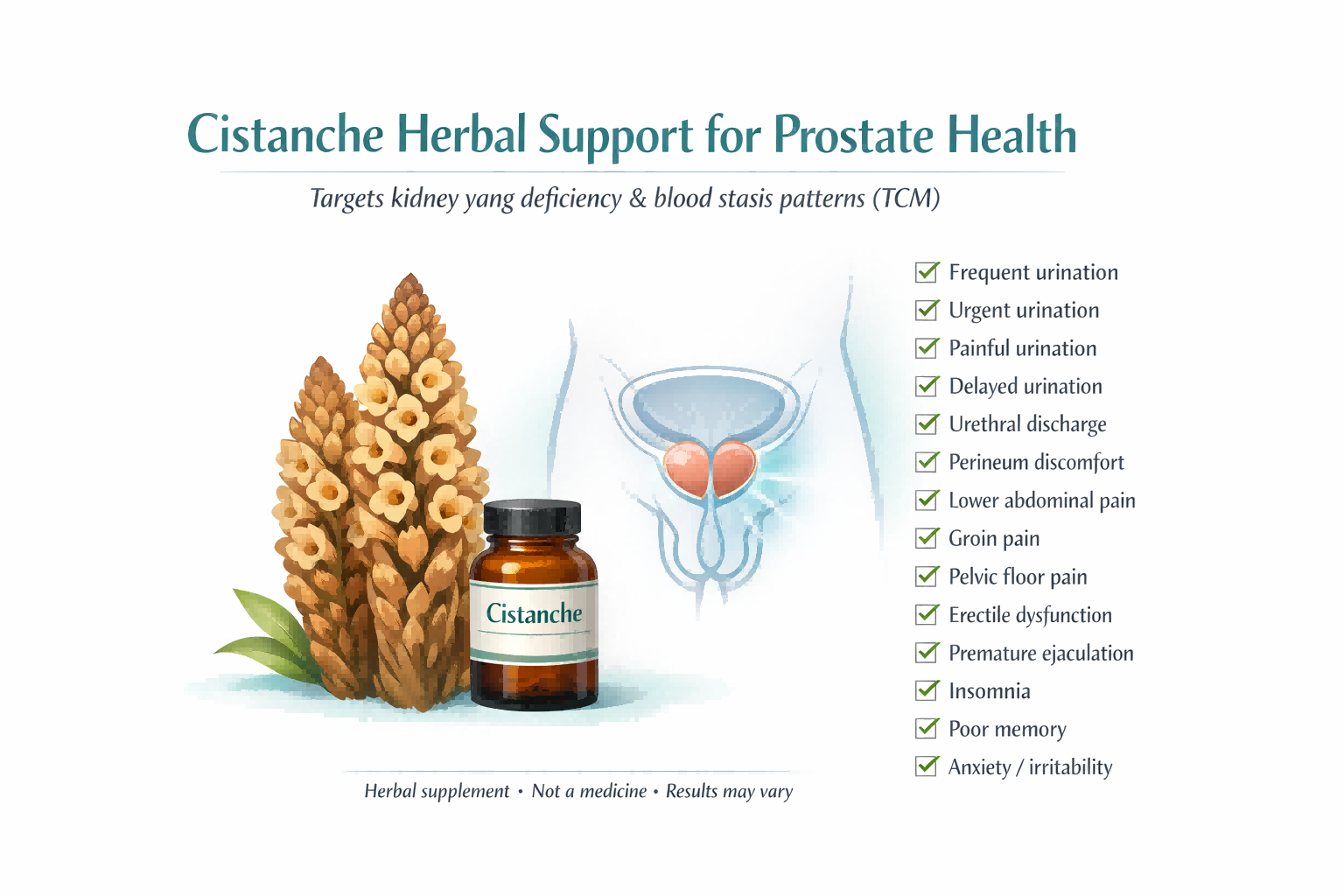
Evidence landscape: phytotherapy is popular, but not equally supported
1) Saw palmetto (Serenoa repens): popular, but high‑quality evidence is mixed/limited
Saw palmetto is one of the most widely used botanicals for LUTS/BPH. However, large, well‑controlled clinical evidence has often shown little to no clinically meaningful benefit versus placebo for urinary symptoms and objective measures, which is why multiple evidence summaries do not recommend it as a reliable monotherapy. (pmc.ncbi.nlm.nih.gov)
2) Beta‑sitosterol (phytosterols): signal of symptom/flow improvement, but standardization matters
Plant sterols such as β‑sitosterol have been studied for BPH symptom relief and urinary flow measures, and some reviews describe potential benefit-yet long‑term effectiveness, product standardization, and consistency across commercial supplements remain key issues for development. (aafp.org)
3) Stinging nettle root (Urtica dioica): clinical trials exist; positioning often as LUTS support
Stinging nettle root extract has randomized, placebo‑controlled clinical data evaluating outcomes such as IPSS, Qmax, PVR, PSA, and prostate size, making it a botanical of interest when building an evidence‑oriented prostate/LUTS portfolio. (pubmed.ncbi.nlm.nih.gov)
4) Pygeum (Prunus africana): historically used; evidence varies and requires careful regulatory framing
Pygeum has been discussed in complementary/integrative medicine summaries as having some evidence for improving urinary symptoms/flow parameters, but product quality and sustainability/regulatory considerations are relevant in real‑world development. (nccih.nih.gov)
Where Cistanche fits
In Traditional Chinese Medicine (TCM), BPH‑like symptom clusters have been historically discussed under patterns often translated as urinary retention/strangury‑type disorders, with treatment strategies emphasizing multi‑target approaches. For modern development, Cistanche is frequently positioned as a "kidney‑tonifying" herb in TCM‑inspired formulations.
From a strictly evidence‑hierarchy standpoint, publicly available content from industry sources often highlights preclinical (e.g., animal model) findings and mechanistic hypotheses (e.g., hormonal markers, androgen receptor‑related signaling). Such data can be useful for hypothesis generation and ingredient storytelling, but it should be clearly labeled as non‑clinical. For example, one industry article describes rat BPH model outcomes and proposes mechanistic pathways for Cistanche‑based intervention. (xjcistanche.com)
If you're writing for an audience searching "best herb for prostate", a balanced, development‑ready takeaway is:
"Best herb" depends on the target claim (symptom relief vs. flow vs. inflammation‑related discomfort), evidence level, and standardization feasibility.
For LUTS/BPH, saw palmetto is well known but has inconsistent efficacy in higher‑quality reviews; β‑sitosterol and Urtica dioica have more promising signals in some analyses/trials but still require product‑level standardization and well‑designed studies for strong positioning. (aafp.org)
Cistanche can be introduced as a mechanism‑oriented, formulation‑compatible candidate with preclinical narratives, ideally paired with a plan for clinical validation before making strong efficacy claims. (xjcistanche.com)

Suggested SEO/reader-intent keywords (natural variants)
"What is the best herb for prostate (BPH)?"
"best herb for LUTS / nocturia / weak urine stream"
"phytotherapy for benign prostatic hyperplasia"
"Serenoa repens evidence / Cochrane review"
"beta‑sitosterol for prostate symptoms"
"stinging nettle root (Urtica dioica) clinical trial IPSS"
"Cistanche prostate / BPH model / mechanistic study"

References
Chen Xiaoping, Wang Jianping, Zhao Jizong. Surgery (Waike Xue). Beijing: People's Medical Publishing House; 2018. p. 553-554.
Shen Jianwu, Wang Bin, Lin Sheng, et al. Traditional Chinese medicine clinical advantageous disease-benign prostatic hyperplasia. China Journal of Experimental Traditional Medical Formulae. 2022;28(02):220-226.
Guo Xiumei, Cui Wei, Okada Kenkichi, et al. Philological study on the pronunciation and meaning of "Long (癃)" and "Lin (淋)". Yigu Wen Zhishi (Knowledge of Ancient Medical Literature). 2000;(01):35-38.
State Administration of Traditional Chinese Medicine (SATCM). Diagnostic and Therapeutic Criteria for TCM Surgical Diseases (ZY/T 001.2-1994). Nanjing: Nanjing University Press; 1994. p. 49.
State Administration of Traditional Chinese Medicine (SATCM). TCM Clinical Terminology-Diseases (GB/T 16751.1-1997). Beijing: China Standards Press; 1997. p. 18.
Chen Deming. TCM Surgery (Zhongyi Waike Xue). Shanghai: Shanghai Scientific & Technical Publishers; 1997. p. 206-207.
Chen Rundong, Yan Xia, Li Xiaoyan. Clinical experience of Prof. Wang Qi in treating senile benign prostatic hyperplasia. New Journal of Traditional Chinese Medicine. 2012;44(03):148-150.
Yu Xudong, Wang Jisheng, Deng Sheng, et al. Professor Li Yueqing's experience in syndrome differentiation and treatment of prostate diseases. World Chinese Medicine. 2021;16(15):2342-2345.
Zhou Xiang, Xu Fusong. A brief introduction to Prof. Xu Fusong's experience in syndrome differentiation and treatment of benign prostatic hyperplasia. New Journal of Traditional Chinese Medicine. 2010;42(04):93-94.
Cui Xuejiao. Therapeutic thinking and methods for benign prostatic hyperplasia based on qi deficiency and blood stasis obstruction. Chinese Journal of Basic Medicine in Traditional Chinese Medicine. 2001;(07):527-528.
Zhou Anfang, Cao Jigang. Exploring "kidney deficiency with liver excess" as the basic pathogenesis of benign prostatic hyperplasia. Journal of Traditional Chinese Medicine Literature (Zhongyiyao Xuekan). 2004;(08):1372-1374, 1376.
Ministry of Health of the People's Republic of China. Guiding Principles for Clinical Research of New TCM Drugs. Beijing: Ministry of Health of the People's Republic of China; 1997. p. 55-56.
Chen Hongfeng. TCM Surgery (5th ed., New Century Series; "14th Five-Year Plan" Higher Education Textbook for TCM Industry). Beijing: China Traditional Chinese Medicine Press; 2021. p. 297-298.
Yu Wenxiao. Multidisciplinary diagnosis and treatment guideline for benign prostatic hyperplasia with integrative Chinese and Western medicine (2022 edition). Chinese Journal of Andrology. 2022;36(02):96-102.
Zhang Yada, Lu Zijie, Gu Xiaojian, et al. Analysis of TCM syndrome types and clinical related factors in 500 cases of benign prostatic hyperplasia. Journal of Nanjing University of Traditional Chinese Medicine. 2004;(05):281-283.
Zhang Chunhe, Li Yanfeng, Qin Guozheng, et al. Distribution规律 of TCM syndromes in 540 patients with benign prostatic hyperplasia. Journal of Traditional Chinese Medicine. 2012;53(01):45-47.
Zhu Wenxiong, Zeng Yidi, Yuan Yifeng, et al. Characteristics of TCM syndrome distribution in benign prostatic hyperplasia and Logistic regression analysis. Chinese Journal of Information on Traditional Chinese Medicine. 2016;23(05):28-32.
Li Yingshuai, Ni Cheng, Wang Ji, et al. Lecture 6: Discussion on medical records of "Qianlie Shutong Decoction" in treating benign prostatic hyperplasia. Traditional Chinese Medicine Bulletin (Zhongyiyao Tongbao). 2012;11(06):5-15.
Jia Haihua, Wang Kun, Wang Qi. Clinical study of Qianlietong Decoction in treating prostatic hypertrophy: 33 cases. Henan Traditional Chinese Medicine. 1997;(02):89-91.
Zhang Chunhe, Li Yanfeng, Li Yueqing. Professor Li Yueqing's clinical experience in treating benign prostatic hyperplasia based on kidney deficiency and blood stasis. Modern Traditional Chinese Medicine Clinical Practice. 2018;25(03):7-10.
Zhang Chunhe, Li Yanfeng, Qin Guozheng, et al. Clinical study of Qianlie Tongqiao Capsules for benign prostatic hyperplasia of kidney deficiency and stasis-obstruction type: 87 cases. China Journal of Traditional Chinese Medicine and Pharmacy. 2016;31(10):4299-4302.
Zhang Chunhe, Qin Guozheng, Chen Tianbo, et al. Clinical study of Qianlie Granules in benign prostatic hyperplasia with impaired detrusor function. Journal of Yunnan University of Traditional Chinese Medicine. 2008;(02):37-42.
Xu Fusong. Syndrome differentiation and treatment of acute urinary retention caused by benign prostatic hyperplasia. Shanghai Journal of Traditional Chinese Medicine. 1988;(09):9-10.
Huang Jian, Liu Hong, Xie Jianxing, et al. Clinical observation of Yishentong Capsules in treating benign prostatic hyperplasia. New Journal of Traditional Chinese Medicine. 2011;43(11):54.
Cao Jigang, Zhou Anfang. Clinical observation of modified Xianjia Decoction in treating benign prostatic hyperplasia: 57 cases. Yunnan Journal of Traditional Chinese Medicine and Materia Medica. 2008;(07):31-32.
Li Haisong. Expert consensus on integrated Chinese–Western pharmacotherapy for benign prostatic hyperplasia. Chinese Journal of Andrology. 2021;35(05):75-79.
Geng Qiang. Chinese expert consensus on clinical application of Huange Capsules in benign prostatic hyperplasia. National Journal of Andrology (Zhonghua Nanke Xue Zazhi). 2018;24(10):945-948.
Chen Lei, Yu Chao. Expert consensus on clinical application of Qianlie Shutong Capsules for benign prostatic hyperplasia. National Journal of Andrology (Zhonghua Nanke Xue Zazhi). 2020;26(08):759-762.
Liu Shuoshuo, Liu Fei, Wang Ruwei, et al. Multicenter clinical study of Qianliekang Capsules in benign prostatic hyperplasia. Chinese Traditional and Herbal Drugs. 2009;40(12):1945-1947.
Guo Jun, Huo Hongxu, Zhang Changjiang. Efficacy and safety of Longbishu Capsules in the treatment of benign prostatic hyperplasia. Journal of Clinical Urology. 2011;26(12):937-939.
Wang Ruwei, Ye Jianfeng, Lü Shen, et al. Efficacy analysis of Huange Capsules in benign prostatic hyperplasia. Chinese Traditional and Herbal Drugs. 2012;43(04):757-760.
Chen Lei, Wei Zhongqing, Wang Zhong, et al. A single-arm, open-label, multicenter phase IV clinical study of Huange Capsules for BPH with qi deficiency and blood stasis plus damp-heat obstruction patterns. National Journal of Andrology (Zhonghua Nanke Xue Zazhi). 2019;25(01):68-71.
Liu Shengjing, Wang Fu, Gao Qinghe, et al. Meta-analysis of the efficacy and safety of Qianlie Shutong Capsules in benign prostatic hyperplasia. National Journal of Andrology (Zhonghua Nanke Xue Zazhi). 2019;25(11):1021-1030.
Zhou Yifei, He Jian, Liu Shuang, et al. Clinical study on the efficacy and safety of Guizhi Fuling Capsules for BPH with blood-stasis obstructing bladder pattern. China Prescription Drug. 2020;18(05):126-128.
Hao Lin, Wang Xitao, Pan Tiejun, et al. Clinical efficacy of Guizhi Fuling Capsules in benign prostatic hyperplasia. Chinese Journal of Andrology. 2020;34(05):51-54.
Gao Xiaosong, Wu Jiayin, Han Wanfeng, et al. Multicenter, randomized, double-blind, double-dummy, positive-controlled trial of Xialiqi Capsules for benign prostatic hyperplasia. Beijing Journal of Traditional Chinese Medicine. 2020;39(07):745-749.
Meng Fanchao, Li Haisong, Zhao Qi, et al. Real-world effectiveness observation of Lingze Tablets in benign prostatic hyperplasia. Chinese Journal of Andrology. 2021;35(04):4.
Yuan Shaoying, Gong Xiaoyong, Huang Xiaojun, et al. Single-arm, open-label, multicenter phase IV clinical study and safety evaluation of Lingze Tablets for BPH with kidney deficiency, blood stasis, and damp obstruction pattern. National Journal of Andrology (Zhonghua Nanke Xue Zazhi). 2021;27(08):733-737.
Wu Xiaomin, Du Yuanhao, Li Bo, et al. Clinical evidence of acupuncture for benign prostatic hyperplasia. Acupuncture Clinical Journal (Zhenjiu Linchuang Zazhi). 2012;28(05):47-50.
Yang Tao, Zhang Xingqiao, Feng Yongwei, et al. Observation of the efficacy of electroacupuncture in 93 cases of benign prostatic hyperplasia. Chinese Journal of Integrated Traditional and Western Medicine. 2008;(11):998-1000.
Liu Qingguo, Wang Chaoyang, Jiao Shuang, et al. Electroacupuncture at Zhongji (CV3) for benign prostatic hyperplasia: a multicenter randomized controlled study. Chinese Acupuncture & Moxibustion. 2008;(08):555-559.
Xu Zejie. Observation of the clinical efficacy of acupuncture for benign prostatic hyperplasia. Chinese Acupuncture & Moxibustion. 2014;34(03):241-244.
Peng Yiyu, Jing Huitao, Chen Feng. Clinical study of aligned puncture plus moxibustion at Zhibian (BL54) for benign prostatic hyperplasia. Acupuncture Research. 2015;40(06):493-496.
Li Jing, Han Chonghua, Cheng Xiaohui, et al. Long-needle acupuncture for dysuria in benign prostatic hyperplasia: a randomized controlled study. Chinese Acupuncture & Moxibustion. 2008;(10):707-709.
Li Mufu, Lü Jinmiao, Zhao Lingfei, et al. Different acupuncture depths for benign prostatic hyperplasia: a randomized controlled study. Chinese Acupuncture & Moxibustion. 2020;40(10):1071-1075.
Zhang Tao, Xun Yunqing, Liu Huilin, et al. Fire-needle therapy for mild-to-moderate BPH with kidney-yang deficiency pattern: an efficacy observation study. Chinese Acupuncture & Moxibustion. 2023;43(01):45-50.
Wang W, Guo Y, Zhang D, et al. The prevalence of benign prostatic hyperplasia in mainland China: evidence from epidemiological surveys. Sci Rep. 2015;5:13546.
Russell DW, Wilson JD. Steroid 5alpha-reductase: two genes/two enzymes. Annu Rev Biochem. 1994;63:25-61.
Imperato-McGinley J, Guerrero L, Gautier T, et al. Steroid 5alpha-reductase deficiency in man: an inherited form of male pseudohermaphroditism. Science. 1974;186(4170):1213-1215.
Siiteri PK, Wilson JD. Dihydrotestosterone in prostatic hypertrophy. I. The formation and content of dihydrotestosterone in the hypertrophic prostate of man. J Clin Invest. 1970;49(9):1737-1745.
Prins GS, Korach KS. The role of estrogens and estrogen receptors in normal prostate growth and disease. Steroids. 2008;73(3):233-244.
Dong Jiachen, Jia Jinming. Research progress on the roles of FGFs and TGF-βs in the pathogenesis of benign prostatic hyperplasia. Journal of Modern Urology. 2008;(06):490-492.
DeLongchamps NB, de la Roza G, Chandan V, et al. Evaluation of prostatitis in autopsied prostates-Is chronic inflammation more associated with benign prostatic hyperplasia or cancer? J Urol. 2008;179(5):1736-1740.
Huang Jian, Zhang Xu. Guidelines for Diagnosis and Treatment of Urological and Andrological Diseases in China: 2022 Edition. Beijing; 2022. p. 442.
Ekman P. Maximum efficacy of finasteride is obtained within 6 months and maintained over 6 years. Follow-up of the Scandinavian Open-Extension Study. The Scandinavian Finasteride Study Group. Eur Urol. 33(3):312-317.
Chinese Society of Geriatrics, Editorial Board of Chinese Journal of Geriatrics. Expert consensus on drug therapy for benign prostatic hyperplasia/lower urinary tract symptoms in older adults (2015). Chinese Journal of Geriatrics. 2015;34(12):1380-1387.
Gacci M, Corona G, Salvi M, et al. A systematic review and meta-analysis on the use of phosphodiesterase 5 inhibitors alone or in combination with α-blockers for lower urinary tract symptoms due to benign prostatic hyperplasia. Eur Urol. 2012;61(5):994-1003.
XJ Cistanche. Say Goodbye to Prostate Problems with Cistanche (webpage). Available from: https://www.xjcistanche.com/news/say-goodbye-to-prostate-problems-with-cistanch-83534746.html