Acteoside: Research On Antioxidant And Antihypertensive Activity
Mar 14, 2022
Contact: joanna.jia@wecistanche.com
Antioxidant And Antihypertensive Activities Of Acteoside And Its Analogs
Chao-Hsiang CHEN1,2, Yin-Shiou LIN3, Mei-Yin CHIEN2,4, Wen-Chi HOU5,6,*, and Miao-Lin HU1,*
Abstract. Acteoside (Act), a phenylethanoid glycoside, is an active compound in several plants and traditional herbal medicines. Act along with its structural isomer, isoacteoside (Isoact), and an analog, 6-O-acety- lacteoside (6-O-acetylact), were used in the study to investigate the antioxidant, anti-angiotensin-converting enzyme (ACE), and hemolysis inhibitory activities in vitro and antihypertensive activity against spontaneously hypertensive rats (SHR) in vivo. We showed that Act, Isoact, and 6-O-acetylact effectively scavenged 1,1-diphenyl-2-picryl-hydrazyl radicals (with IC50 at 11.4, 9.48, and 9.55 μM, respectively) and superoxide radicals (with IC50 at 66.0, 38.5, and 39.1 μM, respectively). As Isoact and 6-O-acetylact had similar radical-scavenging activities, only Act and Isoact were used for the following studies. Both Act and Isoact inhibited xanthine oxidase activity with IC50 at 53.3 and 62.2 μM, respectively. Both Act and Isoact also significantly inhibited ACE activity and the hemolysis induced by 2,2’-azo-bis(2-amidinopropane)dihydrochloride, but the effects of Act were stronger than Isoact. We then orally administered a single dose ofAct or Isoact (10 mg/Kg body weight) to SHR and measured the changes of systolic blood pressure (SBP) and diastolic blood pressure (DBP) over 24 h. Act, but not Isoact, showed antihypertensive activity in lowering SBP and DBP. The results suggest the potential usefulness of the Act as a health food product for antioxidant protection and blood pressure regulation.
Keywords: Acteoside; Antihypertensive activity; Angiotensin-converting enzyme (ACE); Antioxidant; Hemolysis.
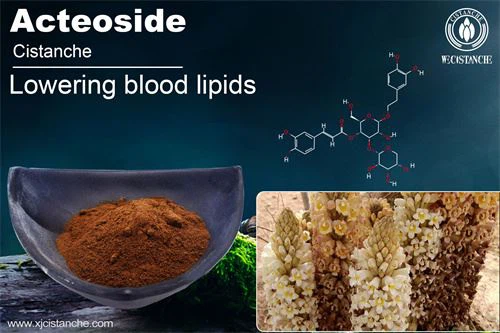
active ingredient acteoside in cistanche
IntroductIon
Acteoside (Act), a phenylethanoid glycoside containing caffeic acid, 3’,4’-dihydroxy phenylethanol, glucose, and rhamnose, was first isolated from flowers of Syringa Vul- garis (Birkofer et al., 1968), and together with the structural isomer of isoacteoside (Isoact) and the derivative of 6-O-acetylacteoside (6-O-acetylact), has been found in many plants and herbal medicines, such as Ligstrum purpurascens (Wong et al., 2001), Callicarpa dichotoma (Koo et al., 2006; Lee et al., 2006), Cistanche deserticola and Boschniakia rossica (Wu et al., 2006), Scrophularia ningpoenis (Huang et al., 2008), Rehmannia glutinosa (Li et al., 2006). The act was reported to exhibit antimetastatic activity on B16 melanoma cells in C57BL/6 mice models (Ohno et al., 2002). Act, Isoact, and 6-O-acetylact were recently shown to inhibit IL-1β-activated expression of intercellular CAM-1 and vascular CAM-1 in human umbilical vein endothelial cells (Chen et al., 2009). Act also protects bovine pulmonary endothelial cells from hydroxyl radical-induced oxidative stress (Chiou et al., 2004) and inhibits nitric oxide and TNF-α production through blocking of AP-1 activation in lipopolysaccharide-stimulated macrophages (Rao et al., 2009). Act and Isoact exhibit neuroprotective activities in vitro (Koo et al., 2005). Koo et al. (2006) reported that Act and its aglycones effectively scavenge 1,1-diphenyl-2-picryl-hydrazyl (DPPH) and nitric oxide in vitro. However, few studies have compared side-by-side the in vitro antioxidant activities of Act and its structurally related compounds such as Isoact and 6-O- acetylact.
Several classes of pharmacological agents have been used in the treatment of hypertension (Mark and Davis, 2000). One class of antihypertensive drugs, known as angiotensin I converting enzyme (ACE) inhibitors (i.e. peptidase inhibitors), has a low incidence of adverse side- effects and are the preferred class of anti-hypertensive
agents when treating patients with concurrent secondary diseases (Fotherby and Panayiotou, 1999). ACE (peptidyl- dipeptide hydrolase EC 3.4.15.1) is a dipeptide-liberating Zn-containing exopeptidase, which removes a dipeptide from the C-terminus of angiotensin I to form angiotensin II, a very hypertensive compound. Several antioxidant peptides (reduced glutathione and carnosine-related peptides) exhibit ACE inhibitory activities (Hou et al., 2003). The first clinically available, orally active ACE inhibitor, captopril, was developed for hypertensive treatments (Ondetti et al., 1977; Borer, 2007). The act has been reported to exert nitric oxide-mediated relaxing effects on the endothelium- intact aortic rings of SD rats (Wong et al., 2001). Ahmad et al. (1995) have reported that Act induces a dose-dependent decrease in systolic blood pressure (SBP) and diastolic blood pressure (DBP) following its intravenous injection into normotensive anesthetized Wistar rats. However, it is unclear whether orally administered Act and/or its related isomers are antihypertensive in vivo. In the present study, we investigated the in vitro antioxidant capacity and ACE inhibitory activities as well as the in vivo antihypertensive activity of Act, Isoact, and/or 6-O-acetylact using the spontaneous hypertensive rats (SHRs). These studies are expected to provide useful data for the development ofAct as a health food product.
Materials and Methods
Materials
2,2’-azo-bis(2-amidinopropane)dihydrochloride (AAPH), ACE (I unit, rabbit lung), butylated hydroxytoluene (BHT), DPPH, N-(3-[2-furyl]acryloyl)-Phe-Gly- Gly (FAPGG), NADH, phenazine methosulfate (PMS), xanthine, and xanthine oxidase were purchased from Sigma Chemical Co. (St. Louis, MO, USA). Captopril was purchased from Calbiochem Co. (CA, USA). Act, Isoact, and 6-O-acetylact (Figure 1) were purchased from Equal Corp. (purities > 98%, Shanghai, China). Other chemicals and reagents were from Sigma Chemical Co. (St. Louis, MO, USA).
Scavenging activity of Act, Isoact, and 6-O- acetylact against dPPH radicals by spectrophotometry
A volume (0.3 mL) ofAct, Isoact, and 6-O-acetylact (final concentrations were 1.56 to 50 µM), BHT and ascorbic acid (final concentrations were 2.4 to 60 µM) were added to 0.1 mL of 1 M Tris-HCl buffer (pH 7.9) and then mixed with 0.6 mL of 100 µM DPPH in methanol to a final concentration of 60 µM for 20 min under light protection at room temperature (Liu et al., 2004; Lin et al., 2008). The decrease of absorbance at 517 nm was measured and expressed as ΔA517 nm. Deionized water was used as a blank experiment. The scavenging activity of DPPH radical (%) was calculated with the equation: (ΔA517blank − ΔA517sample) ÷ ΔA517blank × 100. The IC50 stands for the concentration of half-inhibition.

Inhibitory activity of Act and Isoact against xanthine oxidase
The xanthine oxidase activity was measured by determining uric acid formation at 295 nm using xanthine as a substrate (Kalckar, 1947). The different amounts of Act and Isoact (the final concentrations were 25, 50, and 75 µM) were pre-mixed with 50 μL of 1 mU/mL xanthine oxidase at 4°C for 1 h, and then the 300 μL of 1 mM xanthine were added. The changes of absorbance at 295 nm were recorded over 2 min and expressed as ΔA295 nm/ min. The xanthine oxidase inhibitory activity (%) was calculated as follows: (ΔA295 nm/min black − ΔA295 nm/ min sample) ÷ ΔA295 nm/min black × 100. Deionized water was used instead of sample solution as a blank experiment. IC50 stands for the concentration of half-inhibition.
Scavenging activity of Act, Isoact, and 6-O- acetylact against superoxide radicals by spectrophotometry
The superoxide radical was generated by the PMS-NA- DH system (Liu et al., 2004; Lin et al., 2008). All 0.2 mL samples, containing different amounts of Act, Isoact, and 6-O-acetylate (the final concentration was 15.6, 31.3, 62.5, 125, and 250 µM), were added in sequence to 0.2 mL of 630 µM nitroblue tetrazolium, 0.2 ml of 33 µM PMS, and 0.2 ml of 156 µM NADH in 100 mM phosphate buffer (pH 7.4). Deionized water was used instead of sample solution as a blank experiment. Ascorbic acid (the final concentration was 6, 9, 12, and 24 µM) was used as a positive control. The changes of absorbance at 560 nm were recorded during 2 min and expressed as ΔA560 nm/min. The scavenging activity of superoxide radicals (%) was calculated as follows: (ΔA560 nm/min black − ΔA560 nm/min sample) ÷ ΔA560 nm/min black × 100. IC50 stands for the concentration of half-inhibition.
determination of AcE inhibitory activity of Act and Isoact by HPLC
Each 50 µL of Act (0.2, 0.4, 0.5, and 2.0 µmole) and Isoact (0.1, 0.2, 0.5, 1.0, and 2.0 µmole) were premixed with 15 µL of 1U/mL ACE for 5 min, and then 200 µL of 0.5 mM FAPGG were added and reacted at room temperature for 10 min (Anzenbacherova et al., 2001). The 800 µL methanol was added to stop the reaction. The blank experiment was FAPGG only. In the control experiment, ACE reacted with FAPGG under the same conditions. Chromatographic separation of FAPGG and FAP was carried out on the Hitachi (Japan) chromatographic system with a 10 µL-loop. The HPLC analysis was performed on a Biosil Aqua-ODS-W 5 µ column (Biotic Chemical Co., Ltd., Taiwan, 250 × 4.6 mm i.d.), particle size 5 µm. The reacted mixture was separated isocratically with a mobile phase consisting of 0.02 M nonylamine (adjusted to pH 2.4 with phosphoric acid) and acetonitrile in a ratio of 67.5:32.5 (V/V) (Anzenbacherova et al., 2001). The flow rate was 1 mL/min; the injection volume was 10 µL; the detector was set at 345 nm. The ACE inhibitions (%) of Act and Isoact were calculated as follows: [(Area of FAPGGblank − Area of FAPGGcontrol) − (Area of FAPGGblank − Area of FAPGGsample) ÷ (Area of FAPGGblank − Area of FAPGGcontrol) × 100.
Inhibitory activity of Act and Isoact against AAPH-mediated hemolysis
The free-radical chain oxidation of rat red blood cells (RBC) through AAPH-mediated hemolysis (Miki et al., 1987). Rat blood was placed into heparinized tubes and centrifuged at 1000 ×g for 10 min. After being washed with 0.15 M NaCl thrice, the packed RBC was obtained by centrifugation at 1000 ×g for 10 min. The different amounts ofAct and Isoact (the final concentrations were 2, 5, and 10 µM) were mixed 25 μL of20% RBC suspension (V/V, in 10 mM PBS) and 25 μL of 500 mM AAPH solution at 37°C for 0, 1, 1.5, 2, 2.5, 3, and 3.5 h with gentle shaking. Each mixture was centrifuged at 1000 ×g for 10 min, and the supernatant was measured at 536 nm. Deionized water was used instead of AAPH solution or sample solution, respectively, as a blank group or as a control group. The hemolysis inhibition (%) ofAct and Isoact at 3 h or at 3.5 h were calculated as follows: (ΔA536 nmcontrol − ΔA536 nmsample) ÷ ΔA536 nmcontrol × 100.
Antihypertensive effects of Act and Isoact on SHr
The effects of orally administered Act, Isoact, and captopril by feeding tube (2.0 × 80 mm) on the reduced SBP and the reduced DBP were determined according to the method of previous reports (Lin et al., 2006; Lin et al., 2008; Han et al., 2011). All animal experimental procedures followed published guidelines (National Science Council, 1994). The male SHRs (8 weeks of age, National Laboratory Animal Center, Taipei) were housed individually in steel cages kept at 24°C with a 12-h light-dark cycle and had free access to a standard mouse/rat chow (Prolab RMH2500, 5P14 Diet, PMI Nutrition International, Brentwood, MO) and water. SHRs were randomly divided into control and sample treatments for SBP and DBP determinations (six rats per group). For a short-term antihypertensive experiment, 0.5 mL of 10 mg Act or Iso- act/Kg of SHR or 5 mg captopril/Kg of SHR were orally administered once, and tail blood pressure was measured at 2, 4, 6, and 24 h after a single oral administration. The 0.5 mL distilled water was used for a blank experiment. An indirect blood pressure meter (BP-98A, Softron Co. Ltd. Tokyo, Japan) was used to measure SBP and DBP four times at each determination for each treatment.
data analysis
Values are presented as means ± SD and analyzed using one-way ANOVA, followed by the post hoc Tukey’s test for multiple mean comparisons. The student’s t-test was performed, when only two groups of data were compared (such as between Act and Isoact at the same concentration). A p-value < 0.05 is considered statistically significant. The statistical analysis was performed using SPSS for Windows, version 10 (SPSS, Inc., Chicago, IL, USA).

acteoside in cistanche to enhance memory
Results
Scavenging activity of PPH and superoxide radicals
Act, Isoact, and 6-O-acetylact exhibited dose-dependent DPPH scavenging activities at pH 7.9 (Figure 2). The IC50 values were 11.4, 9.48, and 9.55 µM, respectively, for Act, Isoact, and 6-O-acetylact. The IC50 values of positive controls of ascorbic acid and BHT were 13.1 and 18.5 µM, respectively.
Inhibition of xanthine oxidase activity
Act and Isoact were shown to exhibit dose-dependent inhibition of xanthine oxidase (Figure 3). The IC50 was calculated to be 53.3 and 62.2 µM, respectively, for Act and Isoact.
Inhibition of superoxide dismutase activity
Because both Act and Isoact inhibited xanthine oxidase activity, we used the PMS-NADH system to generate superoxide radicals (Liu et al., 2004; Lin et al., 2008). Act,

Isoact, and 6-O-acetylact exhibited dose-dependent superoxide radical scavenging activities (Figure 4). The IC50 values were 66.0, 38.5, and 39.1 µM, respectively, for Act, Isoact, and 6-O-acetylact. The IC50 values of the positive control of ascorbic acid were 9.0 µM. From the results of Figures 2 and 4, it was clear that Isoact and 6-O-acetylate had similar radical-scavenging activities against DPPH and superoxide radicals, and thus only Act and Isoact were selected for further biological activity screenings.
AcE inhibitory activities of Act and Isoact
In the preliminary test, we found that Act and Isoact interfered with the absorbance of the ACE substrate FAPGG and its hydrolyzed product FAP at 345 nm as used for continuous spectrophotometric assay (Holmquist et al., 1979). Therefore, the separation coupled with detection ofAct or Isoact and FAPGG by HPLC was used to monitor ACE inhibitory activities. Figure 5A to Figure 5D are typical HPLC chromatograms from 10 µl reaction mixtures of a blank test (FAPGG only, Figure 5A); control test (ACE re-acted with FAPGG to produce FAP, Figure 5B); 0.5 µmole ofAct (312.5 µg), ACE and FAPGG (Figure 5C); and 0.5 µmole of Isoact (312.5 µg), ACE and FAPGG (Figure 5D). The area of FAPGG in Figure 5B was the lowest and that in Figure 5A the highest of four typical HPLC chromatograms. The areas of FAPGG in Figures 5C and 5D are dependent on the ACE inhibitory activities of different concentrations of Act and Isoact. The calculated ACE inhibitions of Act and Isoact are shown in Figure 5E. The act showed higher ACE inhibitory activities than did Isoact, and the IC50 of the former was calculated to be 472 µM by area in the HPLC chromatograms.
Inhibitory activity of Act and Isoact against AAPH-mediated hemolysis
The inhibitory activities of Act and Isoact against AAPH-mediated hemolysis at concentrations of 2, 5, and 10 µM were evaluated over 3.5 h (Miki et al., 1987). The results of Figure 6A demonstrate that the hemolysis in rat RBC dramatically increased (expresses as ΔA536 nm) after 3-h or 3.5-h reactions in the presence ofAAPH radicals (as control groups, white cycle symbol). Little or no hemolysis was observed in the absence ofAAPH radicals during the 3.5-h reaction (as blank groups, black cycle symbol). Therefore, the hemolysis inhibition of Act and Isoact at 3 h or at 3.5 h was calculated as follows: (ΔA536 nmcontrol − ΔA536 nmsample) ÷ ΔA536 nmcontrol × 100. Figure 6B
shows that both Act and Isoact at 2, 5 and 10 µM exhibited concentration-dependent inhibition on AAPH-induced hemolysis, with the inhibitory effects of Act significantly stronger than those of Isoact at each concentration used.
Antihypertensive effects of Act and Isoact on SHr
SHRs received a single oral administration of Act and Isoact (10 mg/Kg SHR), and changes in SBP and DBP were recorded over 24 h. We previously reported that the blood pressure (SBP and DBP) of SHR was changeable during 24-h (Lin et al., 2006; Han et al., 2011). Therefore, a comparison at a fixed time (such as 2, 4, 6, 8, and 24 h) between blank and sample instead of before and after oral administration itself was used. It was found that Act, but not Isoact, effectively reduced SBP and DBP of SHR compared to the blank (distilled water) group. SBP was significantly reduced in the Act group at 2, 4, and 6 h by 18.8, 16.5, and 14.9 mmHg, respectively, but the reduction of SBP (3.3 mmHg) at 24 h after Act treatment was not sta-

artistically significant (Figure 7A). As shown in Figure 7B, DBP was decreased in the Act group at 2, 4 and 6 h (by 8.5, 7.6, and 12.0 mmHg, respectively), although only the result obtained at 6 h was statistically significant (P < 0.05). It was noted that Act and captopril (as positive control) had similar effects on SBP at early stages (2, 4, and 6 h) after oral administration.

acteoside in cistanche have good effects on antioxidant
DISCUSSION
Active oxygen species and free radical-mediated reactions are involved in degenerative or pathological processes such as aging, cancer, coronary heart disease, and Alzheimer’s disease (Ames, 1983; Gey, 1990; Smith et al., 1996). Several reports have focused on screening the antioxidant activities from natural resources. In the present study, we first compared the antioxidant activities of Act, Isoact, and 6-O-acetylate. Act and Isoact are structural isomers in which the constituent of caffeic acid moiety is bonded to the C-4 hydroxyl group of glucose in the former and to the C-6 hydroxyl group of glucose in the latter. While the constituents of rhamnose and 3’,4’- dihydroxy phenyl ethanol, respectively, are bonded to the C-3 and C-1 hydroxyl groups of the glucose moiety in the same Act and Isoact molecule, 6-O-acetylact is an Act derivative in which acetic acid is bonded to the C-6 hydroxyl group in the glucose moiety (Figure 1). Koo et al. (2006) reported that Act and its aglycones exhibited DPPH-scavenging activities, and the order of these activities (expressed as IC50) was Act (1.28 µM) > caffeic acid (2.22 µM) > 3’,4’-dihydroxy phenyl ethanol (7.72 µM) > α-tocopherol (15.1 µM). In the present report (Figure 2), the order of DPPH scavenging activities (expressed as IC50) is 6-O-acetylate (9.55 µM) ≈ Isoact (9.48 µM) > Act (11.4 µM). These values were comparable to or better than those of ascorbic acid (IC50 of 13.1 µM) and BHT (IC50 of 18.5 µM) for scavenging DPPH radicals. The higher IC50 of Act in the present report might be from the final concentration of 60 µM DPPH instead of 30 µM used of Koo et al. reported (2006). As DPPH radical as- say belongs to the electron-transfer reaction (Huang et al., 2005), it is speculated that the derivative in C-6 hydroxyl group of the glucose moiety, such as acetyl group in 6-O- acetylate and caffeic acid moiety in Isoact, may more easily provide an electron-transfer reaction than those of the C-6 free hydroxyl group in the glucose moiety ofAct for the DPPH scavenging assay.
Act, 6-O-acetylate and Isoact have been reported to possess superoxide-scavenging activity in vitro using the xanthine/xanthine oxidase system to generate superoxide radicals (Wang et al., 1996; Gao et al., 1999). However, our present study indicated that Act exhibited xanthine oxidase inhibitory activities (Figure 3). Therefore, the superoxide radical was generated by using the PMS-NADH system in the present report (Liu et al., 2004; Lin et al., 2008) instead of the xanthine/xanthine oxidase system. Indeed, using the xanthine/xanthine oxidase system to generate superoxide radicals, Wang et al. (1996) obtained an IC50 of 63 µM Act against superoxide radicals, and this value is close to that for inhibition of xanthine oxidase activity by Act, as reported in the present study (53.3 µM). It was reported that caffeic acid exhibited xanthine oxidase inhibitory activities (Chiang et al., 1994). It may be speculated that the superoxide-scavenging activities using xanthine/xanthine oxidase generating system of some phytochemicals with structures associated with caffeic acids, such as Act or Isoact (Wang et al., 1996; Gao et al., 1999), may have been contributed, at least in part, on xanthine oxidase inhibitions. Interestingly, Wang et al. (1996) found that Act (0.5 and 2.5 mM) did not inhibit xanthine oxidase activity which was determined by an oxygen electrode for oxygen consumptions during xanthine oxidation. Thus, it is important to bear in mind that different methods for assaying superoxide-scavenging activity may produce contradictory data.
Li et al. (1993) have reported a similar extent of inhibition of Act and Isoact against AAPH-mediated hemolysis in the RBC of mice. However, we showed here that Act exhibited much higher inhibitory activity against AAPH- induced hemolysis in RBC of rats than did Isoact (Figure 6). It is unclear whether such inconsistency may have been due to the difference in rodent species.
Kang et al. (2003) reported that Act exhibited ACE inhibitory activities, and the IC50 was 373.3 µg/mL which was calculated to be 598 µM using Hip-His-Leu as substrates. In the present report, the Act showed higher ACE inhibitory activities than did Isoact, and the IC50 of the former was calculated to be 472 µM by area in the HPLC chromatograms (Figure 5). The act has been reported to exert nitric oxide-mediated relaxing effects on endothelium- intact aortic rings of SD rats (Wong et al., 2001). Although Act has been shown to be antihypertensive in Wistar rats,
the study employed intravenous injection of Act into an anesthetized rat in order to rule out the adsorption factor (Ahmad et al., 1995). Herein, we administrated Act orally to SHRs and determined changes in blood pressure. We found that the oral administration fact, but not of Isoact, exhibited antihypertensive effects by lowering SBP and DBP over 24 h after a single administration (Figure 7). Act at a dose of 10 mg/kg body weight had an effect close to that of captopril in the dose of 5 mg/kg SHR in lowering SBP and was better than captopril at lowering DBP.
In conclusion, Act exhibited antioxidant activities, ACE inhibitory activities, and antihypertensive effects on SHRs. The results presented here will benefit the effort to develop herbal medicines or related products using the Act, which has been found in many plants and herbal medicines, for anti-oxidant protection and therapeutic effects in the future.

Cistanche acteoside for antioxidation and anti-aging
1Department food Science and Biotechnology, National Chung Hsing University, Taichung, Taiwan
2Ko Da Pharmaceutical Co., Ltd, Tao-Yuan, Taiwan
3School of Pharmacy, Taipei Medical University, Taipei, Taiwan
4Graduate Institute of Biomedical Materials and Engineering, Taipei Medical University, Taipei, Taiwan
5Traditional Herbal Medicine Research Center, Taipei Medical University Hospital, Taipei, Taiwan
6Graduate Institute of pharmacognosy, Taipei Medical University, Taipei, Taiwan
(Received March 12, 2012; Accepted April 20, 2012)
LITERATURE CITED
Ahmad, M., G.H. Rizwani, K. Aftab, V.U. Ahmad, A.H. Gilani, and S.P. Ahmad. 1995. Acteoside: a new antihypertensive drug. Phytother. Res. 9: 525-527.
Ames, B.N. 1983. Dietary carcinogens and anticarcinogens: oxygen radicals and degenerative diseases. Science 221:1256-1264.
Anzenbacherova, E., P. Anzenbacher, K. Macek, and J. Kvetina. 2001. Determination of enzyme (angiotensin convertase) inhibitors based on enzymatic reaction followed by HPLC.J. Pharmaceut. Biomed. Anal. 24: 1151-1156.
Birkofer, L., C. Kaiser, and U. Thomas. 1968. Acteoside and neoacteoside: Zuckerester aus Syringa vulgaris. Naturforsc- hung 23B: 1051-1058.
Borer, J. S. 2007. Angiotensin-converting enzyme inhibition: a landmark advance in treatment for cardiovascular diseases. Eur. Heart J. Suppl. 9(Suppl. E): E2-E9.
Chen, C.H., T.Y. Song, Y.C. Liang, and M.L. Hu. 2009. Acteoside and 6-O-acetylacteoside downregulate cell adhesion molecules induced by IL-1β through inhibition of ERK and JNK in human vascular endothelial cells. J. Agric. Food
Chem. 57: 8852-8859.
Chiang, H.C., Y.J. Lo, and F.J. Lu. 1994. Xanthine oxidase inhibitors from leaves ofAlsophila spinulosa (Hook) Tryon. J. Enzyme Inhibit. 8: 61-71.
Chiou, W.F., L.C. Lin, and C.F. Chen. 2004. Acteoside protects endothelial cells against free radical-induced oxidative stress. J. Pharm. Pharmacol. 56: 743-748.
Fotherby, M.D. and B. Panayiotou. 1999. Antihypertensive therapy in the prevention of stroke: what, when, and for whom? Drugs 58: 663-674.
Gao, J.J., K. Igalashi, and M. Nukina. 1999. Radical scavenging activity of phenylpropanoid glycosides in Caryopteris incana. Biosci. Biotechnol. Biochem. 63: 983-988.
Gey, K.F. 1990. The antioxidant hypothesis of cardiovascular disease: epidemiology and mechanisms. Biochem. Soc. Trans. 18: 1041-1045.428 Botanical Studies, Vol. 53, 2012
Han, C.H., J.C. Liu, K.H. Chen, Y.S. Lin, C.T. Chen, C.T. Fan, H.L. Lee, D.Z. Liu, and W.C. Hou. 2011. Antihypertensive activities of processed garlic on spontaneously hypertensive rats and hypertensive humans. Bot. Stud. 52: 277-283.
Holmquist, B., P. Bunning, and J.F. Riordan. 1979. A continuous spectrophotometric assay for angiotensin-converting enzyme. Anal. Biochem. 95: 540-548.
Hou, W.C., H.J. Chen, and Y.H. Lin. 2003. Antioxidant peptides with angiotensin-converting enzyme inhibitory activities and applications for angiotensin-converting enzyme purification. J. Agric. Food Chem. 51: 1706-1709.
Huang, D., B. Ou, and R.L. Prior. 2005. The chemistry behind antioxidant capacity assays. J. Agric. Food Chem. 53: 1841-1856.
Huang, C.G., Y.J. Shang, J. Zhang, J.R. Zhang, W.J. Li, and B.H. Jiao. 2008. Hypouricemic effects of phenylpropanoid glycosides acteoside of Scrophularia ningpoenis on serum uric acid levels in potassium oxonate-pretreated mice. Amer. J.
Chin. Med. 36: 149-157.
Lee, K.Y., E.J. Jeong, H.S. Lee, and Y.C. Kim. 2006. Acteoside of Callicarpa dichotoma attenuates scopolamine-induced memory impairments. Biol. Pharm. Bull. 29: 71-74.
Li, J., P. Wang, R. Zheng, Z. Liu, and Z. Jia. 1993. Protection of phenylpropanoid glycosides from Pedicularis against oxidative hemolysis in vitro. Planta Med. 59: 315-317.
Li, H., G.X. Chou, Z.T. Wang, and Z.B. Hu. 2006. HPLC de- termination of acteoside in Radix Rehmanniae. Zhongguo Zhong Yao Za Zhi 31: 822-824.
Lin, S.Y., C.C. Wang, Y.L. Lu, W.C. Wu, and W.C. Hou. 2008. Antioxidant, anti-semicarbazide-sensitive amine oxidase, and anti-hypertensive activities of geraniin isolated from Phyllanthus urinaria. Food Chem. Toxicol. 46: 2485-2492.
Liu, D.Z., Y.S. Lin, and W.C. Hou. 2004. Monohydroxamates of aspartic acid and glutamic acid exhibit antioxidant and angiotensin-converting enzyme inhibitory activities. J. Agric.Food Chem. 52: 2386-2390.
Kalckar, H.M. 1947. Differential spectrophotometry of purine compounds by means of a specific enzyme. J. Biol. Chem.167: 429-443.
Kang, D.G., Y.S. Lee, H.J. Kim, Y.M. Lee, and H.S. Lee. 2003. Angiotensin-converting enzyme inhibitory phenylpropanoid glycosides from Clerodenron trichotomum. J. Ethnopharmacol. 89: 151-154.
Koo, K.A., S.H. Sung, J.H. Park, S.H. Kim, K.Y. Lee, and Y.C. Kim. 2005. In vitro neuroprotective activities of phenylethanoid glycosides from Callicarpa dichotoma. Planta Med.71: 778-780.
Koo, K.A., S.H. Kim, T.H. Oh, and Y.C. Kim. 2006. Acteoside and its aglycones protect primary cultures of rat cortical cells from glutamate-induced excitotoxicity. Life Sci. 79:709-716.
Lin, C.L., S.Y. Lin, Y.H. Lin, and W.C. Hou. 2006. Effects of tuber storage protein of yam (Dioscorea alata cv. Tainong No.1) and its peptic hydrolyzates on spontaneously hyper- tensive rats. J. Sci. Food Agric. 86: 1489-1494.
Mark, K.S. and T.P. Davis. 2000. Stroke: development, prevention, and treatment with peptidase inhibitors. Peptides 21:1965-1973.
Miki, M., H. Tamai, M. Mino, Y. Yamamoto, and E. Niki. 1987. Free-radical chain oxidation of rat red blood cells by molecular oxygen and its inhibition by α-tocopherol. Arch Biochem. Biophys. 258: 373-380.
National Science Council. 1994. Guide for the care and use of laboratory animals. National Science Council, Taiwan.
Ohno, T., M. Inoue, Y. Ogihara, and I. Saracoglu. 2002. The anti-metastatic activity of acteoside, a phenylethanoid glycoside.Biol. Pharm. Bull. 25: 666-668.
Vendetti, M. A., B. Rubin, D. W. Cushman. 1977. Design of specific inhibitors of angiotensin-converting enzyme: a new class of orally active antihypertensive agents. Science 196: 441-444.
Rao, Y.K., S.H. Fang, S.C. Hsieh, T.H. Yeh, and Y.M. Tzeng. 2009. The constituents ofAnisomeles India and their anti-inflammatory activities. J. Ethnopharmacol. 121: 292-296.
Smith, M.A., G. Perry, P.L. Richey, L.M. Sayre, V.E. Anderson, M.F. Beal, and N. Kowal 1996. Oxidative damage in Alzheimer's. Nature 382: 120-121.Wang, P., J. Kang, R. Zheng, Z. Yang, J. Lu, J. Gao, and Z. Jia.
1996. Scavenging effects of phenylpropanoid glycoside from Pedicularis on superoxide anion and hydroxyl radical by the spin trapping method. Biochem. Pharmacol. 51: 687- 691.
Wong, I.Y.F., Y. Huang, Z.D. He, C.W. Lau, and Z.Y. Chen. 2001. Relaxing effects of Ligstrum purpurascens extract and purified acteoside in rat aortic rings. Planta Med. 67:317-321.
Wu, Y.T., L.C. Lin, J.S. Sung, and T.H. Tsai. 2006. Determination of acteoside in Cistanche deserticola and Boschniakia rossica and its pharmacokinetics in freely-moving rats using LC-MS/MS. J. Chromatogr. B 844: 89-95.