Anti-Aging β-Klotho Gene-Activated Scaffold Promotes Rejuvenative Wound Healing Response in Human Adipose-Derived Stem Cells
Apr 12, 2023
3. Discussion
This study aimed to investigate the functional impact of an anti-aging β-Klotho gene-activated scaffold on human ADSCs for enhanced wound healing applications. Overall, we found that the gene-activated scaffold offers controlled activation of ADSCs’ regenerative abilities as depicted in Figure 5. Specifically, the gene-activated scaffold transiently enhanced ADSCs’ stemness through the activation of transcription factor Oct-4. The gene-activated scaffold also promoted early activation of the anti-fibrotic gene TGF- β3, a crucial factor for controlled healing with reduced scarring. Furthermore, the activated ADSCs temporally controlled endothelial angiogenesis and supported dermal fibroblast healing through paracrine signaling. Towards maturation, the ADSCs also controlled the activation of pro-fibrotic response in the dermal fibroblasts. Meanwhile, the ADSCs on the gene-activated scaffold effectively regenerated the dermal basement membrane by enhancing laminin and collagen IV deposition. This response was further associated with reduced scar-associated α-SMA protein expression and improved qualitative elastin matrix deposition. Our study collectively determined that the β-Klotho gene-activated Cistanche possesses tremendous potential for wound healing and could advance stem cell-based therapy for rejuvenating healing applications.
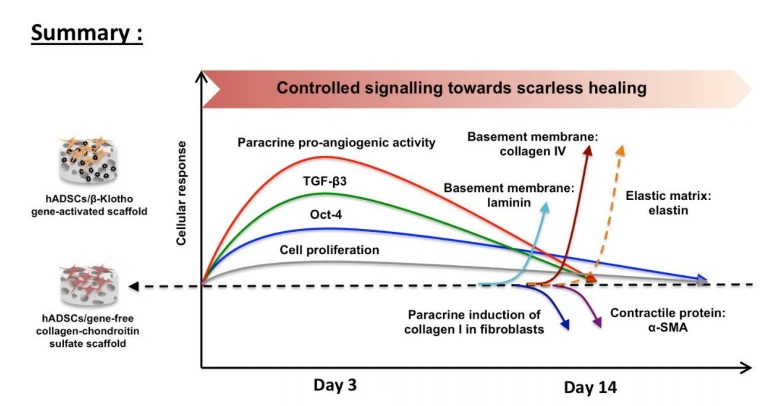
Figure 5. A schematic of the functional impact of B-Klotho gene-activated scaffold on human ADSCs for wound healing applications. The key findings of this study are the (1) transient enhancement of stem cell pluripotency and anti-fibrotic response, (2) improved paracrine control towards angiogenesis, and pro-fibrotic collagen remodeling in dermal fibroblasts and ultimately, (3)increased maturation of the basement membrane with control over scar-associated proteinsexpressionDotted lines for elastin matrix implies improved qualitative deposition.

Click Here To Know How Cistanche Wound healing Effects
In wound healing strategies, plasmid-based gene therapy is applied to transiently enhance cellular responses until wound repair is complete [37]. Our gene-activated scaffold also shows that the therapeutic β-Klotho gene is transiently regulated over 14 days. The signifificantly enhanced (170-fold) expression of the β-Klotho mRNA at day 3 could be attributed to the immediate-early CMV promoter that is known to enhance transcriptional activation of the encoded transgene [38]. However, in the MSCs, the CMV could undergo DNA methylation or histone deacetylation that can reduce the transgene expression [39]. Moreover, the plasmids generally are non-replicating episomes, limiting the transfer of transgene to dividing cells, and causing a decline in the transgene expression over time [40]. The presence of heterochromatic markers originating from the bacterial sequences of the plasmid could further repress transgene expression [41], overall contributing to a transient gene expression.
One of the avenues pursued in the treatment of hard-to-heal wounds is the application of cell-seeded bioactive scaffolds. One reason is their ability to promote rapid wound repair. Metabolically active cells in the graft secrete paracrine factors and undergo differentiation, orchestrating the complex signaling events in the wound environment [42]. Stem cells, in particular, have a unique ability to sense external stimuli and modulate their response to restore homeostasis [43]. However, stem cells lose their stemness when they are expanded in vitro to generate large cell numbers for the graft. Our study shows that the stemness can be transiently enhanced using a gene-activated scaffold carrying an anti-aging gene β-Klotho. Specifically, we noted that the anti-aging gene-activated scaffold enhanced the expression of the stemness gene Oct-4 in the ADSCs. Oct-4 is one of the key transcriptional factors in embryonic stem cells and is essential for controlled embryonic development [44]. In the ADSCs, the activation of the Oct-4 gene can promote their proliferation and differentiation potential [45]. Thus, the increased expression of Oct-4 may facilitate rapid differentiation of the ADSCs on the gene-activated scaffold into host cells and aid in the healing process.
Having observed the activation of the Oct-4 gene in the ADSCs, we then assessed the angiogenic potency of the ADSCs. Angiogenesis is crucial for the efficient integration of the graft with the host tissue [46]. Cells in the graft trigger angiogenesis through the secretion of paracrine factors. Angiogenesis is also a crucial event for granulation tissue development and its activity diminishes as the granulation tissue matures [47]. This programmed limitation of the angiogenic activity at the healing’s later stages is essential for controlling scarring and hyper granulation that can impede re-epithelialization [48]. Our finding also shows that the ADSCs on the gene-activated scaffold can enhance endothelial sprouting and control their growth through paracrine signaling. Additionally, the signifificant increases in the endothelial cells’ metabolic activity and sprouting in response to day 3 CM demonstrate the potential of the ADSCs-laden gene-activated scaffold to integrate with the host tissue rapidly. Moreover, the use of stem cells CM is a commonly adopted cell-free approach to enhance quality wound healing [49]. As a limitation, we acknowledge that adult dermal endothelial cells would serve a better cell model for studying angiogenesis; however, to maintain consistency with our previous studies and the HUVECs being widely accepted as the “gold-standard” cell candidate [50], we adopted the HUVECs angiogenesis assay.
An increase in fibroblast remodeling activity is a general feature of granulation tissue maturation [51]. During this stage, the collagen III matrices is gradually replaced by stronger collagen I fibers [51]. Collagen fibers then promote wound contraction [52], and wound contraction is indispensable for complete wound closure [53]. However, an aggressive sustained increase in collagen I deposition can increase scar formation [54]. Controlling scarring is crucial as it can inhibit the development of other skin appendages such as hair follicles, sebaceous glands, and sweat glands, for example, in burn wounds [54]. Our finding demonstrates that the aged (day 14) CM from the gene-activated scaffold group could control the expression of pro-fibrotic collagen I in adult dermal fibroblasts. This controlled effect on the fibroblasts occurred without further influence on the fifibroblast’s migration or their anti-fibrotic collagen III expressions relative to the gene-free scaffold group. Therefore, we suggest that the ADSCs-laden gene-activated scaffold may offer better control in limiting scarring in vivo through controlled collagen I expression. Li et al., have also shown that the ADSCs CM can signifificantly reduce collagen I expression in fibroblasts derived from hypertrophic scars [55]. Another study by Wang et al., demonstrated a similar reduction in collagen I expression in keloid-derived fibroblasts [56], collectively demonstrating the anti-fibrotic potential of the ADSCs’ CM.

One of the significant findings that we noted with the application of the β-Klotho gene-activated scaffold is the enhanced regeneration of the basement membrane in the ADSCs. The regeneration of the basement membrane is essential for blood vessel maturation and complete re-epithelialization [57,58]. Importantly, the trend in which the proteins laminin (2.1-fold) and collagen IV (8.8-fold) are upregulated further indicates increased maturation of the basement membrane in the gene-activated scaffold group [59]. Besides acting as an anti-aging factor [60], the beta klotho functions to enhance sensitivity to fibroblast growth factor (FGF) by FGF receptors [61]. Additionally, an increase in FGF signaling has been found to promote basement membrane maturation through the deposition of laminin and collagen IV [62]. Therefore, considering beta klotho’s role as a co-receptor of FGF, the increased basement maturation in the gene-activated scaffold group is potentially mediated by an increase in ADSCs’ FGF signaling.
The basement membrane component remarkably upregulated in the gene-activated scaffold group is the collagen IV protein. The collagen IV protein represents 50% of all basement membranes [63] and provides structural stability to the basement membrane [59]. However, aging signifificantly reduces collagen IV expression in the dermal-epidermal junction [58,64] and the lack of collagen IV can promote scar pathogenesis [65]. Thus, our results suggest that the increased basement membrane regenerative potency of the ADSCs-laden gene-activated scaffold can signifificantly aid in enhanced healing in aged patients. Other studies have also shown that adipose tissue-derived ECM possesses the tremendous therapeutic potential for skin repair [66]. Furthermore, tissue-engineered grafts rich in laminin and collagen IV is also of interest for respiratory epithelium repair [67].
In addition to the pro-fibrotic control towards the fibroblasts, our study further shows that the ADSCs in the gene-activated scaffold also express a 2-fold lower expression of the scar-associated protein α-SMA [68]. Although we did not evaluate its impact in vivo, the reduction in local α-SMA expression is crucial for improved qualitative healing [69]. Using fibrotic agents such as bleomycin [70] could be one way to evaluate better the anti-fibrotic properties of the ADSCs/gene-activated scaffold construct in vitro; however, our focus was to establish the provisional therapeutic potential of the construct.
Another indicator that the ADSCs-laden gene-activated scaffold may improve qualitative healing is the deposition of fibrous elastin matrix instead of patchy extracellular secretions in the gene-free scaffold group. Elastin deposition is one of the main activities that drive fetal scarless wound healing [71]. However, adult skins lack the deposition of elastin [71]. As such, tropoelastin, a precursor of elastin, is often incorporated into biomaterial scaffolds to control scarring in wound healing [72]. Taken together, our fifindings imply that the ADSCs/β-Klotho gene-activated scaffold construct may confer a strong anti-fibrotic response in vivo.
4. Materials and Methods
4.1. Preparation of Gene-Activated Scaffold
The gene-activated scaffold was developed using a 2-step process. Firstly, solid porous collagen-chondroitin sulfate scaffolds were fabricated by a freeze-drying slurry of bovine tendon type 1 collagen and chondroitin-6-sulfate derived from shark cartilage (Sigma, UK). An optimized freeze-drying process designed to create uniform pores was used to produce the scaffolds [73]. Based on our published protocol [74], the freeze-dried scaffolds were then dehydrothermally (DHT) treated at 105 ◦C under vacuum for sterilization and mechanical improvement. The sterilized scaffolds were then chemically cross-linked with 14 mM N-(3-Dimethylaminopropyl)-N’-ethylcarbodiimide hydrochloride and 5.5 mM N-Hydroxysuccinimide (2.5 molar ratios of EDC/NHS) (Sigma, UK) solution to further improve the mechanical stability [75]. The cross-linked scaffolds were then washed with PBS (Gibco, Paisley, UK) to remove residual chemicals. Once the scaffolds were ready, polyplexes at an N/P10 ratio (nitrogen to phosphate ratio) were prepared by mixing a predetermined volume of branched polyethyleneimine (PEI) solution with plasmid DNA (pDNA) encoding for the human beta-Klotho gene (β-Klotho), obtained from SinoBiological, Beijing, China. The N/P10 ratio was chosen based on our previous studies that found that polyplexes formulated at an N/P 10 ratio could effectively form small, stable cationic nanoparticles with plasmids as large as GLuc (5.76 kb) [21,23]. Prior to use, the plasmids were diluted in endotoxin-free water to obtain a working concentration of 0.5 µg/µL. The plasmid contains human enhanced immediate-early cytomegalovirus (CMV3) promoter to promote high-level stable and transient expression of the encoded gene in mammalian cells.
The plasmid/PEI mix was allowed to settle for 30 min to self-assemble into polyplex nanoparticles. The nanoparticles were then soak-loaded onto the scaffolds by pipetting equal volumes of the polyplex solution per side of the scaffold. A total of 2 µg pDNA was used per scaffold to develop the gene-activated scaffold.
4.2. Cell Seeding on β-Klotho Gene-Activated Scaffold
Human ADSCs (iXCells Biotechnologies, San Diego, CA, USA) were expanded to passage 4 in the ADSCs growth medium (Cat no. MD0003) supplied by the company. A total of 5 × 10⁵ ADSCs (2.5 × 10⁵ per side) were then seeded per gene-free scaffold (control, n = 3) or gene-activated scaffold (test, n = 3). After letting the cells settle for about 20 min, 2 mL of transfection media OptiMEM (Gibco, UK) was added, and the cellularized scaffolds were incubated at 37 ◦C for 24 h. After the 24 h incubation, the cellularized gene-free or gene-activated scaffolds were transferred into new 12-well plates, and fed with 2 mL of ADSCs growth medium. Media change was then performed every 3–4 days until day 14 by collecting 1 mL of the conditioned media (CM) and replacing it with equal volume of fresh media. All CM were stored at −80 ◦C until analysis.
4.3. qRT-PCR Analyses to Determine β-Klotho Gene Overexpression and Activation of Functional Genes
In order to determine the transient regulation of the target genes, cells were harvested at days 3 (early) and 14 (late) post-seeding on the gene-free or gene-activated scaffolds. The cells were first lysed using the Qiazol lysis reagent (Qiagen, Germantown, MD, USA). Chloroform was then added to separate the cell lysate into protein, DNA, and RNA phases. Using the RNeasy Kit (Qiagen, Manchester, UK), the RNA was extracted, and their quality and quantity were determined using a Multiskan Go plate reader (Thermo Scientific, UK) with the absorbance set at 260 nm. Genomic DNA was then removed by mixing the RNA with a genomic DNA wipeout buffer (Qiagen, Manchester, UK) and heating to 42 ◦C for 2 min. Subsequently, reverse transcription was performed to prepare the cDNA. Duplicates of cDNA per replicate (n = 3) were loaded into the qRT-PCR plates and then the assay was run using the primers listed in Table 1. Fold change in mRNA expression relative to the cells on the gene-free scaffold was calculated using the 2−∆∆CT method from averages of three replicates per group. Human GAPDH (Hs_GAPDH_1_SG, Cat. No. QT00079247) was used as the housekeeping gene.

4.4. Bioactivity Analyses of Secreted Factors from the ADSCs on β-Klotho Gene-Activated Scaffold
4.4.1. Pro-Angiogenic Bioactivity Analyses
4.4.2. Dermal Fibroblasts Healing and Maturation Analyses
After the angiogenesis assay, we investigated the CM’s potency for dermal healing by employing a scratch assay of human adult dermal fibroblasts (iXcells, Cat no. 10 HU-014). For this study, we specifically chose the aged CM from day 14 to study its influence on fibroblast wound closure during maturation. A total of 1 × 10⁴ cells/well in a 96-well plate were seeded and incubated overnight in the fibroblast growth medium. The next day, a wound was created on the monolayer by horizontally scratching a 200 uL pipette tip across the well. The monolayer was then rinsed with PBS to remove any debris and fed with the CM. Wound closure was recorded between 12–16 h after the scratch. Immunostaining was used to study the expression of pro-fibrotic collagen I (1:100, Novusbio, UK) and anti-fibrotic collagen III (1:100, Novusbio, UK) in the fibroblasts. The fibroblasts were counterstained with rhodamine (1:800, Abcam, UK) for F-actin imaging. Immunostaining was performed as described in Section 4.5, with the exception of tissue processing and deparaffinization. Both HUVECs and the fibroblasts were used at passage 4.
4.5. Immunoflfluorescence Imaging of Extracellular Matrix Proteins
After 14 days of culture, the cellularized gene-free or gene-activated scaffolds were harvested for detection of matrix deposition using immunofluorescence. The processing of the samples was performed as described previously. Briefly, the scaffolds were first washed with PBS and fixed in 10% neutral buffered formalin for 20 min. The fixed samples were then processed using the standard protocol for deparaffinization. The blocks were then cut into 7-µm thick slices and collected on charged slides. The sections were then deparaffinized using xylene followed by rehydration of the section with decreasing gradients of ethanol. Subsequently, the cells were permeabilized with 0.2% Tween®20 (Sigma-Aldrich, France) solution in PBS for 30 min (10 min wash × 3) and blocked using 10% NGS (Normal Goat Serum, Invitrogen, Rockford, IL, USA)/5% BSA/0.3 M Glycine (prepared in permeabilizing solution) for 1 h. After blocking, the slides were rinsed in PBS and then incubated at 4 ◦C overnight with the antibodies to target matrix proteins listed in Table 2. The next day, the slides were rinsed in PBS thrice for 2–3 min each to remove any unbound primary antibodies. Subsequently, the slides were incubated in either Alexa 488-conjugated goat anti-mouse IgG (A32723, Invitrogen, UK) or Alexa 594-conjugated goat anti-rabbit IgG (A11012, Invitrogen, UK) at 1:800 dilution at room temperature for 1 h in the dark. The rinsing step was performed as before and counterstained for nuclei using the mounting medium with DAPI (ab104139, Abcam, UK). The slides were then imaged using a fluorescence microscope (Olympus BX43, Japan) at 20× objective. Samples incubated with only secondary antibodies were used as controls.
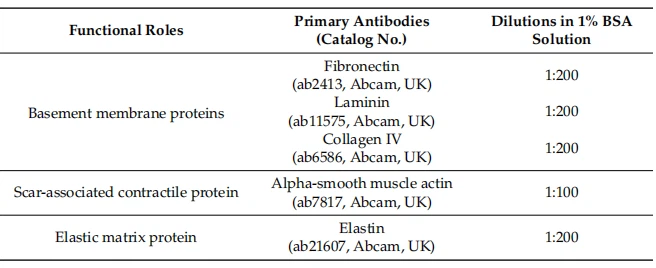
Image Quantification
Image] software (Image, NIH, MD, USA) was used to semi-quantitatively determine the amount of expressed proteins. For each marker, a constant threshold value was first determined through preliminary imaging of various sections. Using the set threshold value integrated density (stained area x mean gray value) of the images was determined and then normalized to the number of cells (DAPI counting) to give a final mean fluorescence density per cell. An average was quantified from 8-10 random images per replicate with a minimum of three replicates per group. The averages obtained from the three replicates/group were then used for measuring relative expression between the groups.
4.6. Statistical Analysis
All results are expressed as mean + standard deviation. Unpaired, two-tailed t-test was generally used to calculate the statistical significance between groups, where p < 0.05was considered to be significant
This study showed that the anti-aging β-Klotho gene-activated cistanche offers controlled activation of the regenerative capacity of ADSCs. The key findings of this study are the (1) transient enhancement of stem cell pluripotency and anti-fibrotic response, (2) improved paracrine control towards angiogenesis, and pro-fibrotic collagen remodeling in dermal fibroblasts, and ultimately, (3) increased maturation of the basement membrane with control over scar-associated proteins’ expression. Conclusively, these results suggest that the ADSCs-laden β-Klotho gene-activated scaffold may possess great potential a treating a wide range of dermal wounds.

resources, A.L.L., F.J.O. and M.B.K.; data curation, A.L.L. and M.B.K.; writing—original draft preparation, A.L.L.; writing—review and editing, A.L.L., F.J.O. and M.B.K.; visualization, A.L.L.; supervision, F.J.O. and M.B.K.; project administration, M.B.K.; funding acquisition, F.J.O. and M.B.K. All authors have read and agreed to the published version of the manuscript.
Conflicts of Interest: The authors declare that no conflict of interest exists.
References
1. Laiva, A.L.; O’Brien, F.J.; Keogh, M.B. Innovations in gene and growth factor delivery systems for diabetic wound healing. J. Tissue Eng. Regen. Med. 2018, 12, e296–e312. [CrossRef] [PubMed]
2. Makrantonaki, E.; Wlaschek, M.; Scharffetter-Kochanek, K. Pathogenesis of wound healing disorders in the elderly. JDDG J. Dtsch. Dermatol. Ges. 2017, 15, 255–275. [CrossRef] [PubMed]
3. Ganguly, P.; El-Jawhari, J.J.; Burska, A.N.; Ponchel, F.; Giannoudis, P.V.; Jones, E.A. The analysis of in vivo aging in human bone marrow mesenchymal stromal cells using colony-forming unit-fibroblast assay and the CD45lowCD271+ phenotype. Stem Cells Int. 2019, 2019, 5197983. [CrossRef]
4. Westerweel, P.E.; Teraa, M.; Rafifii, S.; Jaspers, J.E.; White, I.A.; Hooper, A.T.; Verhaar, M.C. Impaired endothelial progenitor cell mobilization and dysfunctional bone marrow stroma in diabetes mellitus. PLoS ONE 2013, 8, e60357. [CrossRef]
5. Murray, R.Z.; West, Z.E.; Cowin, A.J.; Farrugia, B.L. Development and use of biomaterials as wound healing therapies. Burn. Trauma 2019,
6. [CrossRef] [PubMed] 6. Ebrahimian, T.G.; Pouzoulet, F.; Squiban, C.; Buard, V.; André, M.; Cousin, B.; Tamarat, R. Cell therapy based on adipose tissue-derived stromal cells promotes physiological and pathological wound healing. Arterioscler. Thromb. Vasc. Biol. 2009, 29, 503–510. [CrossRef]
7. Wu, Y.; Chen, L.; Scott, P.G.; Tredget, E.E. Mesenchymal stem cells enhance wound healing through differentiation and angiogenesis. Stem Cells 2007, 25, 2648–2659. [CrossRef] [PubMed]
8. Foubert, P.; Gonzalez, A.D.; Teodosescu, S.; Berard, F.; Doyle-Eisele, M.; Yekkala, K.; Fraser, J.K. Adipose-Derived Regenerative Cell Therapy for Burn Wound Healing: A Comparison of Two Delivery Methods. Adv. Wound Care 2016, 5, 288–298. [CrossRef] [PubMed]
9. Assi, R.; Foster, T.R.; He, H.; Stamati, K.; Bai, H.; Huang, Y.; Dardik, A. Delivery of mesenchymal stem cells in biomimetic engineered scaffolds promotes healing of diabetic ulcers. Regen. Med. 2016, 11, 245–260. [CrossRef] [PubMed]
10. Jiang, Y.; Chen, B.; Liu, Y.; Zhufu, Z.; Yan, X.; Hou, X.; Tan, Q. Effect of collagen scaffold with adipose-derived stromal vascular fraction cells on diabetic wound healing: A study in a diabetic porcine model. Tissue Eng. Regen. Med. 2013, 10, 192–199. [CrossRef]
11. Falanga, V.; Sabolinski, M. A bilayered living skin construct (APLIGRAF®) accelerates complete closure of hard-to-heal venous ulcers. Wound Repair Regen. 1999, 7, 201–207. [CrossRef] 12. Hart, C.E.; Loewen-Rodriguez, A.; Lessem, J. Dermagraft: Use in the treatment of chronic wounds. Adv. Wound Care. 2012, 1, 138–141. [CrossRef] [PubMed] 13. Dinh, T.L.; Veves, A. The efficacy of Apligraf in the treatment of diabetic foot ulcers. Plast. Reconstr. Surg. 2006, 117, 152S–157S. [CrossRef] [PubMed]
14. Eaglstein, W.H.; Falanga, V. Tissue engineering and the development of Apligraf®, a human skin equivalent. Clin. Ther. 1997, 19, 894–905. [CrossRef]
15. Jiang, T.; Xu, G.; Wang, Q.; Yang, L.; Zheng, L.; Zhao, J.; Zhang, X. In vitro, expansion impaired the stemness of early passage mesenchymal stem cells for the treatment of cartilage defects. Cell Death Dis 2017, 8, e2851. [CrossRef] [PubMed]
16. Liu, J.; Ding, Y.; Liu, Z.; Liang, X. Senescence in Mesenchymal Stem Cells: Functional Alterations, Molecular Mechanisms, and Rejuvenation Strategies. Front. Cell Dev. Biol. 2020, 8, 258. [CrossRef] [PubMed]
17. Wang, W.; Xu, X.; Li, Z.; Lendlein, A.; Ma, N. Genetic engineering of mesenchymal stem cells by non-viral gene delivery. Clin. Hemorheol. Microcirc. 2014, 58, 19–48. [CrossRef]
18. Deveza, L.; Choi, J.; Lee, J.; Huang, N.; Cooke, J.; Yang, F. Polymer-DNA Nanoparticle-Induced CXCR4 Overexpression Improves Stem Cell Engraftment and Tissue Regeneration in a Mouse Hindlimb Ischemia Model. Theranostics 2016, 6, 1176–1189. [CrossRef] [PubMed]
19. O’Brien, F.J. Biomaterials & scaffolds for tissue engineering. Mater. Today 2011, 14, 88–95. 20. Yannas, I.; Tzeranis, D.; Harley, B.; So, P. Biologically active collagen-based scaffolds: Advances in processing and characterization. Philos. Trans. R. Soc. A Math. Phys. Eng. Sci. 2010, 368, 2123–2139. [CrossRef]
21. Laiva, A.L.; Raftery, R.M.; Keogh, M.B.; O’Brien, F.J. Pro-angiogenic impact of SDF-1α gene-activated collagen-based scaffolds in stem cell-driven angiogenesis. Int. J. Pharm. 2018, 544, 372–379. [CrossRef] [PubMed]
22. Lackington, W.A.; Raftery, R.M.; O’Brien, F.J. In vitro efficacy of a gene-activated nerve guidance conduit incorporating non-viral PEI-pDNA nanoparticles carrying genes encoding for NGF, GDNF and c-Jun. Acta Biomater. 2018, 75, 115–128. [CrossRef]
23. Tierney, E.G.; Duffy, G.P.; Hibbitts, A.J.; Cryan, S.A.; O’Brien, F.J. The development of non-viral gene-activated matrices for bone regeneration using polyethyleneimine (PEI) and collagen-based scaffolds. J. Control. Release 2012, 158, 304–311. [CrossRef] [PubMed] 24. Laiva, A.L.; O’Brien, F.J.; Keogh, M.B. SDF-1α gene-activated collagen scaffold drives functional differentiation of human Schwann cells for wound healing applications. Biotechnol. Bioeng. 2021, 118, 725–736. [CrossRef] [PubMed]