Autosomal Dominant Polycystic Kidney Disease Prevalence Among A Racially Diverse United States Population, 2002 Through 2018
Jun 17, 2022
For more info. contact tina.xiang@wecistanche.com
Introduction
Although autosomal dominant polycystic kidney disease (ADPKD) is considered rare, it remains the leading genetic kidney disease and the fourth leading cause of ESKD, accounting for 5% of overall patients with ESKD in the United States(1). Timely recognition and identification of those with ADPKD are of particular importance because earlier diagnostic evaluation and intervention may prevent the progression of the disease. Moreover, improved identification and evaluation of this population may contribute to a better understanding of genetic penetration and response to current treatment practices, which can pave the way for earlier and more effective treatment strategies.
Estimating the prevalence of ADPKD has been challenging due to the variability of penetrance of this genetic condition, with many individuals remaining asymptomatic and undiagnosed for decades, and given a lack of practical approaches to screening for ADPKD in the general population. Although genetic studies of selected samples estimate the total prevalence of ADPKD to be approximately one in 1000, population-based studies have estimated the diagnosed prevalence of ADPKD to be much lower, ranging from 25 to 68 patients per 100,000 persons. Differences between these estimates may be related to the use of different definitions of ADPKD, or differences in the populations studied. Larger population-based studies examined diagnosed prevalence, whereas genetic studies aimed to document ADPKD in both patients who were diagnosed and undiagnosed. In addition, population-based studies have examined more generalizable samples, as opposed to smaller, racially homogenous populations. Our study builds on earlier studies by examining ADPKD prevalence among different races and ethnicities and fills key gaps in the literature, particularly in Asian and Hispanic individuals, where the US prevalence data are lacking.
Using a large, ethnically diverse population from a routine clinical practice environment that reliably captures demographic information and utilization, we sought to identify and characterize patients with ADPKD. Furthermore, we sought to determine the prevalence of ADPKD overall and by race and ethnicity.

Click here to contact suppliers and get your cistanche experience
Methods
We conducted a cross-sectional analysis among members of the Kaiser Permanente Southern California (KPSC) health system between January 1, 2002, and December 31, 2018. KPSC is a prepaid integrated health system providing comprehensive care to >4.7 million members. The patient population is racially, ethnically, and socioeconomically diverse, reflecting the general population of South California(11). The study protocol was reviewed and approved by the KPSC Institutional Review Board and was exempt from informed consent (IRB 11823).
The study population included members of any age with ≥6 months of continuous membership in the health plan. This time requirement was used to reliably capture ADPKD diagnoses and comorbidities. We included individuals who had been diagnosed with ADPKD identified by inpatient and outpatient International Classifications of Diseases, Ninth and Tenth Revision (ICD-9, ICD-10) diagnosis codes specific to ADPKD (ICD-9,753.12,753.13 and ICD-10, Q61.2, Q61.3). Individuals were required to have ≥2 diagnosis codes on two separate encounter dates(which may have been consecutive days)to be included. The second encounter date was considered the index date. Patients were not excluded if they transitioned to another health care system unless they had <6 months of membership. Patients on RRT with dialysis or kidney transplant were not excluded. Individuals with ≥2 autosomal recessive PKD diagnosis codes were excluded. Comorbidities, including hypertension, diabetes, cerebral aneurysm, liver cysts, nephrolithiasis, ischemic heart disease, congestive heart failure, and cerebrovascular disease were determined based on ICD-9/ICD-10 diagnoses codes before or at the index date. Laboratory data and vital sign assessments including blood pressure and body mass index were collected from the electronic health record(EHR) from 1 year before or within 90 days after the second ADPKD diagnosis code. Renal function was expressed as eGFR calculated from serum creatinine levels using the Chronic Kidney Disease Epidemiology Collaboration equation. Proteinuria was defined as any urine dipstick with ≥1+ protein, urine protein-creatinine ratio >0.2, albumin-creatinine ratio >30 mg/g, or a 24-hour urine collection with >200 mg total protein or >30 mg of albumin. Medication use was retrieved from the internal pharmacy dispensing records. Information on demographics, laboratory characteristics, and comorbidities were obtained for individuals with ADPKD. To get an idea descriptively of the ADPKD population on initial identification or presentation, information was retrieved from before or immediately after the"index date" of ADPKD. Comparisons were made between individuals categorized into five different race and ethnicity categories:(non-Hispanic) White, Black, Hispanic, Asian/Pacific Islander, and other/unknown. Differences were assessed using chi-squared or Fisher's exact test for categorical variables, and ANOVA or Wilcoxon rank-sum test for continuous variables, as appropriate. The race was categorized based on consolidated race and ethnicity information from California state birth certificates and KPSC membership and clinical systems, supplemented by language preference. ADPKD prevalence was calculated for the overall study period and annually. Overall prevalence during the study period was calculated as unique patients with ADPKD divided by unique members. For year-specific annual prevalence, we looked at the snapshot of January 1 of each year: several patients meeting ADPKD criteria as of January 1 were identified as the numerator and the number of members was counted as the denominator. Given the age/sex distribution of southern California may differ from the entire United States, we calculated age- and sex-standardized prevalence by race and ethnicity using the direct method based on the 2010 US census population (www.census.gov), with six age groups(<5,5-14,15-24, 25-44,45-64, and ≥65 years)(12). All of the analyses were performed using SAS(Version 9.4 for Unix; SAS Institute, Cary, NC)

Results
A total of 9,071,375 KPSC members were identified between 2002 and 2018, of whom 3868 were identified as having been diagnosed with ADPKD. The mean (SD) age of the study population was 48.4(18.2) years, with 90% of the population 25 years or older,51% were men and 42% were White, 12% were Black, 32% were Hispanic,10% were Asian (including Pacific Islander), and 5% were other/unknown members(Table 1). Characteristics of the ADPKD population from 2002 to 2018 appear in Table 1.
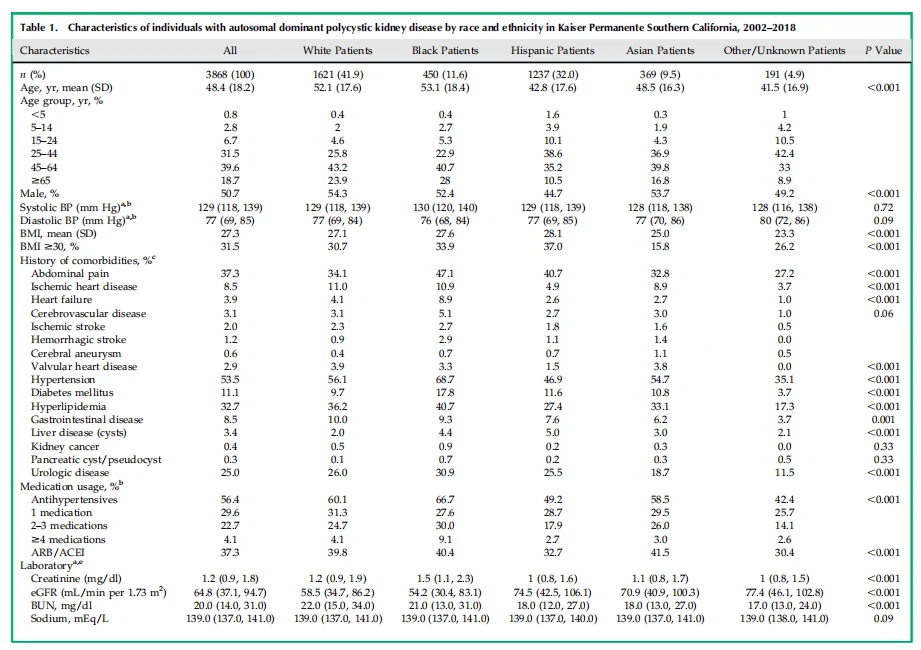
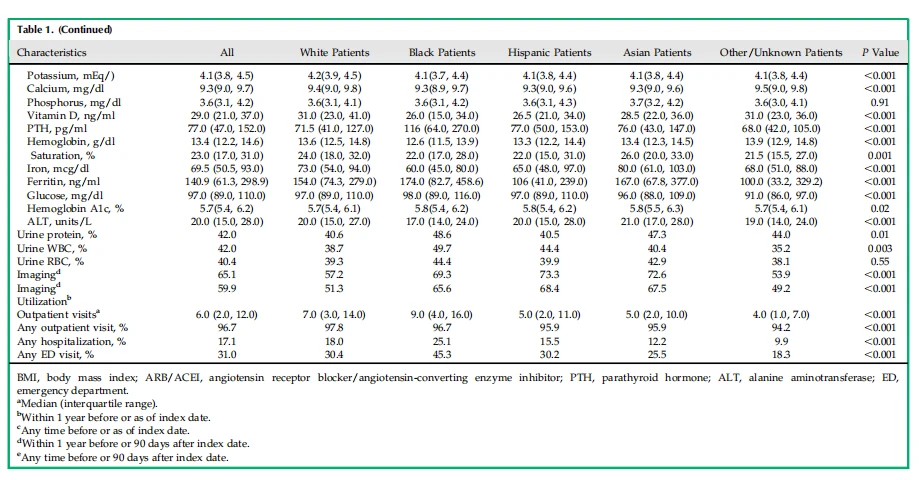
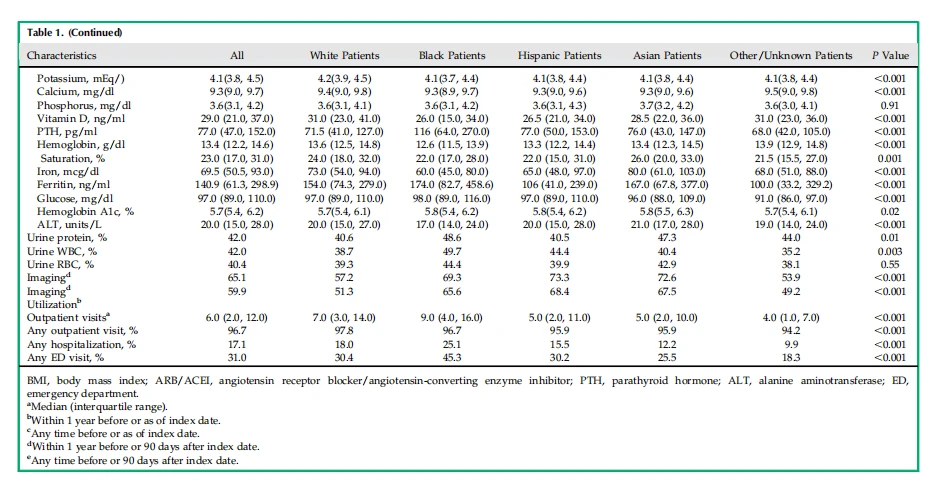
Black members with diagnosed ADPKD were older (53.1 years), whereas Hispanic members with ADPKD were the youngest(42.8 years). Black members were more likely to have a history of heart failure, cerebrovascular disease, hypertension, diabetes, hyperlipidemia, and urologic diseases. Antihypertensive use was more prevalent among Black members compared with the other races and ethnic groups. They also had higher parathyroid hormone, ferri-tin, urinary protein, and white blood cell counts, and lower hemoglobin, iron, and alanine aminotransferase measures.
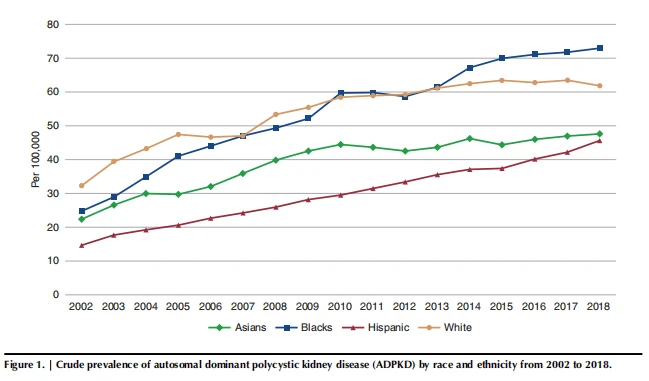
The crude prevalence of ADPKD was 42.6 per 100,000 persons. Differences in prevalence were evident by race and ethnicity:63.2,73.0, 39.9,48.9, and 9.4 per 100,000 persons for non-Hispanic White, Black, Hispanic, Asian/Pacific Islander, and other/unknown members, respectively; P<0.001). Sex-specific prevalence was 43.3 and 42.0 per 100,000 for males and females, respectively. Prevalence of ADPKD trended higher over the study period among all races and ethnicities from 19.5 in 2002 to 50.8 per 100,000 persons in 2018(Figure 1). The overall age- and sex-standardized prevalence was 41.5 per 100,000 persons.
As a sensitivity analysis, we calculated ADPKD prevalence in our study period after excluding members of unknown race and ethnicity in both the numerator and denominator. This resulted in a crude ADPKD prevalence of 52.2 per 100,000 persons(compared with 42.6). That was due to the percentage of unknowns being higher for patients who were non-ADPKD(9%)compared with the ADPKD population (5%).

Discussion
Our study was performed within a real-world clinical environment of a large, racially and ethnically diverse population, and observed a crude ADPKD prevalence of 42.6 per 100,000 people. We observed differences in prevalence by race and ethnicity with ADPKD prevalence higher among Black members (73.0 per 100,000) and non-Hispanic White members (63.2), and lower among Asian/Pacific Islander (48.9)and Hispanic members(39.9). In terms of management, 37% of the entire ADPKD population and 62% of the hypertensive population were treated with angiotensin-converting enzyme inhibitors or angiotensin receptor blocker drugs (Table 1). Future studies to further examine angiotensin-converting enzyme/angiotensin receptor blocker under-utilization in patients with ADPKD with hypertension, and variables associated with prescribing differences are needed, especially in ethnically diverse populations.
Our prevalence estimates are similar to other population-based estimates from Europe and the US. Two population-based studies in Europe estimated the point prevalence of ADPKD to be 24 and 39 per 100,000 persons, respectively (4,10). A study in the US found prevalence estimates of 43 per 100,000 from both national survey data and combined claims data from commercial and Medicaid populations(2). Similar to these population-based studies, our ADPKD estimates of diagnosed prevalence remain lower than genetic studies of total prevalence. Our prevalence definition may lead to the capture of patients with ADPKD that remain asymptomatic and undiagnosed. One example of this is the fact that our ADPKD population had a rate of proteinuria that is higher than previously reported among the ADPKD population(42% vs 17%)(13).In our real-world environment, these patients with ADPKD may have been identified later in the course of the disease when they manifested with symptoms, rather than those that were proactively identified and followed. Additionally, the average age at diagnosis for this population may differ from other registries because of the greater ethnic and racial diversity in our sample.
A potential limitation to our study is that ADPKD was identified using an EHR-based approach (ICD codes). Some ADPKD may have been overdiagnosed based on variable interpretation of ultrasound findings of cysts rather than using the unified Pei criteria(14). Conversely, the actual number of patients with ADPKD was likely under-captured because there was no active screening for ADPKD across the entire KPSC population. Overall, EHR-based approaches to rare diseases within KPSC have been described to have modestly high positive-predictive values(15). An additional limitation is that our study may introduce a bias, as evidenced by the rising rates of ADPKD across our observation window. One possible reason for the increase in prevalence over time is improved diagnostic techniques. Although total prevalence (including undiagnosed patients) would be expected to be relatively stable over time, diagnosed prevalence will vary with improved detection of disease.
Our study does introduce a potential diagnosis or detection bias within our membership population during the period 2002-2018. The median membership at KPSC is 17 years and new membership retention is >80% within 1 year of joining KPSC. During this period, the membership of KPSC grew by about 1.4 million members. Thus, we suspect that if newer members had more clinical care encounters over time, it could lead to more identification and diagnoses of ADPKD. Despite these potential limitations, our ADPKD cohort is one of the largest to date with detailed clinical information. Our study is also one of the first evaluating ADPKD prevalence among different races and ethnicities, including Hispanic and Asian patients.

Prior studies have provided only limited information on whether race and ethnicity differences affect the progression to ESKD in the ADPKD population. Although the prevalence of ESKD/ADPKD was described to be lower in non-Hispanic Black patients than in non-Hispanic White patients in the US Renal Data System, Black patients initiated dialysis at younger ages (16,17). Further study of the relationship between race and ADPKD progression using longitudinal, rather than cross-sectional, data is needed for a better understanding of whether ethnicity should be considered in the evaluation, management, and treatment of ADPKD.
In a large diverse population, we observed an estimated ADPKD prevalence of 42.6 per 100,000 persons. Black and non-Hispanic White members had a higher prevalence compared with Hispanic and Asian members. This cohort, established by an EHR-based approach, has the potential to improve our understanding of ADPKD by addressing knowledge gaps, including longitudinal outcomes based on race and ethnicity and differences in the rate of renal function decline. Studying this cohort may provide greater insights that lead to more efficient strategies to manage patients with high-risk ADPKD and treatment strategies to prevent ESKD.