Benefit Of Hyaluronic Acid To Treat Facial Aging in Completely Edentulous Patients Part 2
Jun 05, 2023
Glycoside of cistanche can also increase the activity of SOD in heart and liver tissues, and significantly reduce the content of lipofuscin and MDA in each tissue, effectively scavenging various reactive oxygen radicals (OH-, H₂O₂, etc.) and protecting against DNA damage caused by OH-radicals. Cistanche phenylethanoid glycosides have a strong scavenging ability of free radicals, a higher reducing ability than vitamin C, improve the activity of SOD in sperm suspension, reduce the content of MDA, and have a certain protective effect on sperm membrane function. Cistanche polysaccharides can enhance the activity of SOD and GSH-Px in erythrocytes and lung tissues of experimentally senescent mice caused by D-galactose, as well as reduce the content of MDA and collagen in lung and plasma, and increase the content of elastin, have a good scavenging effect on DPPH, prolong the time of hypoxia in senescent mice, improve the activity of SOD in serum, and delay the physiological degeneration of lung in experimentally senescent mice With cellular morphological degeneration, experiments have shown that Cistanche has the good antioxidant ability and has the potential to be a drug to prevent and treat skin aging diseases. At the same time, echinacoside in Cistanche has a significant ability to scavenge DPPH free radicals and can scavenge reactive oxygen species and prevent free radical-induced collagen degradation, and also has a good repair effect on thymine free radical anion damage.

Click On Antioxidants Cistanche
【For more info: david.deng@wecistanche.com / WhatApp:86 13632399501】
Lips are often very thin in completely edentulous people, despite wearing prostheses. In such a situation, HA fillers are of prime interest for volumizing effects that can last for 6 to 18 months, depending on the source, the extent of the cross-linking, and the concentration of injected product [12,36]. It is particularly indicated for restoring the natural curves of lips and redefining the vermilion contour (Figure 7A, B).

In addition, the presence of asymmetry and eversion of lips will make it even more complex to rehabilitate the smile in completely toothless situations, in which soft tissues are the only reference points [37]. Wrinkle filling and soft tissue augmentation can correct such defects and harmonize the smile line with the lip curvature (Figure 8).

Following sometimes traumatic avulsions, canine bumps are frequently affected by increased resorption affecting the soft tissues by a profile hollowed out below the wings of the nose. Prosthetic extrados is not always sufficient for restoring this volume. Volumizing injections in these areas are likely to correct marked defects.
When the bone shift is not fully compensated by the wearing of prostheses, hyaluronic acid injections prove to be a tool that should not be neglected for the restoration of volume to the various tissues and compensation of the shift in the jawbones.
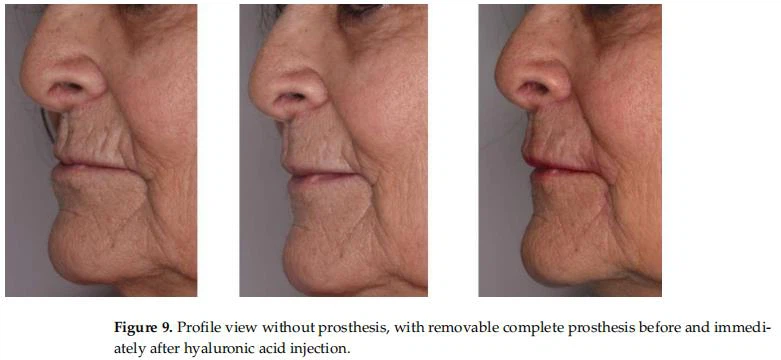
It is undoubtedly recommended to perform the injections with the prostheses in the mouth, to be able to anticipate and optimize the desired result while avoiding unsightly over-corrections, which may subsequently cause discomfort during the placement of the prostheses (Figure 9).
5. Discussion
Starting from clinical challenges, we aimed to highlight the interest of hyaluronic acid in the total edentulous patient in general practice, through clinical cases and literature survey. There are many studies detailing the use and safety of soft-tissue fillers, but none of them investigated the interest of HA as a therapeutic prosthetic restoration in the fully edentulous patient.
As rightly stated, “No one filler is the correct choice for all applications” [37]. However, due to its volumizing and hydrating properties, low risk of complications, resorbability of the molecule, and simplicity of use, HA appears to be an appropriate filler for reducing the nasolabial fold, redefining lips contour, and improving live support in edentulous patients, with an obvious beneficial effect in the aging face [35].

Many available fillers can be used for dermal injection, thus providing volumetric support. Animal collagen and synthetic fillers (hyaluronic acid, calcium hydroxyapatite, polylactic acid, and polymethylmethacrylate) have volumetric and biological effects, such as effects on fibroblast production and
angiogenesis. Fat grafting and autologous platelet-derived preparations are also interesting techniques for facial rejuvenation because they are . autologous and have regenerative effects.
Calcium hydroxyapatite fillers (composed of CaHA microspheres surrounded by resorbable aqueous gel carrier) and polylactic acid are interesting for correcting deep wrinkles and folds, with an immediate result after the injection, but the lack of immediately reversible still represents a major limitation to complement full denture rehabilitation, when the effects of misplaced or excess of HA can be reversed within few days. In the same vein, the main problems of polymethylmethacrylate injections are the long-term, questionable side effects and permanent duration [11]
Regenerative procedures could also be considered to complement full denture rehabilitation, to have a more proactive prevention and maintenance approach. Indeed, regenerative approaches in facial rejuvenation are the logical steps in aging treatment. These procedures can include stem cell use, autologous platelet-derived preparations (i.e., PRF), or fat grafts [39].

Autologous platelet-derived preparations for dermal injection have been shown to lead to significant rejuvenation of the face skin [40]. The rejuvenation properties of fat grafts and fat-derived stem cells have also been described, as well as the intradermal injections of fat, combined with platelet-rich fibrin (PRF) for patients undergoing facial rejuvenation treatments [41]. The regenerative effects of adipose tissue and cell-enriched fat grafts on facial aesthetics were clear at the histologic and cellular levels, but these regenerative effects were not clinically apparent when comparing cell-enriched fat grafts to fat grafts alone. Both fat-PRF and HA injections were shown to improve facial skin status without serious complications [41]. Fat grafts and PRF or HA injections are recognized to be safe, highly effective, and long-lasting methods for skin rejuvenation. Fat grafts and PRF show higher biological effects, but require invasive sampling (blood or fat tissue), while HA is a ready-to-use device.
In daily dental practice, we observe an increase in the number of totally edentulous patients already carrying oral rehabilitation with classical full dentures or complex implant-supported rehabilitations. These restorations can be functionally satisfactory, while no longer fulfilling their role of supporting soft tissues, due to inevitable aging. In such circumstances, there is a need for volume and tissue support to complement dental prosthetic rehabilitation. Among all the available fillers and regenerative procedures, HA injections appear to be an optimal compromise between efficacy, simplicity, and safety. HA can then be a satisfactory solution to improve aesthetics without repairing prostheses and entering into full rejuvenation treatments.
6. Conclusions
The growing aesthetic demand of patients, of all ages, requires being attentive to their requests and responding appropriately. The democratization of youthfulness in the media and society imposes on practitioners, as well as on patients, a permanent cosmetic approach. HA allows us to improve patients’ smiles. For specific situations of edentulous patients, dermal HA injections combine the cosmetic aspect with the therapeutic aspect. These minimally invasive injections help to correct, in an ephemeral way, the uncompensated bone losses, mucous volume losses, and asymmetries. In addition to the dental rehabilitation of complete edentulism, and without the requirement of full rejuvenation therapy, HA injections are beneficial therapeutically to treat completely edentulous patients.

Author Contributions: Conceptualization, S.A. and D.C.; methodology, P.-Y.C.-D.; investigation, P.-Y.C.-D., and D.B.; analysis, M.R. and L.P.; writing—original draft preparation, S.A. and D.C.; writing—review and editing, P.-Y.C.-D.; supervision, S.M.; project administration, D.C. and S.M. All authors have read and agreed to the published version of the manuscript.
Funding: This research received no external funding.
Institutional Review Board Statement: The study was conducted by the Declaration of Helsinki and approved by the Institutional Review Board of CHU de Montpellier (IRB Accreditation number: 198711; protocol code: IRB-MTP_2022_01_202201029; date of approval: 19 January 2022).
Informed Consent Statement: Informed consent was obtained from all subjects involved in the study. Written informed consent has been obtained from the patients to publish this paper.
Data Availability Statement: Not applicable.
Conflicts of Interest: The authors declare no conflict of interest.
References
1. Tyrovolas, S.; Koyanagi, A.; Panagiotakos, D.B.; Haro, J.M.; Kassebaum, N.J.; Chrepa, V.; Kotsakis, G.A. Population Prevalence of Edentulism and Its Association with Depression and Self-Rated Health. Sci. Rep. 2016, 6, 37083. [CrossRef] [PubMed]
2. Peres, M.A.; Macpherson, L.M.D.; Weyant, R.J.; Daly, B.; Venturelli, R.; Mathur, M.R.; Listl, S.; Celeste, R.K.; Guarnizo-Herreño, C.C.; Kearns, C.; et al. Oral Diseases: A Global Public Health Challenge. Lancet 2019, 394, 249–260. [CrossRef]
3. Kassebaum, N.J.; Bernabé, E.; Dahiya, M.; Bhandari, B.; Murray, C.J.L.; Marcenes, W. Global Burden of Severe Tooth Loss: A Systematic Review and Meta-Analysis. J. Dent. Res. 2014, 93, 20S–28S. [CrossRef] [PubMed]
4. Vos, T.; Flaxman, A.D.; Naghavi, M.; Lozano, R.; Michaud, C.; Ezzati, M.; Shibuya, K.; Salomon, J.A.; Abdalla, S.; Aboyans, V.; et al. Years Lived with Disability (YLDs) for 1160 Sequelae of 289 Diseases and Injuries 1990–2010: A Systematic Analysis for the Global Burden of Disease Study 2010. Lancet 2012, 380, 2163–2196. [CrossRef]
5. Wulfman, C.; Tezenas du Montcel, S.; Jonas, P.; Fattouh, J.; Rignon-Bret, C. Aesthetic Demand of French Seniors: A Large-Scale Study: Aesthetic Demand of French Seniors. Gerodontology 2010, 27, 266–271. [CrossRef]
6. Bartlett, S.P.; Grossman, R.; Whitaker, L.A. Age-Related Changes of the Craniofacial Skeleton: An Anthropometric and Histologic Analysis. Plast. Reconstr. Surg. 1992, 90, 592–600. [CrossRef]
7. Iacopino, A.M.; Wathen, W.F. Geriatric Prosthodontics: An Overview. Part II. Treatment Considerations. Quintessence Int. 1993, 24, 353–361.
8. Gerth, D. Structural and Volumetric Changes in the Aging Face. Facial Plast. Surg. 2015, 31, 3–9. [CrossRef]
9. Basker, R.M.; Davenport, J.C.; Thomason, J.M. Prosthetic Treatment of the Edentulous Patient; Wiley-Blackwell: Chichester, UK; Ames, IA, USA, 2011; ISBN 978-1-4051-9261-3.
10. Braz, A.; de Paula Eduardo, C.C. Reshaping the Lower Face Using Injectable Fillers. Indian J. Plast. Surg. 2020, 53, 207–218. [CrossRef]
11. Dayan, S.H.; Ellis, D.A.F.; Moran, M.L. Facial Fillers. Facial Plast. Surg. Clin. N. Am. 2012, 20, 245–264. [CrossRef]
12. Urdiales-Gálvez, F.; Martín-Sánchez, S.; Maíz-Jiménez, M.; Castellano-Miralla, A.; Lionetti-Leone, L. Concomitant Use of Hyaluronic Acid and Laser in Facial Rejuvenation. Aesthetic Plast. Surg. 2019, 43, 1061–1070. [CrossRef] [PubMed]
13. La Gatta, A.; Salzillo, R.; Catalano, C.; D’Agostino, A.; Pirozzi, A.V.A.; De Rosa, M.; Schiraldi, C. Hyaluronan-Based Hydrogels as Dermal Fillers: The Biophysical Properties That Translate into a “Volumetric” Effect. PLoS ONE 2019, 14, e0218287. [CrossRef] [PubMed]
14. Mericske-Stern, R. Prosthetic Considerations. Aust. Dental J. 2008, 53, S49–S59. [CrossRef] [PubMed]
15. Yazdanian, M.; Arefifi, A.H.; Alam, M.; Abbasi, K.; Tebyaniyan, H.; Tahmasebi, E.; Ranjbar, R.; Seifalian, A.; Rahbar, M. Decellularized and Biological Scaffolds in Dental and Craniofacial Tissue Engineering: A Comprehensive Overview. J. Mater. Res. Technol. 2021, 15, 1217–1251. [CrossRef]
16. Drago, C.; Carpentieri, J. Treatment of Maxillary Jaws with Dental Implants: Guidelines for Treatment: Implant Guidelines for Maxillary Prostheses. J. Prosthodont. 2011, 20, 336–347. [CrossRef]
17. Araujo, M.G.; Lindhe, J. Dimensional Ridge Alterations Following Tooth Extraction. An Experimental Study in the Dog. J. Clin. Periodontol. 2005, 32, 212–218. [CrossRef] [PubMed]
18. Van der Weijden, F.; Dell’Acqua, F.; Slot, D.E. Alveolar Bone Dimensional Changes of Post-Extraction Sockets in Humans: A Systematic Review. J. Clin. Periodontol. 2009, 36, 1048–1058. [CrossRef]
19. Tan, W.L.; Wong, T.L.T.; Wong, M.C.M.; Lang, N.P. A Systematic Review of Post-Extractional Alveolar Hard and Soft Tissue Dimensional Changes in Humans. Clin. Oral Implant. Res. 2012, 23, 1–21. [CrossRef]
20. Gosain, A.K.; Klein, M.H.; Sudhakar, P.V.; Prost, R.W. A Volumetric Analysis of Soft-Tissue Changes in the Aging Midface Using High-Resolution MRI: Implications for Facial Rejuvenation. Plast. Reconstr. Surg. 2005, 115, 1143–1152. [CrossRef]
21. Coleman, S.; Grover, R. The Anatomy of the Aging Face: Volume Loss and Changes in 3-Dimensional Topography. Aesthetic Surg. J. 2006, 26, S4–S9. [CrossRef]
22. Wysong, A.; Joseph, T.; Kim, D.; Tang, J.Y.; Gladstone, H.B. Quantifying Soft Tissue Loss in Facial Aging: A Study in Women Using Magnetic Resonance Imaging. Dermatol. Surg. 2013, 39, 1895–1902. [CrossRef] [PubMed]
23. Bidra, A.S.; Manzotti, A.; Wu, R. Differences in Lip Support with and without Labial Flanges in a Maxillary Edentulous Population. Part 2: Blinded Subjective Analysis: Part 2: Blinded Subjective Analysis. J. Prosthodont. 2018, 27, 17–21. [CrossRef] [PubMed]
24. Shah, A.R.; Kennedy, P.M. The Aging Face. Med. Clin. N. Am. 2018, 102, 1041–1054. [CrossRef] [PubMed]
25. Rebibo, M.; Darmouni, L.; Jouvin, J.; Orthlieb, J.D. Vertical Dimension of Occlusion: The Keys to Decision: We May Play with the VDO If We Know Some Game’s Rules. Int. J. Stomatol. Occlusion Med. 2009, 2, 147–159. [CrossRef]
26. Carlsson, G.E. Facts and Fallacies: An Evidence Base for Complete Dentures. Dent. Update 2006, 33, 134–142. [CrossRef]
27. Monnet-Corti, V.; Antezack, A.; Pignoly, M. Comment Parfaire l’esthétique Du Sourire: Toujours En Rose! Orthod. Fr. 2018, 89, 71–80. [CrossRef]
28. Wilson, N.H.F. Principles and Practice of Esthetic Dentistry; Wilson, N.H.F., Millar, B.J., Eds.; Essentials of esthetic dentistry; Elsevier: Edinburgh, UK; New York, NY, USA, 2015; ISBN 978-0-7234-5558-5.
29. Kamashita, Y.; Kamada, Y.; Kawahata, N.; Nagaoka, E. Inflfluence of Lip Support on the Soft-Tissue Profile of Complete Denture Wearers. J. Oral Rehabil. 2006, 33, 102–109. [CrossRef]
30. Besford, J.N.; Sutton, A.F. Aesthetic Possibilities in Removable Prosthodontics. Part 3: Photometric Tooth Selection, Tooth Setting, Try-in, Fitting, Reviewing, and Trouble-Shooting. Br. Dent. J. 2018, 224, 491–506. [CrossRef]
31. Enríquez, A.; Sánchez, E.; Guizar, J.; del Campo, C.; Fandiño, L. Esthetic Restoration with Artifificial Gingiva in an Atrophied Alveolar Ridge: Clinical Report. Int. J. Periodontics Restor. Dent. 2016, 36, 567–571. [CrossRef]
32. Waliszewski, M. Restoring Dentate Appearance: A Literature Review for Modern Complete Denture Esthetics. J. Prosthet. Dent. 2005, 93, 386–394. [CrossRef]
33. Coachman, C.; Salama, M.; Garber, D.; Calamita, M.; Salama, H.; Cabral, G. Prosthetic Gingival Reconstruction in a Fixed Partial Restoration. Part 1: Introduction to Artificial Gingiva as an Alternative Therapy. Int. J. Periodontics Restor. Dent. 2009, 29, 471–477.
34. Zielke, H.; Wölber, L.; Wiest, L.; Rzany, B. Risk Profiles of Different Injectable Fillers: Results from the Injectable Filler Safety Study (IFS Study). Dermatol. Surg. 2008, 34, 326–335. [CrossRef] [PubMed]
35. Rohrich, R.J.; Bartlett, E.L.; Dayan, E. Practical Approach and Safety of Hyaluronic Acid Fillers. Plast. Reconstr. Surg. Glob. Open 2019, 7, e2172. [CrossRef] [PubMed]
36. Narins, R.S.; Brandt, F.S.; Lorenc, Z.P.; Maas, C.S.; Monheit, G.D.; Smith, S.R. Twelve-Month Persistency of a Novel Ribose–Cross-Linked Collagen Dermal Filler. Dermatol. Surg. 2008, 34, S31–S39. [CrossRef]
37. Bass, L.S. Injectable Filler Techniques for Facial Rejuvenation, Volumization, and Augmentation. Facial Plast. Surg. Clin. N. Am. 2015, 23, 479–488. [CrossRef]
38. Crowley, J.S.; Kream, E.; Fabi, S.; Cohen, S.R. Facial Rejuvenation With Fat Grafting and Fillers. Aesthetic Surg. J. 2021, 41, S31–S38. [CrossRef]
39. Cohen, S.R.; Hewett, S.; Ross, L.; Delaunay, F.; Goodacre, A.; Ramos, C.; Leong, T.; Saad, A. Regenerative Cells For Facial Surgery: Biofifilling and Biocontouring. Aesthetic Surg. J. 2017, 37, S16–S32. [CrossRef]
40. Hassan, H.; Quinlan, D.J.; Ghanem, A. Injectable Platelet-rich Fibrin for Facial Rejuvenation: A Prospective, Single-center Study. J. Cosmet. Dermatol. 2020, 19, 3213–3221. [CrossRef]
41. Liang, Z.-J.; Lu, X.; Li, D.-Q.; Liang, Y.-D.; Zhu, D.-D.; Wu, F.-X.; Yi, X.-L.; He, N.; Huang, Y.-Q.; Tang, C.; et al. Precise Intradermal Injection of Nanofat-Derived Stromal Cells Combined with Platelet-Rich Fibrin Improves the efficacy of Facial Skin Rejuvenation. Cell. Physiol. Biochem. 2018, 47, 316–329. [CrossRef]
【For more info: david.deng@wecistanche.com / WhatApp:86 13632399501】