Benefit Of Hyaluronic Acid To Treat Facial Aging in Completely Edentulous Patients Part 1
Jun 05, 2023
Abstract: Hyaluronic acid (HA) is widely used in aesthetic medicine for its moisturizing and anti-aging action. This molecule, naturally present in the body, has an interesting response to aging, accentuated in totally edentulous patients. While its aesthetic benefits for facial rejuvenation are well-documented, there is a lack of description and investigation on its therapeutic usefulness for edentulous patients. The management of completely edentulous patients is a daily reality in dental practice and requires specific attention. The aesthetic and functional challenge is considerable. The displacement of the bone base is often marked, and the lack of soft tissue support is sometimes challenging to correct with prosthetic reconstruction. This review aims to present the physiological processes appearing in completely edentulous patients and prosthetic solutions available to recreate oral functions and counteract facial aging. As prosthetic rehabilitations are not fully satisfying for counterbalancing the impression of excessive facial aging, we investigated the applications of HA injection in the perioral area, to improve edentulism treatment, and discussed the advantages and disadvantages, compared to other dermal fillers and rejuvenation therapies. Considering the specific situations of edentulous patients, dermal HA injections help to correct uncompensated bone losses and mucous volume losses and appear to be therapeutically beneficial for treating completely edentulous patients, without the requirement for full rejuvenation therapy.
Glycoside of cistanche can also increase the activity of SOD in heart and liver tissues, and significantly reduce the content of lipofuscin and MDA in each tissue, effectively scavenging various reactive oxygen radicals (OH-, H₂O₂, etc.) and protecting against DNA damage caused by OH-radicals. Cistanche phenylethanoid glycosides have a strong scavenging ability of free radicals, a higher reducing ability than vitamin C, improve the activity of SOD in sperm suspension, reduce the content of MDA, and have a certain protective effect on sperm membrane function. Cistanche polysaccharides can enhance the activity of SOD and GSH-Px in erythrocytes and lung tissues of experimentally senescent mice caused by D-galactose, as well as reduce the content of MDA and collagen in lung and plasma, and increase the content of elastin, have a good scavenging effect on DPPH, prolong the time of hypoxia in senescent mice, improve the activity of SOD in serum, and delay the physiological degeneration of lung in experimentally senescent mice With cellular morphological degeneration, experiments have shown that Cistanche has the good antioxidant ability and has the potential to be a drug to prevent and treat skin aging diseases. At the same time, echinacoside in Cistanche has a significant ability to scavenge DPPH free radicals and has the ability to scavenge reactive oxygen species and prevent free radical-induced collagen degradation, and also has a good repair effect on thymine free radical anion damage.

Click on Cistanche Tubulosa Supplement
【For more info: david.deng@wecistanche.com / WhatApp:86 13632399501】
1. Introduction
Facial aging is a natural and unavoidable phenomenon, with more visible effects for completely edentulous patients. The transition to edentulousness represents physical, psychological, and social handicaps and should be considered with empathy, to restore the patient’s smile.
Edentulism is easily assimilated to aging, but it has also been proven to be associated with depression and poor self-rated health [1]. Tooth loss reflects the endpoint of dental disease. In 2010, 158 million people (2.3% of the global population) were completely edentulous. Even though the prevalence of severe tooth loss reduced between 1990 and 2010, declining from 4.4% to 2.3%, the burden of edentulism is likely to grow as populations age and live longer [2–4]. Nowadays, aesthetic expectations have increased among people of all ages [5]. Clinical situations and patients’ expectations and complaints will guide smile restoration toward fixed or removable prosthetic rehabilitation. Understanding the specificity of aging in totally edentulous patients is essential for overcoming facial changes and restoring an aesthetic and functional smile. Loss of volume in the lower third of the face is inherent in aging, due to elastic and collagenous fibers degeneration, fat tissue reduction, and skin dehydration. This volume loss is aggravated by edentulism, as teeth play an important role in lip and cheek support, and tooth loss is sometimes not completely compensated by prostheses [6–8]. The limitations of complete dentures in restoring tissue loss, as well as in fully supporting the lips and cheeks, will lead to the appearance of premature aging. Facial muscles may lose some of their tone through aging, but dystonia may also occur because of functional limitations, as the underlying artificial dentures are only sitting on the mucosa and not attached to the facial skeleton [9]. The labial contour of the denture determines the amount of support provided for the lip, and inadequate lip and cheek support induces a poor facial appearance.

Therefore, it is of prime importance to understand the specific physiopathology of facial aging occurring with edentulism. To counteract the excessive impression of facial aging in edentulous patients, dental and orofacial treatments can target both prosthodontics and lip dynamism and volume. Different methods can be used for non-surgical rejuvenation and beautification of the lower third of the face, such as micro-focused ultrasound, radiofrequency, botulinum toxin, and injectable fillers [10]. The therapeutic choice will be directed toward a specific product or technique, according to the desired effect, properties of the product, duration of action, and practitioner’s experience [11]. For tissue volume and dynamism, different injectable fillers can be used, such as calcium hydroxyapatite (CaHA), permanent silicon, collagen, or hyaluronic acid (HA). Hyaluronic acid is the most popular biodegradable dermal filler, widely used in aesthetic medicine for facial rejuvenation and soft tissue volume augmentation. It is a natural polysaccharide found in the human dermis and epidermis. When injected in the dermis, its effect lasts from 6 to 18 months, depending on the source, extent of cross-linking, and concentration [12]. In addition to volume augmentation, HA plays a major role in connective tissue hydration, improves tissue vascularization, and activity stimulates dermal fibroblasts [13].
This review aims to discuss the potential therapeutic role of hyaluronic acid in restoring edentulous patients’ smiles. Considering the challenges to overcome with completely edentulous patients’ rehabilitation, starting from clinical cases, then a literature survey, we investigate the specificity of aging in completely edentulous patients and therapeutic possibilities for treating edentulism. We discuss the interest in hyaluronic acid injections for improving and perfecting prosthetic restoration.
2. Completely Edentulous Patients Physiological Processes
2.1. Bone Resorption
Bone structures are the support for skin tissues. Over time, they undergo changes related to general factors, such as aging, osteoporosis, or possible deficiencies in calcium absorption, as well as local factors, such as dental extraction, occlusal trauma, lack of adaptation of prostheses, and uncompensated tooth loss over a prolonged period, causing repercussions on the supported tissues. These multiple parameters vary accordingly for every patient because they are dependent on individual genetic variations. The main changes are a decrease in the anterior height of the facial mass, correlated with tooth loss and alveolar bone resorption [6]. With aging, bone structures undergo morphological and structural changes, such as involution and atrophy. The loss of teeth results in the absence of bone stimulation through chewing and, therefore, a decrease in bone density and loss of width and height of the alveolar bone [14]. Regeneration and augmentation of the alveolar bone could be necessary for aesthetic and functional prosthetic restoration [15].
In the first year after tooth loss, the alveolar bone is reduced by about 25% of its width, and resorption in the anterior region is generally four times greater in the mandible than in the maxilla. The maxillary incisor–canine region benefits from the presence of several skin muscles that limit anterior resorption. In the maxillary posterior sectors, alveolar bone resorption concerns mainly the vestibular sides of the ridges and occurs in a centripetal manner. Conversely, in the posterior mandibular sectors, resorption is centrifugal, accentuating the anteroposterior displacement of the maxillae [14,16]. In addition, the height of the jawbone is reduced, due to the expansion of the maxillary sinus, which continues over time, involving a decrease in the vertical dimension and crushing of the profile [17–19]. The chin appears to be fully projected forward, which is responsible for the typical profile of total edentulism (Figure 1) [10].

2.2. Soft Tissues Aging
Lips can be described as two parts—one white, cutaneous, and peripheral, and the other one red, at the inner part, called vermilion. This red part is divided into a dry visible part and a wet internal part. Lips are bounded by nasal ala, nasolabial folds, and labiodental folds. In a completely edentulous patient, the facial muscles inserted on structural bones are no longer supported during their contractions because of tooth loss.
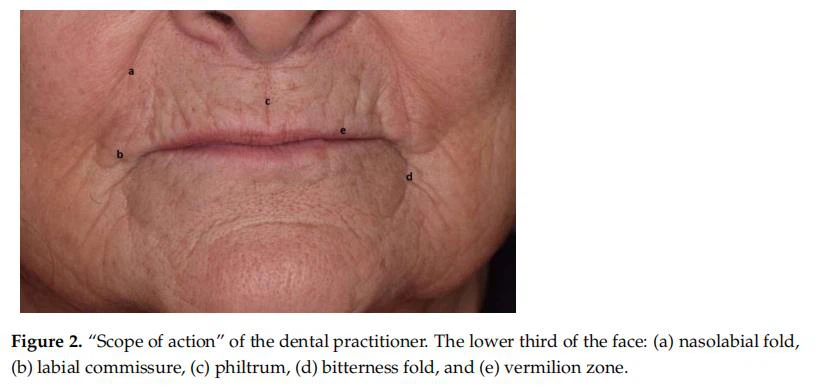
Among these, the orbicularis oris muscle encircles the mouth, inside the lips. A lack of support induces mouth orbicular muscle atrophy, then loss of volume and lips eversion. As a consequence, the visible part of the vermilion shrinks, and the lips invaginate inside the oral cavity, accentuating fine lines and wrinkles on and around the lips. Lowering muscles at the mouth angle (depressor anguli oris) and depressant muscles of the lower lip (depressor labii inferioris) accentuates the labiomandibular folds. The nasolabial angle increases, and the labiodental crease is more pronounced (Figure 2) [8,20–22].
3. Prosthetic Solutions in Response to Aging in Completely Edentulous Patients
Bone structure resorption undeniably leads to an increase in prosthetic height. In the horizontal direction, the anteroposterior shift of bone structures complicates the restoration of aesthetics and function [23,24].
Depending on prosthetic rehabilitation, a prospective set-up will allow us to visualize and foreshadow the future prosthesis, to validate aesthetics and function. During prosthesis realization, the steps of occlusion model adjusting and teeth positioning are essential, as they will directly influence the labial projection and lip positions.
3.1. Importance of Occlusal-Vertical Dimension (OVD)
In completely edentulous patients, the determination of adequate maxilla–mandibular relationship in three dimensions is the first and most important step [25].
For the vertical dimension, an underestimation of the height of the lower part of the face will accentuate the already marked nasolabial and labio-mental folds and generate salivary stasis that might induce candidiasis, such as angular cheilitis. Previous prostheses can guide the practitioner in OVD determination. However, anterior and posterior landmarks have often disappeared [26]. Then, it is a matter of defining an agreement fitting for both physiology and aesthetics. A reduction of OVD will induce an increase in skin folds and inadequate lip support.
3.2. Importance of Prosthetic Teeth Positioning
The support of the upper lip is controlled by maxillary incisors coronal two-thirds [27]. The patient’s type and profile guide the practitioner in the choice of incisor shape (triangular, square, or oval). Their size, position on the dental arch, and bulging condition of the lips support. The fitting of prosthetic teeth is meticulously checked from the front and profile [28]. The front view allows us to adjust the symmetry and position of the maxillary central incisors, axial inclination, and ratio between teeth. The profile view guides the parallelism of the curves, the contour of the incisal edge, and passive labial support [29,30].

Prosthetic teeth are positioned according to functional, aesthetic, and phonetic requirements. Thin or prominent lips are more affected by incisal edge position than thick or vertical lips. An overly buccal incisor profile is an obstacle to lip closure. In the profile view, the harmony of the lower third of the face correlates with S-shaped curves, following the sub-nasal point, white-red lip junction, and chin tip.
3.3. Artificial Gingiva
During completely edentulous patient rehabilitation (either fixed on implants or removable), prosthetic teeth play a central supporting role for the lips but are not sufficient to compensate for the recoil of the orbicular muscle (orbicularis oris) above the cranial part of the prosthesis.
Peri-oral soft tissue support can be corrected using the polished exterior surfaces of the prostheses, which have both functional and aesthetic roles [31]. Muscles perpendicular to the occlusion plane of the prosthesis have a destabilizing role. On the contrary, muscle fibers parallel to this plane act positively on the stability of the prosthesis. When modeling the artificial gingiva, a concave profile is sought next to the orbicular muscle, where the fibers are parallel to the occlusion plane [32,33].
Artificial gingiva also provides support for the lip: its shape and volume are an integral part of the aesthetic success of the smile. In large-scale anterior rehabilitation, the resin thickness of a fixed prosthesis will compensate for bone loss and lack of support from the overlying soft tissues [8]. In addition, at the level of the maxillary canine bulges, which undergo strong bone resorption after extraction, the resin sculpted in the axis of the prosthetic teeth will compensate alveolar processes' collapse and lift the nasolabial fold and labial commissure (Figure 3).

Even when carefully respecting the theoretical and clinical rules of occlusal vertical dimension and teeth positioning, prosthetic rehabilitation cannot fully counteract the impression of excessive facial aging, with a lack of lip support, limited soft tissue volume, and marked folds. Therefore, there is a need for therapeutic intervention on the perioral soft tissue, to improve edentulism treatment.
4. Hyaluronic Acid: Therapeutically for Dental Reconstruction and Lip Support
In modern societies, influenced by advertising and social networks, aesthetic demands and patients’ expectations are constantly increasing. The quest for youth is growing considerably and pushes dental surgeons to become architects of smiles.

In Western culture, dental prosthesis integration should be as natural as possible. However, a prosthesis itself cannot always respond to a patient’s expectations and complaints. Smile conception and design will aim not only at functionality but also at aesthetics, in harmony with the face.
4.1. Hyaluronic Acid (HA)
Hyaluronic acid (HA) is a molecule naturally produced in the human body by various cells (fibroblast, synovial cells, muscle cells, and endothelial cells). HA is a natural polysaccharide and component of the human dermis and epidermis. It harbors many properties, such as hydration and suppleness of the skin, healing, intra-articular lubrication, and antioxidants, making it essential for the human body for skin suppleness and joint functioning. Synthetic hyaluronic acid injections are used in many medical fields: derivatives of HA are the biodegradable fillers most widely used in Europe and the USA [34].
Injection of HA fillers in the peri-oral area (lip, nasolabial and labiomandibular folds, and labiodental crease) adds a tool to the therapeutic arsenal for the completely edentulous patient when prostheses are not sufficient to compensate for too advanced bone loss. These peri-oral injections should be considered part of oral rehabilitation treatment.
Products are conditioned as gel in syringes, with different viscosities, depending on the hyaluronic acid concentration (Figure 4).
Viscosity will be chosen according to the area to be injected: more viscous for nasolabial folds and chin and more fluid for lips and small riddles. Several techniques are available, depending on the area to be corrected: retro racing injections using an atraumatic cannula or multi-puncture injections with a needle. It is imperative to inject with the prostheses positioned in the mouth to avoid over-correction and distortion of the final result.

4.2. Particularity of Completely Edentulous Patients
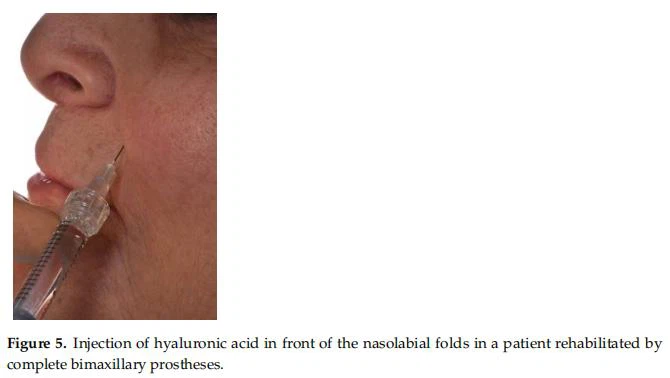
Each anatomic region differs slightly, in terms of injection technique. The goal in every region is to avoid danger zones that could lead to skin necrosis or visual loss [35]. Marked nasolabial folds can be filled with HA to restore volume and unfold the tissues (Figure 5). Drooping labial commissures, giving “a sad look”, can be relieved by injection below the end of the commissure (Figure 6).

【For more info: david.deng@wecistanche.com / WhatApp:86 13632399501】