Chemical Constituents And Neuroprotective Mechanisms Of Cistanche Genus Plants: A Research Review
Sep 23, 2026
Abstract
Plants belonging to the genus Cistanche (family Orobanchaceae) are widely used herbal medicines, with their dried scaly fleshy stems adopted as official medicinal parts. Owing to favorable safety profiles, multiple Cistanche species have been officially listed into the Chinese catalogue of food‑homologous medicinal substances. Phytochemical investigations demonstrate that Cistanche plants are rich in phenylethanoid glycosides, iridoid glycosides, lignans and other secondary metabolites. Modern pharmacological pre‑clinical studies reveal that extracts and pure compounds derived from Cistanche exert comprehensive neuroprotective bioactivities: suppressing neuronal apoptosis, mitigating cerebral ischemia‑reperfusion injury, ameliorating learning‑memory deficits and cognitive impairment, as well as producing therapeutic‑relevant effects against neurodegenerative disorders including Parkinson's disease, Alzheimer's disease and vascular dementia. This review systematically summarizes major chemical constituents and contemporary mechanistic research regarding neuroprotective properties of Cistanche genus plants. It provides theoretical references for further clinical translation, resource development and comprehensive utilization of bioactive ingredients obtained from Cistanche raw materials.
Keywords: Cistanche genus; chemical constituents; neuroprotective mechanism; research progress; phenylethanoid glycosides
1. Introduction
The genus Cistanche comprises approximately 20 recognized species worldwide, among which five species are naturally distributed across China's arid and semi‑arid zones including Inner Mongolia, Ningxia, Gansu, Qinghai and Xinjiang regionspublic-pag.... Four species have received relatively intensive pharmacological and phytochemical research: Cistanche deserticola Y. C. Ma, Cistanche tubulosa Wight, Cistanche salsa G. Beck and Cistanche sinensis G. Beck. Cistanche species are obligate root‑holoparasitic plants, parasitizing root systems of host shrubs such as Haloxylon ammodendron, Tamarix spp., Kalidium foliatum, Salsola passerina and Suaeda physophora. Medicinal materials are harvested from dried fleshy stems covered with scale‑like leaves.
Cistanche ("Rou Cong Rong") has long been documented within classical Traditional Chinese Medicine (TCM) literatures. Shennong's Classic of Materia Medica, one of the earliest TCM monographs, records: "Cistanche tastes sweet, slightly warm in nature. It mainly treats five consumptions and seven injuries, tonifies the middle‑jiao, relieves cold‑heat pain in the genital region, nourishes five zang‑organs, strengthens yin, boosts essence‑qi, improves fertility, and treats abdominal masses in women. Long‑term intake lightens the body; it grows in mountain valleys". Subsequent ancient works including Supplement to Materia Medica, Comprehensive Discourses on Materia Medica, Materia Medica of Tang‑Yue‑Zi further supplemented its clinical indications and herbal property descriptions.
In 2023, national health authorities of China formally approved Cistanche into the food‑medicine homology catalogue after food‑safety risk assessment. This regulatory milestone greatly expands potential market scenarios for resource exploitation, facilitating multi‑directional industrial development of *Cistanche‑derived products for dietary supplement, cosmetic and pharmaceutical sectors. Nevertheless, systematic collation of phytochemical profiles and neuro‑pharmacological mechanisms remains necessary to guide downstream application. This review compiles up‑to‑date literature covering characteristic chemical components and neuroprotective pharmacological mechanisms of Cistanche genus plants, aiming to offer supporting evidence for resource exploration and translational research.

2. Major Chemical Constituents of Cistanche Genus
Multiple classes of secondary metabolites have been isolated and structurally elucidated from Cistanche tissues, primarily consisting of phenylethanoid glycosides, iridoid glycosides, lignan glycosides, benzyl alcohol glycosides, phenylpropanoids, monoterpenes, phenolic glycosides, sterols, organic acids, alkaloids, volatile oils and polysaccharide fractions. Among them, phenylethanoid glycosides, iridoid glycosides and lignans constitute the core bioactive marker compounds for pharmacological researches.
2.1 Phenylethanoid Glycosides (PhGs)
Phenylethanoid glycosides, also categorized as phenylpropanoid derivatives, represent signature constituents of Cistanche. These glycosidic molecules are formed via covalent linkage between phenylethanol aglycone moieties and sugar units; common substituent functional groups include acetyl groups, β‑D‑glucose, α‑L‑rhamnose, caffeoyl, feruloyl, coumaroyl and 2,3,4‑triacetyl‑α‑L‑rhamnose residues. Up to now, 86 distinct phenylethanoid glycoside monomers have been isolated and identified from different Cistanche plant materials. Representative well‑investigated monomers include echinacoside, acteoside (verbascoside), isoacteoside, tubuloside A, tubuloside B, 2′‑acetylacteoside and salidroside. Different Cistanche species exhibit quantitative and qualitative divergence in PhGs composition: C. tubulosa generally accumulates higher total PhGs concentration compared with C. deserticola. Phenylethanoid glycosides possess polyhydroxylated aromatic structures, which endow them with potent antioxidant, anti‑inflammatory, neuroprotective and skin‑protective biological potentials, and are regarded as principal material basis for most pharmacological activities of Cistanche raw herb.
2.2 Iridoid and Iridoid Glycosides
Iridoid glycosides constitute another important class of bioactive secondary metabolites from Cistanche. Identified compounds include 8‑epideoxyloganic acid, 8‑epiloganic acid, mussaenosidic acid, adoxosidic acid, geniposidic acid, geniposide, 6‑deoxycatalpol, catalpol, leonuride and cistanin. These iridoid‑type molecules demonstrate antioxidant, anti‑inflammatory and neuro‑modulating capacities. Variations in iridoid profiles can be observed across four major Cistanche source species (C. tubulosa, C. salsa, C. deserticola, C. sinensis).
2.3 Lignans and Lignan Glycosides
Multiple lignan‑type chemical entities have been purified, such as (+)‑pinoresinol, (+)‑pinoresinol‑O‑β‑D‑glucopyranoside, (+)‑syringaresinol, (+)‑syringaresinol‑O‑β‑D‑glucopyranoside and liriodendrin. Lignan glycosides from Cistanche contribute to antioxidation and partial neuro‑regulatory effects, though relevant pharmacological studies are comparatively less abundant than PhGs‑oriented researches.

2.4 Other Chemical Components
Beyond the three dominant compound groups described above, Cistanche also contains benzyl‑alcohol glycosides, phenylpropanoids, monoterpenes, sterols (daucosterol, β‑sitosterol), organic acids, alkaloids, amino acids, vitamins, volatile oil components and polysaccharides. Polysaccharide fractions extracted from Cistanche exhibit anti‑aging, immunomodulatory and neuroprotective effects in animal assays, occupying an indispensable position in holistic pharmacological actions of crude Cistanche extracts.
3 Neuroprotective Pharmacological Activities and Mechanisms
Mounting in‑vitro cellular experiments and in‑vivo animal model studies demonstrate that Cistanche extracts and purified monomers exert multi‑faceted neuroprotective effects, covering inhibition of neuronal apoptosis, alleviation of cerebral ischemia‑reperfusion damage, improvement of learning‑memory performance, intervention against Alzheimer's disease (AD), Parkinson's disease (PD), vascular dementia (VD), as well as auxiliary effects for depression and spinal cord‑associated neural injuries. Detailed mechanistic evidence is summarized as follows.
3.1 Inhibition of Neuronal Apoptosis
Controlled neuronal apoptosis is essential for physiological nervous‑system development; excessive neuronal apoptosis constitutes a key pathological driver for diverse neurodegenerative disorders. Bcl‑2‑family proteins are central regulatory switches governing apoptosis progress: anti‑apoptotic members including Bcl‑2 and Bcl‑xl suppress programmed cell death, while pro‑apoptotic proteins (Bax, Caspase‑3) initiate apoptotic cascades.
Cistanche polysaccharides can enhance SOD and GSH‑Px antioxidant enzyme activities in brain tissues of D‑galactose induced aging mice, reduce MDA lipid‑peroxidation level, up‑regulate Bcl‑2 gene expression, strengthen neuronal self‑repair capability and lower apoptotic neuronal population, thereby protecting brain neurons from senescence‑associated damage.
Echinacoside, a core PhG monomer, activates ERK signaling pathways to suppress Caspase‑3 protease activation and cytochrome‑C release from mitochondria, ultimately conferring protective effects for neurons. Tubuloside B attenuates H₂O₂‑triggered PC12 neuronal apoptosis: it lowers intracellular reactive oxygen species load, inhibits Caspase‑3 enzymatic activity and stabilizes mitochondrial membrane potential. Acteoside exerts protective influence against PC12 neuronal injury induced by D‑galactose, through up‑modulating cAMP / PKA / CREB signal‑transduction cascade and facilitating neuronal repair processes. Campneoside II significantly counteracts MPP⁺‑provoked apoptosis in rat cerebellar granule neurons. Collectively, multiple active ingredients of Cistanche interfere with mitochondrial‑dependent apoptotic pathways to reduce neuronal loss.
3.2 Attenuating Cerebral Ischemia‑Reperfusion Injury
Cerebral ischemia‑reperfusion injury (CIRI) represents a complex pathophysiological event after ischemic‑stroke reperfusion therapy, jointly mediated by oxidative stress, energy metabolism disturbance, massive free‑radical burst, neuroinflammatory responses, intracellular calcium overload, apoptotic‑gene activation, nitric‑oxide over‑production and excitatory‑amino‑acid toxicity.
Acteoside ameliorates hypoxic‑ischemic brain damage in neonatal rats: it modulates β‑catenin / Wnt signaling axis, down‑regulates pro‑apoptotic Caspase‑3 and Bax protein abundance, decreases pro‑inflammatory TNF‑α and IL‑1β concentrations, and elevates mRNA and protein expression levels of Wnt1, Wnt3a and β‑catenin. Total glycosides obtained from Cistanche mitigate CIRI‑provoked neuronal apoptosis and neuroinflammatory response via down‑regulating lncRNA‑GAS5 gene expression.
Echinacoside provides neuroprotection for MCAO‑operated CIRI model rats: it promotes mitochondrial autophagy mediated by HIF‑1α / BNIP3 signaling pathways, reduces cerebral infarct volume and alleviates neuronal pathological injury. Total Cistanche glycosides also suppress excitatory‑amino‑acid accumulation and inhibit NF‑κB‑pathway over‑activation within hippocampal tissue, consequently improving cognitive deficits in CIRI experimental animals.
3.3 Improvement of Learning and Memory Functions
Impairment of learning‑memory capacity is a prominent phenotype for brain aging, cerebral ischemia and multiple neurodegenerative diseases. Cistanche‑derived substances improve learning‑memory performance through antioxidation, anti‑apoptosis and synaptic‑plasticity regulation.
Cistanche polysaccharides protect senescent neurons, ameliorate memory defects in D‑galactose subacute‑aging mouse models. One underlying mechanism involves enhancement of synaptic plasticity: polysaccharide treatment elevates expression of synaptophysin (SYP) and growth‑associated protein‑43 (GAP‑43) within mouse hippocampus, promoting synapse genesis and increasing synaptic quantity.
Echinacoside mitigates memory deterioration in Aβ₂₅‑₃₅‑induced AD‑model rats by reinforcing free‑radical scavenging capability and lowering cerebral oxidative‑stress burden. Acteoside improves cognitive indexes for D‑galactose aging animals, which correlates with protection of cholinergic neurons. Total Cistanche glycosides produce notable ameliorative effects on learning‑memory behaviors of SAMP8 accelerated‑senescence mice. Acteoside also modulates inflammatory‑cytokine profiles in MCAO rats: it reduces hippocampal IL‑1α, IL‑2 and TNF concentration, meanwhile raising IFN‑γ level, which contributes to memory‑function restoration.
3.4 Amelioration of Cognitive Dysfunction
Acetylcholine (ACh) serves as vital neurotransmitter for nerve impulse transmission inside brain tissue. Excessive acetylcholinesterase (AChE) activity accelerates ACh hydrolysis, disturbs cholinergic neurotransmission and triggers cognitive dysfunction.
Acteoside extracted from C. deserticola relieves cognitive deficits in chronic cerebral hypoperfusion mouse models. Its pharmacological effect is associated with maintaining hippocampal AChE homeostasis, decreasing MDA oxidative‑stress marker and boosting SOD antioxidant enzymatic activity. Total Cistanche glycosides strengthen Aβ peptide clearance capacity, support neuronal recovery and rescue cognitive impairment in Aβ‑lesioned experimental rats. Echinacoside activates hippocampal FOXO1‑dependent autophagy, alleviates sevoflurane‑induced neurotoxicity and reverses anesthetic‑evoked cognitive decline in laboratory mice.
3.5 Pharmacological Effects against Parkinson's Disease
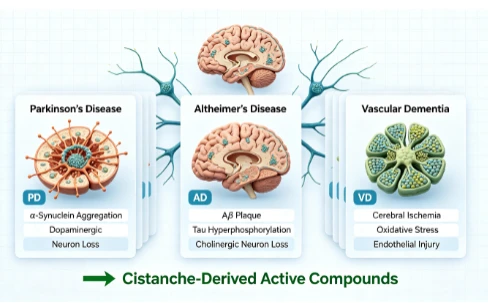
Parkinson's disease (PD) is a prevalent age‑related neurodegenerative disorder. Core pathological hallmarks include progressive degeneration of nigrostriatal dopaminergic neurons and intracellular aggregation of α‑synuclein protein aggregates.
Cistanche polysaccharides protect damaged neurons in 6‑OHDA‑lesioned PD‑model rats. The protective mechanism relates to activation of Wnt / β‑catenin signaling and suppression of GSK‑3β kinase activity. Acteoside inhibits LPS‑stimulated neuroinflammatory responses in BV‑2 microglia cells: it down‑regulates iNOS and COX‑2 inflammatory‑protein expression, and reduces secretion of NO, IL‑6 and TNF‑α pro‑inflammatory mediators. Echinacoside restrains NLRP3 / Caspase‑1 / IL‑1β inflammatory‑signal cascades, mitigates α‑synuclein pathological accumulation and improves neurological behaviors in PD‑model mice. Total glycosides from Cistanche exert anti‑neuroinflammatory functions partially by tuning SIRT1 / NF‑κB signaling network.

3.6 Intervention against Alzheimer's Disease
Alzheimer's disease (AD) is the most common neurodegenerative dementia worldwide, accounting for 50 %‑70 % of total dementia patients. Major pathological characteristics cover amyloid‑beta (Aβ) plaque deposition, hyper‑phosphorylated tau‑protein‑mediated neurofibrillary tangles, cholinergic‑neuron loss, neuroinflammation and severe oxidative stress.
Acteoside treatment decreases Aβ peptide aggregation and neuronal apoptosis in AD‑model mice, elevates surviving‑neuron quantity and rescues learning‑memory deficits. Cistanche polysaccharides increase Bcl‑2 expression, inhibit Caspase‑3 protease activity and alleviate hippocampal‑neuron damage triggered by Aβ₂₅‑₃₅ intoxication. Echinacoside activates Nrf2 antioxidative‑defense pathway, suppresses TXNIP‑NLRP3 inflammasome axis, lowers TNF‑α and IL‑1β inflammatory‑cytokine release, stimulates PI3K / Akt signaling and augments PPAR‑γ transcriptional activity in APP / PS1 transgenic AD mice. Acteoside activates ERK1 / 2‑Nrf2 signaling, reduces hippocampal IL‑6, TNF‑α, IL‑1β and GFAP levels and relieves neuroinflammation to restore cognitive performance in AD‑animal assays.
3.7 Therapeutic Potential for Vascular Dementia
Vascular dementia (VD) represents cognitive‑impairment syndrome induced by cerebral‑vascular lesions and subsequent brain parenchymal injury; ischemic cerebrovascular pathologies constitute its predominant etiology.
Echinacoside improves learning‑memory behaviors in VD‑model rats. It up‑regulates protein expression of BDNF, TrkB, Akt and NMDAR within hippocampal tissue. Meanwhile, echinacoside mitigates oxidative‑stress damage, activates Nrf2‑associated antioxidant pathways, relieves hippocampal mitochondrial impairment and optimizes cognitive indexes. Clinical observational research indicates that total Cistanche glycosides can mitigate dementia severity, enhance cognitive function and activities‑of‑daily‑living performance for VD patients, presumably by reinforcing cerebral antioxidant‑enzyme activities.
3.8 Other Neuro‑Related Pharmacological Actions
Beyond above‑mentioned classic neurodegenerative‑disease models, modern pharmacological researches expand to additional neuro‑protective phenotypes. Echinacoside ameliorates mitochondrial structural injury in CUMS chronic‑unpredictable‑mild‑stress depression‑model rats: it reduces MDA and LDH concentrations, elevates SOD level and modulates p‑Drp1 mitochondrial‑fission‑related‑protein expression, thereby relieving depressive‑like behavioral manifestations. Echinacoside also reverses abnormal mitochondrial fragmentation and suppresses neuroinflammatory reactions induced by chronic cervical‑spinal‑cord compression animal models. In aging‑model animal studies, Cistanche phenylethanoid glycosides raise brain‑tissue SOD activity, enhance organism antioxidant and immune competence and delay age‑related functional decline.

4 Summary and Future Perspectives
Under TCM theoretical framework, Cistanche ("Rou Cong Rong") tonifies kidney‑yang, replenishes essence‑blood and relaxes intestines to alleviate constipation. Phytochemical studies confirm that phenylethanoid glycosides, iridoid glycosides and lignan‑type compounds constitute its principal bioactive chemical pool. Abundant pre‑clinical in‑vitro and animal‑model experiments verify multi‑dimensional neuroprotective pharmacological properties of Cistanche raw materials and purified monomers: inhibiting neuronal apoptosis, alleviating cerebral ischemia‑reperfusion injury, ameliorating learning‑memory dysfunction and cognitive impairment, as well as producing intervention effects for Parkinson's disease, Alzheimer's disease, vascular dementia, depression and other nervous‑system pathological conditions. These experimental findings lay fundamental pre‑clinical data foundation for potential clinical application.
China possesses abundant wild and artificially‑cultivated Cistanche plant‑resource reserves. Nevertheless, current research landscape still exhibits obvious limitations. First, most available evidence derives from cellular and animal‑model pre‑clinical experiments; high‑quality clinical trials remain scarce. Second, partial neuro‑protective molecular mechanisms are only partially elucidated; multiple signal‑pathway cross‑talk phenomena await deeper mechanistic exploration. Third, comparative pharmacological investigation across different Cistanche source‑species is insufficient; the correlation between complex multi‑component compatibility and in‑vivo holistic efficacy needs further systematic research.
In future work, multi‑omics technologies including metabolomics, transcriptomics and proteomics can be adopted to decode multi‑target synergistic modes of Cistanche multi‑component mixtures. High‑quality randomized controlled clinical trials should be promoted to validate real‑world clinical efficacy and safety. Advanced drug‑delivery systems can be developed to improve brain‑targeting bioavailability of phenylethanoid‑glycoside active molecules. Collectively, these research directions will further unlock developmental and translational value of Cistanche genus medicinal resources for neuro‑protective pharmaceutical, nutraceutical and functional‑food industries.
Acknowledgements
This work was financially supported by Gansu Provincial Science and Technology Program Project (Grant No. 20JR10RA355); Gansu Provincial Health Industry Scientific Research Project (GSWSKY2022‑27); National TCM Advantage Specialty Construction Project (Document No. Ganwei Zhongyi Han〔2023〕63). We thank Gansu Provincial Hospital of Traditional Chinese Medicine for experimental platform support.
References
[1] Wang W C. Flora Reipublicae Popularis Sinicae[M]. Volume 69. Beijing: Science Press, 1990.
[2] Chinese Pharmacopoeia Commission. Pharmacopoeia of People's Republic of China (Volume I)[S]. Beijing: China Medical Science Press, 2020.
[3] Huang S. Shennong's Classic of Materia Medica[M]. Reprint Edition. Beijing: Ancient Books of China Press, 1982.
[4] Song Q Q. Phytochemical profiling and anti‑vascular‑dementia pharmacodynamic material basis of Herba Cistanche[D]. Beijing: Beijing University of Chinese Medicine, 2019.
[5] Wang L W. Isolation, quantitative‑analysis and bioactivity‑research of chemical constituents from Cistanche plants[D]. Hohhot: Inner Mongolia University, 2016.
[6] Wu J F, Yin Q W, Pan Y Z, et al. Rapid chemical profiling of total glycoside capsules of Cistanche by UPLC‑Q‑TOF‑MS/MS[J]. China Journal of Chinese Materia Medica, 2016, 41(17):3244‑3251.
[7] Zhang H W. Phytochemistry and fingerprint spectrum research of Cistanche salsa[D]. Hohhot: Inner Mongolia Medical University, 2008. [8] Nan Z D, Ren H Z, Zhao M B, et al. Four new cis‑phenylethanoid glycosides from cultivated Cistanche deserticola in Tarim Basin[J]. China Journal of Chinese Materia Medica, 2018, 43(6):1169‑1174.
[9] Wang J F. Qualitative and quantitative analysis of phenylethanoid glycosides in different parts of Cistanche deserticola[D]. Beijing: Peking Union Medical College, 2014.
[10] Pan Y N. Phytochemistry and bio‑activity investigation of fresh Cistanche tubulosa[D]. Shenyang: Shenyang Pharmaceutical University, 2011.
[11] Cao L B, Gong X C, Jia J Q, et al. Rapid qualitative analysis of chemical constituents from Cistanche salsa using direct‑injection multi‑stage mass‑spectrometry full‑scan mode[J]. China Journal of Chinese Materia Medica, 2021, 46(16):4150‑4156.
[12] Liu W J, Liu Y, Song Q Q, et al. Comparison of chemical profiles between wild and cultivated Cistanche tubulosa by ¹H‑NMR spectroscopy[J]. China Journal of Chinese Materia Medica, 2018, 43(17):3506‑3512.
[13] Hu J Q, Feng J Y. Chemical constituents and pharmacological actions of Cistanche deserticola[J]. Clinical Journal of Chinese Medicine, 2012, 4(15):26‑28.
[14] Liu W J, Cao Y, Song Q Q, et al. Qualitative‑analysis of chemical constituents from flower and lignified stem of Cistanche deserticola[J]. China Journal of Chinese Materia Medica, 2018, 43(18):3708‑3714.
[15] Song Z H, Mo S H, Chen Y, et al. Chemical‑constituent research of Cistanche tubulosa[J]. China Journal of Chinese Materia Medica, 2000, 25(12):728‑730.
[16] Tu P F, Lei L, Zhao M B, et al. A series of benzyl‑alcohol‑glycoside compounds derived from Cistanche salsa[P]. Chinese Patent: CN02117640, 2004‑07‑07.
[17] Cai K R, Liu Z X, Sun X D. Neuro‑protective effect and mechanism of Cistanche polysaccharide on D‑galactose‑induced aging‑mouse brain neurons[J]. Chinese Journal of Gerontology, 2018, 38(19):4732‑4734. [18] Zhu M Z, Lu C, Li W. Echinacoside is sufficient to activate Trk signaling and protect neurons from rotenone‑caused toxicity[J]. Journal of Neurochemistry, 2013, 124(4):571‑580.
[19] Deng M, Ju X D, Tu P F, et al. Tubuloside B counteracts H₂O₂‑evoked apoptosis in PC12 neuronal cells[J]. Chinese Journal of Pathophysiology, 2008, 24(9):1816‑1821.