Cistanche And Fruit Wine: How The Desert Ginseng Is Finding Its Way Into Modern Functional Beverages
Nov 27, 2026
Introduction: A Desert Herb Meets the Fruit Wine Glass
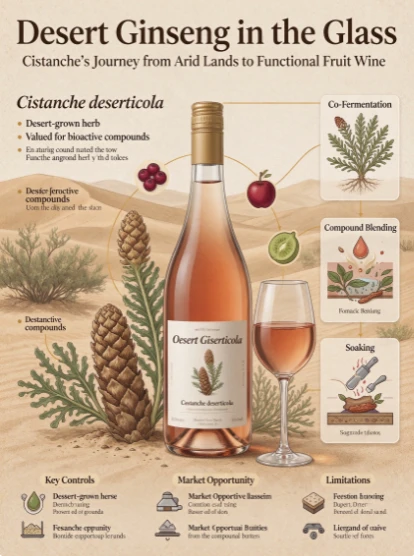
Across the dry, sandy expanses of northwestern China, a humble parasitic plant has been prized for well over a thousand years. It is called Cistanche deserticola, and in Chinese tradition it carries a nickname that sums up its reputation: the "desert ginseng." Unlike true ginseng, however, cistanche does not grow lush green leaves or produce berries. It draws its nutrients by attaching itself to the roots of desert shrubs, and the part that people use is its fleshy, scaly underground stem.
For centuries, cistanche was treated mainly as a medicinal herb. Ancient herbal classics such as the Shennong Bencao Jing (The Divine Farmer's Classic of Materia Medica) and the Bencao Gangmu (Compendium of Materia Medica) both record its use, describing it as a gentle tonic that supports vitality and healthy aging. Today, modern research is beginning to explain what those traditional practitioners sensed: the plant is packed with distinctive bioactive compounds that show antioxidant, immune-supporting, and neuroprotective potential.
At the same time, a quiet revolution is happening in the beverage world. Consumers are moving away from high-alcohol, low-nutrition drinks and toward products that feel both enjoyable and genuinely good for them. Low-alcohol fruit wines, functional drinks, and "better-for-you" alternatives are among the fastest-growing categories in many markets. This shift has created an interesting question: could cistanche, long confined to medicine cabinets and small-batch tonic wines, become a mainstream functional ingredient in modern fruit wine?
This article explores that question. It looks at why cistanche is attracting attention, how it can be combined with fruit into wine, what different production methods do to quality, and where the industry still needs to improve. The goal is to give a clear, practical picture of cistanche's role in compound fruit wine today and where it may go next.
What Makes Cistanche Special
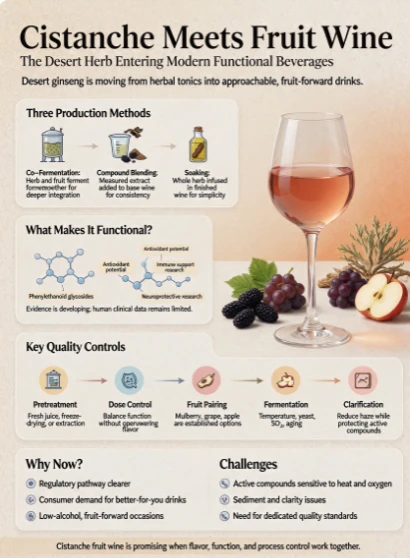
The appeal of cistanche begins with its chemistry. Researchers have identified several groups of compounds that are characteristic of the plant. The most studied are the phenylethanoid glycosides (PhGs), a class of molecules that includes echinacoside and acteoside (also called verbascoside). These compounds are strong antioxidants, meaning they can help neutralize free radicals and reduce oxidative stress in the body. Alongside them sit iridoids, lignans, polysaccharides, galactitol, and various oligosaccharides. It is the combined action of these components, rather than any single one, that is thought to produce cistanche's broad range of effects.
Traditional Chinese medicine classifies cistanche as warm and salty-sweet in nature, and it has long been associated with kidney health, bowel regularity, and general vitality. Modern pharmacological studies have added more detail, suggesting that cistanche and its extracts may support antioxidant defense, help slow certain signs of aging, modulate immune function, and offer protection to nerve cells. It is important to note that much of this evidence comes from laboratory and animal research; human clinical data is still developing. Still, the underlying chemistry is compelling enough that cistanche has become a favorite subject for functional-food researchers.
There are actually two main species used commercially: Cistanche deserticola and Cistanche tubulosa. Both are recognized sources of phenylethanoid glycosides, and both grow in the desert regions of Inner Mongolia, Gansu, Xinjiang, and neighboring areas. For manufacturers, the key point is that these active compounds dissolve reasonably well in ethanol and water. This simple fact matters enormously, because it means cistanche's beneficial components can be extracted into a liquid drink-exactly what a fruit wine is.
A Regulatory Milestone That Changed Everything
For a long time, cistanche sat in a legal gray zone for food products. It was clearly valued as a medicine, but using it in everyday foods and beverages was restricted or uncertain. That changed in November 2023, when desert cistanche (Cistanche deserticola) was officially approved for inclusion in China's catalog of substances that are "both food and traditional Chinese medicine"-often called the medicine-food homology (药食同源) list.
This may sound like a bureaucratic detail, but it is actually a landmark event for the industry. Before the listing, cistanche could be used mainly in health supplements and traditional medicinal wines. After the listing, food and beverage companies gained a clear legal pathway to formulate cistanche into ordinary foods and drinks. It opened the door for everything from teas and candies to juices and, notably, fruit wines.
The practical result is visible in the marketplace. Cistanche products are already sold as tea substitutes, tablets, granules, capsules, and oral liquids. But the most exciting new direction is arguably in beverages, where cistanche's health halo can meet consumer demand for flavor, low alcohol, and natural ingredients all at once.
Why Fruit Wine, and Why Now
Traditional cistanche liquor is usually a high-alcohol spirit in which the whole herb has been soaked. It is strongly medicinal, often aimed at middle-aged and older male consumers, and it rarely appeals to younger drinkers or casual occasions. Fruit wine is different. It is typically lower in alcohol, fruitier, and more food-friendly-something a person might open with dinner or share at a small gathering.
The idea behind cistanche compound fruit wine is to bring these two worlds together. The fruit provides aroma, sweetness, acidity, and drinkability. The cistanche provides functional appeal and a subtle herbal complexity. If the two are blended well, the result is a beverage that is pleasant to drink and carries a credible wellness story. For producers, this also means a higher-value product: consumers in many markets will pay a premium for a drink that tastes good and offers functional benefits.
Three Ways to Put Cistanche Into Fruit Wine
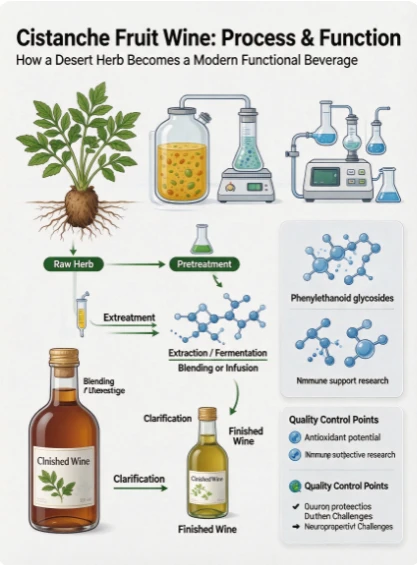
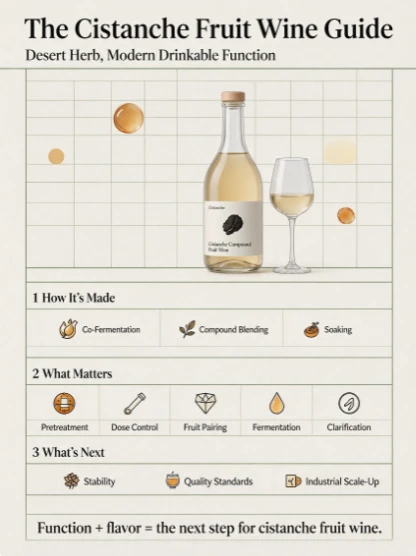
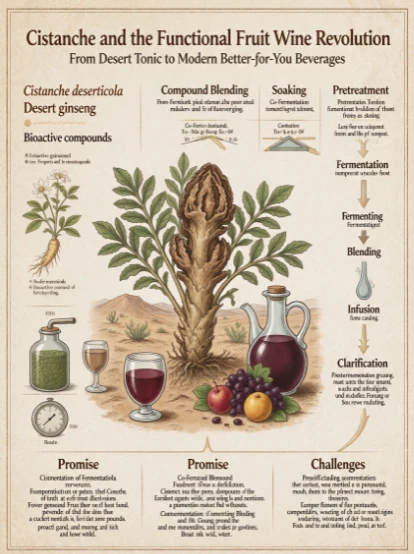
In practice, producers use three main approaches to combine cistanche with fruit into wine. Each has its own logic, strengths, and drawbacks.
Method 1: Co-Fermentation
Co-fermentation is the most sophisticated of the three, and today it is the mainstream route for serious cistanche fruit wine development. The idea is simple in principle: cistanche-or an extract made from it-is fermented together with the fruit juice by yeast. During fermentation, the yeast's metabolic activity helps release and transform cistanche's active compounds, while the evolving wine blends herbal, fruity, and alcoholic notes into a single harmonious profile.
In practice, this method takes several forms. Some researchers juice fresh cistanche and add it to concentrated apple juice before pitching yeast; the juicing step, combined with a color-protection treatment, helps prevent the cistanche from oxidizing and turning brown. Others take a more engineered route: they freeze-dry cistanche, grind it into an ultra-fine powder, and co-ferment that powder with mulberry. The fine grinding and low-temperature processing help preserve a higher share of the active compounds.
Co-fermentation solves a classic problem with simple soaking: it tends to extract active ingredients more effectively and produces a smoother, better-integrated flavor. The trade-off is complexity. There are more variables to control-temperature, yeast strain, nutrient levels, timing-and some heat-sensitive compounds can degrade during fermentation if conditions are not carefully managed. Done well, however, it yields the most stable and refined product.
Method 2: Compound Blending
The second approach skips fermentation of the herb altogether. Instead, the producer starts with a finished base-fermented wine, distilled spirit, or edible alcohol-and adds cistanche extract along with other food-grade or medicine-food ingredients to adjust the final product. Think of it as building a cocktail from carefully measured components rather than cooking everything from scratch.
This method has a major advantage: precision. Because the active components are added as a measured extract, a producer can control exactly how much phenylethanoid glycoside, alcohol, and sugar ends up in each bottle. Batch-to-batch consistency is far easier to achieve, production is faster, and the process scales well for industrial output. Researchers have used orthogonal experimental designs to optimize the ratio of ingredients and lock in a repeatable formula.
The downside is flavor. Blended products often lack the depth and natural roundness that fermentation creates, and they can taste somewhat flat or one-dimensional. They are excellent for standardized, functional-first products, but less appealing for drinkers who prioritize taste.
Method 3: Soaking (Infusion)
Soaking is the oldest and simplest method. It relies on the fact that ethanol is a good solvent: when cistanche sits in alcohol, its active components gradually dissolve into the liquid. Traditionally, this was done with high-proof white liquor and whole, dried cistanche stems, producing a strong medicinal tonic.
More recently, producers have adapted the technique to fruit wine. One patent describes using a finished fruit wine as the base, then adding whole, uncut fresh cistanche that has been washed, color-protected, and drained. The mixture is sealed and left to infuse at room temperature, away from light, for an extended period. Because the cistanche is not chopped or pulverized, fewer nutrients are lost in processing, and the gentle fruit-wine base extracts the plant's polysaccharides and phenylethanoid glycosides slowly. After infusion, the wine is filtered, clarified, and sterilized.
The appeal of soaking is its simplicity and low equipment cost. It is ideal for small-scale or artisanal production. The weakness is efficiency: extraction is slow and incomplete, so the concentration of active compounds ends up lower than with other methods, and the wine may show more sediment or instability over time.
Pretreatment: The Step That Sets Up Success
No matter which method is used, what happens to the cistanche before it meets the wine has an outsized effect on the final quality. Pretreatment determines how well the active compounds are released, how the flavor develops, and whether the finished wine stays clear.
For soaking, pretreatment is minimal-usually just washing, peeling, and color protection. For co-fermentation, the options are much richer, and researchers have tested several distinct strategies:
Fresh juicing. Washing, peeling, and slicing fresh cistanche, then soaking it in a color-protection solution before mashing and filtering. This preserves the fresh, natural flavor and most of the inherent nutrients.
Freeze-drying plus ultra-fine grinding plus enzymatic treatment. This is a more aggressive, modern approach. The cistanche is freeze-dried, ground to an ultra-fine powder, mixed with mulberry juice, and then treated with cellulase and pectinase enzymes. The enzymes break down cell-wall structures, dramatically increasing the amount of active compounds that dissolve out. The result is a wine with noticeably better nutritional density.
Hot reflux extraction. Here, dried cistanche is ground and boiled with water in a reflux system, then filtered and concentrated. The high temperature efficiently pulls out polysaccharides and phenylethanoid glycosides and, as a side benefit, reduces the herb's bitter, earthy taste. The trade-off is that prolonged heat can damage heat-sensitive compounds, lowering the product's overall health value.
High-temperature softening. Some researchers soften cistanche by boiling it together with red dates, then crush and concentrate the mixture before fermentation. This technique is often paired with fruits like pomelo and aims to release flavor and nutrients while simplifying handling.
Each strategy reflects a different balance between extraction efficiency, flavor, and protection of delicate compounds. There is no single "best" method-only the method best suited to the specific recipe, fruit base, and target consumer.
Getting the Dose Right
The amount of cistanche added is a classic case of "too little is useless, too much is unpleasant." Add too little, and the wine has no meaningful functional benefit. Add too much, and the herbal, medicinal taste takes over and the wine may become unstable.
Research on mulberry–cistanche fermentation suggests that a ratio of roughly 1,000 parts mulberry to 9 parts cistanche gives the best balance of flavor and functional content. Studies on grape-based cistanche wine point to a similar sweet spot, around 5 grams of cistanche per kilogram of base, which delivers enough active compounds without overwhelming the palate. In another grape-wine study, a ratio of 1 part cistanche concentrate to 4 parts grape juice scored highest on sensory evaluation.
The exact number varies with the fruit, the processing method, and the target product, but the principle is consistent: cistanche works best as a supporting character, not the lead. Its role is to add function and a subtle herbal note, while the fruit remains the star of the flavor.
Choosing the Right Fruit Partner
Cistanche's warm, salty-sweet character makes it a surprisingly flexible partner, and it has been tested with mulberry, grape, apple, pomelo, jujube, and more. Each fruit brings a different contribution:
Mulberry is a natural match. Its sweet-tart profile helps mask the herb's medicinal edge, and its anthocyanins work alongside cistanche's compounds to boost antioxidant activity. Mulberry-based cistanche wines tend to appeal to younger consumers.
Grape is perhaps the most commercially practical choice. Its rich aroma easily covers any residual herbiness, and the resveratrol in grapes pairs well with cistanche's active compounds. Grape wines also enjoy the broadest market acceptance.
Apple emerged as a favorite in comparative testing. When researchers paired cistanche with apple, Hami melon, jujube, and grape juices, apple juice produced the best yeast activity and growth. Jujube and melon juices darkened the wine and hurt its appearance, while apple and grape maintained a clean, attractive color-and apple delivered the best mouthfeel of the group.
The takeaway for product developers is practical: start with grape or apple if you want broad appeal and reliable fermentation, or reach for mulberry if you want a functional, antioxidant-forward story aimed at a younger demographic.
Fermentation and Aging: The Details That Shape Quality
Once the ingredients are combined, a handful of variables decide whether the wine is smooth and stable or harsh and cloudy.
Temperature is the first and most important control. Fermentation temperature directly shapes which flavor compounds form and in what balance. For fruit wine, the main fermentation is usually kept between about 15 and 30 °C. In mulberry–cistanche research, 23 °C emerged as the optimal point, paired with an RX60 yeast strain and a main fermentation of about eight days.
Yeast strain matters almost as much as temperature, because different yeasts produce different flavor profiles and different levels of stability. Choosing the wrong strain can leave the wine thin, overly alcoholic, or unstable.
Sulfur dioxide (SO₂) is a quiet workhorse in winemaking. Added in small amounts, it prevents early browning and suppresses spoilage microbes. For cistanche grape wine, researchers found that about 70 mg/L of SO₂ was enough to protect the active compounds and keep the wine clean without noticeably altering flavor.
Aging is where the rough edges are smoothed away. Cistanche wines are typically aged at a cool 8–12 °C for three to six months, with humidity held around 70–80%. During this time, the wine is periodically racked (transferred off its sediment) to keep it clear and encourage the flavors to integrate. Done patiently, this turns a decent wine into a rounded, mellow one.
Keeping the Wine Clear
Cistanche contains large molecules-polysaccharides and proteins-that can make wine cloudy or throw sediment over time. For a product that must sit on a shelf and look appealing, clarification is essential.
Two main approaches are used. The first is cold settling: simply holding the wine at 0–4 °C for 7 to 10 days and letting particles fall out naturally. It is gentle and inexpensive, and works well for small batches. The second is fining agents: adding materials such as bentonite, gelatin, activated carbon, or diatomaceous earth after primary fermentation, stirring, and allowing the agent to bind to haze-forming particles before the wine is racked and filtered. This method is faster and better suited to industrial scale.
When researchers compared four fining agents on cistanche health wine, all four clarified the wine effectively, but three of them-activated carbon, gelatin, and chitosan-also stripped away some of the active compounds. Diatomaceous earth proved to be the best choice, delivering clear wine while preserving more of the beneficial components. This is a useful reminder that in functional winemaking, every processing step must be judged not only by how it affects appearance, but also by whether it protects the ingredients that make the product special.
Why Cistanche Fruit Wine Is Worth Making
Put the pieces together, and the case for cistanche fruit wine becomes clear.
First, it occupies a genuinely distinct niche. It is not a plain fruit wine, and it is not a harsh medicinal tonic. It combines a wellness story with real drinkability, moderate alcohol, and a layered aroma of fruit, wine, and a light herbal note. That makes it suitable for far more occasions-dinner, gifting, social gatherings-than traditional cistanche liquor, and it can appeal to both men and women and to a wider age range.
Second, it adds value along the entire supply chain. For producers, it commands a higher price than ordinary fruit wine. For cistanche growers in desert regions, it creates demand for a deeper, more diversified processing industry. And because cistanche can be cultivated in arid, marginal land, expanding its use can bring economic, social, and ecological benefits to regions where few other cash crops thrive.
An Honest Look at the Limitations
For all its promise, cistanche fruit wine still faces real obstacles that producers should not underestimate.
Stability is a persistent challenge. The phenylethanoid glycosides in cistanche are sensitive to heat and oxygen, so they can degrade during processing and storage. Meanwhile, the same large molecules that give cistanche its health benefits-polysaccharides and proteins-are also the ones most likely to cause cloudiness or sediment later in the bottle's life. Keeping the wine clear and potent over a long shelf life is harder than it sounds.
There is no dedicated quality standard. At present, cistanche fruit wine is judged against generic fruit wine standards. There is no national or industry standard that specifies how much echinacoside or acteoside a cistanche wine should contain, or how its functional claims should be verified. The result is a market with wide quality differences and a credibility gap that holds back the whole category.
Industrial infrastructure lags behind. Cistanche cultivation is not yet fully standardized, and raw-material quality varies from batch to batch. Advanced extraction and directed-fermentation technologies are not widely adopted, and many companies lack the research depth needed to develop consistent, high-quality products. Until these gaps close, scaling up will remain difficult.
Where the Industry Is Heading
The good news is that every one of these limitations has a plausible technical answer, and the broader direction of food technology points the way.
On the process side, the industry is moving toward gentler, smarter extraction. Enzymatic hydrolysis, ultrasound-assisted extraction, and supercritical-fluid extraction can pull out active compounds with less heat damage than traditional methods. Downstream, techniques such as encapsulation can protect sensitive compounds, low-temperature and oxygen-controlled fermentation can slow degradation, and nano-clarification can tackle the sediment problem more precisely than conventional fining.
On the standards side, the most important step is to build a dedicated quality-control framework built around cistanche's signature compounds-especially the phenylethanoid glycosides. With clear quantitative limits, validated efficacy-evaluation methods, and full traceability from farm to bottle, the category could move from "functional-looking" to genuinely trustworthy. Faster, simpler detection methods would also let more producers verify quality without heavy investment.
Finally, there is the story itself. Cistanche has a rare combination: a deep traditional heritage, a modern regulatory green light, a growing body of science, and a name-"desert ginseng"-that instantly communicates value. If producers pair good science with clear, honest communication, cistanche fruit wine has a realistic chance to grow from a regional novelty into a globally recognized functional beverage.
Conclusion
Cistanche has spent most of its history as a quiet desert remedy. Today, thanks to new regulatory status, better extraction science, and a consumer shift toward healthier drinks, it is stepping into a new role as a functional ingredient in fruit wine. Through co-fermentation, blending, or soaking, and with careful attention to pretreatment, dosage, fruit selection, fermentation, and clarification, producers can create a beverage that is both enjoyable and meaningful.
The path forward is not without obstacles-stability, standardization, and industrial maturity all need work. But the fundamentals are strong, and the direction of travel is clear. For anyone interested in the future of functional beverages, cistanche fruit wine is a category worth watching closely.