Cistanche Tubulosa: An Ancient Materia Medica Under Modern Scientific Scrutiny
Nov 27, 2026
1 Summary
The legal scientific name of Cistanche tubulosa is Cistanche tubulosa (Schenk) Wight. It has been included as one of the source species of the medicinal material Cistanche in the Chinese Pharmacopoeia since the 2005 edition. It parasitizes the roots of Tamarix species and is mainly distributed in desert and oasis-edge habitats of southern Xinjiang. It differs from Cistanche deserticola, which parasitizes Haloxylon ammodendron, in botanical source, cross-sectional characters, and the proportional composition of its chemical constituents [1][4].
Effects of Cistanche: Improve Kidney Function
Click here to view Cistanche for Kidney disease products
【Ask for more】 Email:cindy.xue@wecistanche.com / WhatsApp: 0086 18599088692 / WeChat: 18599088692
In traditional materia medica, Cistanche is described as tonifying kidney yang, replenishing essence and blood, and moistening the intestines to relieve constipation. These are applications within the framework of historical culture and traditional Chinese medicine theory, and they cannot be taken as direct evidence of efficacy against modern diseases [2]. Modern chemical studies have identified phenylethanoid glycosides, iridoid glycosides, lignans, oligosaccharides, and polysaccharides. Echinacoside and acteoside are the core marker compounds used for quality control in the Chinese Pharmacopoeia [1][3].
As of October 2026, small-scale randomized, double-blind, placebo-controlled human studies have been published, but they have mostly enrolled participants with locomotor function problems, cognitive concerns, or spinal cord disease symptoms; the samples are small, and the interventions are often combined with Ginkgo biloba. Such evidence cannot support claims that the material treats Alzheimer disease, cervical spondylosis or aging [5][6][7].
Regarding safety, animal toxicology and early clinical signals are generally mild, yet the European Food Safety Authority declined to recognise a particular aqueous extract as a novel food because of concerns about serious adverse events in humans. The legal boundaries between medicinal material, health food and ordinary food should be kept separate, and self-treatment should never replace standard medical care [8][9].
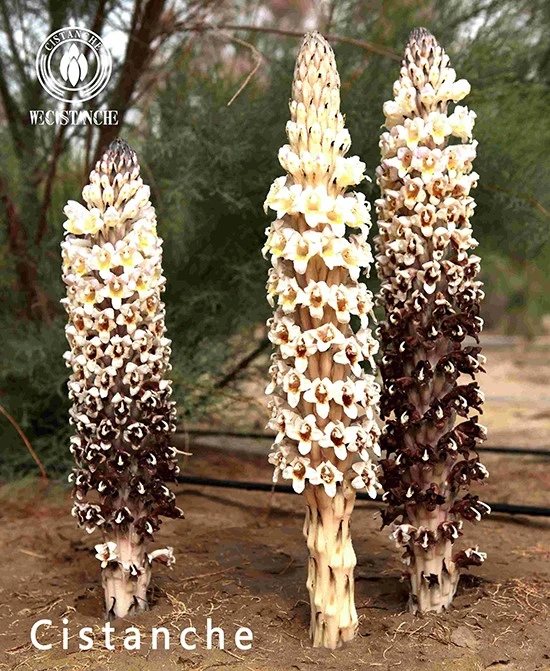
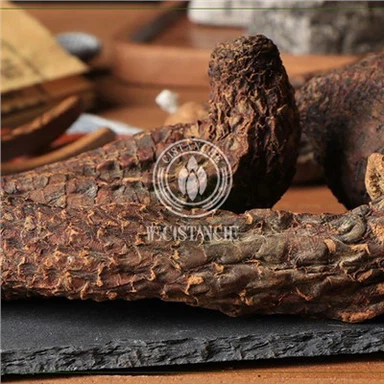
Desert-living cistanche
2 From a Desert Plant to a Pharmacopoeia Medicinal Material: Species, Ecology and Materia Medica Status
Cistanche tubulosa is a desert plant that depends on a host for survival rather than a common vegetable or a freely harvested wild food. It belongs to the family Orobanchaceae and the genus Cistanche. The whole plant may reach 60 to 100 cm in height, with the above-ground portion about 30 to 35 cm tall. The corolla is tubular and funnel-shaped, flowering usually from May to June and fruiting from July to August. The key feature of its life cycle is not independent rooting in the soil but the formation of a haustorium after seed germination, which connects to the vascular system of the host and draws nutrients from the roots of Tamarix species. The Chinese Digital Plant Specimen Database records it from the Minfeng area of southern Xinjiang, commonly in relatively moist Tamarix thickets and dune habitats at an altitude of about 1200 m [4]. This parasitic habit means that yield, quality, and harvest timing cannot be discussed in isolation from host health, soil moisture, and artificial inoculation techniques. When host stands are overused, or the desert ecosystem degrades, the ecological basis of supply comes under pressure at the same time.
The name Cistanche is not the common name of a single species but the official name of a medicinal material. The Chinese Pharmacopoeia specifies that the material is the dried scaly fleshy stem of Cistanche deserticola Y.C.Ma or Cistanche tubulosa (Schenk) Wight of the family Orobanchaceae [1]. The former usually parasitizes Haloxylon ammodendron and is traditionally traded as soft Dayun. The latter, whose cross-section shows scattered vascular bundles and a harder texture, belongs to the hard Dayun type in empirical identification. The fact that both species may be used as Cistanche does not mean that all similarly named commodities, regional substitutes or adulterants share the same botanical source, the same marker content or the same history of edible use.

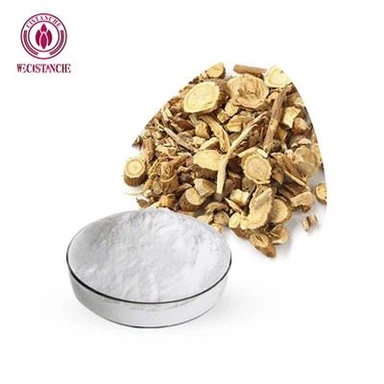
cistanche powder
Traditional materia medica gives Cistanche a cultural starting point for research, but it is not a modern pharmacological conclusion. Cistanche was first recorded in the Shennong Bencao Jing, where it is described as treating five kinds of overstrain and seven kinds of injury, tonifying the middle, nourishing the five viscera, strengthening yin, replenishing essence and qi, and making the body light on prolonged use [2]. Later materia medica further summarised its actions as tonifying kidney yang, replenishing essence and blood and moistening the intestines to relieve constipation. It must be understood cautiously that this language belongs to traditional syndrome and efficacy terminology, not to modern diagnostic claims such as curing impotence, reversing infertility, curing constipation, or delaying aging. Traditional experience explains why physicians observed and used the plant over many generations, and it can suggest candidate directions for modern research; but an ancient usage record has not been tested by randomization, blinding, long-term follow-up, uniform diagnostic criteria, and conflict-of-interest management.
This boundary also determines the way evidence is graded in this review. Traditional use, animal and cell experiments, and human clinical evidence answer different questions. Traditional records answer how the material was understood and used historically; in vitro and animal studies answer what biological signals appear in particular models; clinical studies come closer to answering whether a reproducible effect occurs in a defined population at a defined dose and preparation relative to a control. Only by keeping the three levels apart in reporting can one avoid translating test-tube concentrations, animal doses or traditional efficacy statements directly into health advice that supposedly suits everyone.

Phenylethanol glycoside is the main active component of Cistanche tubulosa
3 How the Pharmacopoeia Defines Cistanche tubulosa: Characters, Content Limits and Processing
The species can be screened preliminarily by macroscopic characters, but final identification still requires reference standards and instrumental analysis. The Pharmacopoeia describes Cistanche tubulosa as subfusiform, oblanceolate-fusiform or oblanceolate-columnar, slightly curved, 5 to 25 cm long and 2.5 to 9 cm in diameter. The surface is brown to blackish brown. The cross-section is granular, greyish brown to greyish brown, with scattered punctate vascular bundles. By comparison, Cistanche deserticola is oblanceolate-cylindrical, with pale brown punctate vascular bundles arranged in wavy rings in the cross-section [1]. Thus, hard texture, scattered vascular bundles and Tamarix parasitism can assist empirical identification, but gross characters vary with harvest time, drying, cutting and storage, and cannot by themselves prove species, origin, adulteration or compliance of active constituents.
Quality control in the Pharmacopoeia rests on thin-layer chromatographic identification and high-performance liquid chromatographic assay. Identification compares fluorescent spots with reference substances of echinacoside and acteoside under prescribed sample preparation and developing conditions, viewed under ultraviolet light at 365 nm [1]. The assay requires, calculated on the dried basis, that the total of echinacoside and acteoside be not less than 0.30 percent in Cistanche and not less than 1.50 percent in Cistanche tubulosa [1]. This difference is a minimum limit rather than a quality score: meeting the standard only means that the batch satisfies the statutory floor. It does not mean that Cistanche tubulosa is necessarily superior to Cistanche deserticola in every pharmacological activity, nor does it replace examination of extraction technology, other constituents, contaminants and actual exposure.
Moisture, ash and extractives together restrict the room for material that looks acceptable but is adulterated. The Pharmacopoeia limits moisture to not more than 10.0 percent and total ash to not more than 8.0 percent; the extractives obtained by cold maceration with dilute ethanol must be not less than 35.0 percent for Cistanche and not less than 25.0 percent for Cistanche tubulosa [1]. These items respectively restrict excessive moisture, inorganic impurities and abnormal extractable matter, but they have clear limits: they cannot distinguish legitimate congeneric sources or material from different localities, nor can they identify some adulterants, illegal dyeing, pesticide residues, or added foreign sugars and concentrated extracts. A certificate of analysis from a legitimate channel should therefore be read as proof that a batch is compliant, not as a permanent or cross-brand guarantee of quality.

Echinacoside is the main chemical component of Cistanche tubulosa

Acteoside is the main chemical component of Cistanche tubulosa
Processing likewise changes the form of the material and the starting point of a preparation; it does not convert a traditional use into a therapeutic promise. The Pharmacopoeia includes Cistanche slices and wine-processed Cistanche. The former is prepared by removing impurities, washing, moistening thoroughly, cutting into thick slices, and drying; the latter is prepared from slices by stewing or steaming with wine until the wine is fully absorbed [1]. Wine processing may affect solubility, taste, and part of the chemical profile, but the publicly available evidence is not sufficient to show that a particular processed product has a uniform, quantifiable advantage for any modern disease. When comparing preparations in clinical or product development work, the botanical source, ethanol concentration, solid content, marker content, and batch-to-batch variation should be reported batch by batch, rather than merely stating Cistanche tubulosa.
4 Chemical Composition: A Multicomponent System Rather Than a Single Echinacoside Molecule
Phenylethanoid glycosides are the focus of research, but they are not a synonym for the whole material basis. A systematic review of the genus Cistanche notes that the main chemical classes include phenylethanoid glycosides, iridoids and their glycosides, lignans, oligosaccharides and polysaccharides, and that more than 100 compounds have been isolated from the genus so far [3]. Representative phenylethanoid glycosides in Cistanche tubulosa include echinacoside, acteoside, isoacteoside and tubuloside A. The Pharmacopoeia selects echinacoside and acteoside for assay mainly because they are relatively stable, available as reference substances, quantifiable and representative; this does not mean that unmeasured iridoids, oligosaccharides, polysaccharides, lignans or processing products have no biological significance.
Cistanche tubulosa and Cistanche deserticola are often summarised as sharing the same action with different proportions. Both may contain phenylethanoid glycosides, but the statutory lower limit for total glycosides is higher for Cistanche tubulosa [1]. This difference makes the species an important material for standardised extracts and preparation research, yet it does not support the conclusion that the species is stronger for every health outcome. The effect of a medicinal material depends on harvest, host, locality, season, processing, extraction solvent, preparation, route of administration, dose, human metabolism, and clinical endpoint; marker content is only one link in that chain. Reading high content as high efficacy overlooks multicomponent synergy, metabolic transformation, and the exposure-response relationship.
A constituent entering a cell and a constituent entering the human circulation are two different questions. Echinacoside and acteoside have been repeatedly studied for antioxidant, anti-inflammatory, and neuroprotective activity in vitro and in animals [3]. However, polar glycosides such as echinacoside often face low oral absorption, rapid first-pass metabolism, and transformation by gut microbiota. The review states explicitly that although phenylethanoid glycosides show broad pharmacological activity, their clinical value still depends on overcoming low bioavailability, rapid metabolism, and extensive metabolism [3]. High concentrations in cell experiments therefore only suggest candidate mechanisms; evidence that truly links chemical structure to human effects must also include gut metabolites, plasma exposure, distribution to target tissues, long-term tolerability, and clinical benefit.
Cistanche tubulosa experiment
5 Pharmacological Research Landscape: Rich Preclinical Signals, Limited Human Conclusions
Research activity in the neurological and cognitive field is intense, but the most defensible conclusion is that further verification is warranted rather than that efficacy has been established. In 2024, a randomized, double-blind, placebo-controlled trial enrolled 100 middle-aged and older participants and compared a combined extract of Cistanche tubulosa and Ginkgo biloba with placebo over 90 days. Each pair of tablets contained 72 mg echinacoside and 27 mg flavonol glycosides. The study observed improvements over placebo in the Mini-Mental State Examination, the Montreal Cognitive Assessment, quality-of-life scales, and some memory tests, and reported no treatment-related adverse events [6]. The design comes closer to causal inference than open, uncontrolled studies, but it still has limitations, including the combination product, the sample size and the involvement of a commercial sponsor. It cannot show that Cistanche tubulosa alone is effective, nor that improved scale scores equal prevention, delay, or treatment of Alzheimer disease.
An earlier Alzheimer study enrolled only 18 patients with moderate disease in an open, non-placebo-controlled design over 48 weeks. The Mini-Mental State Examination fell from a baseline of 14.78 to 14.06, and the ADAS-cog total improved by 0.4 points without statistical significance; the authors considered that cognition and other functions had not deteriorated markedly and explicitly called for larger trials for confirmation [5]. The scientific value of this study lies in exploratory observation of long-term use, not in confirmed efficacy. Without a concurrent placebo arm, age, the natural course of the disease, concomitant treatment, care conditions, and variability of scale assessment may all contribute to the result.
Table 1. Key human and preclinical evidence on Cistanche tubulosa
|
Study type |
Subjects and intervention |
Main findings |
Evidence judgement |
|
Open-label, uncontrolled clinical study |
18 patients with moderate Alzheimer disease; Cistanche total glycoside capsules for 48 weeks [5] |
No significant improvement on cognitive scales; tolerability signals require larger trials |
Exploratory human signal; efficacy not confirmed |
|
Randomized, double-blind, placebo-controlled trial |
26 subjects with pre-symptomatic or mild locomotive syndrome; 30 percent ethanol extract of Cistanche tubulosa for 12 weeks [7] |
Step width and 5-metre walking speed improved in participants over 60 years; muscle mass unchanged |
Small-sample human signal; limited generalisability |
|
Randomized, double-blind, placebo-controlled trial |
100 middle-aged and older participants; combined Cistanche and Ginkgo biloba product for 90 days [6] |
Several cognitive, memory, and quality-of-life scales improved versus placebo |
Signal of a combination product; cannot be attributed to Cistanche tubulosa alone |
|
In vitro and animal studies |
Extracts or isolated compounds including phenylethanoid glycosides and iridoids [3] |
Antioxidant, anti-inflammatory and neuroprotective activity signals |
Candidate mechanisms; not equivalent to human efficacy |
Studies of movement, pain and quality of life give preliminary support to functional exploration rather than to the elimination of symptoms. A Japanese randomized, double-blind, placebo-controlled study, registered in 2020 to 2021 and with results published, enrolled 41 patients with cervical myelopathy and gave 2400 mg of Cistanche tubulosa extract daily for 24 weeks. The primary result concerned the visual analogue pain scale, on which the extract group improved relative to placebo; the investigators also recorded 21 reports of drug-related adverse events, including elevated transaminases and eczema, all of which resolved by the end of the study [10]. Another 12-week study enrolled 26 patients with pre-symptomatic or mild locomotive syndrome and found improved step width and walking speed in those over 60 years, while trunk and limb skeletal muscle mass did not change [7]. Results of this kind support replication trials; they do not mean that the extract can replace rehabilitation, medication, or necessary surgical assessment.
Preclinical studies suggest several mechanistic routes, but these cannot be translated directly across species into efficacy. A Japanese review isolated and classified iridoids, aliphatic monoterpene glycosides, phenylethanoid glycosides, sugar esters and lignan glycosides from Cistanche tubulosa, and related isolates showed activity in isolated blood vessels, acute liver injury models in mice and glucose tolerance models [11]. The systematic review also compiles animal and in vitro signals for immune regulation, anti-inflammatory action, hepatoprotection, antioxidant, antibacterial, antiviral and anti-fatigue effects [3]. The most reasonable use of such work is to generate hypotheses, select biomarkers, optimise extraction and design early clinical trials, not to convert animal improvement into consumer claims of treatment, anti-aging or immune enhancement.

Effects of cistanche-improve kidney function
6 Safety: Available Data Neither Support Absolute Absence of Risk Nor Confirm Broad Harm
The statement that no obvious toxicity was seen holds only under particular experimental conditions and dose ranges. Animal toxicology studies of Cistanche tubulosa and its extracts have reported low acute oral toxicity and no clear abnormal signals in genotoxicity or subchronic toxicity tests [12]. These results can reduce risk concerns for early human studies, but they cannot show that the material is necessarily safe for children, pregnant or lactating women, people with hepatic or renal impairment or coagulation disorders, surgical patients, or long-term high-dose users. Toxicological conclusions depend strictly on species, sex, preparation, dose, duration of exposure, endpoints and experimental standards, and extrapolation from rats to humans requires uncertainty analysis.
Regulatory opinion reveals that the yardstick for pharmaceutical development data differs from that for the safety assessment of a general food use. In 2021, the European Food Safety Authority assessed an application for a water extract of Cistanche stems as a novel food. The extract had phenylethanoid glycosides as its marker constituents, at least 70 percent of the total, of which echinacoside accounted for 25 to 45 percent, and the applicant proposed a maximum daily intake of 2 g in food supplements. The assessment gathered three clinical studies involving 1076 patients with vascular dementia, in which 12 events were judged by the investigators as definitely, probably, or possibly related to exposure, including two serious events of cerebral haemorrhage and epilepsy. The expert panel therefore considered that safety had not been established and noted that some repeated-dose toxicology studies did not meet good laboratory practice and the relevant guidelines [8]. This opinion is not a blanket rejection of the medicinal material or of prescription drugs approved in China, but it makes clear that experience in a particular patient group during drug development does not automatically mean that the substance can be promoted safely to ordinary adults as a daily food.
The boundary between medicinal material and health food must not be blurred by marketing phrases such as desert ginseng. As of the cut-off date of the sources used here, the Chinese official catalogue covers Cistanche deserticola, not all Cistanche tubulosa without distinction. A 2023 announcement traditionally recommended moderate consumption and stated explicitly that pregnant women, lactating women, and infants are not advised to consume it; when used as a health food ingredient, it is regulated as health food, and when used as a medicinal material, it is regulated as such [9]. The State Administration for Market Regulation also reminds the public that health food is not medicine and cannot replace the treatment of disease [13]. Consumers should therefore not use natural origin, ancient tribute status or phenylethanoid glycoside content as grounds for self-treating chronic disease, cognitive impairment, sexual dysfunction or constipation.
7 Quality Identification and Rational Purchasing: What Consumers Can and Cannot Do
Practical identification starts with the supply channel and the documents, not with online tutorials on judging texture. Consumers should choose products that provide a lawful source, a batch certificate of analysis and complete labelling, and should check whether the botanical source is stated explicitly as Cistanche tubulosa, whether the locality, harvest or production batch, processing or extraction method, recommended daily intake and suitable or unsuitable populations are declared. For decoction pieces, a legitimate product should allow verification of characters, moisture, ash, extractives and the combined echinacoside and acteoside content; for extracts or formula granules, the standardisation method, residual solvents and contaminant control should also be reviewed. Without a certificate of analysis, claims such as wild, geo-authentic or high content are only marketing language.
Gross characters can assist preliminary screening but cannot serve as a certificate of identity. The fusiform or oblanceolate-columnar outline, brown to blackish-brown surface, granular cross-section, and scattered vascular bundles of Cistanche tubulosa can be compared macroscopically with the wavy ring pattern of Cistanche deserticola [1]. But cultivation, degree of drying, direction of slicing, and duration of storage all change appearance, and non-specialists can hardly distinguish congeneric or regionally used materials. For high-value products, or where safety is a concern, the safest route is to require traceable batches and third-party laboratory reports rather than to rely on colour, odour or personal experience in judging authenticity.
Regulatory enquiries should target a specific product rather than the general term Cistanche. For health food, the blue-hat logo and the registration or filing information should be checked on the platform of the regulatory authority; for medicinal materials, the production licence, drug standard and inspection documents should be verified; for ordinary food, it should be confirmed whether the particular botanical source has a legal basis for food use. The National Health Commission once disclosed that 65 registered health foods contained Cistanche at that time, of which three explicitly contained Cistanche tubulosa [14]. This historical figure cannot show that every similar product on the market today is effective or safe, but it is enough to remind consumers that the number of products, the volume of advertising and the strength of scientific evidence are not the same thing.
8 Evidence Synthesis, Limitations and Future Directions
The most robust summary at present is this: the traditional basis of use is deep, chemical and mechanistic research is abundant, but clinical confirmation is still at an early stage. The Pharmacopoeia already provides a statutory framework for botanical source, character, and content control [1]; chemical research lays the foundation for standardisation and mechanistic exploration [3]; and small randomized controlled studies provide human signals that deserve replication [6][7][10]. However, as of October 2026, there is still a shortage of sufficiently numerous, geographically diverse, independently funded, pre-registered phase III or large multicentre trials with clinically important outcomes as primary endpoints. Existing clinical studies have small samples; some interventions are combination extracts; some populations are in specific disease states, and improvement in scale scores cannot directly replace endpoints of disease progression, quality of life, or long-term safety.
The priority for future research should shift from discovering further activity to building replicable evidence. First, botanical source, extraction process, batch content, storage conditions, and preparation exposure need to be standardised, especially the pharmacokinetics of echinacoside, acteoside, and their gut metabolites. Second, independently replicated randomized, blinded, placebo-controlled trials should be conducted on single Cistanche tubulosa extracts, so that the effects of combination products are not attributed to the individual herb. Third, clinical endpoints should go beyond total scale scores to include long-term follow-up, real quality of life, functional outcomes, and pre-specified safety monitoring. Fourth, quality research should add fingerprint chromatograms, heavy metals and pesticide residues, mycotoxins, adulterant identification and comparison of different botanical sources and processing methods, instead of pursuing only high content of two markers.
Sustainable supply is both an industrial issue and a precondition for valid scientific conclusions. Cistanche tubulosa parasitizes Tamarix, and its supply at scale depends on host stand establishment, artificial inoculation, rational harvesting, and restoration of the desert ecosystem. Over-harvesting of wild resources damages the supply chain and may weaken windbreak, sand-fixation and biodiversity values. Researchers and industry should disclose cultivation, harvest and supply-chain data, and consumers should avoid wild products of unknown origin with exaggerated efficacy claims. Only when ecology, quality, chemical exposure and clinical evidence can be traced to one another does the modern scientific reading of an ancient materia medica become more than a list of constituents, and turn into health knowledge that is verifiable, reproducible and accountable.
References
[1] Chinese Pharmacopoeia Commission. Cistanche. Chinese Pharmacopoeia. https://ydz.chp.org.cn/#/item?bookId=1&entryId=207 The material is the dried scaly fleshy stem of Cistanche deserticola Y.C.Ma or Cistanche tubulosa (Schenk) Wight of the family Orobanchaceae.
[2] Shennong Bencao Jing (The Divine Farmer's Materia Medica). https://h5.baike.qq.com/mobile/overview_detail.html?adtag=hunyuan.cs.ybtool&m=aac7c846e3a6d8c83fa898367cf6a6e0&name=%E8%82%89%E8%8B%81%E8%93%89&rank=0&searchid=e28dfa98342ab786d27f221bceb5c409&sn=yidian-sn-AMLT4ijGPhWL5na0pRHA7rASWbKTLJe2XS%2Bqel5Gvh6M41VsHOCRllzRnVzNSUgO The text states that the herb treats five kinds of overstrain and seven kinds of injury, tonifies the middle, relieves cold and heat pain in the genital tract, nourishes the five viscera, strengthens yin, replenishes essence and qi, promotes fertility, treats abdominal masses in women, and makes the body light on prolonged use.
[3] PubMed record, systematic review of Cistanche. https://pubmed.ncbi.nlm.nih.gov/29054705/ Phenylethanoid glycosides have demonstrated wide pharmacological actions and have great clinical value if challenges such as poor bioavailability and fast, extensive metabolism are addressed.
[4] Chinese Digital Plant Specimen Database. Species record. https://www.cvh.ac.cn/spms/detail.php?id=e3628f5f It grows in relatively moist Tamarix thickets and dune habitats at an altitude of 1200 m, and commonly parasitizes the roots of Tamarix L. species.
[5] PubMed Central article on Cistanche tubulosa glycosides in Alzheimer disease. https://pmc.ncbi.nlm.nih.gov/articles/PMC10852647/ This trial was an open-label, non-placebo-controlled clinical study on Cistanche tubulosa glycosides for the treatment of moderate Alzheimer disease.
[6] PubMed record of a randomized controlled trial on cognition. https://pubmed.ncbi.nlm.nih.gov/38972848/ A randomized controlled trial involving 100 Chinese middle-aged and older participants was conducted to investigate the potential synergistic effects on cognitive function.
[7] PubMed record of a trial in locomotive syndrome. https://pubmed.ncbi.nlm.nih.gov/33477648/ Twenty-six subjects with pre-symptomatic or mild locomotive syndrome completed all tests and were analysed in the study.
[8] AGRIS record of the European Food Safety Authority opinion on a novel food. https://agris.fao.org/search/en/records/675974e7c7a957febdf7513a The Panel concludes that the safety of the novel food has not been established.
[9] China Pharmaceutical News reports on the 2023 announcement. https://www.cnpharm.com/c/2023-11-21/1032634.shtml The National Health Commission traditionally recommends moderate consumption, and special populations such as pregnant women, lactating women, and infants are not advised to consume the substance.
[10] Japan Registry of Clinical Trials, trial record. https://jrct.mhlw.go.jp/en-latest-detail/jRCTs041200080 Three adverse events, namely increased alanine aminotransferase, increased aspartate aminotransferase, and eczema, were judged by the attending physician as events associated with taking the drug.
[11] Chemical and Pharmaceutical Bulletin, review article. https://www.jstage.jst.go.jp/article/cpb/67/7/67_c19-00008/_html/-char/en Several phenylethanoid glycosides such as echinacoside and acteoside, and the related isolates, were identified.
[12] Wanfang Data record of a toxicological study. https://med.wanfangdata.com.cn/Paper/Detail?id=PeriodicalPaper_ajshswzy202604009 Under the conditions of this experiment, no acute toxicity, genotoxicity, or subacute toxicity was observed, which indicates that Cistanche tubulosa has relatively good safety.
[13] State Administration for Market Regulation, news release. https://www.samr.gov.cn/xw/mtjj/art/2026/art_9bfddd942a5d46c9a4053b05324adc95.html Health food belongs to special food and is not medicine, and it cannot replace drug treatment of disease.
[14] National Health Commission notice. https://www.nhc.gov.cn/wjw/tia/202101/e2111db036984a6fa92207612bd20f7a.shtml There are 65 registered health foods containing Cistanche, of which three products contain Cistanche tubulosa.