Study On The State-target Discriminatory Law Of Constipation Treatment Cases By The Prestigious Veteran Physician Of Traditional Chinese Medicines Ⅱ
Mar 11, 2025
3 Discussion
3.1 Classification of Related Syndromes and Their Changing Patterns
The syndromes associated with constipation mainly include deficiency syndrome (虚态) and obstruction syndrome (壅态), followed by heat syndrome (热态), dryness syndrome (燥态), blood stasis syndrome (瘀态), cold syndrome (寒态), and stagnation syndrome (郁态). Based on the pathological progression of these syndromes, constipation in its early stage is primarily characterized by obstruction syndrome and stagnation syndrome. In the mid-stage, it predominantly presents as heat syndrome and dryness syndrome, while in the late stage, it transitions to deficiency syndrome, cold syndrome, and blood stasis syndrome.
The overall progression of constipation syndromes shifts from excess to deficiency. In the early stage, factors such as improper diet, emotional distress, and disrupted qi movement contribute to stagnation and obstruction, often manifesting as excess syndromes. Over time, prolonged qi stagnation and phlegm-damp accumulation lead to internal heat, resulting in heat and dryness syndromes. In the later stages, due to the gradual depletion of vital energy and prolonged presence of pathogenic factors, intestinal yin deficiency and reduced bowel motility may develop, leading to deficiency syndromes.

Cistanche Essential For Treatment Of Constipation
3.2 Target Prescriptions and Target Drugs for Constipation
3.2.1 Stagnation Syndrome (郁态)
The target prescription for stagnation-type constipation is Liu Mo Tang (六磨汤), with target drugs including Bai Shao (白芍, Radix Paeoniae Alba) and Da Fu Pi (大腹皮, Areca Peel).
Bai Shao is recorded in the Shen Nong Ben Cao Jing (神农本草经):
"It treats pathogenic qi, abdominal pain, blood stasis, and firm accumulations, and relieves pain." [2]
Modern pharmacological studies have shown that total glycosides of Bai Shao can inhibit the activation of the Wnt/β-catenin signaling pathway and suppress inflammatory factor expression, thereby improving gastrointestinal function and alleviating constipation symptoms [3-4].

3.2.2 Obstruction Syndrome (壅态)
The target prescription for obstruction-type constipation includes Da Cheng Qi Tang (大承气汤).
Da Cheng Qi Tang, originating from Shang Han Lun (伤寒论), consists of Da Huang (大黄, Radix et Rhizoma Rhei), Hou Po (厚朴, Magnolia Bark), Zhi Shi (枳实, Immature Bitter Orange), and Mang Xiao (芒硝, Mirabilite).
Research by Li Zhijun et al. [5] indicates that Da Cheng Qi Tang is highly effective in treating intestinal paralysis, with mechanisms involving increasing plasma motilin levels and reducing vasoactive intestinal peptide (VIP) levels, thereby improving intestinal peristalsis and relieving pain. Studies by Nie Ben et al. [6] suggest that the constipation-relieving effects of Da Cheng Qi Tang may be related to reducing nitric oxide (NO) content and scavenging free radicals.
The target drugs for obstruction-type constipation include Zhi Ke (枳壳, Mature Bitter Orange), Zhi Shi (枳实, Immature Bitter Orange), Da Huang (大黄, Radix et Rhizoma Rhei), and Hou Po (厚朴, Magnolia Bark).
Zhi Shi is documented in Shang Han Lun (伤寒论) as follows:
"It treats heat-induced constipation, abdominal fullness, and pain, and can be combined with Da Huang, Mang Xiao, and Hou Po, as in Da Cheng Qi Tang." [7]
Zhi Shi is commonly used in clinical practice as a qi-regulating herb, with similar applications to Zhi Ke. Modern studies have shown that Zhi Ke contains hesperidin, which can be metabolized into hesperetin by gut microbiota, promoting small intestinal motility in mice and aiding in the elimination of accumulated substances in the intestines, thereby alleviating abdominal distension [8].
Da Huang is known for its strong purgative effects, helping to cleanse the intestines and promote metabolism. It is widely used for treating constipation due to obstruction. As stated in Yao Pin Hua Yi (药品化义):
"Da Huang is heavy and turbid in nature, moving downward forcefully. It has the power to 'break through barriers and open gates,' hence it is called 'General Da Huang'." [9]
Additionally, due to its cold and bitter properties, Da Huang is also suitable for treating heat-type constipation. Rhein, a lipophilic anthraquinone primarily present in medicinal rhubarb, is the main active component responsible for Da Huang's laxative effects [10]. Pharmacological studies have shown that rhein is absorbed after metabolism by gut microbiota and can regulate plasma motilin levels, while also reducing the expression of aquaporins (AQPs) in the colonic mucosa of constipated mice, thereby exerting its purgative effects [11-13]. Moreover, Da Huang can improve and treat constipation by modulating the arachidonic acid metabolism pathway [14].
Hou Po is known for its ability to regulate qi, alleviate bloating, and remove accumulated substances, making it a key herb for treating obstruction-type constipation. It is often used in combination with Da Huang, Zhi Shi, and other herbs, as seen in Hou Po San Wu Tang (厚朴三物汤) from Jin Gui Yao Lue (金匮要略).
Research by Kang Lei et al. [15] identified aloin, luteolin, and naringenin as key active components in Hou Po San Wu Tang responsible for its laxative effects. Studies by ZHEN et al. [16] found that aloin can promote bowel movement by upregulating AQP3 expression in the gut tissues of constipated mice. Additionally, research suggests that naringenin alleviates constipation symptoms by increasing the expression of Cajal interstitial cells and AQP3 in the colons of loperamide-induced constipated mice [17].

3.2.6 Deficiency Syndrome (虚态)
The target drugs for deficiency-type constipation include Bai Zhu (白术, Atractylodes Macrocephala), Dang Gui (当归, Angelica Sinensis), and Rou Cong Rong (肉苁蓉, Cistanche Deserticola).
Bai Zhu is commonly used for treating deficiency-type constipation, especially in individuals with spleen qi deficiency. Research by HE et al. [32] showed that Atractylenolide I and III can significantly inhibit inflammatory mediators produced by macrophages and reduce the expression of inducible NOS (iNOS).
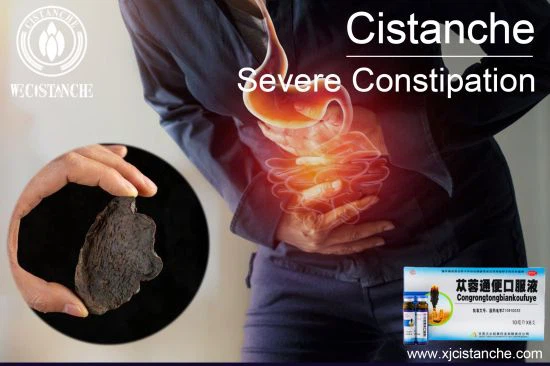
Rou Cong Rong (Cistanche Deserticola) is known for its effects of tonifying kidney yang, nourishing essence and blood, and moistening the intestines to relieve constipation. It is particularly effective when combined with other herbs to treat cold-type deficiency constipation due to kidney yang deficiency, which is commonly seen in elderly patients. Rou Cong Rong is often paired with Bai Zhu to enhance both qi-tonifying and bowel-regulating effects.
Liu Yuanhong et al. [33] conducted network pharmacology studies to identify key active compounds and target proteins in the Bai Zhu-Rou Cong Rong combination. Their experimental research suggested that these active ingredients may influence key targets such as PTGS2, AKT1, TNF, and IL-6, regulating multiple signaling pathways to alleviate constipation.
Dang Gui (Angelica Sinensis) is a blood-tonifying herb with a strong aroma and a sweet, pungent, and slightly bitter taste. It mainly enters the liver, heart, and spleen meridians and nourishes the blood to moisten the intestines, making it beneficial for treating deficiency-dryness-type constipation.
Du Lidong et al. [34] discovered that the mechanism behind Dang Gui's laxative effects may involve the regulation of PLC-IP3-CaM and AC-cAMP-PKA signaling pathways, as well as modulating the expression of aquaporins (AQPs) in colonic tissues.
3.2.7 Cold Syndrome (寒态)
The target prescriptions for cold-type constipation include Ji Chuan Jian (济川煎) and Fu Zi Li Zhong Wan (附子理中丸), with target drugs such as Gan Jiang (干姜, Dried Ginger), Xiao Hui Xiang (小茴香, Fennel), and Rou Cong Rong (肉苁蓉, Cistanche Deserticola).
Ji Chuan Jian is known for its effects of warming the kidneys, tonifying essence, and moistening the intestines to relieve constipation, and is primarily used to treat kidney yang deficiency and fluid insufficiency. Therefore, both deficiency-type and cold-type constipation can be treated with Ji Chuan Jian.
Studies have shown that Ji Chuan Jian exerts its therapeutic effects on constipation by regulating intestinal function, with mechanisms involving increasing the expression of C-Kit protein in colonic tissues and reducing serum VIP levels [35-37]. The effectiveness of Ji Chuan Jian has been found to be positively correlated with its concentration.
Additionally, bioinformatics studies suggest that Ji Chuan Jian may exert its effects by modulating multiple targets such as MAPK3, MAPK1, Akt1, BAX, and RAF1, which are associated with various disease pathways [38].
Fu Zi Li Zhong Wan is primarily used to treat spleen and stomach deficiency-cold syndromes. However, it should be used with caution, as Fu Zi (附子, Aconite) is highly warming and is not suitable for individuals with excess heat in the spleen and stomach or internal damp-heat conditions.
Li Dong'an et al. [39] found that Fu Zi Li Zhong Wan can significantly antagonize ileal motility inhibition induced by adrenaline and relieve intestinal spasms caused by acetylcholine, thereby restoring normal intestinal function.
3.2.8 Blood Stasis Syndrome (瘀态)
The target drug for blood stasis-type constipation is Tao Ren (桃仁, Semen Persicae).
Tao Ren enters the heart, liver, and large intestine meridians and has invigorating blood circulation, removing blood stasis, moistening the intestines, and relieving constipation effects.
For blood stasis-related symptoms, Tao Ren not only promotes blood circulation to relieve pain but also helps expel stagnant blood while moistening the intestines to facilitate bowel movements.
Due to its high oil content, Tao Ren is particularly effective for treating dryness-type constipation. Similarly, other oil-rich Chinese herbs such as Bai Zi Ren (柏子仁, Platycladus Seeds) and Ku Xing Ren (苦杏仁, Bitter Apricot Seeds) also have moistening and laxative properties.
4 Conclusion
In summary, under the guidance of the state-target differentiation and treatment theory, the medical records of famous old Chinese medicine practitioners in treating constipation were analyzed, and a preliminary framework for state-target differentiation and treatment of constipation was constructed to make its diagnosis and treatment rules accurate and practical, which is conducive to the clinical promotion and application of the experience of famous old Chinese medicine practitioners.
References
[1] Jiang Lingfang. Research on the application of acupuncture in functional constipation (heat accumulation constipation) based on the theory of skin of traditional Chinese medicine [D]. Nanchang: School of Medicine, Nanchang University, 2023.
[2] Xu Lingtai. Shennong Bencao Jing Baizhonglu [M]. Beijing: China Medical Science and Technology Press, 2016.
[3] MA X, CHI Y H, NIU M, et al. Metabolomics coupled with ultivariate data and pathway analysis on potential biomarkers in cholestasis and intervention effect of Paeonia lactiflora pall [J]. Front Pharmacol, 2016, 7: 14.