Cistanche Deserticola Polyphenols: How Science Unlocks Their Antioxidant And Blood-Sugar-Supporting Potential
Nov 25, 2026
A Plain-Language Look at the Research
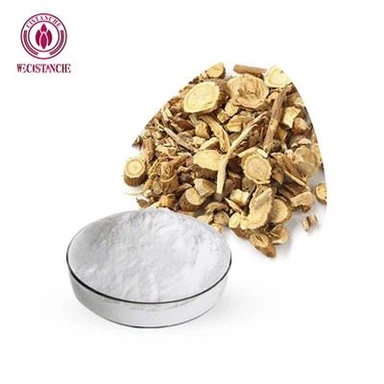
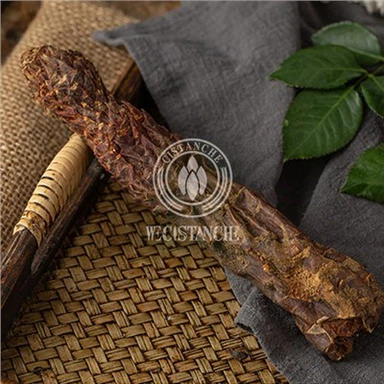
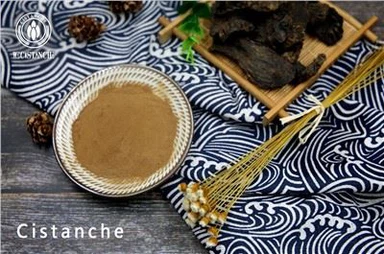
Deep in the arid regions of northwestern China grows a plant that has been prized in traditional medicine for more than a thousand years. Cistanche deserticola - often called "desert ginseng" - survives by attaching itself to the roots of desert shrubs, drawing nutrients from one of the harshest environments on Earth. For centuries, people have used it to support energy, vitality, and overall well-being.
Today, scientists are taking a closer look at one specific group of compounds inside this plant: polyphenols. A recent study published in the Journal of Food Safety & Quality set out to answer a practical question. Could researchers extract these polyphenols efficiently and affordably, and - just as important - do the resulting extracts actually show measurable antioxidant and blood-sugar-related activity in laboratory tests?
The short answer is yes on both counts. But the real value of the research lies in the details: the precise recipe the scientists developed, the numbers behind the activity tests, and what those numbers do and do not mean for everyday health. This article breaks it all down in plain language, without the dense academic jargon.

What Are Plant Polyphenols, and Why Should You Care?
Before diving into the study, it helps to understand what polyphenols actually are.
Polyphenols are a large family of natural compounds found in fruits, vegetables, tea, coffee, herbs, and many medicinal plants. Chemically, they share a common feature: their molecules contain multiple "phenol" structures - rings of carbon atoms with attached hydroxyl (OH) groups. That structure is what gives many polyphenols their characteristic ability to interact with other molecules, including unstable molecules called free radicals.
Think of polyphenols as the plant's built-in defense system. Plants produce them to protect themselves against UV radiation, pests, and environmental stress. When we consume those plants, researchers believe some of those protective properties may carry over to benefit human cells as well.
Two of the most studied benefits are:
Antioxidant activity. Free radicals are unstable, highly reactive molecules that can damage cells, proteins, and DNA through a process called oxidative stress. Antioxidants help neutralize these free radicals, keeping the system in balance.
Metabolic support. Certain polyphenols appear to influence enzymes involved in carbohydrate digestion and blood sugar regulation.
In cistanche, the most important polyphenol subgroup is called phenylethanoid glycosides. These compounds - the best-known being echinacoside and verbascoside (also called acteoside) - are essentially a sugar molecule linked to a phenolic structure. They have been the focus of much of the plant's modern research because they show strong activity in laboratory antioxidant and anti-inflammatory tests.
Why Cistanche Deserves a Closer Look
Cistanche deserticola is not just a traditional curiosity. In China, it is officially recognized as a "medicine-food homology" (also called "food and medicine dual-use") item, meaning it is considered safe and suitable for use both as food and as a medicinal ingredient. That regulatory status makes it an attractive candidate for functional foods and supplements.
The plant contains a rich mix of active components, including phenylethanoid glycosides, iridoids, lignans, polysaccharides, and volatile compounds. Polyphenols are among the most interesting because they combine two desirable traits: they are relatively abundant in the plant, and they are well studied for their antioxidant and enzyme-inhibiting behavior.
Here is the catch, though. Having useful compounds inside a plant is one thing. Getting them out - efficiently, affordably, and without destroying them in the process - is a separate engineering challenge. That is exactly the problem the research team set out to solve.
The Challenge: Extracting More While Using Less
Most earlier studies on cistanche polyphenols used a fairly straightforward approach: soak the plant material in 70% ethanol to dissolve out the phenolic compounds. This works, but it comes with trade-offs. High-concentration ethanol costs more and requires more solvent handling, which raises production costs and environmental burden.
The researchers behind this study wanted a better recipe. Their goal was to find conditions that would:
Extract a higher amount of polyphenols,
Use less ethanol, and
Keep the process practical for real-world manufacturing.
To do that, they turned to ultrasound-assisted extraction. Here is how it works in simple terms. Plant cells have rigid walls that hold the valuable compounds inside. Ultrasound sends high-frequency sound waves through the liquid mixture, creating millions of microscopic bubbles that rapidly form and collapse. This process - called cavitation - essentially "shakes" the plant cells apart, helping the solvent reach the polyphenols and release them into the liquid. Compared to simply soaking the plant, ultrasound extraction is faster, often more efficient, and can work at gentler temperatures.
How the Experiment Was Run (In Plain English)
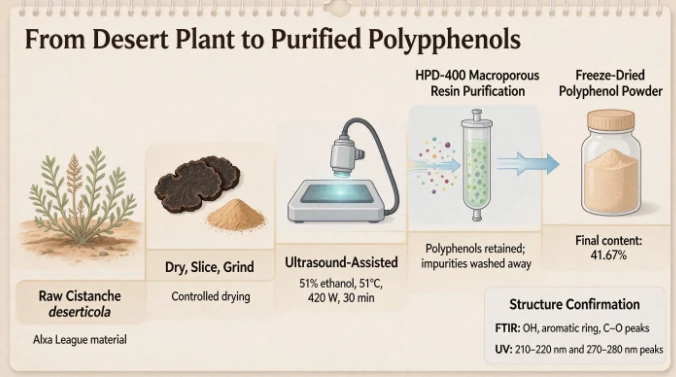
The researchers used Cistanche deserticola harvested from the Alxa League in Inner Mongolia, a region known for producing high-quality cistanche. They cleaned the plants, sliced them into thin pieces, dried them at a controlled temperature, and ground them into a fine powder.
From there, the basic procedure looked like this:
Mix a measured amount of cistanche powder with ethanol solution at a fixed ratio.
Warm the mixture in a water bath for two hours.
Apply ultrasound at a set power for a set time.
Filter the liquid to collect the polyphenol-rich extract.
To measure success, they used the Folin–Ciocalteu method, a standard laboratory technique that produces a blue color when it reacts with phenolic compounds. The darker the blue, the more polyphenols are present. By measuring that color with an instrument, the team could calculate exactly how much polyphenol they had extracted from each gram of plant material.
The scientists then tested one variable at a time - ethanol concentration, extraction temperature, ultrasound power, and ultrasound time - to see how each one affected the final polyphenol yield.
Finding the Sweet Spot: One Variable at a Time
The single-variable tests produced clear, intuitive patterns.
Ethanol concentration. When the ethanol level rose from 30% to 50%, the polyphenol yield climbed steadily, peaking at 50%. Beyond that point, going up to 60%, 70%, and 80% actually made things worse. Why? Polyphenols dissolve best when the solvent's polarity matches their own chemistry. Pure or near-pure ethanol is simply too different in character to pull them out efficiently, while a roughly half-ethanol, half-water mixture strikes the right balance.
Extraction temperature. The yield increased as the temperature rose from 30°C to 50°C, reaching its highest point at 50°C. But pushing to 70°C and 80°C caused a clear drop. Moderate heat helps the polyphenols dissolve and diffuse out of the plant. Too much heat, however, can damage heat-sensitive compounds - some polyphenols begin to oxidize or break down at higher temperatures.
Ultrasound power. More power helped up to a point. The yield rose steadily from 100 W to 400 W, peaking at 400 W. At 500 W, it began to fall. Stronger ultrasound improves cavitation and mass transfer, but excessive power can generate local hot spots that degrade fragile compounds.
Ultrasound time. Extending the treatment from 10 to 30 minutes improved the yield, with the maximum at 30 minutes. After that, yields plateaued and then declined slightly as longer exposure increased the chance of oxidative damage.
Each of these findings points to the same general principle: in extraction, there is almost always a "goldilocks zone." Too little energy or solvent fails to release the compounds; too much destroys them.
Response Surface Optimization: Finding the Best Recipe Scientifically
Testing one variable at a time is useful, but it has a blind spot. It cannot tell you how variables interact with each other. Maybe a slightly lower temperature works better when the power is higher, or vice versa.
To capture those interactions, the researchers used a statistical technique called response surface methodology, specifically a Box–Behnken design. Without getting lost in the math, here is the idea: instead of testing every possible combination (which would take an enormous number of experiments), the method uses a smartly chosen set of experiments to build a mathematical model that predicts the outcome across the whole experimental space.
Three factors were selected for this optimization: ethanol concentration, extraction temperature, and ultrasound power. (Ultrasound time was left out because the single-factor tests showed it stopped mattering much after 30 minutes.)
The model turned out to be remarkably accurate, explaining more than 99% of the variation in the data - a sign that the scientists could trust its predictions. It also revealed the relative importance of each factor: extraction temperature had the strongest influence, followed by ultrasound power, and then ethanol concentration.
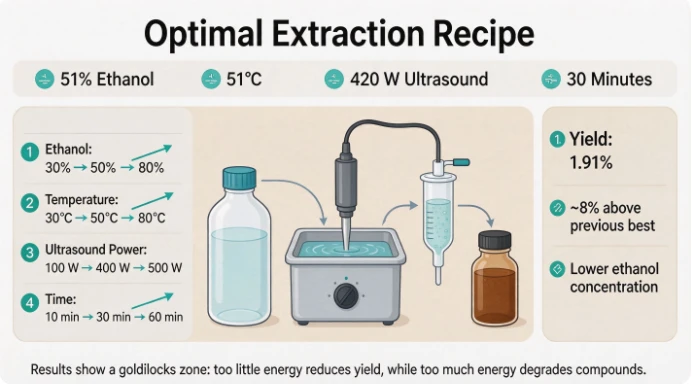
The model pointed to a theoretical optimum: about 50.96% ethanol, 50.62°C, and 422.38 W of ultrasound power. For practical purposes, the team rounded these to a clean, realistic recipe: 51% ethanol, 51°C, 420 W, and 30 minutes.
When they tested this recipe three times, the results matched the prediction almost perfectly. The average polyphenol yield was 1.91% - meaning every 100 grams of dried cistanche powder yielded nearly 2 grams of polyphenol extract. Compared with earlier studies that typically used 70% ethanol, this new process not only cut the ethanol concentration down to about half but also produced a higher extraction level, roughly 8% above the best value reported in previous literature.
Purification: From Crude Extract to Concentrated Polyphenols
A crude extract still contains a lot of "passengers" alongside the polyphenols - sugars, proteins, and other water-soluble materials. If you want a genuinely concentrated product, you need a purification step.
The team chose HPD-400 macroporous adsorption resin for this job. Macroporous resins work like tiny sponges with carefully sized pores. When the crude extract passes through a column packed with this resin, the polyphenols stick to the resin's surface while unwanted impurities wash away with water. Later, the polyphenols are released using ethanol.
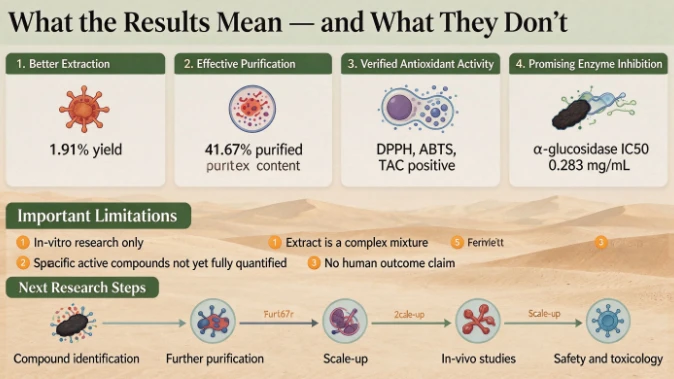
After this purification and freeze-drying, the polyphenol content jumped to 41.67%. In other words, nearly 42% of the final purified product consisted of polyphenols - a substantial enrichment compared with the raw extract. This is a meaningful number because it tells manufacturers and formulators how concentrated the active material really is.
The Antioxidant Story: What the Numbers Show
With a purified sample in hand, the researchers ran a battery of standard antioxidant tests. These tests are well established in food science and use different types of free radicals to get a complete picture.
DPPH Radical Scavenging
The DPPH test is one of the most common ways to measure antioxidant power. It uses a synthetic free radical that is stable and deeply purple in solution. When an antioxidant neutralizes the radical, the purple color fades - the more it fades, the stronger the antioxidant effect.
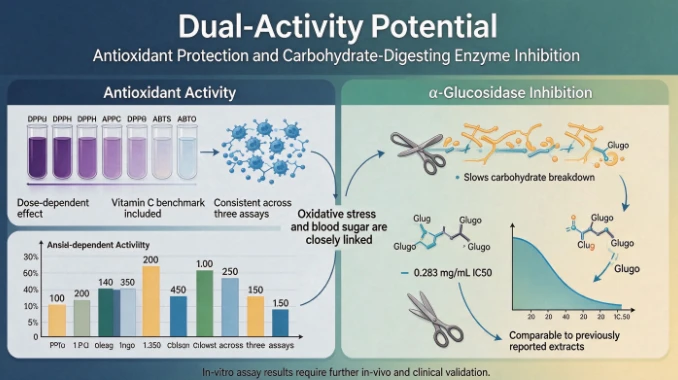
The purified cistanche polyphenols showed a clear, dose-dependent effect: the more extract added, the more radicals were neutralized. At a concentration of 1.0 mg/mL, the extract cleared about 5.8% of the radicals. At 5.0 mg/mL, that rose to about 81.3%. The IC50 - the concentration needed to neutralize half of the radicals - was 2.866 mg/mL. (A lower IC50 means a stronger antioxidant.)
ABTS Radical Scavenging
The ABTS test uses a different radical and is often considered more sensitive. Here the cistanche extract performed even better. Scavenging rose from about 29.2% at 0.5 mg/mL to about 86.1% at 2.0 mg/mL, with an IC50 of 0.841 mg/mL. The fact that the ABTS IC50 is much lower than the DPPH IC50 simply reflects that these are different tests measuring slightly different things - in this case, the extract was particularly effective against the ABTS radical.
Total Antioxidant Capacity
This test measures overall reducing power - the extract's general ability to act as an antioxidant across a broad range of reactions. Here too, activity increased with concentration. At 1.0 mg/mL, the total antioxidant capacity was 1.84 μmol/mL.
For perspective, the researchers ran the same tests with vitamin C (ascorbic acid) as a benchmark. Vitamin C is a powerful, purified antioxidant, and it outperformed the cistanche extract in head-to-head comparisons - which is expected. Plant extracts are complex mixtures, not single purified molecules. What matters is that the cistanche polyphenols showed genuine, consistent, concentration-dependent antioxidant activity in every test. Their numbers also fell within, and in some cases above, the range reported for other cistanche extracts in earlier studies.
The Blood Sugar Connection: Slowing Down Sugar Absorption
The second half of the study focused on a specific enzyme: α-glucosidase.
To understand why this enzyme matters, picture what happens when you eat carbohydrates. Complex carbs must be broken down into simple sugars before your body can absorb them. The enzyme α-glucosidase is one of the key "scissors" that snips those carbs into absorbable glucose. If you slow down that enzyme, you slow down the release of sugar into the bloodstream - which is exactly how a class of diabetes medications called alpha-glucosidase inhibitors (the best-known being acarbose) works.
In the laboratory, the cistanche polyphenol extract showed strong, dose-dependent inhibition of α-glucosidase. At 200 μg/mL, it inhibited the enzyme by about 47.2%. At 1000 μg/mL, inhibition reached about 85.2%. The IC50 was 0.283 mg/mL - a level the authors note is competitive with, and in some cases better than, previously reported cistanche extracts.
Acarbose, the prescription drug used as a positive control, was more potent in the test tube. But that is neither surprising nor the point. The point is that a natural plant extract - without pharmaceutical-grade purification - demonstrated meaningful enzyme-inhibiting activity. This is precisely the kind of early-stage evidence that makes a natural ingredient worth studying further as a potential complementary approach to blood sugar management.
How Does It Work?
The researchers suggest the mechanism likely comes down to chemistry. The phenolic hydroxyl groups in cistanche polyphenols can interact with the α-glucosidase enzyme, binding to it and reducing its ability to do its job. This is a plausible, well-established mechanism for how many plant polyphenols exert enzyme-inhibiting effects.
Why Antioxidant and Blood-Sugar Activity Belong Together
At first glance, antioxidant activity and blood sugar support might seem like two unrelated benefits. In fact, they are deeply connected.
High blood sugar creates a cascade of problems, and one of the most important is oxidative stress. When glucose levels run high, cells generate an excess of free radicals, which can damage insulin-producing cells in the pancreas and impair the body's response to insulin. Over time, this oxidative damage contributes to many of the complications associated with diabetes.
This is why a natural ingredient that offers both antioxidant activity and α-glucosidase inhibition is scientifically interesting. It could, in theory, address two parts of the same problem at once - slowing sugar absorption while also helping the body cope with oxidative stress. The researchers explicitly highlight this dual-action potential as one of the study's most notable findings.
To be clear: this is early-stage, in-vitro (test-tube) evidence. It tells us the extract has the right biological properties to be worth pursuing. It does not yet prove what will happen inside a human body.
How Scientists "See" the Polyphenols: UV and Infrared Spectroscopy
One of the cleverer parts of the study involved confirming that the purified extract actually contained the expected polyphenol structures. The researchers used two spectroscopic techniques.
Infrared (FTIR) spectroscopy works by shining infrared light through the sample and seeing which wavelengths get absorbed. Different chemical bonds absorb different wavelengths, producing a kind of molecular fingerprint. The cistanche sample showed absorption patterns characteristic of polyphenols: a broad peak for hydroxyl (OH) groups, peaks for aromatic ring structures, and peaks for carbon-oxygen bonds. These are exactly the features you would expect in a phenolic-rich extract.
Ultraviolet (UV) spectroscopy tells a complementary story. The sample showed strong absorption around 210–220 nm and a secondary peak around 270–280 nm - patterns typical of compounds containing aromatic rings with phenolic substitution.
Together, these two techniques confirmed that the extraction and purification process had successfully concentrated genuine polyphenolic compounds while preserving their key structural features. In practical terms, the process worked as intended.
What the Results Mean in Practical Terms
Let's step back and summarize what this research actually achieved:
A better extraction recipe. The team developed an ultrasound-assisted method using only 51% ethanol - roughly half the concentration used in many earlier studies - while achieving a higher polyphenol yield. For manufacturers, that means lower solvent costs and a more efficient process.
A meaningful purification step. The macroporous resin method concentrated the polyphenols to 41.67% of the final product, giving formulators a much clearer picture of what they are working with.
Verified antioxidant activity. The extract showed genuine, dose-dependent activity across three different antioxidant tests.
Promising α-glucosidase inhibition. The extract slowed a key carbohydrate-digesting enzyme in the lab, suggesting potential relevance to blood sugar management.
Confirmed chemical identity. Spectroscopy verified that the product really does contain polyphenol-type compounds with intact functional groups.
An Honest Look at the Limitations
Good science is honest about what it has not yet proven, and this study is no exception. Several important caveats deserve attention:
It is in-vitro research. Everything was done in test tubes and laboratory assays, not in animals or humans. A compound can behave very differently inside a living body, where it must survive digestion, absorption, and metabolism. What happens in a test tube is a starting point, not a conclusion.
The extract is still a mixture. At 41.67% polyphenol content, the sample is enriched but not a single pure compound. It contains many different polyphenols, and the study did not pinpoint exactly which ones are responsible for the observed activity. The authors themselves note that more work is needed - using techniques like HPLC and LC-MS - to identify and quantify specific active compounds such as echinacoside and verbascoside.
No comparison to human outcomes. The study makes no claim about treating, curing, or preventing any disease, and neither should we. Anyone considering cistanche polyphenols for blood sugar support should view them as a potential complementary area of research, not a replacement for medical care or prescribed medication.
Where the Research Goes Next
The authors outline a clear roadmap for future work:
Deeper characterization. Identify and quantify the individual polyphenols in the extract, especially echinacoside and verbascoside.
Further purification. Explore finer resin fractionation and membrane separation to isolate the most active components.
Scale-up. Move from laboratory-scale extraction to industrial-scale production while maintaining quality.
In-vivo studies. Test the extract in living organisms to understand absorption, metabolism, and real-world effects.
Safety and toxicology. Establish a full safety profile before considering the ingredient for broader food or supplement use.
This is a sensible, step-by-step path from "interesting lab result" to "trusted commercial ingredient."
Frequently Asked Questions
Is cistanche a food or a medicine? In China, Cistanche deserticola is classified as a medicine-food homology item, meaning it can be used in both food and traditional medicinal contexts. This dual status is one reason it has attracted attention as a functional ingredient.
What are the main polyphenols in cistanche? The most studied are phenylethanoid glycosides, particularly echinacoside and verbascoside (acteoside). These compounds are known for strong antioxidant activity in laboratory tests.
Does this study prove cistanche lowers blood sugar in people? No. The blood-sugar-related finding is that the extract inhibits the α-glucosidase enzyme in a laboratory assay. That is promising but far from proof of any human effect. It is a reason for further research, not a medical claim.
What does the optimal extraction recipe look like? According to the study, 51% ethanol, 51°C, 420 W of ultrasound power, and 30 minutes of treatment produced the best yield - 1.91% polyphenol extraction from dried cistanche powder.
Why does the study mention both antioxidant and blood-sugar activity? Because oxidative stress and blood sugar problems are closely linked. An ingredient that offers both antioxidant protection and enzyme inhibition could, in principle, address two parts of the same health challenge.
The Bottom Line
This study does something genuinely useful: it turns a traditional plant with a long history of use into a well-characterized, efficiently produced ingredient. By combining ultrasound-assisted extraction with response surface optimization and macroporous resin purification, the researchers achieved a higher polyphenol yield using less ethanol - and then showed that the resulting extract has real, measurable antioxidant and α-glucosidase-inhibiting activity in the laboratory.
For anyone interested in cistanche as a natural ingredient - whether a manufacturer, a formulator, or simply a curious consumer - the takeaway is clear. The science is catching up to the tradition. The plant's polyphenols are not just folklore; they are a concentrated source of compounds with demonstrated laboratory activity. The road from test tube to trusted product is still long, but this research marks a solid step forward on that path.