From Waste To Worth: Recovering Antioxidant Polysaccharides From Cistanche Residue
Nov 24, 2026
Introduction
When a factory extracts the active ingredients from a medicinal plant, something is always left behind. That leftover material - the spent plant mass known in the industry as "residue" - is usually treated as waste. It gets discarded, composted, or at best sold off cheaply as filler.
But what if the "waste" was never really waste at all?
That is the question at the heart of a 2026 study published in the journal Science and Technology of Food Industry. The researchers looked at the residue left over after extracting the main active compounds from Cistanche - a prized desert herb - and found that it still contained a valuable treasure: polysaccharides, a class of carbohydrate molecules with real antioxidant potential.
Even more impressively, they showed that this hidden value can be recovered using a clean, scalable technology called membrane separation, turning what would have been discarded into a resource with genuine commercial promise.
This article explains what the researchers found, why it matters, and what it could mean for the future of Cistanche as both a medicine and a sustainable industrial crop.

Cistanche: The "Desert Ginseng"
Cistanche is a genus of parasitic plants that grow in the arid deserts and semi-deserts of northwestern China, particularly in Xinjiang and Inner Mongolia. In Chinese, the medicinal herb is called Rou Cong Rong (肉苁蓉), and it has been used in traditional medicine for more than two thousand years, with its earliest record appearing in the Shennong Bencao Jing, one of the oldest known pharmacological texts.
Cistanche is sometimes called the "desert ginseng" - a nod to both its harsh habitat and its prized status as a tonic herb. Traditional uses center on supporting vitality, nourishing the kidneys, and promoting healthy bowel function. It is also classified as a "medicine-food homology" substance in China, meaning it is recognized as safe enough to be used both as a medicine and as a food ingredient.
Modern science has begun to explain Cistanche's reputation. The plant is rich in phenylethanoid glycosides - a class of compounds that includes well-known actives like echinacoside and acteoside - as well as iridoids, lignans, polysaccharides, and other bioactive molecules. The phenylethanoid glycosides, in particular, are the primary target of modern industrial extraction, because they are considered the plant's most valuable active components.
But here's the catch: after those prized phenylethanoid glycosides are extracted, a great deal of plant material remains. And that material, as this study shows, is far from worthless.
The Residue Problem
To understand the significance of this research, it helps to picture what happens in a typical Cistanche extraction operation.
A manufacturer takes dried Cistanche stems, processes them, and extracts the phenylethanoid glycosides using solvents. What remains is the residue - the spent plant tissue from which the target compounds have been removed. Historically, this residue has been treated as a byproduct with little economic value.
That is a problem on two fronts. First, it is wasteful: the residue still contains meaningful quantities of other useful substances, particularly polysaccharides. Throwing it away means losing that value. Second, it creates an environmental burden: large volumes of discarded plant material must be disposed of somehow, and that disposal has costs and consequences.
The researchers behind this study saw an opportunity. Instead of asking "how do we get rid of this residue?", they asked a better question: "what valuable things are still inside it, and how do we get them out?"
The answer, they found, was polysaccharides - and the key to unlocking them was membrane technology.
Polysaccharides: The Overlooked Treasure in the Residue
Polysaccharides are large molecules made up of many sugar units linked together. They are found throughout nature - in starch, in plant cell walls, and in many medicinal herbs - and they are increasingly recognized as important bioactive compounds.
In Cistanche, polysaccharides have been linked to a range of potential health benefits. Research has suggested they may act as antioxidants, helping to neutralize harmful free radicals. They have also been studied for possible anti-aging, liver-protective, anti-inflammatory, immune-boosting, and even anti-tumor activities. These properties make Cistanche polysaccharides attractive candidates for use in medicines, functional foods, and health supplements.
The problem is that the polysaccharides left in Cistanche residue are not a single, pure substance. They are a complex mixture of molecules of different sizes and compositions. Crude, unrefined polysaccharide extracts are difficult to work with: the mixture is messy, the contribution of each component is unclear, and impurities such as proteins, pigments, and salts interfere with both research and product development.
To unlock the value of Cistanche polysaccharides, you first need a way to sort them - to separate the mixture into cleaner fractions based on molecular size. That is where the researchers turned to an elegant solution.

Membrane Separation: A Cleaner Way to Sort Polysaccharides
Traditional methods for purifying polysaccharides have limitations. Column chromatography offers high resolution but is difficult to scale up to industrial volumes. Alcohol precipitation is crude and raises environmental concerns.
Membrane separation technology offers a compelling alternative. It works on a simple principle: a membrane with microscopic pores allows smaller molecules to pass through while retaining larger ones. By passing a polysaccharide solution through a series of membranes with different pore sizes, you can separate the mixture into distinct molecular-weight fractions - cleanly, efficiently, and without harsh chemicals.
In this study, the researchers used ultrafiltration membranes with three different molecular weight cutoffs: 300 kDa, 50 kDa, and 10 kDa (a kilodalton, or kDa, is a unit of molecular mass). By combining these membranes in sequence, they were able to split the Cistanche residue polysaccharides into four size-based fractions:
CTP1 - molecules larger than 300 kDa
CTP2 - molecules between 50 and 300 kDa
CTP3 - molecules between 10 and 50 kDa
CTP4 - molecules smaller than 10 kDa
The process itself was straightforward. The researchers first extracted the polysaccharides from the residue by boiling it in water. They then passed the extract through the membrane system at controlled pressure and temperature, collected the different fractions, concentrated them, and finally freeze-dried them into powders.
The result was four distinct polysaccharide fractions, each representing a different size class of molecules - ready to be studied individually.
What the Fractions Are Made Of
Once the four fractions were in hand, the researchers analyzed their chemical composition. The differences were revealing.
First, they measured three key components in each fraction: total sugar content, protein content, and uronic acid content (uronic acids are a hallmark of "acidic" polysaccharides).
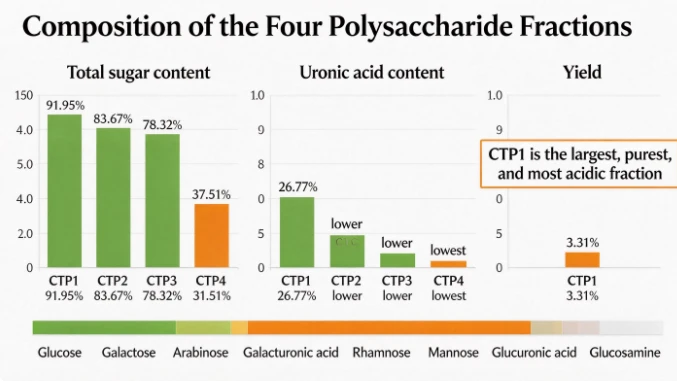
CTP1, the largest-molecular-weight fraction, was the clear standout. It had the highest total sugar content - 91.95% - and, crucially, the highest uronic acid content at 26.77%, significantly more than the other three fractions. CTP1 also had the highest yield, at 3.31% of the original residue weight.
The other fractions told a story of decline. As molecular weight dropped from CTP2 through CTP4, the total sugar content fell from 83.67% to 78.32% to 37.51%, and the uronic acid content generally trended downward as well. The smallest fraction, CTP4, was notably different - less than 40% sugar, with a much lower uronic acid content, suggesting it contains a higher proportion of non-polysaccharide material.
This pattern made sense. The membrane's job is to sort by size, and it turns out that size correlates with composition: the larger Cistanche polysaccharides are richer in sugars and uronic acids, while the smaller fraction is more diluted with other substances.
The Building Blocks: Monosaccharide Composition
The researchers went one step further and identified the individual sugar building blocks - the monosaccharides - that make up each fraction.
Using a chemical technique that breaks polysaccharides down into their individual sugars and then measures each one, they found that all four fractions are heteropolysaccharides - complex molecules built from eight different monosaccharides. The main ones, in order of abundance, were:
Glucose - the most abundant sugar overall
Galactose - the second most abundant
Arabinose
Galacturonic acid - the acidic sugar component
Rhamnose
Mannose
Glucuronic acid
Glucosamine
While all four fractions contained the same set of sugars, the proportions differed meaningfully:
CTP1 had the highest glucose (35.10%) and galacturonic acid (13.76%) content - consistent with its high total sugar and uronic acid readings.
CTP2 was richest in galactose (33.37%) and glucuronic acid.
CTP3 stood out for its high arabinose content (12.76%).
CTP4 had the highest mannose (3.48%) and rhamnose (12.59%) proportions.
The most important observation was that CTP1 was the most "acidic" fraction - it contained the most galacturonic acid. This matters because acidic polysaccharides often display distinctive biological activities, a connection that would become clear when the researchers tested the fractions for antioxidant power.
What the Molecules Look Like: Fingerprints and Microscopy
Two additional techniques rounded out the structural picture.
Infrared spectroscopy (FTIR) was used to confirm that all four fractions genuinely were polysaccharides. The spectra showed the characteristic absorption peaks expected of carbohydrate molecules - including strong, broad O-H peaks, C-H stretching peaks, and, notably, a peak near 1738 cm⁻¹ that indicates the presence of uronic acid structures, confirming the acidic nature of the polysaccharides.
Crucially, the FTIR results also showed that the membrane separation process had not damaged the fundamental structure of the polysaccharides. The essential sugar linkages and functional groups remained intact. In other words, the sorting process was gentle - it separated the molecules without breaking them.
Scanning electron microscopy (SEM) provided a striking visual complement. The four fractions looked remarkably different under the microscope:
CTP1 appeared porous and loose, with an irregular, sponge-like surface.
CTP2 was smooth and relatively compact.
CTP3 showed a fine, rippled texture.
CTP4 displayed sparse, scattered nano-scale particles with a smoother surface.
These visual differences reflect real physical differences in how the molecules aggregate and pack together - which, in turn, is linked to their size, their sugar composition, and the intermolecular forces between them. It's a vivid reminder that "molecular weight" is not just an abstract number; it shapes how a material actually looks and behaves.

Putting the Fractions to the Test: Antioxidant Activity
The heart of the study was the antioxidant testing. The researchers evaluated all four fractions using four complementary assays, comparing each against vitamin C (ascorbic acid) as a benchmark.
DPPH Free Radical Scavenging
The DPPH assay measures how well a substance neutralizes a stable free radical. The results showed a clear dose-dependent pattern: as concentration increased, so did scavenging activity.
CTP1 was the strongest performer. At the highest tested concentration of 8 mg/mL, CTP1 achieved a DPPH scavenging rate above 61%. Its IC50 - the concentration needed to scavenge half the free radicals, where lower means stronger - was 4.946 mg/mL, the best of the four fractions.
For comparison, the other fractions' IC50 values were higher (weaker): CTP2 and CTP3 both at 7.534 mg/mL, and CTP4 at 8.472 mg/mL. Vitamin C, as expected, was far more potent, with an IC50 of just 0.961 mg/mL.
ABTS+ Radical Scavenging
The ABTS assay tells a similar but even more striking story. Here, CTP1 performed remarkably close to vitamin C. At a concentration of 4 mg/mL, CTP1's IC50 was 0.486 mg/mL - nearly matching vitamin C's 0.450 mg/mL. CTP2 was actually slightly better, at 0.405 mg/mL, while CTP3 lagged at 1.039 mg/mL and CTP4 came in at 0.531 mg/mL.
At 8 mg/mL, CTP1's ABTS+ scavenging rate exceeded 95% - a figure that essentially rivals the benchmark antioxidant.
Superoxide Anion Scavenging
The superoxide anion test measures a different kind of radical. Here, the differences between fractions were less dramatic. All four fractions showed relatively weak activity compared to vitamin C, and their performance was roughly similar to one another. The IC50 values ranged from about 10.54 to 14.03 mg/mL for the Cistanche fractions, versus 0.884 mg/mL for vitamin C.
Total Antioxidant Capacity
The total antioxidant capacity assay also showed a clear dose-dependent trend, with activity rising steadily as concentration increased. Once again, CTP1 led the pack, with an IC50 of 40.00 mg/mL - the strongest of the four. CTP2 followed at 61.30 mg/mL, CTP4 at 71.81 mg/mL, and CTP3 at 79.41 mg/mL.
Why CTP1 Was the Star
Across nearly every test, one fraction consistently outperformed the others: CTP1, the largest-molecular-weight, highest-uronic-acid, highest-sugar fraction.
This is not a coincidence. The researchers drew a direct link between structure and activity. CTP1's superior antioxidant performance appears to be tied to three factors working together:
Its higher uronic acid (acidic sugar) content - acidic polysaccharides are known to display strong antioxidant behavior.
Its higher total sugar content - CTP1 was the "purest" polysaccharide of the four.
Its larger molecular weight - bigger polysaccharide molecules can interact with free radicals more effectively in certain test systems.
This structure-activity relationship is consistent with a broader theme in polysaccharide research: the biological effects of these molecules are not random, but are driven by their specific structural features. By sorting the polysaccharides into size-based fractions, the researchers were able to pinpoint which structural features matter most - a far more precise approach than testing the crude, mixed extract as a whole.
The Bigger Picture: Zero Waste and Sustainability
Beyond the specific scientific findings, this study carries a larger message about how we think about medicinal plants and industrial waste.
Cistanche is a valuable but finite resource. It grows slowly in fragile desert ecosystems, and over-harvesting has already put pressure on wild populations. Cultivation has helped, but the pressure to extract maximum value from every kilogram of plant material is real.
This research shows that the "waste" from Cistanche extraction is not actually waste at all. By applying membrane separation technology, manufacturers can recover a second, high-value product - antioxidant polysaccharides - from material that would otherwise be discarded. This transforms a linear "extract and dispose" model into a more circular "extract, recover, and reuse" model.
The environmental benefits are equally clear. Membrane separation is a clean, green technology that avoids the harsh organic solvents and large energy inputs of some traditional purification methods. It aligns with the growing push toward sustainable manufacturing in the herbal products industry.
The researchers also note the regional significance: Cistanche is a signature resource of northwestern China, particularly Xinjiang. Developing high-value, waste-to-resource technologies for Cistanche could help drive a greener, more efficient, more industrialized herbal economy in the region - turning a desert plant's leftover material into a driver of sustainable development.
What This Means (and What It Doesn't)
As always with laboratory research, it's important to keep the findings in perspective.
What the study establishes:
Cistanche residue, after phenylethanoid glycoside extraction, still contains meaningful amounts of polysaccharides.
Membrane separation can cleanly sort those polysaccharides into four size-based fractions without damaging their structure.
The fractions differ significantly in composition and antioxidant activity.
The largest fraction, CTP1, is the most antioxidant - approaching vitamin C's performance in the ABTS assay and exceeding 95% scavenging at 8 mg/mL.
There is a clear link between a polysaccharide's size, its uronic acid content, and its antioxidant power.
What it does not establish:
These are in vitro (test-tube) results. They do not yet prove that Cistanche residue polysaccharides deliver the same benefits inside the human body.
No cell-based or animal studies were conducted in this work.
The precise molecular structures of the polysaccharides remain to be fully mapped, and the specific mechanisms behind their activity are not yet confirmed.
In short, this is a strong foundation study. It demonstrates a viable, green method for turning Cistanche residue into a valuable polysaccharide product, and it identifies which fraction is most promising. The next steps - cell studies, animal studies, and deeper structural analysis - will determine how far this promise extends.

Frequently Asked Questions
Q: What is Cistanche residue? A: It is the leftover plant material that remains after the main active compounds (phenylethanoid glycosides) have been extracted from Cistanche. Traditionally treated as waste, it still contains useful polysaccharides.
Q: What are the four polysaccharide fractions in this study? A: CTP1 (larger than 300 kDa), CTP2 (50–300 kDa), CTP3 (10–50 kDa), and CTP4 (smaller than 10 kDa). They were separated using ultrafiltration membranes of different pore sizes.
Q: Which fraction has the best antioxidant activity? A: CTP1, the largest fraction. It showed the strongest DPPH scavenging, the best total antioxidant capacity, and ABTS+ scavenging above 95% at 8 mg/mL - close to vitamin C's benchmark.
Q: What makes CTP1 so effective? A: Its high uronic acid (acidic sugar) content, high total sugar content, and larger molecular weight all appear to contribute to its stronger antioxidant activity.
Q: Is membrane separation a good method for polysaccharides? A: Yes. It is clean, scalable, and does not damage the polysaccharide structure - unlike some traditional methods that use harsh solvents or are hard to scale up.
Q: Can these results prove Cistanche polysaccharides are healthy? A: Not directly. The tests were done in the laboratory. Further cell and animal studies are needed to confirm real-world health benefits.
Conclusion
The story of Cistanche is usually told as a story of extraction - of pulling valuable compounds out of a desert plant. But this research tells a different and equally important story: a story of recovery.
By applying membrane separation technology to Cistanche residue, the researchers showed that a material long treated as waste still holds genuine value. They recovered four distinct polysaccharide fractions, mapped their structures, and demonstrated that the largest, most acidic fraction possesses antioxidant activity approaching that of vitamin C.
The implications extend well beyond a single experiment. This work points toward a more sustainable, zero-waste future for the Cistanche industry - one in which every part of the plant is used, environmental burden is reduced, and new functional ingredients are unlocked from what was once thrown away.
For an herb nicknamed the "desert ginseng," it's a fitting next chapter: even the leftovers, it turns out, have something valuable to offer.
Reference
Shamixinuer Abulimiti, Yilizire Shawuti, Yan Ming, et al. Fractionation and Antioxidant Activity Analysis of Polysaccharides from Cistanche deserticola Residue Using Membrane Separation Technology. Science and Technology of Food Industry, 2026, 47(20): 464–471.