Cistanche Flower Benefits And The Best Time To Haverst
Jul 05, 2022
Cistanche, like its host Haloxylon, grows in extremely dry climates, preferring strong sunshine, great changes in cold and heat, and windy and sandy environments. And very different, most other plants prefer fertile soil, but Cistanche prefers barren sandy soil, especially the Gobi desert environment that is alkaline, high in salinity and lacks organic matter.
For more info about Cistanche Deserticola Benefits
Cistanche is rich in alkaloids, crystalline neutral substances, amino acids, trace elements, vitamins, etc., which have a very good nourishing and health care effect on the human body. The appearance of Cistanche is very strange, the root is basal, the stem is stout and flat cylindrical, the flesh is thick, the main stem is prominent, and the lower part is thicker. The succulent leaves of Cistanche deserticola are very small, like scales, they are arranged in an imbricate spiral at the lower part of the stem, closely adhering to the succulent stem.

Cistanche deserticola is a perennial parasitic herb, often parasitic on the roots of Haloxylon ammonium, the pioneer plant for desert control. The roots of Haloxylon ammodendron, which is thinner than a human hair, penetrate a seed of Cistanche (1 gram of Cistanche seeds contains 8,000-10,000 seeds), activating the life of Cistanche. A seed of Cistanche deserticola, from the day it is combined with Haloxylon, has to go through 3 years of unknown underground growth and experience of severe cold and heat, and the moment it is conceived and mature is when it emerges from the ground. It needs to complete all the processes of flowering and seeding before the arrival of the rainy season and grows an average of 7-8 cm per day. From the scorching splendor to the exhaustion of the oil, the accumulation of three years is only a one-time inheritance. The picking season of Cistanche is from April to early May. The newly unearthed Cistanche is left to be small and large. Now the picking technology of Cistanche is mainly performed by experienced professional pickers.

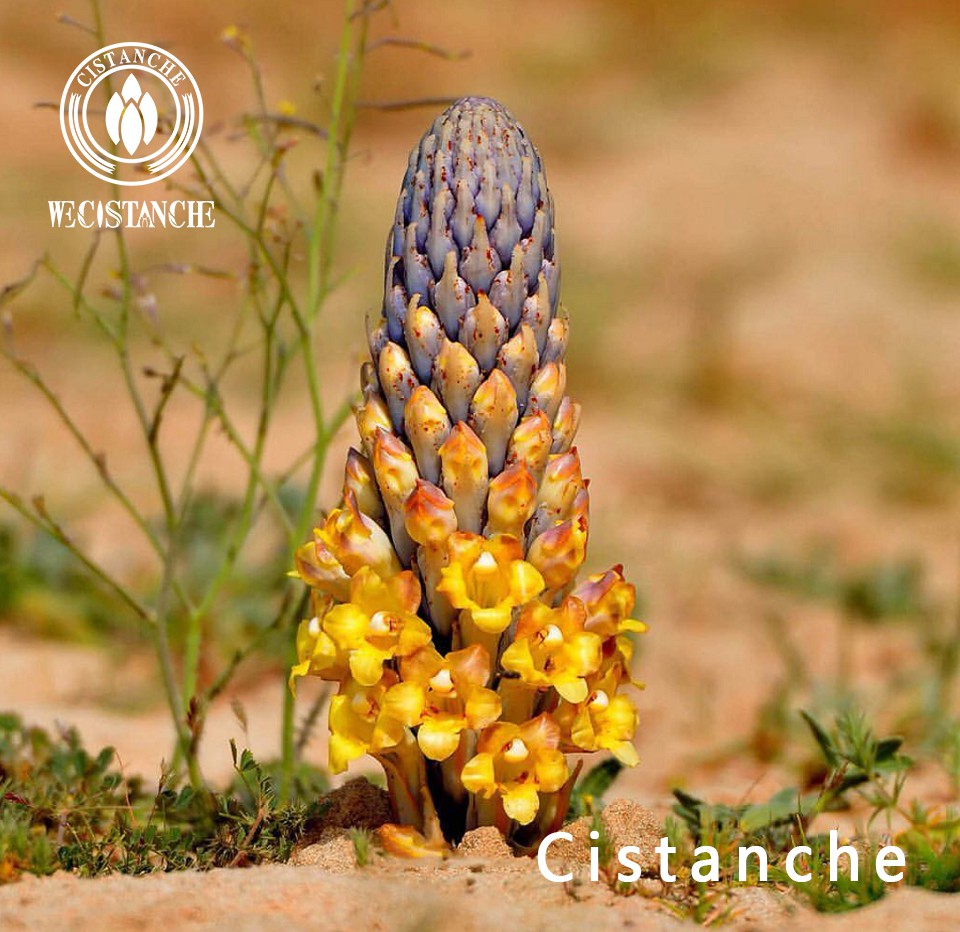
Cistanche is a desert parasitic plant, and its hosts are mainly red willow and Haloxylon ammonica. Cistanche absorbs nutrients from the root of the host and grows slowly underground. When it grows out of the ground, the meeting will not be held until it grows out of the ground. During the flowering season of Cistanche Cistanche, she is like a young girl, her whole body is covered with lavender, light pink, or milky white tubular flowers, which are very beautiful. But don't think it's pretty, this kind of flowering Cistanche is actually not very effective. Generally, the Cistanche that has just been unearthed and has not bloomed is the best, and the effect is the best. Therefore, we often see and use the succulent stem of Cistanche deserticola. The spirally arranged scales on the stem are actually the leaves of Cistanche deserticola. When Cistanche grows out of the ground, the head will flower and bear seeds, and the nutrition of Cistanche will also be affected. Therefore, it is best to harvest Cistanche after unearthed and before flowering.

Later, because of its unique efficacy, Cistanche entered various ancient pharmacopeias. Li Shizhen also explained the origin of the name of Cistanche in "Compendium of Materia Medica": "This thing is tonic but not harsh, so it has the name of calmness. Calm, gentle appearance." Cistanche is said to be the fourth fairy grass recorded by Shennong In the monograph "Shen Nong's Materia Medica", which was collected, summarized and sorted out by many medical scientists during the Qin and Han Dynasties, Cistanche was listed as the top grade, and Cistanche was included in the ancient medical books of the past dynasties. Cistanche is known as desert "living gold" and also known as desert "ginseng". In ancient times, it was a tribute to the imperial court from the vassal states of the Western Regions. Only the royal family could afford tonic medicinal materials (currently it is used for both medicine and food).