Cistanche Herba: Exploring Its Dual‑Benefit Potential For Chronic Kidney Disease‑Related Osteoporosis
Nov 10, 2026
Disclaimer: This article is published for general educational and informational purposes only. It does not constitute medical advice, diagnosis, or treatment recommendations, and it does not replace consultation with a licensed physician, nephrologist, or endocrinologist. Herbal ingredients and dietary supplements should never be used as a substitute for prescribed therapy. Patients living with chronic kidney disease, osteoporosis, or any chronic condition must consult their own clinician before changing diet, supplements, or medication.
1. Introduction: Two Diseases That Keep Meeting Each Other
Public health systems around the world are now carrying a double burden that seldom gets discussed as a single problem. One side of that burden is chronic kidney disease (CKD), a slow, progressive loss of kidney function that affects a very large share of the adult population. The other side is osteoporosis (OP), a systemic skeletal disorder characterized by low bone mass, deterioration of bone microarchitecture, increased bone fragility, and a consequently higher risk of fracture.
On paper, these look like two separate specialties: nephrology handles the kidney, and orthopedics or endocrinology handles the bone. In clinical reality, they overlap constantly. Adult CKD prevalence in China alone has been reported above ten percent, meaning more than one adult in ten lives with some degree of reduced kidney function. Survey data further suggests that a large majority of women over the age of twenty who carry an osteoporosis diagnosis also show some level of renal impairment. Globally, CKD is ranked among the fastest-growing causes of mortality, associated with roughly one point two million deaths each year, and CKD-related mineral and bone disorder is one of the principal drivers behind that elevated death rate.
When bone loss develops on top of impaired kidney function, clinicians describe the combined state as CKD-OP, that is, chronic kidney disease coexisting with osteoporosis. This comorbidity is not simply the sum of two independent diseases. It is a single, tangled pathological network in which damaged kidneys worsen bone metabolism, and altered bone metabolism in turn feeds back into kidney injury. Patients in this group fracture more easily, heal more slowly, and often tolerate standard bone medications less well than patients with normal renal function.
Current pharmaceutical management of CKD-OP relies heavily on anti-resorptive agents that slow bone breakdown. These drugs have genuine value, but they also come with practical problems for this particular patient group. Long-term use can be associated with gastrointestinal discomfort, musculoskeletal pain, and in some cases additional strain on an already compromised kidney. Dose adjustment becomes complicated. Polypharmacy becomes the norm, because the same patient is often taking phosphate binders, active vitamin D analogs, antihypertensives, and diuretics at the same time. Against this background, both researchers and patients have shown growing interest in botanically derived ingredients that act on multiple targets at once, carry long historical records of traditional use, and are generally reported to be gentler than synthetic alternatives.
Cistanche Herba is one of the best-known examples of such an ingredient. In Chinese materia medica it is classified among the upper-grade tonic herbs, described as replenishing essence and marrow and strengthening the kidney. It has been used for centuries, most famously for lower back weakness, knee soreness, and age-related decline in vitality. Modern observational reports describe it as supportive for bone health and, in some dialysis-dependent patients, potentially helpful for maintaining residual kidney function and dialysis adequacy, with few obvious adverse reactions reported. It is mild enough that it can be prepared as a daily herbal tea, which matters enormously for long-term adherence in chronic disease.
What has been missing, until recently, is a modern molecular explanation for why a single herb might plausibly influence both kidney tissue and bone tissue at the same time. A 2022 network pharmacology and molecular docking study set out to build exactly that explanation computationally. This article reorganizes the findings of that kind of research into accessible language for general readers, explains the underlying biology without jargon where possible, and is equally clear about what the evidence does and does not support.
2. The Kidney–Bone Axis: Why These Two Organs Fail Together
To understand why an herb might address both problems at once, readers first need a working picture of the kidney–bone axis. This axis is the set of hormonal and metabolic feedback loops that link renal function to skeletal turnover. It is one of the clearest examples in human physiology of how far apart organs can influence each other.
Healthy kidneys do far more than filter waste. They convert vitamin D into its biologically active form, calcitriol. They maintain the balance of calcium and phosphate in the bloodstream. They respond to parathyroid hormone and, in turn, shape how much of it is produced. They contribute to acid-base balance, which affects how bone mineral is buffered. In effect, the kidney is a control room for skeletal chemistry, even though it never touches a bone directly.
When nephron mass is progressively lost in CKD, that control room starts failing on multiple fronts at once. Phosphate accumulates because the kidney can no longer excrete it efficiently. The conversion of vitamin D slows, so intestinal calcium absorption drops. Lower calcium availability and higher phosphate push the parathyroid glands into sustained overactivity, a state known as secondary hyperparathyroidism. Elevated parathyroid hormone then drives osteoclasts, the cells that break down bone, to resorb mineral faster than osteoblasts can replace it. Calcium and phosphate are pulled out of the skeleton and into the circulation, and the skeleton quietly thins.
The result is a characteristic skeletal phenotype: reduced trabecular bone volume, disrupted microarchitecture, falling bone mineral density, and increasing fracture probability. When this occurs in the setting of chronic kidney disease, it is described as CKD-related mineral and bone disorder, and when it clinically overlaps with osteoporosis, the combined state is what we call CKD-OP.
There is a second layer to this story, and it is arguably the more important one for understanding herbal mechanisms. CKD is not only a metabolic disease; it is also an inflammatory and fibrotic disease. Retained uremic toxins, oxidative stress, and chronic low-grade inflammation activate signaling cascades that promote renal interstitial fibrosis. Those same inflammatory mediators, including TNF-α, interleukin-6, and prostaglandin-synthesizing enzymes, are potent stimulators of bone resorption. In other words, the very inflammation that destroys kidney tissue is also instructing the skeleton to dismantle itself.
This creates a vicious loop. Worsening kidney function increases inflammatory burden, which accelerates bone loss. Bone loss releases mineral and inflammatory mediators that place further stress on renal tissue, which further worsens kidney function. Once a patient is inside this loop, treating only one side is usually insufficient. A bone drug that does not address renal inflammation leaves the driving force intact. A kidney-focused intervention that ignores skeletal turnover leaves the patient fracturing.
That is precisely why multi-target botanical ingredients attract attention. A single compound that dampens shared inflammatory nodes could, in theory, act on both limbs of the loop simultaneously. Conventional synthetic drugs are generally designed around one target for one indication; that specificity is a strength in many contexts, but in a comorbid state like CKD-OP it can also be a limitation. This gap is the scientific rationale behind studying Cistanche Herba.
3. Cistanche Herba: What It Is and What It Contains
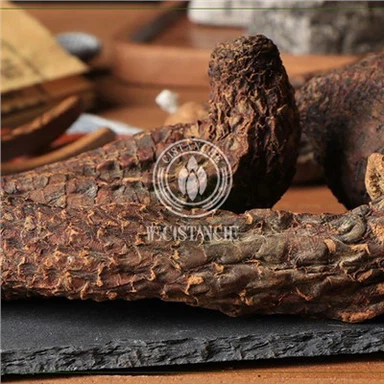
Cistanche Herba refers to the dried fleshy stem of Cistanche deserticola or Cistanche tubulosa, holoparasitic desert plants that attach to the root systems of host shrubs in arid regions. Because wild populations came under pressure from overharvesting and habitat loss, most commercial material today comes from large-scale artificial cultivation, which has also made standardized extracts more consistent in composition.
In traditional terms, the herb is described as sweet and salty in taste, warm in property, and entering the kidney and large intestine meridians. Its classic indications include warming kidney yang, replenishing essence and blood, relieving soreness and weakness of the lower back and knees, strengthening tendons and bones, and moistening the intestines to relieve constipation. A frequently repeated characterization is that it tonifies without being harsh and warms without drying, which distinguishes it from many stronger warming tonics and partly explains why it is used long term rather than in short courses.
Modern phytochemistry has identified dozens of distinct natural compounds in Cistanche tissue, spanning several chemical families. The most studied groups include phenylethanoid glycosides such as echinacoside and acteoside, plant sterols, flavonoids, lignans, and polysaccharides. Each family behaves differently in the body, and the practical question for researchers is not simply what is present in the plant, but which molecules plausibly reach human tissues in meaningful amounts after oral intake.
Network pharmacology research handles this question with two standard screening indices. Oral bioavailability, usually abbreviated OB, estimates what fraction of an ingested compound enters systemic circulation. Drug-likeness, abbreviated DL, estimates how closely a plant molecule resembles the profile of established therapeutic chemicals in terms of size, polarity, and membrane permeability. Common screening thresholds in this field are OB of at least thirty percent and DL of at least zero point one eight.
Compounds that fail these thresholds are not automatically dismissed as irrelevant. Many well-documented bioactive plant constituents score poorly on computed bioavailability while still showing activity in the gut lumen, or acting through metabolites produced by intestinal bacteria. For this reason, standard practice supplements database screening with a literature-based second pass: researchers retrieve compounds with solid published pharmacological evidence and add them back into the analysis even if their computed scores fall short.
In the CKD-OP-oriented network pharmacology work referenced earlier, the researchers retrieved seven candidate compounds from the TCMSP herbal medicine database using the standard thresholds, then added four additional bioactive substances supported by published literature indexed in CNKI and PubMed. Corresponding protein target information was standardized through the UniProt database, non-human targets were removed to keep the analysis focused on human biology, and the final pool consisted of one hundred and seventy-three human-relevant molecular targets associated with Cistanche constituents.
Among those constituents, three compounds repeatedly surfaced as the most promising dual-effect candidates as the analysis progressed: quercetin, β-sitosterol, and salidroside. A short profile of each helps set up the mechanistic discussion later in this article.
Quercetin is a flavonol found widely in onions, apples, berries, tea, and many medicinal plants. It is one of the most extensively studied plant polyphenols in existence, with well-documented antioxidant and anti-inflammatory activity across numerous experimental systems. In bone biology, quercetin has been reported to influence both osteoblast and osteoclast behavior, supporting bone-forming cell function while restraining excessive resorptive activity. In kidney models, it has shown the ability to reduce inflammatory signaling and attenuate inflammatory-type renal damage. Because it is a common plant compound rather than a Cistanche-specific molecule, its significance here lies not in exclusivity but in the fact that its known target profile overlaps substantially with both renal and skeletal pathology.
β-sitosterol belongs to the plant sterol family and is distributed very broadly across the plant kingdom. Plant sterols are structurally similar to cholesterol and interfere with inflammatory cytokine production and nuclear factor signaling. Preclinical work indicates that β-sitosterol can lower levels of TNF-α and PTGS-2-related inflammatory mediators, producing both bone-protective and kidney-protective effects in laboratory settings. In the network model discussed here, it was among the compounds with the strongest computed binding affinity for the key shared target protein, which makes it a high-priority candidate for future experimental work.
Salidroside is a phenylpropanoid glycoside best known from Rhodiola rosea, and it is also present in Cistanche material. It carries moderate computed oral bioavailability and has a substantial preclinical literature. Reported activities include inhibition of NF-κB and MAPK inflammatory cascades, reduction of TNF-α release, and alleviation of renal interstitial fibrosis. It has also been shown to suppress overexpressed PTGS-2 in connective tissue cell models. These properties make it a plausible candidate for counterbalancing the inflammatory stress that links kidney injury to bone loss.
One honest caveat belongs here. Echinacoside and acteoside, the phenylethanoid glycosides most often used as marker compounds for Cistanche quality control, scored low on computed oral bioavailability in database screening. That does not erase their biological relevance, since they may act locally in the gut, may be converted by gut microbiota into active metabolites, and are certainly relevant to product standardization. It simply means that in a computational framework built on predicted systemic exposure, compounds like quercetin, β-sitosterol, and salidroside are more likely to be flagged as direct interactors with human disease-relevant protein targets.
4. How Network Pharmacology Turns a Herb Into a Map
Network pharmacology is frequently described in dense technical language, so it is worth walking through the logic in plain terms. The core idea is simple: instead of asking whether one molecule hits one target, ask how a set of molecules interacts with a large web of human proteins, and then ask which parts of that web overlap with the proteins involved in a given disease.
Step one is assembling the ingredient side of the map, as described above: compounds from the herb, their known or predicted human protein targets, and a standardized identifier for each target so that data from different databases can be compared.
Step two is assembling the disease side. Researchers retrieve disease-associated gene sets for chronic kidney disease and for osteoporosis separately from multiple authoritative databases, typically including DisGeNET, OMIM, TTD, and GeneCards. After merging records and removing duplicates, each disease is represented by a large list of genes with documented associations. The computationally interesting step is the intersection: genes that appear in both the CKD list and the osteoporosis list represent shared molecular ground where the two pathologies overlap. In the CKD-OP analysis discussed here, this intersection produced three thousand eight hundred and forty-six shared disease-relevant targets. That number is a product of database mining, not a measurement from patient tissue, and should be read accordingly.
Step three is intersecting again, this time between the herb's target list and the disease's shared target list. What remains are the proteins that the herb's compounds could plausibly touch and that are also implicated in both kidney and bone pathology. In this analysis, one hundred and thirty-two such targets were identified. These one hundred and thirty-two genes become the working candidate pool.
Step four is building the protein interaction network. The candidate targets are submitted to the STRING database, which catalogs known and predicted protein-protein interactions, and a human-only interaction network is constructed with strict confidence filtering so that isolated, disconnected nodes drop out. The resulting diagram shows how these proteins physically associate, signal to one another, and form functional clusters inside cells. The underlying biological assumption is straightforward: proteins do not act alone, and a protein with many interaction partners tends to sit closer to the center of a functional module.
Step five is identifying the hubs. The CytoHubba plugin in Cytoscape evaluates every node in the network against three metrics. Degree counts how many other proteins a given protein connects to. Betweenness centrality measures how often a protein acts as a bridge along the shortest paths between other nodes. Closeness centrality measures how short the average path is from that protein to every other node in the network. Proteins scoring above the median on all three metrics are designated core hub targets. This filtering step reduced the network to forty-six core hubs, and among them six nodes stood out as the highest-priority key targets: TNF, AKT1, MAPK1, JUN, RELA, and PTGS2, the latter also known as COX-2.
Step six is functional annotation. The core hubs are submitted to the DAVID bioinformatics platform for two complementary enrichment analyses. GO enrichment sorts the hubs into biological processes, cellular components, and molecular functions, answering the question of what these proteins collectively do. KEGG enrichment maps the hubs onto known signaling pathways, answering the question of which cellular circuits they belong to. Only statistically significant entries are retained. The output is usually assembled into a tripartite network diagram connecting active ingredient, core target, and affected pathway, which makes it easy to see which compound is linked to which protein and which pathway.
Step seven is molecular docking, which functions as an in silico plausibility check. Docking simulates whether a small molecule can physically fit into a binding pocket on a protein, using three-dimensional structures of both partners. Researchers download protein crystal structures and compound structures from public repositories, strip out water molecules and any original bound ligands, add hydrogen atoms, assign charge states, and then run semi-flexible docking. The output is a computed binding energy for each compound-protein pair. Lower, that is more negative, binding energy indicates a theoretically more stable interaction. Common interpretive benchmarks treat values at or below minus five kilocalories per mole as indicating feasible binding, and values at or below minus seven as indicating relatively strong affinity.
In this CKD-OP analysis, all three key compounds docked to all six key target proteins with binding energies below the minus five threshold. Notably, PTGS2 emerged as a shared binding partner for all three compounds and showed the lowest average binding energy among the target proteins examined, making it the most computationally favored hub in the entire model. The predicted interactions clustered mainly around TNF pathway and NF-κB pathway biology.
A crucial interpretive point must be stated clearly, because it is the single most common misunderstanding in popular coverage of this kind of research. Network pharmacology and molecular docking are prediction tools, not experiments. They generate testable hypotheses by integrating existing databases and physics-based scoring. They do not demonstrate that a compound actually reaches a target tissue in a living human, at a concentration sufficient to alter that target's behavior, without being metabolized into something else first. Digestion, absorption, first-pass liver metabolism, tissue distribution, and efflux transport all sit between a docking score and a biological effect. Everything discussed in the following sections should therefore be read as a mechanistic hypothesis with supporting preclinical context, not as established therapeutic fact.
5. Reading the Six Hub Targets and Three Pathways
The value of the network output lies in the specific proteins it surfaces, because each of them has an established role in one or both of the diseases under discussion. Understanding those roles explains why the model pointed where it did.
TNF, tumor necrosis factor alpha, is a master pro-inflammatory cytokine. In chronic kidney disease, elevated circulating TNF-α drives tubular injury, promotes interstitial inflammation, and contributes to fibrosis progression. In bone, TNF-α is one of the most potent known stimulators of osteoclast differentiation and resorptive activity; it directly tips the remodeling balance toward bone loss. A single mediator that damages kidney parenchyma and simultaneously accelerates skeletal breakdown sits exactly at the crossroads of CKD-OP. If a compound can moderate over-activated TNF signaling, it has a theoretical route to influence both limbs of the disease loop.
PTGS2, also called COX-2, is the inducible enzyme that converts arachidonic acid into inflammatory prostaglandins. It is normally expressed at low levels and rises sharply under inflammatory conditions. In renal tissue, COX-2 overexpression amplifies local inflammation and is associated with progressive damage and fibrosis. In bone microenvironments, prostaglandins produced through this pathway shift remodeling toward resorption and are linked to osteoporotic progression. Multiple preclinical reports describe quercetin, β-sitosterol, and salidroside each suppressing PTGS-2 upregulation in cell models, which aligns neatly with the docking results showing favorable binding between all three compounds and the PTGS2 structure. This convergence is why PTGS2 was treated as the central shared node in the model, and why it is the most reasonable starting point for future wet-lab validation.
RELA, known as p65, is the DNA-binding component of the NF-κB transcription factor complex. NF-κB is the central switch controlling inflammatory gene expression. When RELA-containing NF-κB dimers translocate into the nucleus, they turn on a large battery of pro-inflammatory genes, including TNF-α, interleukin-6, and PTGS2 itself. Sustained NF-κB activation is a well-recognized driver of renal interstitial fibrosis and of osteoclastogenesis. Because it sits upstream of several other hubs in the network, NF-κB is functionally a bottleneck: interventions that reduce its activation tend to dampen multiple downstream inflammatory outputs at once.
AKT1, protein kinase B, is a central node in cell survival, proliferation, and fibrosis-regulatory signaling. In the kidney, AKT signaling influences tubular cell survival and participates in the accumulation of fibrotic tissue. In bone, AKT pathway activity affects osteoblast proliferation, differentiation, and survival, and therefore directly shapes bone formation capacity. Disturbance of AKT1 signaling is implicated simultaneously in progressive renal injury and in reduced osteoblast function, which makes it a plausible shared node rather than a coincidence.
MAPK1, also called ERK2, belongs to the mitogen-activated protein kinase cascade that transmits extracellular stress and inflammatory signals into the nucleus and alters gene expression. Excessive MAPK activation promotes synthesis of fibrosis-related proteins in kidney tissue and supports osteoclast maturation in bone tissue. Modulating this node could, in theory, reduce both fibrotic renal damage and excessive resorptive activity.
JUN is a component of the AP-1 transcription factor complex, which cooperates with NF-κB in driving inflammatory gene transcription. JUN participates in cellular stress responses in renal tissue and contributes to osteoclast gene expression programs. It is the kind of node that connects upstream stress signals to downstream effector programs.
Taken together, these six proteins form an interconnected module that links inflammatory stress, renal fibrosis, and unbalanced bone remodeling. That module maps closely onto the recognized core features of CKD-OP, which is why the network approach produced a coherent rather than arbitrary result.
KEGG enrichment highlighted three signaling pathways as most relevant: the TNF signaling pathway, the NF-κB signaling pathway, and the oxytocin signaling pathway. The first two are thoroughly established inflammatory circuits and require no further explanation. The third is more surprising and therefore more interesting. Oxytocin signaling is not commonly discussed in CKD-OP contexts, but emerging biology indicates that oxytocin-related signaling participates in bone metabolism regulation and can exert anti-fibrotic effects in renal tissue. Its appearance in the enrichment output is a genuine pointer toward an under-explored area rather than a settled mechanism.
GO enrichment completes the picture by grouping the hubs into functional categories. The dominant biological processes involve positive regulation of transcription in response to drug and stress stimuli, modulation of apoptotic processes, cellular response to hypoxia, and inflammatory signal transduction. Subcellular localization concentrates in the nucleus, nucleoplasm, and extracellular space. Dominant molecular functions are protein binding, transcription factor binding, and enzyme binding. The consistent theme across all three enrichment layers is inflammation control, cellular stress response, and transcriptional regulation, which is exactly the mechanistic territory one would expect for a multi-component herb acting on a comorbid inflammatory-fibrotic state.
6. Hypothetical Mechanisms for Quercetin, β-Sitosterol, and Salidroside
With the network map in hand, it becomes possible to assemble working hypotheses for the three key compounds. These hypotheses integrate computational prediction with independently published preclinical findings, and they remain hypotheses.
Quercetin has the broadest evidence base of the three. Preclinical studies report that it suppresses osteoclast formation, proliferation, and maturation while supporting osteoblast growth and function, and that this bone-protective effect is at least partly mediated through inhibition of PTGS-2 expression, restraint of NF-κB pathway activation, and normalization of TNF-α levels. In kidney damage models, quercetin suppresses PTGS-2 and TNF-α, modulates MAPK and NF-κB signaling, and produces renoprotective outcomes in a dose-dependent manner. The hypothesis that follows is that quercetin could mitigate CKD-OP by simultaneously reducing inflammatory mediator release in renal tissue and rebalancing the osteoblast-to-osteoclast activity ratio in bone tissue, largely through PTGS2-centered regulatory events.
β-sitosterol contributes a complementary angle. As a plant sterol, it lowers TNF-α, PTGS-2, and NF-κB pathway-related protein expression in experimental settings and exerts broad anti-inflammatory effects through mechanisms that partially overlap with sterol membrane interactions and nuclear factor modulation. Anti-inflammatory action of this kind can plausibly ease inflammatory-driven renal tissue damage while reducing inflammatory stimulation of bone resorption. Docking results placed β-sitosterol among the strongest binders to the PTGS2 structure, which marks the compound-target pair as a high-priority object for experimental verification.
Salidroside brings a fibrosis-oriented dimension. It reduces PTGS-2 expression in connective tissue cell models and blocks NF-κB pathway activation. Renal preclinical literature indicates that salidroside lowers TNF-α release, inhibits both NF-κB and MAPK cascades, and alleviates renal interstitial fibrosis progression. On that basis, salidroside is hypothesized to slow the fibrotic transformation of kidney tissue while restraining inflammation-provoked bone loss in the CKD-OP setting.
The reason these three compounds are discussed together rather than ranked against one another is that the classical logic of multi-component herbal medicine does not depend on a single winner. The proposed model is multi-component, multi-target, and multi-pathway: different constituents attach to different hub proteins within the same intertwined inflammatory and fibrotic network, collectively weakening the vicious cycle between renal damage and skeletal loss. PTGS2 is the computationally predicted convergence point of this collective action, and the TNF and NF-κB axes are the main highways through which that convergence is thought to operate. Whether this collective action actually occurs, and at what dose, and in what extract composition, is precisely the open experimental question.
7. What This Research Cannot Tell You
Scientific literacy requires as much attention to limits as to findings, and this body of work has several substantive ones.
The most important limitation is methodological. Network pharmacology and molecular docking are in silico techniques. They mine accumulated published data about genes and proteins, and they compute binding scores using simplified physics. They cannot simulate human digestion, microbial metabolism, tissue penetration, or intracellular concentration. A compound can produce an excellent docking score and still never reach a relevant concentration at the target site in a living person. Every mechanistic conclusion in this field therefore remains provisional until it is tested in cell culture, in disease-relevant animal models, and eventually in human studies.
The second limitation concerns database bias. Disease-gene databases aggregate published research, which means well-studied genes are over-represented and under-researched ones are systematically underweighted. Herbal target information depends on prior pharmacological literature, so it inherits the same bias. Computational output tends to reflect what science has already chosen to study, and it cannot discover entirely novel biological relationships that have no literature footprint at all. A network that looks elegant may partly be a map of research fashion.
The third limitation concerns scope. This analysis focused on constituents predicted to intervene in shared CKD-OP pathology networks. It did not evaluate dose-response relationships, safety thresholds, toxicity margins, or interactions with prescription medications. This matters enormously in practice. Patients with chronic kidney disease are frequently on narrow therapeutic index drugs, and some herbal preparations can increase renal solute load, alter drug metabolism, or produce unpredictable interactions. No one with diagnosed kidney disease should self-administer any herbal supplement without their nephrologist's explicit agreement.
The fourth limitation concerns disease stage and product form. Computational work cannot distinguish whether an ingredient prevents onset, slows progression, or reverses established tissue damage. Real-world effects would depend heavily on disease stage, individual physiology, and the form of the preparation. A raw herb decoction, an aqueous extract, an alcohol extract, and an isolated single compound deliver very different constituent profiles and very different pharmacokinetics. Standardization matters. A product with marker compound content on the label may still differ substantially from the material used in any given study.
The fifth limitation is simply the absence of clinical evidence. No large randomized controlled trial of Cistanche in CKD-OP exists at present. What exists is a mechanistic hypothesis, a body of supportive preclinical literature, and a long history of traditional use. Those are legitimate starting points for research, not substitutes for clinical proof.
Looking forward, four research directions follow naturally from the analysis. First, in vitro work using renal tubular cell lines alongside osteoblast and osteoclast cultures should test whether quercetin, β-sitosterol, and salidroside actually modulate TNF, PTGS2, and NF-κB pathway protein expression and function at physiologically plausible concentrations. This is the essential bridge between docking scores and biology. Second, well-characterized animal models of combined CKD and osteoporosis should be used to ask whether Cistanche extract or purified key compounds can improve renal functional indices and bone microarchitectural parameters in the same animals, with tissue-level measurement of the cytokines and pathway proteins predicted by the network. Third, carefully designed human studies should assess safety, tolerability, and biomarker responses in appropriate participant groups, ideally patients with mild to moderate CKD and low bone density, with attention to extract standardization and dose definition. Fourth, the oxytocin signaling pathway deserves dedicated follow-up, since it surfaced prominently in enrichment despite being comparatively unexplored in this disease context.
8. Conclusion
Chronic kidney disease and osteoporosis rarely occur in isolation, and when they coexist as CKD-OP they form a single pathological network driven by intertwined inflammation, oxidative stress, and fibrosis. Conventional pharmaceutical strategies, effective as they are within their own indications, face practical limits in this comorbid setting, which is why multi-component botanical ingredients have attracted sustained research interest.
A published network pharmacology and molecular docking analysis computationally explored how Cistanche Herba might act on both limbs of this network. The model proposed three key bioactive constituents, namely quercetin, β-sitosterol, and salidroside; six core protein hubs, namely TNF, AKT1, MAPK1, JUN, RELA, and PTGS2; and three predominant signaling pathways, the TNF pathway, the NF-κB pathway, and the oxytocin pathway. Within that predicted network, PTGS2 stands out as a shared binding target for all three compounds and as the most computationally favored convergence node, making it the most reasonable focal point for future experimental work.
It bears repeating that these findings are computational hypotheses generated from database mining and molecular simulation. They offer useful mechanistic leads for the modernization of herbal medicine, and they suggest concrete experiments worth running, but they cannot substitute for laboratory or clinical evidence of efficacy and safety. At present there is no sufficient basis for using Cistanche products as a treatment for CKD-OP, and no basis for reducing or replacing prescribed therapy.
Herbs such as Cistanche are genuinely valuable natural resources, and modern bioinformatics offers a real opportunity to decode the multi-component, multi-target, multi-pathway logic that traditional practice arrived at empirically. That decoding is a bridge between centuries of clinical observation and contemporary molecular biology, and it is worth building. But bridges need load testing. Computational output should be read with the same scientific skepticism applied to any other preliminary evidence, and patients living with kidney or bone disease should always follow the guidance of qualified clinicians rather than self-directed supplementation.