Developing A Cistanche Herbal Baijiu: Formulation, Process And 10-Tonne Scale-Up Data
Nov 24, 2026
Meta: Cistanche Herbal Baijiu Formulation Guide | Process & Scale-Up Data
The Chinese baijiu market has quietly changed its buying criteria. Flavor alone no longer closes a sale: buyers now want a product that reads as a real baijiu on the palate and a documented formulation on paper. For a brand owner launching a botanical SKU, two questions decide whether it sells or sits on the shelf - does it taste like liquor rather than medicine, and can you state, in numbers, how much active fraction is actually in the bottle?
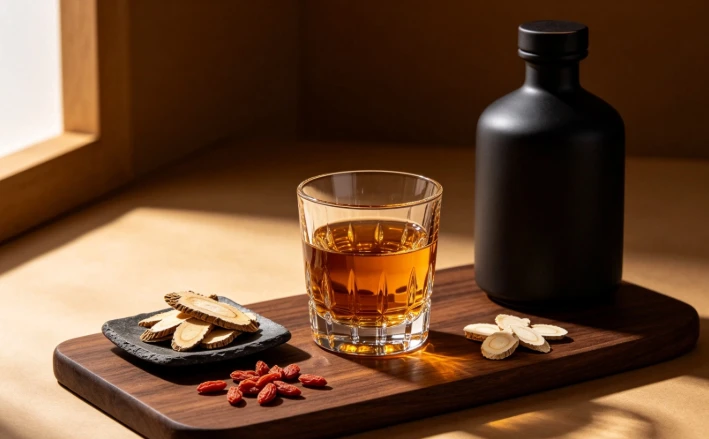
This guide works through a published, patent-backed formulation for a sauce-aroma (jiang-flavor) baijiu blended with deer antler blood freeze-dried powder, goji berry, Huangjing (Polygonatum) and Cistanche - and translates the laboratory figures into a production plan that holds at 10-tonne scale.
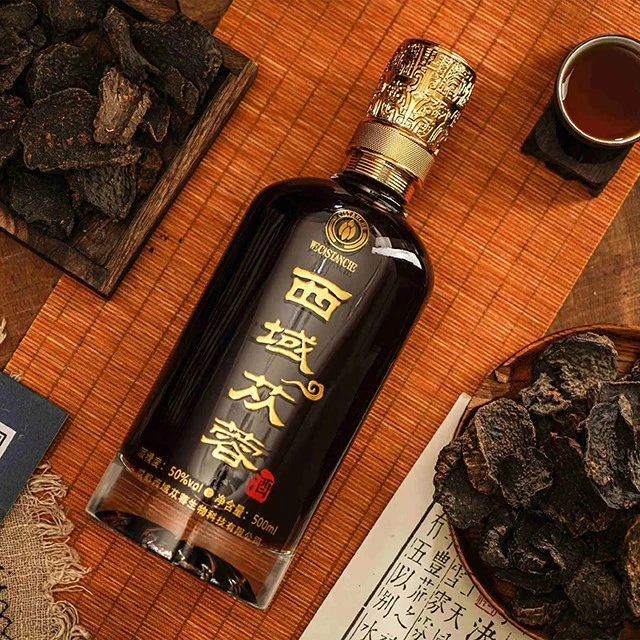
Wecistanche Black Platinum 50° herbal liquor health liquor medicinal liquor supplier wholesale Bulk sale Global Shipping
Supportive Service of Wecistanche
Email:wallence.suen@wecistanche.com
Why most botanical baijiu launches stall
The off-note problem
Blood- and root-based botanicals carry gamey, earthy, iron-like notes that sweetness cannot hide once the alcohol is above 50% vol. Traditional products simply mix fresh deer antler blood into baijiu, and the result reads as "supplement" rather than "drink".
The heat problem
High-temperature maceration is the default shortcut, and it is also where the value is destroyed. In the source data, a 50 °C / 7-day process on a 53% vol base returned an amino acid content of 78.65 mg/L, i.e. 47.16% below the low-temperature route - with visible browning, a total acid figure rising to 4.25 g/L and a shorter shelf life. You can sell the first bottle; you cannot sell the second.
The "herbs as decoration" problem
Remove the goji, Huangjing and Cistanche and keep only the blood powder: amino acid content drops to 92.37 mg/L (−37.95%), the body turns thin, the sweetness disappears and the gamey note comes forward. The botanicals are structural, not decorative.
The scale problem
Fresh antler blood spoils, transport is difficult, and without fixed parameters every batch drifts. A buyer who cannot audit a batch cannot commit to a repeat order.
Consumer complaint → commercial consequence → design answer
|
What the end consumer says |
What it costs the brand |
Design answer |
|
"These tonic wines all taste the same - bloody and herbal, two sips and done" |
No repeat purchase, no gifting |
Sweetness architecture from goji + Huangjing; sensory target is amber-gold, pronounced sweet aroma, mellow entry, clean finish |
|
"It says 'functional' but nobody tells me what's inside" |
No premium pricing power |
A printable QC number: amino acid content 147–149 mg/L as glycine equivalent |
|
"This bottle doesn't taste like the last one" |
Distributor returns, review damage |
Fixed parameters plus a 10-tonne bill of materials |
|
"The herbs killed the baijiu" |
Category rejection by core baijiu drinkers |
51% vol Daqu sauce-aroma base kept intact; aroma layered rather than replaced |
The formulation blueprint
Per 1 litre of finished blended liquor:
|
Component |
Working range |
Optimized level |
Function in the blend |
|
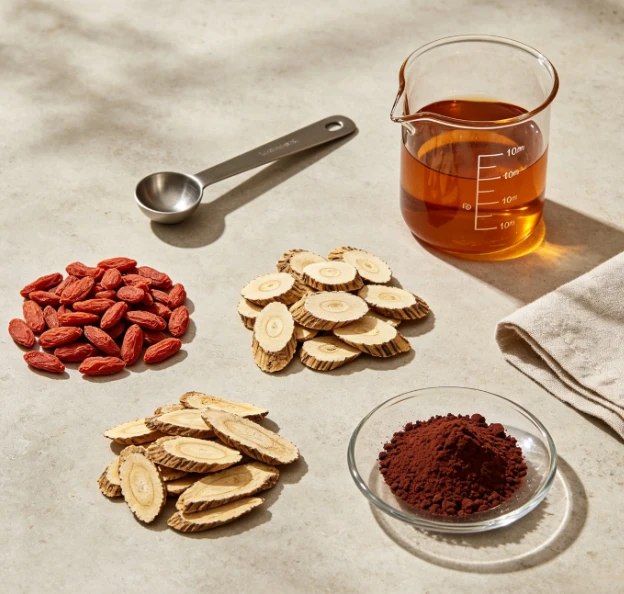
Deer antler blood freeze-dried powder |
0.3–0.5 g/L |
0.4 g/L |
Core active fraction: amino acids, peptides, phospholipids |
|
Goji berry (Lycium barbarum) |
30–50 g/L |
50 g/L |
Natural sweetness, color, polysaccharides |
|
Huangjing (Polygonatum sibiricum) |
40–60 g/L |
40 g/L |
Body and mouthfeel; above 40 g/L viscosity rises and extraction efficiency falls |
|
Cistanche (Rou Cong Rong) |
5–7 g/L |
6 g/L |
The "desert ginseng" note; beyond 6 g/L dissolution saturates and amino acid content plateaus, then declines |
|
Base liquor |
49–53% vol |
51% vol Daqu sauce-aroma |
Aroma backbone; 51% vol gave the highest dissolution without amino acid precipitation |
Each level above is the peak of a single-factor gradient, not a guess: blood powder peaks at 0.4 g/L, goji at 50 g/L, Huangjing at 40 g/L, Cistanche at 6 g/L.
The process - four steps, five numbers
|
Step |
Operation |
Parameter |
|
S1 |
Pretreatment |
Herbs washed, dried at 40 °C, milled to 20 mesh; blood powder stored sealed at −4 °C; base liquor diluted with purified water from 53 to 51% vol |
|
S2 |
Maceration |
Solid-to-liquid 1:1 (range 1:0.5–1:2.5); 15 °C (range 10–30 °C); 48 h (range 12–60 h); sealed and light-protected; stirred every 12 h for 5–10 min |
|
S3 |
Clarification |
Vacuum filtration through a 0.45 μm membrane, held at 10–20 °C (15 °C in the examples) |
|
S4 |
QC and filling |
Physico-chemical, sensory and active-fraction assays; aseptic filling |
Why those numbers: at 49% vol the lipophilic actives do not dissolve fully; above 51% vol amino acids begin to precipitate and degrade. Temperature peaks at 15 °C (131.88 μg/mL in the gradient series) - warmer degrades, colder under-extracts. Maceration saturates at 48 h. Solid-to-liquid at 1:1 is the balance point between insufficient solvent and over-dilution.
An orthogonal four-factor test ranked the drivers as solid-to-liquid ratio > alcohol content > temperature > time, with the best combination reaching 154.89 mg/L.
QC markers you can put on a COA
|
Marker |
Result (lab) |
Result (10 t batch) |
|
Amino acid content (glycine equivalent, ninhydrin/UV 568 nm) |
148.86 mg/L |
147.23 mg/L |
|
Total acid |
3.68 g/L |
3.68 g/L |
|
Total esters |
3.21 g/L |
3.21 g/L |
|
Liquor yield |
96.2% |
96.2% |
|
Standard |
GB 2757 (distilled and blended liquor) |
Compliant, sensory matched to the lab sample |
The assay itself is a simple, transferable method: glycine standard curve, y = 0.0581x + 0.0485, R² = 0.9999, absorbance at 568 nm. Any incoming-materials lab can run it, which means your number is verifiable by your customer.
The 10-tonne bill of materials
|
Material |
Quantity for 10 t finished liquor |
|
51% vol Daqu sauce-aroma baijiu |
10,245.9 kg |
|
Deer antler blood freeze-dried powder |
4.3 kg |
|
Goji berry |
538.7 kg |
|
Huangjing |
403.9 kg |
|
Cistanche |
64.6 kg |
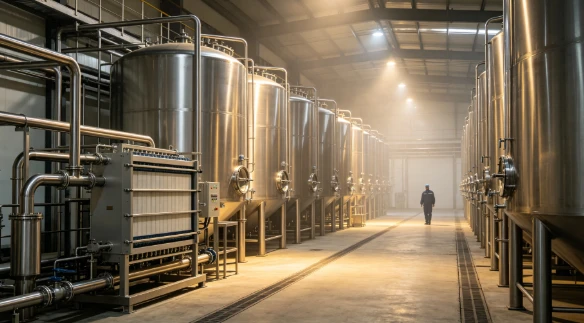
Industrial execution swaps the lab glassware for a plate-and-frame coarse filter plus diatomite and micro-membrane filtration, with the tank held at 15 °C and stirred 10 min every 12 h. No specialized large-scale equipment is required - the line fits existing baijiu plants, which is the practical reason this formulation is worth copying rather than inventing.
Sensory target (write this into your brief)
Amber-gold body; sauce aroma, fruit and herbal notes in balance; pronounced sweet aroma; mellow, slightly sweet entry; full sauce-aroma mid-palate; smooth body; clean, long finish. If your sample fails any one of these, the ratio or the maceration temperature is off - not the marketing.
Sourcing Cistanche without gambling on the batch
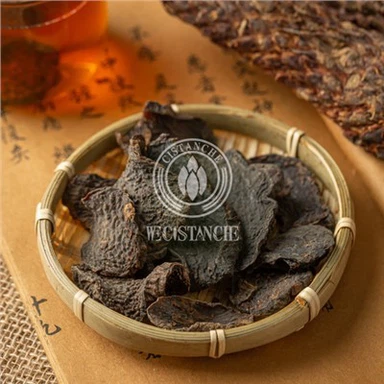
Cistanche is the ingredient that decides your reproducibility, so specify it like a raw material, not a flavor idea:
Species and origin: Cistanche deserticola or C. tubulosa, desert-grown (Xinjiang / Inner Mongolia), with declared harvest season.
Form: sliced or milled; if milled, state the mesh, and confirm low-temperature drying (40 °C) so thermolabile components survive.
Markers: HPLC echinacoside and acteoside (verbascoside) content per batch, reported numerically - not "standardized".
Safety dossier: moisture, ash, heavy metals (Pb, As, Cd, Hg), pesticide residues, microbial limits, and a batch COA plus retention sample.
Consistency: ask for three consecutive lots side by side. A supplier who cannot show lot-to-lot stability cannot support your 10-tonne repeat.
Compliance notes before you print the label
Alcohol carries mandatory warnings and age restrictions in every major market. Keep botanical communication in traditional-use language and avoid disease claims; structure/function wording, permitted botanicals lists and novel-food questions differ by market (EU, US, UK, GCC), so validate the exact claim set with local counsel before artwork sign-off. Nothing in this article is a medical claim or a dosing recommendation.
FAQ
Can I use fresh deer antler blood instead of freeze-dried powder? Not for scaled production. Fresh blood spoils, cannot be dosed reproducibly and varies in active content; the powder fixes the dose at 0.4 g/L and is stored sealed at −4 °C.
Can I run this on a different baijiu style? The parameters were optimized on 51% vol Daqu sauce-aroma. A different aroma type changes the interaction with the botanicals, so ratio, temperature and time need re-validation before you commit a batch.
How do I keep the amino acid figure stable after bottling? Start from the low-temperature route, control dissolved oxygen and light exposure, and store cool. The high-temperature route begins with roughly half the amino acids and browns faster.
What is the smallest batch I can trial? 1 L at lab scale, 100–200 L at pilot, 10 t as the documented industrial configuration.
Do the herbs really matter, or can I simplify? Data says no: without them you lose 37.95% of the amino acid content and the body collapses into a thin, gamey liquid.
Build your SKU on numbers, not adjectives
We supply Cistanche whole herb and extract with batch-level COAs, HPLC marker data and formulation support for botanical liquor projects - from a 1 L bench trial to a 10-tonne run. [Request a sample and specification sheet →]
Keywords: cistanche extract supplier, cistanche herbal baijiu, sauce-aroma baijiu formulation, botanical liquor development, functional baijiu OEM, deer antler blood wine, low-temperature maceration, herbal liquor private label