Cistanche Nutrition And Antioxidant Activity: The Complete Science-Based Guide To The Desert Ginseng
Oct 13, 2026
Introduction: Why Cistanche Deserves a Place in Your Wellness Routine
Cistanche, botanically known as Cistanche deserticola and lovingly called the "Desert Ginseng," is one of the most intriguing and valuable plants in the world of natural health. For more than a thousand years, this remarkable herb has grown in the harshest environments on Earth - the vast, dry deserts of northwestern China - where it survives by parasitizing the roots of hardy desert shrubs. Despite - or perhaps because of - these extreme conditions, Cistanche has built a reputation as a nutritional and functional powerhouse. Its nickname is not an exaggeration: like true ginseng, it is prized not as ordinary food but as a tonic-grade botanical that supports vitality, energy, kidney health, and overall well-being.
Today, as consumers around the world grow more interested in natural, plant-based wellness, Cistanche is stepping out of the herbal tradition and into the modern conversation about nutrition and health. And one of the most exciting areas of modern research is the herb's nutritional composition and its antioxidant activity. These two properties are deeply connected: what a food or herb contains determines what it can do for the body, and its antioxidant capacity is one of the most measurable ways scientists assess its potential health benefits.
This article is written for health-conscious consumers, supplement formulators, manufacturers, importers, and anyone curious about the science behind this desert treasure. It explains, in plain and accessible language, what Cistanche actually contains, why its antioxidant activity matters, how scientists measure it, and what the research says about the best way to unlock its benefits. We will focus on a specific and important variety - Cistanche from Alashan, Inner Mongolia - because origin and growing conditions have a powerful effect on the quality of any botanical.
Before we go further, an important note of clarity: this article is educational and informational in nature. It summarizes findings from published scientific research and is not intended to diagnose, treat, cure, or prevent any disease. Always consult a qualified healthcare professional before using herbal supplements, especially if you are pregnant, nursing, taking medication, or managing a chronic health condition.
What Is Cistanche? The "Desert Ginseng" Explained
To understand why Cistanche is so highly regarded, we first need to understand what it is and where it comes from. Cistanche is a genus of parasitic plants belonging to the broomrape family (Orobanchaceae). Unlike most plants, it does not produce its own food through photosynthesis in the usual way. Instead, it attaches itself to the roots of certain host shrubs and draws water, nutrients, and other substances from them. This parasitic lifestyle is part of what makes Cistanche so special: it concentrates nutrients from the harsh desert environment into a single, fleshy, succulent stem.
The part used in traditional Chinese medicine and modern supplements is this fleshy stem, which is harvested at the right stage of growth and then carefully dried for preservation. The dried herb has a distinctive appearance and a long history of use.
Cistanche's history goes back more than a thousand years. It is first recorded in the Shennong Bencao Jing (The Divine Farmer's Classic of Materia Medica), one of the oldest and most respected pharmacopoeias in the world, where it was placed in the highest class of herbs - those considered safe, nourishing, and suitable for long-term use. Traditional Chinese medicine regards Cistanche as sweet, salty, and warm, and it is traditionally associated with supporting kidney health, replenishing essence and blood, promoting regular bowel movements, and supporting vitality and strength.
Over the centuries, Cistanche has also earned a rich collection of folk names in Chinese, including "jin ya" (golden sprout), "di jing" (earth essence), and "yun tai." Each name reflects a different aspect of how this plant was perceived - as something precious, something connected to the earth, and something with life-giving qualities.
Modern science has begun to explain what tradition intuited. Researchers have now isolated more than 120 different compounds from Cistanche, including phenylethanoid glycosides, lignans and their glycosides, polyphenols, polysaccharides, and various other bioactive molecules. Many of these compounds have been studied for their antioxidant, anti-inflammatory, neuroprotective, and immune-supporting properties. This is why the herb is increasingly finding its way into food products, beverages, and supplements around the world.
Why Nutrition and Antioxidant Activity Matter
When we talk about whether a food or herb is "good for you," two questions matter most: What does it contain, and what can it do? The first question is about nutrition - the proteins, fats, minerals, and bioactive compounds present in the material. The second is about function - what those compounds do once they reach the body.
Antioxidant activity falls into the second category, and it is one of the most heavily studied properties of plant-based foods. To understand why, we need to understand a little about oxidation and free radicals.
Inside every living cell, normal metabolism produces byproducts called free radicals - unstable molecules that have an unpaired electron. Because they are unstable, free radicals are highly reactive. They will "steal" electrons from other molecules, including the lipids in cell membranes, the proteins that carry out cellular functions, and even the DNA in our cells. When too many free radicals build up faster than the body can neutralize them, a state called oxidative stress develops. Over time, oxidative stress is associated with accelerated aging and a wide range of chronic health conditions.
Fortunately, the body has its own defense systems, and we also obtain help from our diet. This is where antioxidants come in. Antioxidants are molecules that can donate electrons to free radicals, neutralizing them and stopping the chain reaction of damage. Plants are among the richest sources of natural antioxidants, because plants themselves produce these compounds to protect against environmental stress - including intense sunlight, drought, and heat. The same compounds that protect the desert plant can also help support the human body.
This is precisely why the antioxidant activity of a herb like Cistanche is so interesting. If Cistanche contains compounds that can effectively neutralize free radicals, then it may help support the body's natural defenses against oxidative stress. And because antioxidants work best as part of a complex network of compounds, the "whole" profile of a plant - its total polyphenols, total flavonoids, and other constituents - can be more valuable than any single molecule in isolation.
This is why researchers measure not just individual compounds, but also "total polyphenol content" and "total flavonoid content," and why they test the overall free-radical-scavenging activity of extracts. These measurements give us a practical picture of a plant's antioxidant potential.
Alashan: A Special Place for Cistanche
Not all Cistanche is created equal. Like fine tea, coffee, or wine, the quality and composition of a botanical depend heavily on where and how it is grown. One of the most celebrated origins for Cistanche is Alashan, a region in Inner Mongolia in northern China.
Alashan is a place of dramatic landscapes - vast deserts, sparse shrubland, and a harsh, dry climate. These conditions may seem unforgiving, but they are exactly what Cistanche and its host plants have adapted to over millennia. The stressful environment pushes the plant to produce protective compounds, which is one reason desert-grown botanicals are often rich in polyphenols and other bioactives.
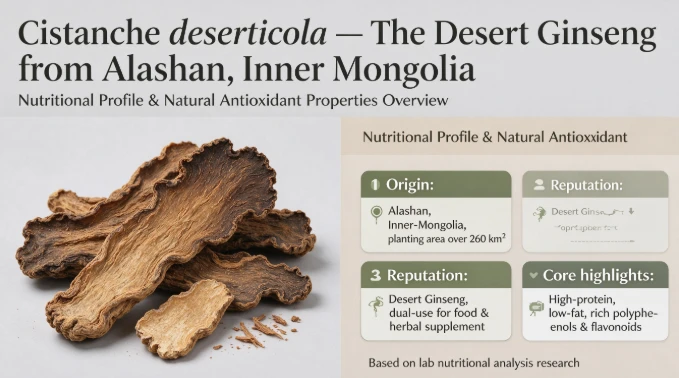
Alashan has become one of the major production areas for Cistanche in China. In recent years, the area planted with Cistanche there has grown to more than 260 square kilometers. This large-scale cultivation is significant for several reasons: it helps meet the growing demand for Cistanche, it reduces pressure on wild populations, and it supports the economic development of the region.
Yet despite this importance, detailed scientific reports on the nutritional composition and antioxidant activity of Alashan Cistanche were relatively scarce. This is part of what makes the research behind this article valuable. By taking a close, careful look at Alashan Cistanche specifically, scientists have been able to give us concrete numbers about what this particular, well-regarded origin actually delivers in terms of nutrition and antioxidant potential.
What the Research Set Out to Do
The study we are exploring was designed with a clear and practical goal: to analyze the nutritional composition of Cistanche from Alashan, Inner Mongolia, and to measure the antioxidant activity of its extracts. By doing both together, the researchers aimed to connect the "what" (what the herb contains) to the "what it can do" (how well it neutralizes free radicals).
To achieve this, they used a careful, systematic approach. Fresh Cistanche was cleaned, sliced, and dried until its moisture content fell below 10%. The dried material was then ground into a fine powder. From this powder, the researchers prepared two different extracts: an aqueous (water) extract and an ethanolic (alcohol) extract. Preparing both types is important because different compounds dissolve differently - some are better extracted by water, others by alcohol - and the two extracts can have different properties.
For the nutritional analysis, they measured moisture, ash, crude protein, and crude fat using established laboratory methods. For the active constituents, they measured total polyphenol content and total flavonoid content using standard colorimetric methods. And for antioxidant activity, they used two of the most widely respected laboratory tests in the field: the DPPH radical scavenging assay and the ABTS radical scavenging assay. We will explain what these tests measure a little later.
The results were analyzed statistically, with each measurement repeated at least three times and reported as an average with a measure of variability. This attention to reproducibility is exactly what makes the findings trustworthy.
The Basic Nutrition Profile: High Protein, Low Fat
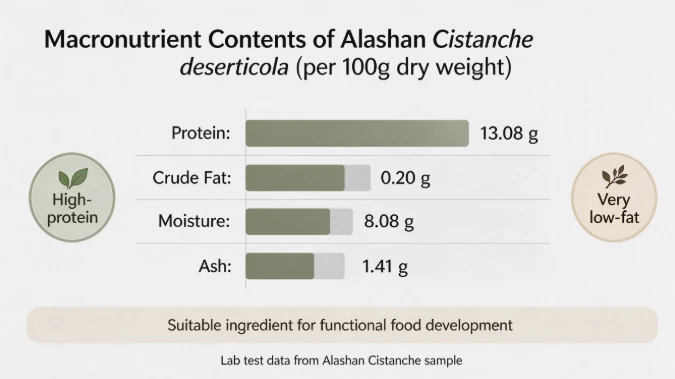
One of the most striking findings of the study concerns the basic nutritional composition of Cistanche. The researchers measured four core components: moisture, ash, crude protein, and crude fat.
The results painted a clear and appealing picture:
Protein: 13.08 g/100 g. This is a substantial amount of protein for a plant-based material. For comparison, many vegetables and even some grains contain far less. This high protein content makes Cistanche stand out as a nutritionally dense herb.
Crude fat: 0.20 g/100 g. The fat content is very low. This is excellent news for health-conscious consumers, because it means Cistanche provides its benefits without adding meaningful dietary fat.
Moisture: 8.08 g/100 g. This reflects the moisture remaining in the dried herb, and it is consistent with the careful drying process used.
Ash: 1.41 g/100 g. Ash represents the mineral content of the material - the inorganic elements left after all organic matter is burned away. A measured ash content of about 1.41 g/100 g indicates a modest but present mineral fraction.
Taken together, these numbers led the researchers to describe Cistanche as a high-protein, low-fat health food. This is a genuinely appealing profile. In a world where many convenient foods are high in fat and low in nutritional value, a botanical that is simultaneously rich in protein and very low in fat stands out as an attractive option for health-focused consumers.
It is also worth noting what these numbers mean in practical terms. Protein is essential for building and repairing tissues, supporting immune function, and countless other processes. Low fat content means Cistanche can be incorporated into products without undermining dietary goals. For formulators, these numbers matter: they indicate that Cistanche can contribute to the nutritional quality of a finished product.
The Active Constituents: Polyphenols and Flavonoids
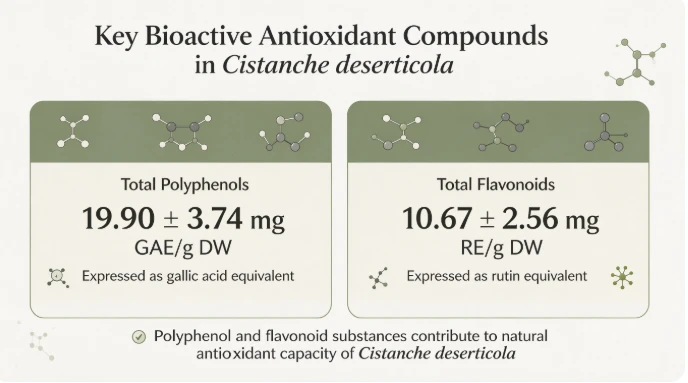
Beyond basic nutrition, the study measured the content of two important classes of bioactive compounds: total polyphenols and total flavonoids. These are the compounds most closely associated with the antioxidant and health-supporting properties of plant foods.
Total Polyphenols: 19.90 ± 3.74 mg GAE/g DW. Polyphenols are a large and diverse family of plant compounds characterized by multiple phenol groups. They are among the most studied antioxidants in food science, found in tea, coffee, berries, grapes, and many medicinal plants. The measurement "mg GAE/g DW" means milligrams of gallic acid equivalents per gram of dry weight - a standard way of expressing total polyphenol content by comparing the sample to a reference compound (gallic acid). A value of about 19.90 mg GAE/g DW indicates that Cistanche contains a meaningful concentration of polyphenolic compounds.
Total Flavonoids: 10.67 ± 2.56 mg RE/g DW. Flavonoids are a specific and very important subclass of polyphenols. They are responsible for much of the color in fruits and vegetables and are widely studied for their antioxidant, anti-inflammatory, and cardiovascular-supporting properties. The measurement "mg RE/g DW" means milligrams of rutin equivalents per gram of dry weight, using the flavonoid rutin as the reference compound. A value of about 10.67 mg RE/g DW indicates a substantial flavonoid presence.
What do these numbers mean? In simple terms, they confirm that Cistanche is a genuine source of antioxidant polyphenols and flavonoids. These compounds are the reason the extracts showed strong free-radical-scavenging activity in the laboratory. They are also the reason Cistanche is increasingly viewed not just as a traditional herb, but as a functional food ingredient with measurable bioactivity.
It is worth emphasizing that the polyphenols and flavonoids in Cistanche work together. Research increasingly suggests that the antioxidant benefits of whole plants come from the combined, synergistic action of many compounds, not any single molecule. This is why measuring "total" content is so meaningful - it captures the overall antioxidant reservoir of the herb.
Antioxidant Activity, Explained Simply
Now we come to the part that connects chemistry to potential health benefit: antioxidant activity. The researchers measured this using two of the most respected laboratory assays in the field - the DPPH assay and the ABTS assay. Let us explain what these are in accessible terms.
Both assays work on the same basic principle. A colored, stable free radical is prepared in solution. When an antioxidant is added, it donates electrons to the radical, neutralizing it. This causes the color to change, and the degree of color change can be measured with a spectrophotometer. The more color that disappears, the more free radicals were neutralized, and the stronger the antioxidant activity.
The DPPH Assay. DPPH is a stable free radical that appears purple in solution. When an antioxidant neutralizes it, the purple color fades to yellow. By measuring how much the color fades, scientists can calculate the percentage of DPPH radicals that were scavenged. This is one of the oldest and most widely used antioxidant assays in food science.
The ABTS Assay. ABTS is another stable free radical, and the assay works on a similar principle. A colored ABTS solution is prepared, and the antioxidant's ability to quench it is measured at a specific wavelength. The ABTS assay is often used alongside DPPH because it can measure both lipophilic and hydrophilic antioxidants, giving a complementary picture of antioxidant capacity.
Both assays produce a result that is usually summarized by a value called IC50. The IC50 is the concentration of the sample needed to scavenge 50% of the free radicals in the test. A lower IC50 means a stronger antioxidant - it takes less of the extract to achieve the same effect. This single number makes it easy to compare different extracts or different samples.
It is also worth noting that these are laboratory tests, and they should not be over-interpreted. An antioxidant assay does not directly prove a health effect in the human body. What it does do is provide a reliable, reproducible measure of the free-radical-scavenging capacity of a substance. This is a valuable piece of the puzzle, and it is especially useful for comparing processing methods, origins, and extraction approaches.
Water Extract vs. Ethanol Extract: Which Is Stronger?
One of the most practical findings of the study concerns the comparison between the two types of extracts: the aqueous (water) extract and the ethanolic (alcohol) extract.
Both extracts demonstrated free-radical-scavenging activity, and both showed a clear dose-effect relationship. This means that as the concentration of the extract increased, its ability to scavenge free radicals also increased. This dose-dependence is exactly what scientists expect to see from a genuine antioxidant, and it confirms that the effect is real and measurable rather than an artifact.
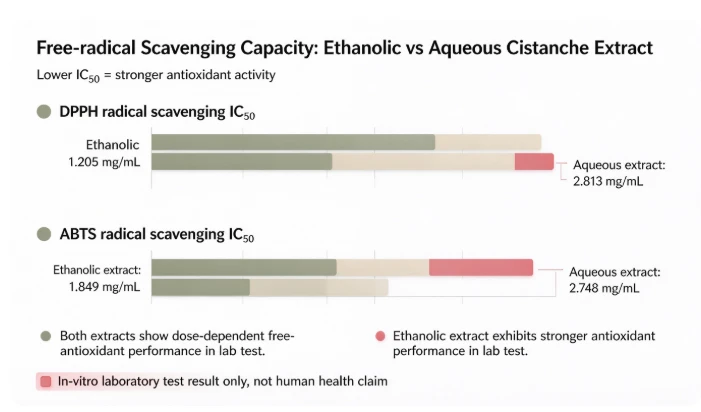
However, the two extracts were not equal in strength. In both the DPPH and ABTS assays, the ethanolic extract showed better radical-scavenging activity than the aqueous extract. This is reflected in the IC50 values:
In the DPPH assay, the ethanol extract had an IC50 of about 1.205 mg/mL, while the water extract had an IC50 of about 2.813 mg/mL.
In the ABTS assay, the ethanol extract had an IC50 of about 1.849 mg/mL, while the water extract had an IC50 of about 2.748 mg/mL.
In both cases, the ethanol extract had the lower IC50, meaning it needed a smaller concentration to achieve the same 50% radical scavenging. This is a clear and consistent result: the ethanolic extract of Cistanche is a more potent antioxidant than the aqueous extract.
Why would this be? The most likely explanation lies in the chemistry of the compounds involved. Many of the most active antioxidant compounds in Cistanche - particularly certain polyphenols and phenylethanoid glycosides - dissolve more readily in alcohol than in water. When the extraction solvent is ethanol, more of these active compounds are pulled into the extract, resulting in a higher concentration of antioxidants and therefore stronger free-radical-scavenging activity.
This finding has direct practical implications. For manufacturers developing Cistanche-based antioxidant products, an ethanolic extraction is likely to yield a more potent extract than a simple water extraction. This is valuable information for product development, formulation, and quality control.
It is also reassuring for consumers in a simpler way: the fact that both water and ethanol extracts show genuine antioxidant activity means that the benefits of Cistanche are not locked away in a solvent that is difficult to use. Both approaches extract active, beneficial compounds - just with different efficiencies.
How the Research Was Done: A Closer Look at the Methods
For readers who want to understand the level of rigor behind these findings, it is worth taking a closer look at how the study was conducted. The methods were carefully chosen to be reproducible and standard.
Sample preparation. Fresh Cistanche was cleaned, sliced into thick pieces, and dried in an oven until the moisture content fell below 10%. The dried material was then ground into a fine powder. To prepare the extracts, one gram of the powdered material was mixed with either 40 mL of hot water or 70% ethanol, and the mixture was extracted using an ultrasonic cleaner for 40 minutes. Ultrasonic extraction uses sound waves to disrupt cell walls and release compounds more efficiently than simple soaking. After extraction, the mixture was centrifuged to separate the liquid extract from the solid residue, and the liquid was made up to a fixed volume.
Nutritional analysis. The moisture content was determined by direct drying, protein by the Kjeldahl method, fat by Soxhlet extraction, and ash by muffle furnace incineration. These are all standard, internationally recognized methods.
Total polyphenol content. This was measured using the Folin-Ciocalteu method, a colorimetric assay that has been the standard for decades. The results were expressed as gallic acid equivalents per gram of dry weight.
Total flavonoid content. This was measured using a colorimetric method based on the reaction of flavonoids with aluminum nitrate, with the results expressed as rutin equivalents per gram of dry weight.
Antioxidant assays. The DPPH and ABTS assays were performed using standard protocols adapted from the published literature. All measurements were repeated at least three times, and the results were analyzed statistically using IBM SPSS 27.0 and GraphPad 8 software.
This methodological rigor is important because it means the reported numbers are reliable and comparable to results from other studies using the same standard methods. When you read that Cistanche contains 19.90 mg GAE/g of total polyphenols, you can trust that this is a meaningful, reproducible measurement.
What These Findings Mean for Consumers
Now let us translate the science into practical guidance for people who buy or use Cistanche products.
First, Cistanche is a nutritious, low-fat botanical. With about 13 grams of protein per 100 grams and only 0.2 grams of fat, it offers a favorable nutritional profile. For consumers looking to add nutrient-dense, low-fat botanicals to their diet or supplement routine, Cistanche is an attractive choice.
Second, Cistanche is a genuine source of antioxidant polyphenols and flavonoids. The measured total polyphenol and total flavonoid content confirms that this herb carries meaningful antioxidant compounds. This supports its traditional reputation and its modern positioning as a functional food.
Third, extraction method matters for potency. The research shows that an ethanolic extract is a more potent antioxidant than a water extract. If you are choosing between products, those made with alcohol-based or hydro-alcoholic extraction may deliver higher antioxidant activity per dose than those made with simple water extraction. This is a useful point to check on a product's label or specification.
Fourth, look for origin and transparency. The study focused on Alashan Cistanche, a major and well-regarded production area. Origin can affect composition, so products that identify their source and provide documented testing are generally more trustworthy.
Fifth, remember that antioxidant content is not the whole story. While antioxidant activity is an important and measurable property, it is only one aspect of a botanical's potential value. The full benefit of Cistanche likely comes from the combined action of its many compounds. Choose products from reputable brands that provide transparent, documented quality information.
What These Findings Mean for Manufacturers and Formulators
For professionals in the supplement and functional food industry, this research offers several actionable insights.
The nutritional profile supports product claims. With its high protein and very low fat content, Cistanche can be positioned and formulated as a high-protein, low-fat functional ingredient. This is a strong selling point for health-focused product categories.
The antioxidant data provides a foundation for quality control. The total polyphenol and total flavonoid content, along with the DPPH and ABTS antioxidant values, give manufacturers measurable parameters that can be used to standardize product quality and to verify that different batches deliver consistent activity.
Ethanol extraction is the preferred route for antioxidant potency. The clear finding that ethanolic extracts outperform aqueous extracts in both antioxidant assays suggests that manufacturers seeking maximum antioxidant activity should consider ethanol or hydro-alcoholic extraction in their processes.
Reproducibility enables scale-up. Because the study used standard, internationally recognized analytical methods, its findings can be replicated and used as benchmarks. This makes it easier for manufacturers to set specifications, compare suppliers, and communicate quality to global buyers.
Origin differentiation adds value. The focus on Alashan Cistanche highlights the value of origin-specific sourcing. Products that can document their specific origin and provide testing data have a competitive advantage in a market that increasingly demands transparency.
The Bigger Picture: Cistanche and the Global Wellness Market
It is worth stepping back to see where Cistanche fits in the broader landscape of natural health and the global botanical market.
Interest in plant-based wellness has never been higher. Consumers around the world - in North America, Europe, Asia, and beyond - are seeking natural products that support health, and they are increasingly sophisticated in how they evaluate these products. They want evidence, not just marketing. They want to know what a product contains, where it comes from, and how it was tested.
Cistanche is well positioned in this environment. It has a thousand-year history of traditional use, a growing body of modern scientific research, and a compelling story - the "Desert Ginseng" that thrives in the harshest conditions on Earth. Research like the study we have explored strengthens its position by providing hard data: nutritional composition, antioxidant capacity, and the science behind extraction.
As the market grows, transparency and quality documentation will become increasingly important. Manufacturers who invest in validated analytical testing, who can document their sourcing, and who communicate quality with evidence rather than vague claims will be best positioned to succeed. Studies like this one provide the foundation for exactly that kind of trustworthy positioning.
There is also an important sustainability dimension. Cistanche grows in fragile desert ecosystems, and its cultivation is closely tied to environmental stewardship and regional economic development. The expansion of Cistanche cultivation in areas like Alashan helps meet demand while supporting local communities and reducing pressure on wild populations. Understanding and communicating the value of this herb - including its nutritional and antioxidant properties - supports this positive cycle.
Frequently Asked Questions
To make this information as practical as possible, here are answers to the questions people most often ask about Cistanche nutrition and antioxidant activity.
Q: Is Cistanche really high in protein?
A: Yes. The study measured a crude protein content of about 13.08 g/100 g in the dried herb. This is a substantial amount for a plant-based botanical, which is why the researchers described Cistanche as a high-protein, low-fat health food.
Q: What are polyphenols and flavonoids, and why do they matter?
A: They are natural compounds found in plants that have antioxidant properties. Polyphenols are a large family of these compounds, and flavonoids are an important subclass. They help neutralize free radicals, which are unstable molecules that can contribute to oxidative stress. Cistanche contains meaningful amounts of both, with a total polyphenol content of about 19.90 mg GAE/g and a total flavonoid content of about 10.67 mg RE/g.
Q: What does IC50 mean?
A: IC50 is the concentration of a substance needed to scavenge 50% of the free radicals in a laboratory test. A lower IC50 means stronger antioxidant activity - it takes less of the substance to achieve the same effect. In this study, the ethanol extract had lower IC50 values than the water extract, meaning it was the more potent antioxidant.
Q: Is ethanol extract really better than water extract?
A: In this study, yes. The ethanol extract showed better DPPH and ABTS radical-scavenging activity than the water extract, likely because more of the active antioxidant compounds dissolve in alcohol. This is useful information for both product developers and consumers choosing between different types of extracts.
Q: Does antioxidant activity in the lab mean it works in the body?
A: Not directly. Laboratory antioxidant assays are useful, reproducible measures of free-radical-scavenging capacity, but they do not by themselves prove a health effect in humans. They are one important piece of the picture, and the value of Cistanche likely comes from the combined action of its many compounds. Always consider the whole body of evidence.
Q: Does origin matter for Cistanche quality?
A: Yes. This study focused on Cistanche from Alashan, Inner Mongolia, a major and well-regarded production area. Growing conditions can affect the composition of a botanical, so origin is an important factor in quality. Products that identify their source and provide testing data are generally more trustworthy.
Q: Is Cistanche safe to consume?
A: Cistanche has a long history of traditional use and is regarded as a nourishing, tonic-grade herb. However, herbal supplements are not appropriate for everyone, and the scientific understanding of their effects is still developing. Always consult a qualified healthcare professional before use, especially if you are pregnant, nursing, taking medication, or managing a health condition.
Q: How is Cistanche typically consumed?
A: Cistanche is used in a variety of ways, including as a dried herb, a powder, an extract, an ingredient in tea, and a component of dietary supplements. The form you choose depends on your goals and preferences, and the research on extraction suggests that products made with alcohol-based extraction may deliver higher antioxidant activity per dose.
Summary: The Key Takeaways
Let us bring the whole picture together into a clear set of conclusions.
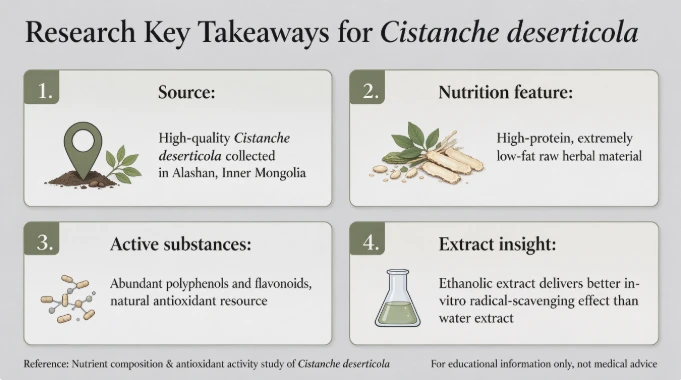
First, Cistanche is a nutritionally dense botanical. The study measured a crude protein content of 13.08 g/100 g and a very low crude fat content of 0.20 g/100 g, leading the researchers to describe it as a high-protein, low-fat health food.
Second, Cistanche is a genuine source of antioxidant compounds. It contains meaningful amounts of total polyphenols (19.90 mg GAE/g DW) and total flavonoids (10.67 mg RE/g DW), the classes of compounds most closely associated with antioxidant activity.
Third, Cistanche extracts show real free-radical-scavenging activity. Both the water and ethanol extracts demonstrated dose-dependent scavenging of DPPH and ABTS free radicals, confirming that the antioxidant effect is real and measurable.
Fourth, the ethanol extract is the more potent antioxidant. With lower IC50 values in both assays (about 1.205 mg/mL vs 2.813 mg/mL for DPPH, and 1.849 mg/mL vs 2.748 mg/mL for ABTS), the ethanolic extract proved stronger than the aqueous extract. This is a practical insight for product development.
Fifth, origin matters. The study focused on Alashan Cistanche, one of the major production areas in Inner Mongolia, and highlighted the value of understanding origin-specific quality.
Finally, for consumers, the practical message is to prioritize transparency and documented quality - understand what a product contains, where it comes from, and how it was tested.
Conclusion
Cistanche, the "Desert Ginseng," is far more than a traditional herb with a storied past. Modern science is revealing that it is also a genuinely nutritious and antioxidant-rich botanical. It delivers meaningful protein with almost no fat, it carries valuable polyphenols and flavonoids, and its extracts demonstrate real free-radical-scavenging activity - with alcohol-based extraction proving especially potent.
These findings matter for everyone. For consumers, they offer reassurance that Cistanche is a substance of real nutritional and functional value, and they provide practical guidance for choosing between products. For manufacturers and formulators, they offer measurable parameters, evidence-based extraction guidance, and a foundation for quality control and product claims.
As the global interest in plant-based wellness continues to grow, research like this becomes ever more valuable. It turns ancient wisdom into measurable science, and it gives producers and consumers alike a common language for quality. Whether you are exploring Cistanche for the first time or sourcing it for a global supply chain, the same principles apply: understand the science, value transparency, and choose quality you can verify.
Medical Disclaimer: This article is for educational and informational purposes only and is not intended to diagnose, treat, cure, or prevent any disease, nor to provide medical advice. Statements about Cistanche and its constituents are based on published scientific literature and should not be interpreted as endorsements for treating any health condition. Always consult a qualified healthcare professional before using herbal supplements, especially if you are pregnant, nursing, taking medication, or have a medical condition. Products containing Cistanche are dietary supplements, not pharmaceuticals, and their effects may vary from person to person.