Cistanche Tubulosa: A Gentle Nourishing Herb For Deficiency-Type Constipation in The Elderly
Nov 05, 2026
Constipation is extremely prevalent among older adults around the world. While it is not classified as a life-threatening disease, persistent constipation can severely reduce quality of life, bringing discomfort such as abdominal distension, poor appetite, restless sleep, and even triggering cardiovascular risks when straining during defecation. Faced with this trouble, many people turn directly to over-the-counter laxatives from pharmacies, including senna leaf, hemp seed pills, and various cleansing teas. These stimulant laxatives work quickly for constipation caused by gastrointestinal heat excess, and the short-term relief effect is obvious. However, a large proportion of elderly constipation belongs to deficiency-type constipation. For these people, repeated use of strong stimulant laxatives often leads to diminishing returns: the bowels may respond at first, but over time, the intestinal function becomes weaker, and constipation grows harder to resolve, creating a vicious cycle [1].

Effects of cistanche-treat constipation
From the perspective of Traditional Chinese Medicine (TCM), constipation in the elderly is most often rooted in physical deficiency, and the pattern known as "excess symptoms arising from underlying deficiency" is particularly common. As people age, primordial qi gradually declines, the root of vitality becomes unstable, liver and kidney yin are insufficient, middle qi fails to rise, clear qi cannot ascend normally, and turbid qi becomes stagnant in the intestinal tract. Without adequate fluid nourishment from essence and blood, the large intestine loses its moistening power and cannot transport waste smoothly, resulting in dry, hard stools and difficult defecation [2]. This type of constipation cannot simply be "pushed out" with purgatives; the core treatment principle is to nourish essence, replenish blood, and moisten dryness while supporting the body's foundation.

Today we introduce a classic TCM herb specialized for moistening intestines and relaxing bowels: Cistanche tubulosa. It is one of the official medicinal species of Herba Cistanches recorded in the Chinese Pharmacopoeia, often called "desert ginseng". We will share the TCM interpretation of this herb by renowned TCM practitioner Ni Haixia, alongside classical medical records and modern clinical understanding.
Cistanche tubulosa is valued as a superior herb for tonifying the kidney and delaying aging. The ancient classic Shennong Bencao Jing (Shennong's Classic of Materia Medica) ranks it as a top-grade medicinal material and states that it can "nourish the five zang organs, boost essence and qi, and lighten the body with long-term administration" [3]. Zhen Quan, a distinguished physician of the Tang Dynasty, wrote that Cistanche tubulosa "benefits the marrow, brightens complexion and extends lifespan". Generations of TCM practitioners regard it as an indispensable herb for tonifying the kidney and replenishing essence-blood. In the desert producing regions of this herb, residents have a long history of eating it as a food ingredient.

Effects of cistanche on constipation
Click here to view Cistanche constipation-relieving products
【Ask for more】 Email:cindy.xue@wecistanche.com / WhatsApp: 0086 18599088692 / WeChat: 18599088692
Miao Xiyong, a famous medical scholar of the Ming Dynasty, further summarized its intestinal-moistening and laxative function from abundant clinical practice, and this application was inherited and widely adopted by later physicians. A well-known classical medical case recorded by Miao Xiyong illustrates this principle vividly. An elderly patient surnamed Tang visited Miao for treatment. The old man had grey hair, a thin body, and a haggard look. His main complaints were chest stuffiness and difficult bowel movements. After syndrome differentiation, Miao judged that his condition was constipation caused by blood dryness and essence-blood depletion, and prescribed Cistanche tubulosa as the core herb. After taking the herbal decoction, Mr. Tang's bowel movements became smooth, his chest oppression disappeared, his energy recovered, and his mental state improved greatly.
Several days later, the constipation relapsed. The elderly man invited another doctor and showed Miao's original prescription. After reading it, this doctor shook his head in doubt and commented: "Cistanche tubulosa is warm and drying by nature; it will fuel internal fire and injure yin fluid. How could it relieve constipation?" The doctor then replaced the formula with other purgative herbs. Instead of improving, the patient's symptoms worsened. Feeling uneasy, Mr. Tang quickly returned to Miao Xiyong's prescription again, and his condition improved rapidly once more.

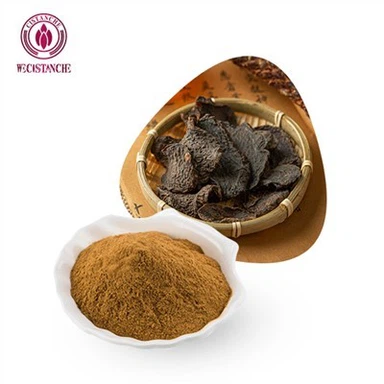
cistanche powder
Later, the second doctor consulted Miao Xiyong to understand the logic. Miao explained that Cistanche tubulosa is primarily an essence-blood nourishing herb. Ancient texts have clearly documented its sweet-salty flavour and warm but non-drying property. In this elderly patient, aging brought gradual decline in physical strength and severe insufficiency of essence and blood. Body fluid circulation became impaired, the intestines lost moisture, and stool was blocked, which further caused chest tightness. By using an appropriate dose of Cistanche tubulosa, the prescription replenished essence, tonified deficiency, nourished fluid and moistened dryness, so the obstruction resolved naturally [4]. The visiting doctor sighed after hearing this: many practitioners fail to cure common illnesses simply because they do not thoroughly study classical medical literature and mechanically label herbs by narrow impressions.

Desert ginseng
Contemporary distinguished TCM expert Dong Jianhua also favours Cistanche tubulosa for managing senile deficiency constipation. An old TCM maxim says, "For dry constipation in the elderly, cook Cistanche congee". Cistanche congee is a mild home remedy, suitable for long-term gentle conditioning rather than quick purgation. It aligns perfectly with the therapeutic idea that elderly patients should be nourished instead of harshly purged [5].
Modern pharmacological research also provides scientific support for this traditional application. The main bioactive constituents of Cistanche tubulosa include phenylethanoid glycosides, polysaccharides and oligosaccharides. These ingredients work through multiple pathways: inhibiting excessive water absorption in the colon, increasing water content and volume of faeces, promoting intestinal peristalsis, protecting interstitial cells of Cajal that regulate gut motility, and modulating gut microbiota to raise short-chain fatty acid levels [6,7]. Unlike senna, rhubarb, and other stimulant laxatives that irritate the intestinal wall and may damage enteric nerves with long-term use, Cistanche tubulosa relieves constipation by nourishing and moistening, which is much safer for frail older adults.
It is important to note that Cistanche tubulosa is not suitable for all constipation cases. It fits deficiency and dryness patterns, while people with excess heat, damp-heat diarrhoea, or spleen-stomach dampness should avoid using it. For elderly readers, TCM syndrome differentiation is still the premise of safe herbal use.

cistanche tea
In summary, senile constipation should not be treated only by forcing bowel movement. For deficiency-type intestinal dryness constipation, nourishing essence-blood and moistening the intestines with mild herbs such as Cistanche tubulosa represents a time-tested holistic strategy from TCM. Combining classical experience with modern pharmacological evidence, this desert herb offers a gentle alternative for older adults struggling with chronic constipation, reducing reliance on strong stimulant laxatives.
References
[1] Suares N C, Ford A C. Prevalence of, and risk factors for, chronic idiopathic constipation in the community: systematic review and meta-analysis [J]. The American Journal of Gastroenterology, 2011, 106(9): 1582-1591.
[2] Zhang S, Shen H, Zhang L. Expert consensus on TCM diagnosis and treatment of constipation [J]. Chinese Journal of Integrated Traditional and Western Medicine, 2023, 43(6): 681-688.
[3] Yuan D, Morikawa T, Xie H, et al. A review of biologically active natural products from a desert plant Cistanche tubulosa [J]. Chemical & Pharmaceutical Bulletin, 2015, 63(1): 1-14.
[4] Miao X Y. Bencao Jingshu (Annotations to the Classic of Materia Medica) [M]. Beijing: People's Medical Publishing House, 2017.
[5] Dong J H. Clinical experience of treating senile constipation by moistening intestines and tonifying kidney [J]. Journal of Traditional Chinese Medicine, 2009, 50(11): 978-979.
[6] Yan H, Zhao M, Wang Y, et al. Aqueous extracts of Herba Cistanche promoted intestinal motility in loperamide-induced constipation rats by ameliorating the interstitial cells of Cajal [J]. Journal of Ethnopharmacology, 2017, 203: 12-20.
[7] Zhang X, Zheng F J, Zhang Z. Therapeutic effect of Cistanche tubulosa on defecation in senile constipation rat model through stem cell factor/c-kit signaling pathway [J]. World Journal of Gastroenterology, 2021, 27(32): 5392-5403.