Inside Cistanche: The Active Compounds Behind Its Benefits And How Science Measures Its Quality
Nov 25, 2026
A Plain-Language Guide to a Famous Desert Herb
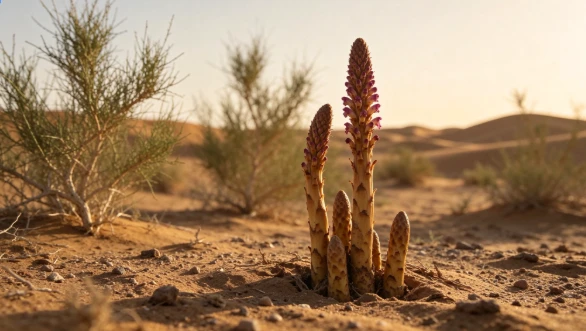
Few plants carry as many titles as Cistanche. In traditional Chinese medicine, it has been used for centuries as a gentle tonic for vitality, reproductive health, brain function, and digestion. In the harsh deserts where it grows, it survives by attaching itself to the roots of other shrubs - a parasitic lifestyle that has earned it the nickname "desert ginseng." And in modern laboratories, it has become the subject of some of the most detailed chemistry and pharmacology research in the herbal world.
But here is a question most people never think about: how do you know a batch of cistanche is actually good? How do you measure whether the expensive powder or extract you are buying contains the compounds that matter?
A recent comprehensive review by a leading Chinese research team set out to answer exactly that question. Published in the journal Chinese Traditional and Herbal Drugs in 2026, the review pulls together more than thirty years of research to explain what is inside cistanche, which compounds drive its effects, and - crucially - how scientists should measure its quality. This article translates that dense academic work into plain language.
A Herb with Two Thousand Years of History
Cistanche first appears in the Shen Nong Ben Cao Jing, one of the oldest texts in Chinese medicine, dating back roughly two thousand years. Its traditional uses center on a set of related benefits: nourishing the "kidney yang" (a concept linked to vitality, warmth, and reproductive function), enriching essence and blood, and moistening the intestines to ease constipation. Historical texts also describe it for soreness in the lower back and knees, weakness, infertility, and general fatigue.
What makes cistanche unusual is its character. Traditional writers noted that it is a gentle tonic - "warming but not harsh." This reputation for balanced, non-aggressive support is part of why it has remained popular for so long, and why it is now moving beyond herbal medicine into foods and health products.
Modern authorities recognize two main species as the official source of cistanche: Cistanche deserticola and Cistanche tubulosa. Both are parasitic plants in the broomrape family (Orobanchaceae), and both grow in the arid regions of northwestern China and neighboring countries. Recently, C. deserticola was officially added to China's list of items considered both food and medicine, while an application to use C. tubulosa extract as a new food ingredient was accepted for review in 2026. In short, cistanche is no longer just an herbal medicine - it is becoming a mainstream functional ingredient.
What Is Actually Inside Cistanche?
Cistanche is chemically rich. Decades of isolation and analysis have revealed that its fleshy stems contain several major families of natural compounds. Here is a tour of the main ones.
Phenylethanoid Glycosides: The Headline Act
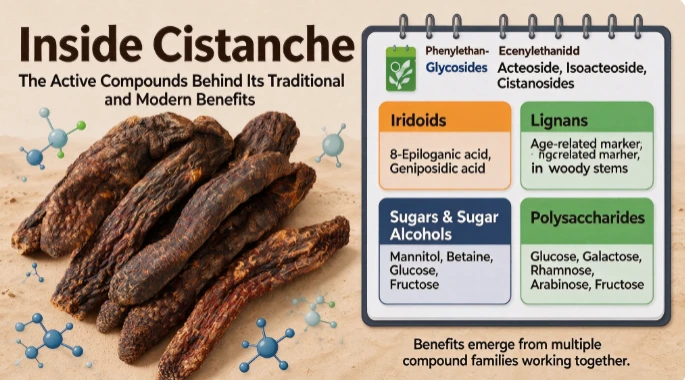
The single most important group - and the most studied - is the phenylethanoid glycosides. These are molecules built from a phenolic alcohol linked to a sugar, with the sugar often further decorated by acids like caffeic acid. More than 70 of these compounds have been identified in cistanche.
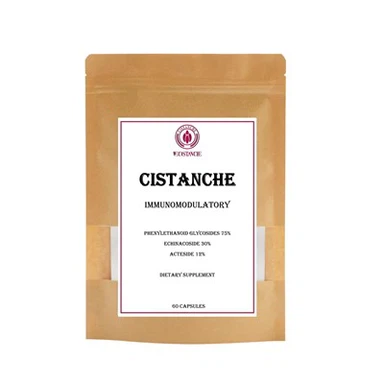
The two biggest names in this group are echinacoside and acteoside (also called verbascoside). They are the most abundant phenylethanoid glycosides in most cistanche species, and they are the compounds that the official Chinese Pharmacopoeia has used as quality-control markers since 2005. Other notable members include isoacteoside, 2'-acetylacteoside, cistanoside A and C through E, tubuloside A and B, and salidroside.
Why do these matter? Because they show the strongest and most consistent biological activity in laboratory and animal studies - antioxidant, neuroprotective, and more, as we will see shortly.
Iridoids: The Second Family
Iridoids are a class of compounds found in many medicinal plants. In cistanche, researchers have identified 26 iridoid-type compounds, mostly in glycoside form. Common examples include 8-epiloganic acid, 6-deoxycatalpol, geniposide, and geniposidic acid. These compounds are gaining attention, particularly for their potential role in brain and mood-related effects.
Lignans: A Clue to Plant Age
Lignans are a smaller component of cistanche, but they are scientifically interesting for a specific reason. In young, fleshy stems, lignan levels are low. As the stem becomes woody and fibrous with age, lignan content rises sharply. This makes lignans a useful signal - a natural "age marker" that can reveal whether the plant material has become overly woody, which is generally considered lower quality.
Sugars, Sugar Alcohols, and Small Molecules
Cistanche also contains a collection of simple, water-soluble compounds: glucose, fructose, sucrose, mannitol (a sugar alcohol), and betaine. These unglamorous molecules turn out to be very important. In C. deserticola, mannitol is one of the most abundant components. Betaine is also a major constituent. Both are closely linked to cistanche's traditional laxative effect and to its ability to withstand cold desert conditions. Interestingly, these water-soluble compounds are much more abundant in C. deserticola than in C. tubulosa - a distinction that matters for quality control, as we will see.
Polysaccharides
Cistanche is also rich in polysaccharides - long chains of sugar molecules - built from glucose, galactose, rhamnose, arabinose, and fructose. At least 13 distinct polysaccharides have been characterized. These large molecules are associated with immune-modulating, antioxidant, and anti-aging effects in laboratory studies.
Volatile Compounds
Finally, cistanche contains small amounts of volatile (aroma) compounds. The dominant one is eugenol, a fragrant phenolic compound also found in cloves. Other volatiles include fatty acids, esters, and alcohols. These contribute to the plant's scent profile but are not the focus of most quality research.
How the Active Compounds Actually Work
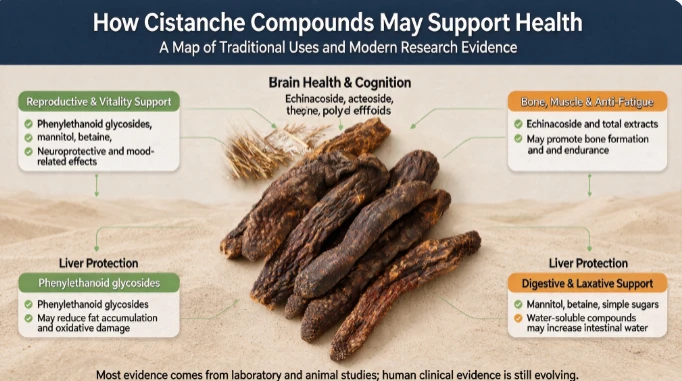
With the chemistry established, the bigger question is: what do these compounds do? Here is what the accumulated research shows. A note before we proceed - most of this evidence comes from laboratory experiments and animal studies, not large human clinical trials. The science is promising, but it is still evolving.
Reproductive and "Vitality" Support
In traditional medicine, cistanche is above all a reproductive tonic. Modern researchers have tested this idea directly. Using animal models that mimic "kidney yang deficiency" - a state characterized by reduced energy, sexual function, and cold sensitivity - they found that several cistanche components improve markers of reproductive function. The phenylethanoid glycosides showed the strongest effects, but mannitol, betaine, oligosaccharides, and polysaccharides also contributed.
The mechanism appears to involve the hypothalamic-pituitary-gonadal (HPG) axis, the hormonal control system that regulates reproduction. Cistanche seems to help normalize this axis and support testosterone production. One recent line of work even points to the gut microbiome as a mediator - certain cistanche glycosides may feed beneficial bacteria, which in turn produce compounds that protect reproductive cells. This is a fascinating example of the "gut–reproduction" connection, but it remains early-stage research.
Brain Health and Cognition
This is where cistanche research has gone furthest. Numerous studies suggest that cistanche extracts and specific compounds can improve learning and memory in animal models of cognitive decline, including models relevant to Alzheimer's disease, vascular dementia, and Parkinson's disease.
The team behind the review made a significant translation of this research into practice. In 2005, a cistanche total-glycoside capsule was approved in China for treating vascular dementia. In a clinical observation involving 124 Alzheimer's patients, the cistanche preparation showed effects comparable to donepezil (a standard Alzheimer's drug) but with noticeably fewer side effects. The single compound echinacoside was further developed as an investigational new drug, receiving clinical trial approval in 2017 and completing Phase I testing.
On the mechanism side, researchers have made notable progress. They identified a specific protein target that echinacoside binds to in order to protect brain cells after injury - a discovery that was named one of the "Top Ten Academic Advances in Traditional Chinese Medicine" for 2022.
Beyond dementia, studies also point to antidepressant-like effects. Cistanche phenylethanoid glycosides and certain iridoids appear to influence mood-related brain chemicals and stress-response systems in animal studies.
Bone and Muscle Support
Traditional texts describe cistanche as strengthening bones, tendons, and muscles - hence "strengthening the sinews and bones." Modern work supports this. In animal models of osteoporosis, cistanche extracts and echinacoside promoted bone formation and reduced bone loss, in part by activating signaling pathways involved in bone growth. Anti-fatigue studies also show that cistanche can extend swimming endurance and improve recovery in animal models.
Liver Protection
A substantial body of research - much of it from the same review team - indicates that cistanche, especially its phenylethanoid glycosides, has liver-protective properties. Studies in models of alcohol-induced liver injury show that cistanche total glycosides reduce fat accumulation, lower markers of liver damage, boost antioxidant enzymes, and help rebalance bile acids. Echinacoside and acteoside are considered the key players.
Digestive and Laxative Support
Cistanche's traditional use for constipation is well supported by research, but the responsible compounds are not what you might expect. The main players are the sugar alcohols - especially mannitol - along with betaine and simple sugars. These water-soluble compounds increase the osmotic pressure inside the intestine, which draws water in, softens the stool, and promotes bowel movement. The research team developed a cistanche total-sugar-alcohol preparation as a constipation treatment, which is now in Phase III clinical trials.
Immune, Antioxidant, and Anti-Aging Effects
Finally, cistanche polysaccharides and phenylethanoid glycosides show immune-modulating and antioxidant activity in laboratory and animal studies. They appear to boost certain immune cells, increase antioxidant enzyme activity, and reduce oxidative damage. This antioxidant capacity is one of the most consistent findings across the entire cistanche literature, and it helps explain why the plant is associated with anti-aging effects.
The Quality Problem: Why Two Markers Are Not Enough
Here is where the story gets interesting - and where it becomes directly relevant to anyone buying or selling cistanche.
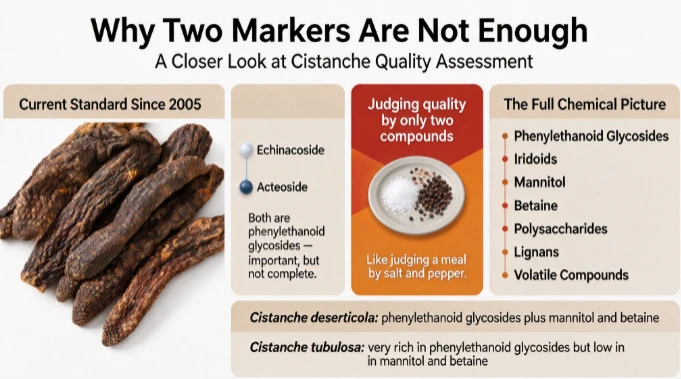
Since 2005, the official Chinese standard for cistanche quality has relied on measuring just two compounds: echinacoside and acteoside. There is a good reason for this choice. Both are abundant, easy to measure, and clearly active. If a batch contains a lot of them, it is probably decent cistanche.
But there is also a problem. Echinacoside and acteoside are both phenylethanoid glycosides - the same type of compound. Measuring two members of one family tells you little about the other families that matter: the iridoids, the sugar alcohols, betaine, and the polysaccharides. Yet these other compounds drive some of cistanche's most important traditional effects, particularly its laxative action.
Think of it this way: judging cistanche by echinacoside and acteoside alone is a bit like judging a meal by its salt and pepper. Important, yes. Complete? Far from it.
The issue becomes even clearer when you compare the two main species:
Cistanche deserticola is rich in phenylethanoid glycosides and contains substantial mannitol and betaine.
Cistanche tubulosa is even richer in phenylethanoid glycosides (especially echinacoside and acteoside) but contains little mannitol and essentially no betaine.
In other words, the two species have meaningfully different chemical profiles. A quality standard that only looks at two phenylethanoid glycosides cannot tell these apart properly, nor can it capture the full functional picture of either one.
On top of species differences, cistanche quality is also shaped by the host plant it grew on, its geographic origin, its age, the harvest season, and how it was processed. All of this makes quality control genuinely difficult - and genuinely important.
What Is a "Quality Marker," Anyway?
To solve this problem, researchers in China have been developing a concept called the Q-Marker (short for "quality marker"). It is a formal framework for choosing the best possible set of chemical compounds to evaluate an herbal medicine's quality.
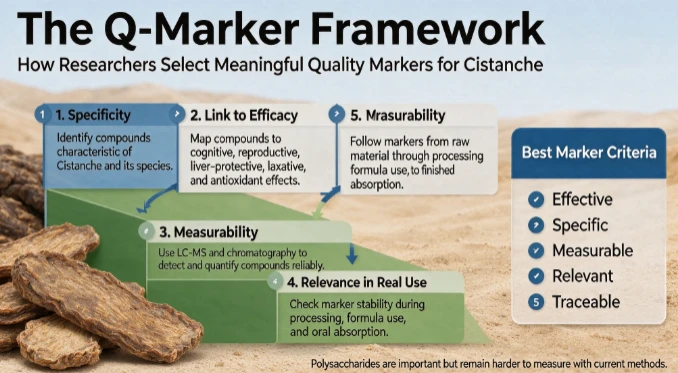
The idea, proposed by prominent Chinese scientists, is that a good quality marker should satisfy several conditions at once. It should:
Be effective - genuinely connected to the plant's therapeutic action.
Be specific - characteristic of this plant, ideally not found in look-alike species.
Be measurable - reliably detectable with available laboratory instruments.
Be relevant in real use - including in herbal formulas and after processing.
Be traceable - present through processing and able to be absorbed into the body.
By applying these criteria systematically, researchers can move beyond "whatever is easiest to measure" toward "whatever actually reflects quality and effect."
How the Researchers Chose Cistanche's Quality Markers
The review's central contribution is a rigorous, step-by-step application of the Q-Marker framework to cistanche. Here is how they reasoned through it.
Step 1: Specificity
The first question is: what is chemically unique about cistanche?
Cistanche belongs to the broomrape family, and its signature compounds are phenylethanoid glycosides. In particular, echinacoside is abundant in cistanche but nearly absent in related plants of the same family, making it a strong identity marker. Among cistanche species, C. tubulosa has the highest phenylethanoid glycoside content, while the less common C. salsa contains almost no echinacoside. This chemical fingerprinting lets scientists distinguish cistanche from its botanical relatives and from adulterants.
Step 2: Link to Efficacy
Next, the researchers matched each compound family to the specific benefits it supports. The picture that emerged is clear:
Phenylethanoid glycosides (echinacoside, acteoside, and others) drive the cognitive, neuroprotective, reproductive, and liver-protective effects.
Iridoids (especially 8-epiloganic acid and geniposidic acid) contribute to mood-related and neuroprotective effects.
Mannitol, betaine, and simple sugars drive the laxative action and support cold tolerance.
Polysaccharides contribute to immune, antioxidant, and anti-aging effects.
This mapping is the core of the review: it shows that cistanche's benefits come from multiple compound families working together, which is exactly why a two-compound standard is inadequate.
Step 3: Measurability
A quality marker is useless if you cannot reliably measure it. Here, the research team has done remarkable work. Using advanced liquid chromatography–mass spectrometry, they identified 513 compounds in cistanche in a single comprehensive analysis, covering phenylethanoid glycosides, iridoids, lignans, sugars, and betaine.
Polysaccharides, despite their importance, were left out of the proposed marker set - not because they are unimportant, but because current measurement methods are not specific or accurate enough. That is an honest limitation, and the authors note that improved methods may change this in the future.
Step 4: Relevance in Real-World Use
Cistanche is rarely used alone; it is usually part of a formula, and it is often processed (for example, soaked in wine) before use. The researchers therefore checked whether their candidate markers survive these real-world steps.
They found that wine-processing changes the chemistry - some phenylethanoid glycosides undergo breakdown and rearrangement, while betaine actually increases. They also found that echinacoside, acteoside, cistanoside A, 8-epiloganic acid, and geniposidic acid can be absorbed into the bloodstream in their original forms after oral administration - a crucial requirement for a marker that is meant to track what actually reaches the body.
Step 5: Traceability
Finally, the team considered whether these compounds could be traced from raw material through processing to the finished product and into the body. Echinacoside and acteoside passed every test. So did 8-epiloganic acid (an iridoid), betaine, and mannitol.
The Proposed Quality Fingerprint
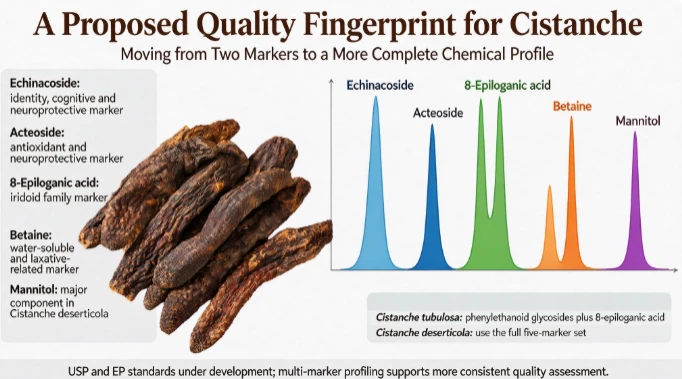
Putting it all together, the review proposes a core set of five quality markers for cistanche:
Echinacoside - phenylethanoid glycoside; cognitive, neuroprotective, and reproductive effects.
Acteoside (verbascoside) - phenylethanoid glycoside; antioxidant and neuroprotective effects.
8-Epiloganic acid - iridoid; represents the iridoid family's contribution.
Betaine - water-soluble small molecule; laxative and metabolic support.
Mannitol - sugar alcohol; laxative action and a major component of C. deserticola.
There is an important nuance, though. Because C. tubulosa contains little mannitol and no betaine, the marker set for C. tubulosa should focus on the phenylethanoid glycosides (echinacoside and acteoside) plus 8-epiloganic acid, while C. deserticola should be evaluated using the full five-marker set. This species-specific approach is a significant step toward accurate, meaningful quality control.
Building a Global Standard
This is not just academic theory. The research team has spent more than thirty years studying cistanche and has directly shaped how it is regulated.
They drafted and revised the cistanche quality standards in the Chinese Pharmacopoeia (2005 and 2010 editions). They developed fingerprinting methods that can distinguish C. deserticola, C. tubulosa, and C. salsa from each other. They created cost-efficient methods to measure multiple phenylethanoid glycosides and the water-soluble components (betaine, mannitol, fructose, glucose, sucrose) at once.
Most notably, the team is now tasked with drafting cistanche standards for the United States Pharmacopeia (USP) and the European Pharmacopoeia (EP) - the two reference standards that define drug and ingredient quality across much of the world. This is a strong signal that cistanche is moving toward internationally recognized quality standards.
The broader body of this work was recognized with a National Science and Technology Progress Award (Second Prize) in 2025, underscoring its significance.
Why This Matters If You Are Buying or Selling Cistanche
For consumers, this research offers a practical lesson: not all cistanche is equal, and the label may not tell you the whole story. A product standardized only on echinacoside and acteoside may be missing the compounds responsible for other traditional benefits - or it may be the wrong species entirely.
For the cistanche industry, the message is equally clear. As the market grows and quality expectations rise, the move toward richer, multi-marker quality standards is inevitable. Suppliers who can demonstrate a complete chemical profile - not just one or two headline numbers - will be better positioned in an increasingly regulated global market.
And for anyone interested in C. tubulosa specifically, this research highlights a genuine selling point: it is the species richest in phenylethanoid glycosides, the compounds with the strongest and best-documented activity. Understanding and communicating this distinction accurately is valuable.
An Honest Look at What We Still Don't Know
Good reviews end by admitting what remains unsolved, and this one is no exception. The authors identify three major gaps:
Iridoids are under-studied. Although iridoids are a major chemical class in cistanche, their connection to specific health effects is still unclear. More research is needed to define their role.
Polysaccharides remain a black box. They clearly have immune, antioxidant, and anti-aging activity, but their mechanisms are not fully understood, and they cannot yet be measured well enough to serve as quality markers.
Processing and formula effects are complex. How cistanche changes when combined with other herbs, or when processed in different ways, is only partially mapped. This matters because cistanche is almost always used in formulas.
The path forward, the authors suggest, involves modern "omics" technologies - metabolomics and multi-omics - to build a complete picture of how cistanche's many compounds work together on multiple targets at once. The goal is to move from measuring a few isolated chemicals to understanding the full "substance–target–effect" network.
Frequently Asked Questions
What are the most important compounds in cistanche? The best-known and most active are the phenylethanoid glycosides, especially echinacoside and acteoside (verbascoside). But mannitol, betaine, iridoids, and polysaccharides also play important roles.
Why do quality standards measure echinacoside and acteoside? Because they are abundant, easy to measure, and clearly linked to cistanche's benefits. However, relying only on these two compounds misses other important components.
What is the difference between Cistanche deserticola and Cistanche tubulosa? Both are official cistanche species. C. tubulosa is richer in phenylethanoid glycosides but contains little mannitol and no betaine. C. deserticola has a broader profile, including significant mannitol and betaine.
What is a quality marker (Q-Marker)? It is a scientifically chosen chemical compound used to evaluate the quality of an herbal medicine. Good quality markers are effective, specific, measurable, relevant in real use, and traceable.
Does cistanche cure dementia or improve memory in humans? Laboratory and animal studies are promising, and a cistanche preparation has shown effects comparable to a standard Alzheimer's drug in a limited clinical observation. However, this is not yet a proven treatment, and anyone with cognitive concerns should consult a doctor.
Is cistanche safe? Cistanche has a long history of use and is recognized as both food and medicine in China. However, as with any supplement, quality varies, and people with medical conditions or those taking medication should consult a healthcare professional.
The Bottom Line
Cistanche is a remarkable plant with a rich chemistry and a growing body of research behind it. Its benefits are not the work of a single "magic" compound - they emerge from a team of chemical families: phenylethanoid glycosides, iridoids, sugar alcohols, betaine, and polysaccharides, each contributing something different.
The review we have explored here does something genuinely valuable: it replaces a simplistic, two-compound view of cistanche quality with a thoughtful, evidence-based framework. By proposing a five-marker quality fingerprint - echinacoside, acteoside, 8-epiloganic acid, betaine, and mannitol - and by tailoring it to each species, the researchers have given both industry and consumers a much clearer way to know whether the cistanche in front of them is the real thing, and the good thing.
As cistanche steps onto the global stage - with official standards being drafted for both the U.S. and European pharmacopeias - this kind of rigor will matter more than ever. The plant that once grew quietly in the desert is now being measured with modern precision, and that is good news for everyone who uses it.