Cistanche Tubulosa And The Biology Of Healthy Ageing: What A 30-Day Mouse Study Actually Showed
Nov 05, 2026
Every few years, a plant that has been quietly used for centuries suddenly shows up in Western supplement catalogues. Cistanche tubulosa is one of those plants. It grows in some of the driest places on earth, spends most of its life underground, and has a chemical profile that has attracted the attention of pharmacologists, formulators and, increasingly, consumers who are trying to slow down the visible and invisible signs of ageing.
The problem is that most of what circulates online about this herb is either vague marketing language or a literal translation of a Chinese research paper that nobody outside a laboratory can follow. Both are unhelpful. One makes claims that cannot be checked. The other buries genuinely interesting data under a wall of statistics.
This article takes a different approach. It works through a specific, published animal experiment on Cistanche tubulosa extract, explains what the researchers did and what they found, and then separates the parts that are solid from the parts that are still open questions. If you are a formulator, a buyer, a clinician with a curious patient, or simply someone trying to understand why this plant keeps appearing in longevity discussions, the goal here is to leave you with an accurate picture rather than a promotional one.
A Plant That Lives by Stealing Water From a Tree
Cistanche tubulosa is a root parasite. It has no meaningful photosynthetic capacity of its own, no green leaves in the ordinary sense, and no independent water supply. Instead, it attaches to the roots of Tamarix shrubs, the salt-tolerant trees that line dried riverbeds across Central Asia, and draws water, minerals and organic carbon directly from its host's vascular system.
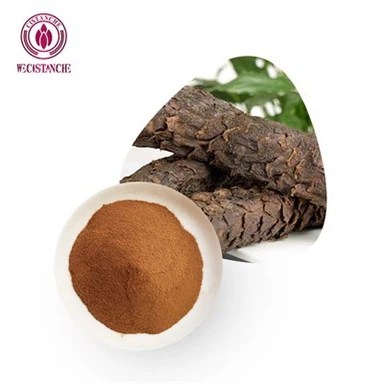
The visible part of the plant is strange looking in a way that has made it easy to romanticise. After the shoot pushes through the sand, it forms a thick, fleshy spike covered in overlapping scale-like leaves, initially pale cream and then flushing purple as the flowers open. Harvested and dried, the whole structure turns a deep brown and takes on a shape that resembles a wrinkled spindle. In Chinese materia medica it has been traded under the name rou cong rong for well over a thousand years, and it carries the nickname "desert ginseng", a comparison that says more about its reputation than its chemistry.
Its range tells you something about its toughness. Wild populations are scattered across the arid belt running from the Sahara and the Negev through Iran and Afghanistan into the Taklamakan margins, Gansu, Inner Mongolia and Xinjiang. The plant prefers sandy, saline ground where almost nothing else will grow, and it emerges only for a short window each spring.
That popularity created a conservation problem. Demand from the traditional medicine trade, combined with a market that paid by weight, led to overharvesting across most of its range. Wild Cistanche tubulosa is now a protected species in China, and the material used in food and supplement manufacturing comes increasingly from cultivated plantings, where host shrubs are managed deliberately and the parasite is harvested on a rotation. This matters for buyers: the shift from wild collection to cultivation changed the supply chain, the price structure, and arguably the consistency of the raw material, because cultivated material can be selected and processed to a defined specification rather than whatever happened to be dug up.
It also sits in an unusual regulatory position. Cistanche species appear on China's list of substances that can be used both as food and as medicine, a category that requires a formal safety evaluation before inclusion. That classification is not proof of efficacy, but it does tell you that the dried material has a long history of oral consumption and a documented safety review behind it, which is more than can be said for many botanicals currently sold in the West.

The Chemistry That Researchers Actually Care About
If you cut through the folklore, most of the modern interest in Cistanche tubulosa comes down to one family of molecules: the phenylethanoid glycosides, usually abbreviated as PhGs.
These are sugar-bearing phenolic compounds, and two of them dominate the profile. Echinacoside is the larger fraction in most commercial extracts. Acteoside, also known as verbascoside, is present in much smaller amounts but is frequently treated as equally important because of its own biological activity. A third compound, isoacteoside, usually appears alongside them, and the broader class also includes echinacoside derivatives and smaller phenolics.
There is a useful technical detail buried in the study this article is built around. The researchers did not simply assume their extract contained what the label claimed. They measured it. Using high-performance liquid chromatography with a C18 column, a methanol-water mobile phase and UV detection at 334 nanometres, they quantified the two key compounds against certified reference standards and reported the results per gram of extract: echinacoside at 236 milligrams per gram, acteoside at 12.7 milligrams per gram, with standard deviations small enough to suggest a well-controlled extraction and a stable starting material.
That is worth pausing on, because it is the single most common failure point in the botanical supplement industry. "Cistanche extract" on a label can mean almost anything. It can mean a crude water decoction with a PhG content in the low single digits. It can mean a product bulked with maltodextrin. It can mean an extract standardised to a number that was never independently verified. A specification of roughly 24 percent echinacoside and just over 1 percent acteoside, confirmed by HPLC with reference standards, is a concrete and checkable claim, and it is the kind of claim a serious buyer should be asking for before discussing price.
Beyond the PhGs, the plant contains polysaccharides, which have been the subject of a parallel body of research into immune modulation and learning and memory; mannitol and other sugar alcohols; betaine and related osmolytes, which help the plant survive salt stress and which have their own modest literature in human nutrition; and various iridoids and lignans in trace amounts. The polysaccharide fraction is interesting but it is a different story, and mixing the two stories together is one of the ways supplement marketing becomes incoherent.
For the experiment discussed here, the researchers were deliberate about which story they were telling. They chose an extract built around the PhG fraction specifically, precisely because the polysaccharide side of Cistanche had already received a lot of attention while the phenylethanoid side had been comparatively under-studied in the context of ageing.
What Ageing Actually Looks Like at the Molecular Level
Before walking through the experiment, it helps to be clear about what the researchers were measuring, because the words involved get used loosely in consumer content.
Living cells generate energy by moving electrons around. A side effect of that chemistry is reactive oxygen species, a family of molecules with unpaired electrons that will happily strip electrons from whatever is nearby, including the lipids in a cell membrane, the proteins that do the cell's work, and the DNA that stores its instructions. This is ordinary. It happens constantly, in every tissue, in every person, from before birth.
What keeps it from being fatal is an antioxidant defence system. Superoxide dismutase, universally shortened to SOD, takes one of the most common reactive species and converts it into hydrogen peroxide. Glutathione peroxidase, GSH-Px, then uses glutathione to reduce that hydrogen peroxide into water. Catalase does something similar by a different route. These enzymes are not supplements you swallow; they are proteins your cells manufacture, and their activity level is a reasonable proxy for how well a tissue is coping with oxidative load.
When the balance tips, lipids in cell membranes start to oxidise in a chain reaction. One of the end products of that chain is malondialdehyde, MDA. MDA is chemically reactive itself, it forms adducts with proteins and DNA, and it is widely used in research as a marker of how much lipid peroxidation has occurred. High MDA is a signal that the antioxidant defences are losing.
This framework connects to the modern biology of ageing in an obvious way. Several of the recognised hallmarks of ageing involve damage accumulation: cellular senescence, mitochondrial dysfunction, loss of proteostasis, and the chronic low-grade inflammation that geroscientists call inflammageing. Oxidative damage feeds into all of them. It is not the whole story of ageing, and the field has moved well past the simple free radical theory that dominated in the 1990s, but it remains a real and measurable part of the story, and it is the part that plant phenolics are best placed to influence.
That is the reason a study like this is worth reading. It does not claim to reverse ageing. It asks a narrower, answerable question: in an animal whose oxidative defences have been deliberately compromised, does a defined plant extract change the measurable markers in the direction you would want?
How Researchers Manufacture an Ageing Mouse
The model used here is called the D-galactose-induced ageing model, and it deserves an honest explanation because it is both useful and imperfect.
D-galactose is an ordinary sugar. At high doses, given over weeks, it overwhelms the enzymes that normally clear it. The surplus is converted through a pathway that generates reactive oxygen species as a by-product, and it also contributes to advanced glycation end products, the same class of compounds that accumulate in diabetic tissue and in normally aged skin and blood vessels. The result, in rodents, is a syndrome that resembles accelerated ageing: reduced antioxidant enzyme activity, elevated lipid peroxidation, slower weight gain, impaired learning and memory, altered organ structure, and a shortened lifespan.
The model has been used for decades and it is well characterised, which is why it remains popular. It is also limited, and the limitations matter for interpretation. It produces a chemically induced approximation of ageing, not ageing itself. A 30-day D-galactose challenge compresses years of human biology into a month, but it compresses only some of the mechanisms. Results from this model tell you something about antioxidant capacity and oxidative tissue damage. They tell you much less about, say, epigenetic drift or clonal haematopoiesis, and they say nothing at all about whether a human taking the same extract for a decade would experience any benefit.
None of that invalidates the experiment. It just tells you which question it can answer. Screening for antioxidant and tissue-protective activity in a validated model is a legitimate and necessary first step. The mistake would be treating that first step as the last one.

The Study Design, Translated Into Plain Terms
The published experiment, from a research group at Xinjiang Agricultural University working with a pharmaceutical biotechnology company in Hotan, used seventy-eight male Kunming mice, five weeks old, weighing 23 to 26 grams. Kunming mice are a widely used outbred strain in Chinese pharmacology, chosen for hardiness and cost rather than genetic uniformity.
The animals were randomised into six groups of thirteen. One group received no intervention and served as the healthy reference. A second group received D-galactose but no treatment, establishing what untreated accelerated ageing looks like. A third group received D-galactose plus vitamin C at 170 milligrams per kilogram of body weight, acting as a positive control, a benchmark to confirm that the model responds to a known antioxidant. The remaining three groups received D-galactose plus the Cistanche extract at three dose levels.
Those dose levels need a small translation, because the original paper reports them per ten grams of body weight, which obscures the comparison for most readers. Converting: the low dose of 1 milligram per 10 grams equals 100 milligrams per kilogram; the middle dose equals 200 milligrams per kilogram; the high dose equals 400 milligrams per kilogram. Vitamin C at 1.70 milligrams per 10 grams equals 170 milligrams per kilogram. All dosing was by oral gavage, once daily, for thirty days.
The outcome measures were chosen to cover three different levels of resolution. First, body weight over the full thirty days, which captures the overall trajectory of the animal's condition. Second, organ indices, calculated as organ weight in milligrams divided by body weight in grams, for the liver and the brain. This ratio is a crude but informative measure: a shrinking organ relative to body mass is one of the classic signs of involution with age, and a brain index that falls sharply is associated with loss of neural tissue and function.
Third, and most important, the antioxidant markers. SOD activity, GSH-Px activity and MDA content were measured in three compartments: liver homogenate, brain homogenate and serum. Measuring all three is a meaningful design choice, because it distinguishes a systemic effect from a local one. A change in serum alone might reflect absorption and circulation. A change in liver and brain tissue suggests the compound or its metabolites are reaching those organs and influencing local redox biology.
Finally, the researchers fixed liver and brain tissue, sectioned it, and stained it with haematoxylin and eosin, the standard histological pairing that renders nuclei blue-purple and cytoplasm pink. This lets a trained observer see cell arrangement, membrane integrity, vacuolation, necrosis and inflammatory infiltration. Numbers tell you about biochemistry; a stained section tells you whether the tissue architecture held up.
What the Thirty Days Showed
The results were reported with standard statistical testing, one-way analysis of variance with group comparisons, and the pattern is consistent enough to be worth describing in sequence.
Body weight first. All groups gained weight across the thirty days, which is normal for five-week-old mice. But from around day twelve onward, every treated group sat above the untreated ageing group, and that gap persisted to day thirty. In the middle of the study, the low-dose animals tracked close to the untreated group, while the middle-dose animals came closest to the healthy reference. The practical reading is simple: D-galactose blunted growth, and the extract partly restored it. Weight gain in a growing mouse is a coarse indicator, but it is a real one, and it is the kind of finding that supports everything that follows.
Organ indices came next, and here the numbers are striking. In the untreated ageing group, the liver index fell to 24.74 milligrams per gram and the brain index to 7.82, against 34.50 and 15.66 in the healthy reference. That is not a subtle difference. It reflects genuine involution of both organs under oxidative challenge.
The middle-dose group recovered to a liver index of 40.15 and a brain index of 18.06. Expressed as multiples of the untreated group, that is 1.62 times for the liver and 2.31 times for the brain, and both values actually exceed the healthy reference, which is unusual and worth noting rather than glossing over. A treated animal exceeding an untreated healthy control on an organ-weight ratio is not necessarily a good sign in absolute terms; it can reflect hypercellularity, oedema, or altered body composition. The authors interpret it as restoration, which is reasonable in context, but the honest reading is that the ratio moved back toward normal and slightly past it, and that the direction of the change is the meaningful finding.
The antioxidant enzymes behaved in a dose-dependent but non-monotonic way, and this is where the data gets genuinely interesting.
For GSH-Px, the untreated ageing group showed 5.95 in liver, 23.45 in brain and 48.56 in serum, against 7.35, 29.34 and 63.13 in the healthy reference. Every extract dose raised liver GSH-Px significantly, with the low dose producing the largest relative gain in liver, 1.37 times the untreated group. Brain GSH-Px responded best at the middle dose, 1.18 times. Serum GSH-Px responded best at the high dose, 1.46 times. Vitamin C, for comparison, reached 8.46 in liver, 26.58 in brain and 59.03 in serum, so the extract matched or exceeded the positive control in several compartments.
For SOD, baseline was 2.82 in liver, 22.56 in brain and 85.21 in serum, dropping to 2.49, 14.54 and 49.62 in the untreated ageing group. The middle dose lifted liver SOD to 2.77, a 1.11-fold gain. The high dose lifted brain SOD to 16.59, a 1.14-fold gain. And the middle dose produced a large serum increase, to 86.38, which is 1.74 times the untreated group and marginally above the healthy reference. Here again the response was not uniform across doses: the low dose did little for liver SOD, the middle dose did little for brain SOD, and the high dose did little for serum SOD. Each compartment had its own best dose.
For MDA, the picture is the cleanest. Baseline was 0.71 in liver, 4.22 in brain and 9.65 in serum, rising to 0.88, 5.83 and 11.26 under D-galactose. All three extract doses lowered liver MDA significantly, all three lowered serum MDA significantly, and the brain responded at every dose with the strongest effect at the high dose, which fell to 3.40, a reduction of 41.68 percent against the untreated group. The middle dose cut liver MDA by 23.86 percent, to 0.67, which is below the healthy reference of 0.71. The middle dose cut serum MDA by 38.30 percent, to 7.17, again below the healthy baseline. Vitamin C reduced the same markers by smaller margins in liver and brain, and by a comparable margin in serum.
The consistency across three compartments and three markers is what gives this study weight. A single significant result can be an artefact of sample size or variance. A pattern in which every dose lowers MDA in every tissue, and every dose raises at least one antioxidant enzyme in at least one tissue, is much harder to dismiss.
The histology added a fourth layer. In the healthy reference, liver cells were regularly arranged with intact membranes and open sinusoids. In the untreated ageing group, the architecture broke down: irregular cell arrangement, patches of necrosis, fibrous tissue proliferation, cellular oedema, destroyed membranes, collapsed sinusoids. Brain sections told a parallel story, with necrotic neurons, condensed nuclei, blurred synaptic structure, and oedematous granule cells.
The middle-dose liver sections looked closest to normal, with only mild sinusoidal dilation and hyperaemia and preserved cell membrane morphology. The low and high dose sections showed improvement but with residual features: dilated central veins, hepatocyte nuclei of uneven size, occasional necrosis at the high dose. In brain, the middle dose produced visibly more neurons, clear synaptic structure and non-condensed nuclei, outperforming both the low and high doses and the vitamin C control.
That bears repeating, because it is the study's most practically useful and least intuitive result: on the tissue-level endpoints, the middle dose was the best, not the highest dose.

The Dose-Response Puzzle Nobody Has Fully Solved
Cistanche extract at 200 milligrams per kilogram outperforming 400 milligrams per kilogram on brain histology, brain GSH-Px and serum SOD is the kind of finding that makes formulation teams sit up.
There are several plausible explanations, and none of them is proven.
The first is hormesis. Many plant polyphenols and phenolics trigger adaptive stress responses: a modest dose activates protective signalling, while a larger dose saturates or even suppresses the same pathway. This is well documented for other polyphenol classes and would explain a bell-shaped response curve.
The second is absorption saturation. PhGs are large, polar glycosides. Their intestinal permeability is limited, and they are partly hydrolysed by gut microbiota before absorption. At higher oral doses, the fraction actually reaching the bloodstream does not scale linearly, and the fraction reaching the brain is smaller still, because of the blood-brain barrier. Doubling the dose does not double the exposure.
The third is metabolic competition. At high concentrations, the same transporters and conjugation enzymes that handle echinacoside and acteoside are handling everything else in the extract, and the result can be a lower effective flux of the active species into tissue.
The fourth is simply statistical noise in a study with thirteen animals per group.
A good formulation decision does not require resolving this. It requires recognising that more is not automatically better, that the effective window for this extract in this model sat in the middle of the tested range, and that dose-finding studies in humans have not been done. Anyone who tells you the correct human dose with confidence is extrapolating.
What Might Be Doing the Work Inside the Cell
The paper's own interpretation is straightforward: because the extract was characterised as PhG-rich, and because earlier work on echinacoside and acteoside has shown antioxidant, anti-inflammatory and anti-apoptotic activity, the observed effects are plausibly attributable to those two compounds.
The supporting literature is real, and worth summarising fairly.
Echinacoside has been reported to extend lifespan in Caenorhabditis elegans, the nematode that serves as a workhorse model in ageing research, and to protect against amyloid-beta toxicity in that organism. Those are whole-organism longevity experiments, which is a stronger class of evidence than a single-tissue assay, though in a very distant relative of humans.
Acteoside has been studied in D-galactose-aged mice with respect to telomerase activity and immune function, with reported reductions in MDA across heart, liver and brain and increases in lymphocyte proliferation and macrophage phagocytosis. A separate study examined acteoside in a combined D-galactose and aluminium chloride model and reported improvements in cognitive measures.
There is also work on echinacoside and PPAR-gamma-dependent antioxidant and anti-inflammatory signalling in a cognitive dysfunction model, and a body of literature on PhG-rich Cistanche fractions showing anti-fatigue effects in rodents.
Mechanistically, the pathways most often implicated are the Nrf2-Keap1 axis, which is the master transcriptional switch for a whole battery of antioxidant enzymes including SOD and glutathione-related enzymes; inhibition of NF-kappa-B signalling, which dampens inflammatory cytokine production; and mitochondrial protection, which reduces the upstream generation of reactive species in the first place. If you want a single coherent story, it is this: the compounds appear to nudge the cell's own defence network into a higher state of readiness rather than directly neutralising radicals one molecule at a time. That is a more durable effect than scavenging, and it is also why effects show up in tissue enzyme activity rather than only in serum.
None of this is settled. Mechanistic work in nematodes, cultured cells and rodent models does not automatically translate to human physiology, and the specific contribution of echinacoside versus acteoside versus the minor constituents in a whole extract has not been separated experimentally.
What This Study Does Not Prove
This section matters more than any other, because the gap between what a mouse study shows and what a supplement label implies is where most consumer confusion lives.
It is an animal study. Seventy-eight mice, one strain, one sex, one age, one laboratory, one batch of extract.
It uses a chemically induced model. D-galactose accelerates a subset of ageing mechanisms. It is not ageing. An extract that protects against galactose-induced oxidative stress may or may not do anything for the oxidative stress of ordinary human life, which accumulates over decades at a much lower intensity and interacts with everything else: sleep, diet, pollution, infection, metabolic health, genetics.
The duration was thirty days. That is enough to change enzyme activity and tissue morphology. It is not enough to say anything about lifespan, frailty, cognitive decline or any clinically meaningful endpoint.
There were no human participants. No pharmacokinetic data, no bioavailability measurement, no dose-ranging in people, no safety monitoring beyond the historical record of oral consumption of the plant.
The sample size per group was modest. The study reports ten animals per group in the results tables, which is standard for this kind of work but limits the statistical power for detecting small effects and increases the chance that a single unusual responder skews a mean.
The dose translation to humans is approximate at best. Using the conventional body-surface-area conversion, a mouse dose of 200 milligrams per kilogram corresponds to a human equivalent dose of roughly 16 milligrams per kilogram, or about 970 milligrams per day for a 60-kilogram adult. That arithmetic is a regulatory convention for starting points, not a prescription, and it assumes the extract is absorbed the same way in both species, which for large polar glycosides is unlikely.
And crucially, the product tested was a characterised extract at a specific specification, not a generic "Cistanche powder". A product with a different PhG content, a different extraction solvent, or a different plant part cannot borrow these results.
Stated plainly: this study supports the hypothesis that a PhG-rich Cistanche tubulosa extract can improve antioxidant capacity and reduce oxidative tissue damage in an animal under oxidative challenge. It does not establish that it slows ageing in humans, and no honest article should imply that it does.
What This Means If You Are Buying or Formulating
For anyone on the commercial side, the practical value of a paper like this is not the headline. It is the specification.
Standardisation is the whole game. The measurable markers that matter are echinacoside and acteoside content, verified by HPLC against reference standards, expressed per gram of extract. A supplier who can provide a certificate of analysis with those figures, a chromatogram, a batch number and a retention-time match is operating at a different level from one who provides a COA with a single "total glycosides" number and no method.
Ask for the method, not just the number. HPLC with UV detection at 330 to 334 nanometres on a C18 column is the standard approach, and the figures should be reproducible across batches within a stated tolerance. If two batches of the same product differ by thirty percent on echinacoside content, the product is not standardised, it is merely tested.
Ask about the plant part and the species. Cistanche tubulosa and Cistanche deserticola are related but distinct, and the literature does not treat them as interchangeable. The English title of the study discussed here actually uses "Cistanche deserticola" while the Chinese text and the plant description are unambiguously Cistanche tubulosa, a translation inconsistency that has propagated into secondary citations online. If a supplier's documentation mixes the two names, that is a signal to look closer, not necessarily a disqualifier, but a signal.
Ask about extraction. PhGs are water-soluble and alcohol-soluble glycosides, typically recovered with aqueous ethanol or water under controlled temperature. Aggressive solvent conditions can hydrolyse the sugar moieties and convert acteoside toward less active aglycones, which is one reason two extracts with identical stated purity can behave differently in an assay.
Think in terms of the effective window, not the maximum dose. The middle-dose superiority in this study is a reminder that formulation decisions should be driven by exposure and response data where available, and by conservative dose selection where it is not.
Consider the delivery format. If the target is systemic antioxidant support, including neural tissue, then bioavailability is the limiting factor, not the label claim. Large glycosides absorb poorly. This is why some manufacturers explore hydrolysis, fermentation, liposomal encapsulation or combination with absorption enhancers, and why the marketing claim "high purity" and the functional claim "well absorbed" are not the same claim.
Finally, keep the claims proportionate. In most jurisdictions, including the United States and the European Union, a product may describe structure-function effects within defined limits but may not claim to prevent, treat or cure disease. Saying that a study found reduced oxidative markers in aged mice is defensible. Saying the product reverses ageing, prevents Alzheimer's disease or extends lifespan is not, and it is the kind of claim that regulators and competitors both look for.

Questions Buyers and Readers Ask Most
Is Cistanche tubulosa the same as Cistanche deserticola? They are separate species in the same genus. Cistanche deserticola is the species historically most used in classical Chinese formulas; Cistanche tubulosa is the one more commonly cultivated and used in modern extract manufacturing. Their chemical profiles overlap, both being PhG-rich, but the ratios differ and the research literature is not fully interchangeable.
What does "standardised to 24 percent echinacoside" mean? It means that in a verified batch, the echinacoside content is approximately 236 milligrams per gram of extract, measured by HPLC against a certified reference standard. It is a statement about one compound's concentration, not about the extract's overall quality, which also depends on acteoside content, solvent residues, heavy metals, microbial load and extraction method.
Can a mouse study like this be used in marketing? The findings can be described accurately and with attribution. What cannot be done is presenting animal data as if it were human evidence, or implying a clinical outcome that was never measured. Cite the study, state the model, state the endpoints, and let the reader draw a proportionate conclusion.
How long would a human need to take it to see anything? Nobody knows. There is no published human trial with these endpoints. The thirty-day mouse protocol has no direct human equivalent, and markers like SOD and MDA in tissue are not routinely measured in healthy people.
Is it safe? The plant has a long history of oral consumption and appears on China's food-medicine list following safety evaluation, which is meaningful but not equivalent to a modern clinical safety programme. Standard cautions for any concentrated botanical apply: quality-assured sourcing, attention to solvent residues, and medical advice for anyone pregnant, nursing, taking medication or managing a condition.
Why did the middle dose work best? Most likely a combination of hormetic dose-response, saturable absorption of large glycosides, and limited statistical power. It is a real observation, not an anomaly to be explained away, and it argues for dose-finding rather than dose-maximising.
Where the Science Goes Next
The obvious next steps are the ones this study did not take. A pharmacokinetic study in animals or humans establishing what actually reaches plasma after oral dosing, and in what form, would do more for formulation than another rodent efficacy trial. A dose-ranging human study using validated oxidative stress markers, with a properly characterised extract and a placebo arm, would be more valuable still, though oxidative markers are notoriously noisy in healthy populations, which is why many trials in this space use functional or inflammatory endpoints instead.
Comparative work separating echinacoside from acteoside from the whole extract would clarify which compound carries which effect, and whether the minor constituents contribute synergistically or redundantly. Work on the gut microbiome is particularly relevant here, because PhGs are metabolised by colonic bacteria into smaller phenolic acids that may be the actual systemically active species, which would substantially change how one thinks about dosing and delivery.
And the field needs replication. A single study from a single group, however carefully executed, is a hypothesis with data behind it, not a settled fact. Independent replication in a different laboratory, with a different extract source, would move this from interesting to reliable.
In the meantime, the honest summary is short. Cistanche tubulosa contains a well-characterised family of phenylethanoid glycosides, led by echinacoside and acteoside. In a validated rodent model of accelerated ageing, a PhG-rich extract at 100 to 400 milligrams per kilogram for thirty days increased antioxidant enzyme activity in liver, brain and serum, reduced lipid peroxidation products in the same three compartments, limited weight loss, restored organ indices toward normal, and preserved tissue architecture, with the middle dose performing best on several endpoints. That is a coherent, reproducible-looking result set, and it is a reasonable basis for continued research and for cautious product development.
It is not proof that the plant slows ageing in people. It is a well-built piece of evidence pointing in a direction, and the difference between those two statements is the difference between science and sales copy.
Reference
Bai D, Bao X, Zeng L, Liu X, Li Y, Sun J, Jin W, Jiang J. Effects of Cistanche tubulosa extract on D-galactose-induced ageing model mice. Science and Technology of Food Industry, 2022; 43(20): 380-386. DOI: 10.13386/j.issn1002-0306.2022010264.
Additional sources referenced in that paper and summarised above include work on echinacoside and lifespan in Caenorhabditis elegans (Chen et al., Biogerontology, 2018), acteoside and telomerase activity in aged mice (Zhang et al., Chinese Journal of Pharmacology and Toxicology, 2008), acteoside in a D-galactose and aluminium chloride model (Peng et al., Phytotherapy Research, 2015), and anti-fatigue effects of PhG-rich Cistanche fractions (Cai et al., Phytotherapy Research, 2010).
This article is an independent editorial summary of published animal research, written for informational purposes. It is not medical advice, and the studies described involved animals, not humans. Statements about traditional use are historical and do not constitute evidence of efficacy in people. Anyone considering a botanical supplement should consult a qualified healthcare professional, and product claims should be reviewed against the advertising rules of the market where the product is sold.