Differences in Composition And Medicinal Efficacy Of Raw Products And Wine Steam-processed Products From Cistanches Herba
Sep 09, 2024
Abstract:
Objective To compare the changes in chemical composition and medicinal efficacy of Roucongrong (Cistanches Herba) before and after processing, so as to clarify the principle of stewing with wine.
Methods LC-MS was applied to identify the chemical composition types before and after concoction of Cistanches Herba, combined with multivariate statistical analysis to find the disparity in components before and after stewing with wine. The efficacy difference was proved by the rat model of hydrogenated cortisone kidney yang deficiency.
Results A total of 45 chemical components were identified from Cistanches Herba samples; The compounds contributed to the differences between Cistanches Herba and wine-stewed Cistanches Herba are echinacoside, verbascoside, isoacteoside and tubuloside B; The total phenylethanoid glycosides extract from Cistanches Herba has a better effect on the improvement of rat model with kidney yang deficiency than wine-stewed Cistanches Herba. Conclusion The composition of Cistanche is changed after being stewed with wine, and the effect on kidney yang deficiency has been enhanced. The ingredients of transformation from Cistanches Herba to wine-stewed Cistanches Herba may be active ingredients that reinforce the kidney and support yang.
Key words: Cistanches Herba; wine-stewed Cistanches Herba; kidney yang deficiency; echinacoside; verbascoside; isoacteoside; tubuloside B

HIGH-QUALITY CISTANCHE HERB FOR SALE
Supportive Service Of Wecistanche
Email:wallence.suen@wecistanche.com
Whatsapp/Tel:+86 15292862950
It is known as "ginseng" and is mainly distributed in Inner Mongolia, Ningxia (Azuqi), Gansu (Changma), Xinjiang and other regions [1]. Cistanche is warm in nature, sweet and salty in taste, and enters the kidney and large intestine meridians. It has the effects of nourishing the liver and kidney, benefiting the essence and blood, and moistening the intestines and relieving constipation. It can be used for kidney yang deficiency, impotence and infertility, soreness of the waist and knees, weakness of the muscles and bones, dry intestines and constipation [2]. Modern research shows that the fleshy stems with scale leaves of Cistanche mainly contain a variety of chemical components such as phenylethanol glycosides, cyclopentane ether terpenes and their glycosides, lignans, sugars, etc. [3], and have multiple pharmacological effects such as anti-aging, antioxidant, anti-dementia, anti-fatigue, and moistening the intestines and relieving constipation [4].
After being stewed with wine, the kidney-tonifying and yang-enhancing effect of Cistanche is enhanced. The processing principle has not been clearly explained. Fan Yanan et al. [5-7] studied the effects of Cistanche on rat defecation, immune function, enteric neurotransmitters and related gene expressions before and after processing. Da et al. used the influence of phenylethanol glycosides before and after processing to explain its processing principle; Zhang Chao et al. [8] used the changes in the content of phenylethanol glycosides before and after processing to explain the processing principle; Zhang Shuyun et al. [9] used the changes in the content of betaine before and after processing to explain the effect of processing on Cistanche. The existing literature on the processing of Cistanche mainly focuses on pharmacology, and the research on components also focuses on the changes in the content of specific components, lacking a systematic study of component differences. This experiment used liquid chromatography-mass spectrometry (LC-MS) technology combined with multivariate statistical analysis to identify the chemical components in Cistanche, to find the difference markers between raw Cistanche and wine-stewed products, and to study the difference in the efficacy of raw Cistanche and wine-stewed products through a rat model of kidney yang deficiency induced by hydrocortisone, so as to explain the material basis of Cistanche in tonifying the kidney and promoting yang and the processing principle of wine-stewed Cistanche.

HIGH-QUALITY CISTANCHE HERB FOR SALE
1 Materials
1.1 Instruments
Ultimate 3000 UPLC-LTQ Orbitrap XL electrostatic field tandem ion trap high-resolution mass spectrometer (Thermo Fisher Scientific, USA), Theraio Xcaliber workstation; BT125D 1/100000 electronic balance (Sartorius Instrument System, Germany); KQ500DE CNC ultrasonic cleaner (Kunshan Ultrasonic Instrument Co., Ltd.); XHF-D high-speed disperser (Guangzhou Hu Ruiming Instrument Co., Ltd.); Multiskan FC microplate reader (Thermo Scientific); HC-3518 high-speed centrifuge (Anhui Zhongke Zhongjia Scientific Instrument Co., Ltd.); BW-YLS-1B multifunctional rat voluntary activity recorder (Shanghai Ruanlong Technology Development Co., Ltd.).
1.2 Drugs
Mass spectrometry grade methanol (Fisher); mass spectrometry grade formic acid (mass fraction 99%, Sigma Aldrich); water (Watsons distilled water); Jinkui Shenqi Pills (Beijing Tongrentang Technology Development Co., Ltd. Pharmaceutical Factory, batch number 1701653); hydrocortisone succinate sodium salt (Tianjin Biochemical Pharmaceutical Co., Ltd., batch number 011705067); superoxide dismutase (SOD) kit (batch number 20170115) and malondialdehyde (MDA) kit (batch number 20170117) were purchased from Nanjing Jiancheng Biotechnology Co., Ltd.; testosterone (T) and estradiol (E2) were determined at Qingdao Kechuang Quality Inspection Center, and creatinine (CREA) and blood urea nitrogen (BUN) were determined at the Analysis and Testing Center of Inner Mongolia Medical University.
1.3 Animals
100 male SD rats, weighing 180-200 g, were purchased from Xinglong Experimental Animal Farm in Haidian District, Beijing, license number: SCXK (Beijing) 2016-0003. This animal experiment has been approved by the Ethics Committee of Beijing University of Chinese Medicine, ethics number: BUCM-4-2022091301-3095.
1.4 Samples
Six batches of Cistanche deserticola were identified as authentic by Professor Li Xiangri of the School of Chinese Medicine, Beijing University of Chinese Medicine, and were derived from the dried fleshy stems with scale leaves of Cistanche deserticola Y. C. Ma, a plant of the Orobanchaceae family. Detailed information on the samples is shown in Table 1.
Table 1 Information sheet of Cistanches Herba samples

2 Methods
2.1 Sample preparation
2.1.1 Preparation of raw products Take clean Cistanche deserticola, soften it, cut it into thick slices, and dry it.
2.1.2 Preparation of wine-stewed products
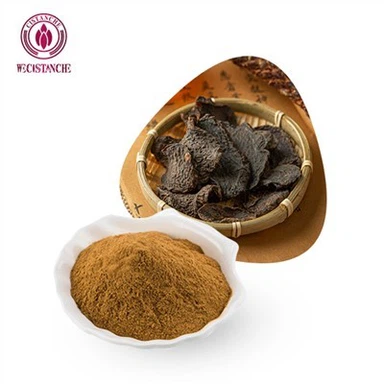
Take 100 g of Cistanche deserticola slices, add 30 mL of rice wine, mix well, and stew until the wine is absorbed. Stew it in water for 12 h, take it out and let it cool slightly, and dry it. See Figure 1 for raw Cistanche deserticola and wine-stewed Cistanche deserticola samples.
2.2 Study on the difference of components of Cistanche deserticola before and after stewing in wine
2.2.1 Preparation of solution
Take about 0.2 g of dry sample powder (passed through a 65-mesh sieve), weigh accurately, place in a 50 mL brown volumetric flask, add 25 mL of 50% methanol aqueous solution, seal tightly, weigh the mass, soak for 30 minutes, ultrasonically treat for 40 minutes (power 250 W, frequency 35 kHz), cool, weigh again, add 50% methanol aqueous solution to make up for the lost mass, shake well, let stand, filter the supernatant through a 0.22 μm microporous filter membrane, and place the filtrate in a brown liquid phase bottle to obtain the solution.

HIGH-QUALITY CISTANCHE HERB FOR SALE
2.2.2 Chromatographic conditions
Waters ACQUITY UPLCTM BEH C18 chromatographic column (100 mm×2.1 mm, 1.7 μm), column temperature of 35 ℃; sample chamber temperature of 10 ℃, sample injection volume of 3 μL, methanol (A)-0.1% formic acid aqueous solution (B) as mobile phase, gradient elution: 0-4 min, 10%-26% methanol; 4-18 min, 26%-40% methanol; 18-24 min, 40%-100% methanol; 24-28 min, 100% methanol. The volume flow rate was 0.3 mL/min, and the detection wavelength was 330 nm.
2.2.3 Mass spectrometry conditions
Electrospray ionization source (ESI) was used, negative ion mode scanning, capillary temperature was 350 ℃, sheath gas volume flow rate was 30 arb, auxiliary gas volume flow rate was 10 arb, spray voltage was 3
KV, capillary voltage was −35 V, tube lens voltage was −110 V, scanning range was m/z 100~1 000, data collection system was Xcalibur 2.1.
2.2.4 Principal components analysis (PCA)
After obtaining the two-dimensional matrix of accurate mass-retention time data pairs, the instrument panel will display all automatically imported accurate retention time information, and the PCA method of the extended statistics module will be used for analysis.
2.2.5 Orthogonal partial least squares discriminant analysis (OPLS-DA) LCMS combines the high separation of liquid chromatography with the high sensitivity of mass spectrometry. The collected data is quite large, and multivariate statistical analysis is required to process the data. OPLS-DA divides the data into two groups and uses a supervised statistical model to obtain a large number of orthogonalized spectra, which clearly show the differences between the two groups of samples. In the additional figure S-Plot format, each point represents an accurate mass retention time data pair, the X-axis represents the variable, the farther the data point is from the zero point, the greater the contribution of the point to the sample difference; the Y-axis represents the correlation between samples in the same sample group, the farther the accurate mass and retention time data pair is from the zero point, the stronger the correlation. Therefore, the mass accurate retention time data pairs at both ends of the S-shaped curve represent the most reliable characteristic ions from each sample group.

HIGH-QUALITY CISTANCHE HERB FOR SALE
2.2.6 Mass spectrometry structure analysis
After obtaining the characteristic ions, the element composition and compound matching were performed by calculating the precise relative molecular mass and combining the existing database and relevant literature to identify the differential components.
2.3 Study on the difference in efficacy before and after stewing with wine
2.3.1 Preparation of Cistanche deserticola extract
Cistanche deserticola (batch number 160901) and the corresponding wine-stewed Cistanche deserticola powder were extracted according to the conditions under "2.2.1", filtered after ultrasonic treatment, repeated twice, the filtrate was combined, concentrated by vacuum distillation, and freeze-dried.
2.3.2 Animal experiment grouping and drug administration

Fig. 1 Cistanches Herba A and wine-stewed Cistanches Herba B
(1) Grouping: Rats were given free access to water and diet. After 1 week of adaptive feeding, they were randomly divided into 5 groups (Table 2), with 10 rats in each group, namely normal group, model group, raw Cistanche deserticola group (PR), wine-stewed Cistanche deserticola group (PW), and positive control Jinkui Shenqi Pill group (JK). (2) Modeling: Except for the normal group, the other four groups were all injected with hydrocortisone sodium succinate injection im, with a dose of 20 mg/kg, for 14 consecutive days. The normal group was injected with the same dose of normal saline. The general condition of the rats in each group was observed to determine whether they showed symptoms such as fear of cold, preference for warmth, cold limbs, clear and long urine, curled up and arched back, dull and messy hair, and mental depression. At the same time, the body weight, number of spontaneous activities, food intake, water intake, urine output and other indicators of the rats in each group were measured.
(3) Administration: The dosage of rats was calculated based on the clinical dosage of Jinkui Shenqi Pills and Cistanche deserticola. The dosage of each Cistanche deserticola group was 1.80 g/kg in terms of raw drug amount. The specific dosage is shown in Table 2. Each extract of Cistanche deserticola and Jinkui Shenqi Pills were prepared into solutions of a certain concentration with deionized water. The solution was administered intragastrically every day with an intragastrically volume of 10 mL/kg for 30 consecutive days. The normal group and the model group were administered intragastrically with an equal volume of deionized water every day. The body weight was measured weekly, and the intragastrically volume was adjusted according to the body weight of the rats. After the administration, the rats were fasted for 12 h. After pentobarbital anesthesia, blood was collected from the abdominal aorta for serum index detection. The kidneys, testicles, epididymis, seminal vesicles and prostate were removed for relevant index detection.