Differences in Composition And Medicinal Efficacy Of Raw Products And Wine Steam-processed Products From Cistanches Herba Ⅱ
Sep 10, 2024
2.3.3 Body weight and body temperature detection
Rats were fed adaptively for 1 week, recorded as 0 day, and body weight and rectal temperature were recorded; after hydrocortisone sodium succinate injection was continuously administered for 14 days, it was recorded as 14 day, and body weight and rectal temperature were recorded; after successful modeling, the drug treatment was carried out according to the dosing scheme for 30 days, recorded as 44 day, and body weight and rectal temperature were recorded.
2.3.4 Spontaneous Activity Frequency Detection
The number of rat activities within 5 minutes was recorded using a multifunctional rat spontaneous activity recorder. The rats were placed in the spontaneous activity instrument, the first 3 minutes were the adaptation period, and the number of spontaneous activities of the rats was counted by the recorder in the last 5 minutes. The room should be quiet, the room temperature should be maintained at 18-22 ℃, and the humidity should be maintained at 45%-65%. The number of spontaneous activities at 0, 14, and 44 days was recorded respectively.
2.3.5 Serum Index Detection
After the rats were anesthetized, blood was collected from the abdominal aorta, placed in a coagulation tube, and centrifuged at 2,000 r/min for 15 min to detect the contents of T, E2, CREA and BUN in the serum.

HIGH-QUALITY CISTANCHE FOR KIDNEY DISEASE
Supportive Service Of Wecistanche
Email:wallence.suen@wecistanche.com
Whatsapp/Tel:+86 15292862950
2.3.6 Organ index calculation
After the rats were anesthetized and blood was collected, the kidneys, testicles, epididymis, seminal vesicles and prostate were removed, wiped dry with filter paper, and the mass was immediately weighed. The organ index was calculated based on the rat mass.
Organ index = organ mass/body mass
2.3.7 Tissue detection
After the rat testicles were removed, the mass was weighed and immediately placed in a -80 ℃ refrigerator for freezing. Before the measurement, they were taken out, thawed, and pre-cooled physiological saline was added to make a tissue homogenate under ice bath conditions, and a 10% tissue homogenate was prepared. The homogenate was immediately centrifuged at 5,000 r/min for 10 min, and the supernatant was taken for use. According to the requirements of the kit, the hydroxylamine method was used to determine the SOD content in testicular tissue, and the TBA method was used to determine the MDA content in testicular tissue.

Fig. 2 Total ion current diagram of Cistanches Herba and wine-stewed Cistanches Herba in negative ion mode
3 Results
3.1 Differences in the composition of Cistanche deserticola before and after processing
3.1.1 Total ion flow diagram
In this study, the mass spectrometer detector used the electrospray ionization source negative ion mode (ESI−). Figure 2 shows the total ion flow diagram of raw Cistanche deserticola and wine-stewed products in negative ion mode. It can be seen that the composition of Cistanche deserticola samples is very complex, and there are obvious differences between raw Cistanche deserticola and wine-stewed products. In addition, by searching the existing database and consulting relevant literature for elemental composition and compound matching, a total of 45 compounds were identified, as shown in Table 3.
Table 3 Identified compounds in Cistanches Herba samples
3.1.2 PCA results
The PCA diagrams of raw Cistanche deserticola and wine-stewed products are shown in Figure 3, which can be clustered separately. It can be determined that there must be differences in the composition of Cistanche deserticola before and after processing.
3.1.3 OPLS-DA results
After OPLS-DA processing, the S-Plot diagram is shown in Figure 4. The two ends of the S-shaped curve in the figure represent the characteristic markers with the greatest contribution in each group. By analyzing the fragment ion data with VIP values greater than 1 at both ends of the S-shaped curve and comparing with the control, four differential components were identified: echinacoside (tR=8.39 min, m/z 785.250 9), verbascoside (tR=11.51 min, m/z
623.198 1), isoverbascoside (tR=13.38 min, m/z623.198 1) and tubuloside B (tR=18.41 min, m/z 665.208 7).

HIGH-QUALITY CISTANCHE LIQUOR FOR KIDNEY DISEASE
3.2 Animal Experimental Results
3.2.1 General Status Observation
After modeling, the rats showed a series of symptoms such as liking warmth and fearing cold, curling up and arching their backs, listlessness, dull and messy hair, cold limbs, decreased appetite, reduced body weight and clear urine. After administration, the above symptoms in each group were significantly improved.
3.2.2 Changes in diet and voluntary activity of rats after modeling
After continuous injection of hydrocortisone sodium succinate injection for 14 days, the body weight, number of voluntary activities within 5 minutes, and food intake, water intake, and urine output of rats in each group were measured to determine whether the hydrocortisone kidney yang deficiency model was successfully established. The results are shown in Table 4. As shown in Table 4, after 14 days of hydrocortisone administration, compared with the normal group, all the groups showed a decrease in body weight, a decrease in food intake, an increase in water intake, an increase in urine output, and a decrease in voluntary activity, and there were significant differences (P < 0.05). According to the description of some kidney yang deficiency syndromes in the clinical diagnosis and treatment terminology of traditional Chinese medicine: "fear of cold and cold limbs, especially below the waist and knees, pale or dark complexion, clear and long urine, frequent urination at night, pale tongue with white fur, weak pulse, etc." Combined with the observation of general condition after modeling, the symptoms after modeling were consistent with the description of kidney yang deficiency, indicating that the modeling was successful.
| No. | Compound | t/min | Ionization Mode | Molecular Formula | Theoretical Value (m/z) | Experimental Value (m/z) | Error (×10⁻⁶) | Fragment Information (m/z) |
|---|---|---|---|---|---|---|---|---|
| 1 | Grape Sugar | 0.79 | [M–H] | C₆H₁₂O₆ | 179.055 | 179.055 | 0.20 | 97, 89 |
| 2 | Grape Tannin | 0.81 | [M–H] | C₁₅H₁₄O₈ | 331.139 | 331.139 | 1.53 | 295, 313, 311 |
| 3 | Sorbitol | 0.88 | [M–H] | C₁₂H₂₂O₁₁ | 341.108 | 341.108 | 1.50 | 179, 161, 143, 131 |
| 4 | Half Milk Sugar | 1.10 | [M–H] | C₆H₁₂O₆ | 181.071 | 181.071 | 2.68 | 163, 101 |
| 5 | Plant-Based Nutrient C | 1.20 | [M–H] | C₂₈H₄₃O₁₂ | 561.197 | 561.197 | -0.01 | 543, 461, 399 |
| 6 | Pine Sugar | 1.21 | [M–H] | C₁₆H₂₀O₈ | 341.123 | 341.124 | 1.63 | 179, 161, 143, 131, 119 |
| 7 | Succinic Acid | 1.52 | [M–H] | C₄H₄O₄ | 117.018 | 117.019 | 3.40 | 99, 73 |
| 8 | Plant-Based Nutrient B | 2.04 | [M–H] | C₂₈H₃₃O₁₃ | 577.192 | 577.192 | -0.03 | 297, 208, 183, 178, 171, 153 |
| 9 | Tea Flavonoids | 2.20 | [M–H] | C₇H₆O₆N₂ | 164.071 | 164.072 | 1.00 | 103 |
| 10 | Beijing Pear Extract | 3.73 | [M–H] | C₁₄H₁₂O₁₁ | 373.113 | 373.115 | 5.48 | 355, 327, 297 |
| 11 | Goji Berry Extract | 4.28 | [M–H] | C₂₀H₂₄O₁₈ | 461.169 | 461.169 | 0.00 | 485, 293, 215, 197, 167 |
| 12 | Pineapple Leaf Extract | 4.74 | [M–H] | C₁₁H₁₂O₇ | 487.145 | 487.146 | 0.88 | 389, 179 |
| 13 | Hibiscus Flower Extract | 4.63 | [M–H] | C₂₄H₂₈O₁₀ | 537.197 | 537.197 | 0.00 | 501, 415, 375, 357 |
| 14 | 8-β-Hydroxylactone | 5.27 | [M–H] | C₁₂H₂₀O₈ | 241.096 | 241.097 | 0.04 | 213, 189 |
| 15 | Rhizoma Dioscoreae | 6.10 | [M–H] | C₁₈H₂₄O₈ | 361.115 | 361.113 | 2.20 | 309, 163, 137 |
| 16 | Strawflower Extract | 6.82 | [M–H] | C₁₅H₂₁O₁₀ | 327.108 | 327.109 | 1.00 | 307, 195 |
| 17 | Bee Pollen | 7.20 | [M–H] | C₁₄H₂₈O₈ | 437.472 | 437.472 | 0.00 | 393, 373, 355 |
| 18 | β-Carotene | 7.53 | [M–H] | C₂₉H₄₆O₁₆ | 629.192 | 629.192 | 0.00 | 617, 479, 459, 315, 221 |
| 19 | Purple Sweet Potato | 7.70 | [M–H] | C₁₇H₂₄O₉ | 371.134 | 371.134 | 0.00 | 349, 328 |
| 20 | Beijing Pear Extract | 8.02 | [M–H] | C₁₇H₂₄O₉ | 371.134 | 371.134 | 0.00 | 349, 328 |
| 21 | Peach Blossom Extract | 8.09 | [M–H] | C₂₈H₄₀O₁₂ | 561.197 | 561.197 | 0.00 | 543, 461, 399 |
| 22 | Ginseng Extract | 10.39 | [M–H] | C₈H₁₈O₈ | 799.266 | 799.266 | 0.03 | 417, 439, 543, 561 |
| 23 | Oolong Tea Extract | 10.63 | [M–H] | C₂₄H₃₄O₁₆ | 539.149 | 539.149 | 0.10 | 637, 621, 471, 473 |
| 24 | Lotus Leaf Extract | 11.51 | [M–H] | C₂₇H₃₄O₁₂ | 549.197 | 549.197 | 0.00 | 197, 153, 135 |
| 25 | Hairy Flower Extract | 11.51 | [M–H] | C₂₉H₄₈O₁₆ | 623.197 | 623.196 | -0.21 | 387, 531 |
| 26 | Bamboo Shoot Extract | 11.51 | [M–H] | C₃₇H₄₈O₂₁ | 827.261 | 827.259 | -1.92 | 461, 315, 135, 297, 161 |
| 27 | Chrysanthemum Extract | 11.60 | [M–H] | C₂₁H₃₀O₉ | 429.118 | 429.118 | 0.00 | 663, 625, 413 |
| 28 | 6-Acetyl Flavone | 12.32 | [M–H] | C₁₈H₁₈O₆ | 345.118 | 345.119 | 0.02 | 301, 281 |
| 29 | Longan Fruit Extract | 13.41 | [M–H] | C₁₈H₁₈O₈ | 417.154 | 417.159 | -0.11 | 165, 119, 327, 129, 27 |
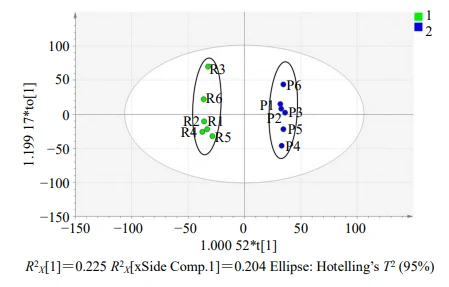
Fig. 3 Principal component analysis diagram of Cistanches Herba (1) and wine-stewed Cistanches Herba (2)

Fig. 4 S-Plot of Cistanches Herba and wine-stewed Cistanches Herba
Table 4 Changes in diet and autonomic activity of rats after modeling ( x s ± , n = 10)
| Group | Body Weight (g) | 24 h Food Intake (g) | 24 h Water Intake (mL) | 24 h Urine Output (mL) | 5 min Spontaneous Activity Count |
|---|---|---|---|---|---|
| Normal | 285.14 ± 9.26 | 15.81 ± 2.19 | 20.86 ± 3.59 | 11.09 ± 2.57 | 100.4 ± 14.7 |
| Model | 226.67 ± 12.14* | 11.92 ± 3.69* | 32.53 ± 4.65* | 15.58 ± 6.38* | 72.7 ± 11.6* |
| PR | 222.89 ± 9.87* | 10.65 ± 4.20* | 31.54 ± 3.55* | 19.36 ± 5.20* | 68.9 ± 18.0* |
| PW | 219.16 ± 10.75* | 12.37 ± 3.42* | 29.11 ± 4.78* | 16.01 ± 3.96* | 62.8 ± 14.9* |
| JK | 230.02 ± 7.95* | 10.22 ± 2.26* | 34.57 ± 5.36* | 19.13 ± 7.57* | 69.3 ± 11.3* |
Notes:
Comparison with the normal group: *P < 0.05.
*P < 0.05 vs normal group.
Table 5 Changes in body weight of rats during dosing cycle ( x s ± , n = 10)
| Group | Body Weight (g) | 0 d | 14 d | 44 d |
|---|---|---|---|---|
| Normal | 192.12 ± 5.48 | 285.14 ± 9.26 | 430.02 ± 6.14 | |
| Model | 187.24 ± 4.56* | 226.67 ± 12.14* | 328.33 ± 14.77* | |
| PR | 185.07 ± 5.11 | 222.89 ± 9.87* | 345.25 ± 8.22*# | |
| PW | 183.48 ± 6.44 | 219.16 ± 10.75* | 362.17 ± 7.82*#Δ | |
| JK | 194.13 ± 5.90 | 230.02 ± 7.95* | 356.94 ± 7.47*# |
Notes:
*P < 0.05 vs normal group.
* P<0.05 vs normal group; # P<0.05 vs model group; △P<0.05 vs PR group. Same as below.
3.2.3 Changes in body weight of rats
Based on the body weight changes of three times on 0, 14, and 44 days, the effect of im hydrocortisone sodium succinate injection on the body weight of rats and the recovery of rat body weight after drug intervention treatment were analyzed. The results are shown in Table 5.
It can be seen from Table 5 that after 1 week of adaptive feeding, the body weight of the rats increased and was relatively balanced. The body weights of the rats were all (200±20) g. There was no significant difference between the groups, indicating that the feeding environment and dietary conditions suitable for the survival of rats. After 14 days of hydrocortisone administration, compared with the normal group, the body weight increase of the rats in the model group and each medication group was reduced, and there was a significant difference (P<0.05). The body weight of the rats in the normal group was

3.2.4 Changes in body temperature of rats
Based on the body temperature changes of three times on 0, 14, and 44 days, the effect of intramuscular injection of hydrocortisone sodium succinate injection on the body temperature of rats and the body temperature recovery of rats after drug intervention were analyzed. The results are shown in Table 6.
3.2.5 Changes in rats' spontaneous activities
Based on the changes in the number of spontaneous activities in 3 days on 0, 14, and 44 days, the effect of im Hydrocortisone Sodium Succinate Injection on the number of spontaneous activities in rats and the recovery of the number of spontaneous activities in rats after drug intervention treatment were analyzed. The results See Table 7.
It can be seen from Table 7 that 14 days after hydrocortisone injection, compared with the normal group, the number of spontaneous activities within 5 minutes of each other group decreased significantly, and there was a significant difference (P<0.05). One month after administration, compared with the model group, the number of spontaneous activities of rats in each Cistanche deserticola administration group increased (P<0.05); compared with the normal group, there was no significant difference in the number of spontaneous activities of rats in each Cistanche deserticola administration group; Compared with the JK group, there was no significant difference in the number of spontaneous activities among the Cistanche deserticola administration groups. It shows that Cistanche deserticola extract can increase the number of spontaneous activities in rats with kidney-yang deficiency, and after 30 days of treatment, the number of spontaneous activities is close to that of normal rats.
3.2.6 Organ index
After 30 days of continuous administration, the rats were fasted for 12 hours and sacrificed. The quality of the organs was measured. The effects of the hydrocortisone-induced kidney yang deficiency model on the organs of rats and the administration of different extracts of Cistanche deserticola were observed from the organ level. Recovery of rat organs after taking the drug. After hydrocortisone administration, the body weight of the rats varied greatly, and the organ mass also changed significantly. This experiment used the organ index as an indicator to consider
The effects on organs were observed before and after administration. The results are shown in Table 8.
It can be seen from Table 8 that compared with the normal group, after intramuscular injection of hydrocortisone sodium succinate in rats, the organ indexes of the kidneys, testicles, epididymis and prostate in the model group all decreased (P<0.05), indicating that hydrocortisone-induced The kidney-yang deficiency model in rats will cause changes in the indexes of the kidneys, testicles, epididymis and prostate, but has little effect on the seminal vesicles.
Overall, compared with the model group, the organ indexes of each administration group were improved, indicating that raw Cistanche deserticola, wine Cistanche deserticola, and Jingui Shenqi Pills could alleviate the decline in organ index in the kidney-yang deficiency model.
From the perspective of each organ, compared with the model group, the wine Cistanche deserticola group can significantly increase the organ index of the kidney (P<0.05). Comparing different drug administration groups, the wine Cistanche deserticola group is better than the raw Cistanche deserticola group (P<0.05). ; From the perspective of testicular index, compared with the model group, each administration group can significantly increase the organ index of the testis (P<0.05). Comparing different administration groups, the wine Cistanche deserticola group has a significant advantage over the raw Cistanche deserticola group. (P < 0.05); from the perspective of epididymal index, compared with the model group, each administration group can significantly increase the organ index of the epididymis (P < 0.05); from the perspective of seminal vesicle index, compared with the model group , the wine Cistanche deserticola group can significantly improve the organ index of the seminal vesicles (P<0.05). Comparing different administration groups, the wine Cistanche deserticola group is significantly better than the raw Cistanche deserticola group (P<0.05); from the perspective of the prostate, compared with the model group In comparison, the raw Cistanche deserticola group and the wine Cistanche deserticola group could significantly increase the prostate organ index (P<0.05).
3.2.7 Detection of renal function indicators
BUN and CREA reflect kidney function. CREA in serum is the end product of nitrogen-containing organic matter, and BUN in serum is the main end product of protein metabolism. Both of them are mainly excreted by glomerular filtration [10-11]. When renal function is damaged, the glomerular filtration function decreases and the concentrations of both increase. Blood BUN and blood CREA levels reflect the status of kidney function: the higher their levels, the more severe the damage to kidney function. In this experiment, the contents of BUN and CREA in rat serum were detected to evaluate the effects of each administration group on renal function in rats with hydrocortisone-induced kidney-yang deficiency.
As can be seen from Table 9, compared with the normal group, the BUN and CREA contents in the model group were increased, and there was a significant difference (P<0.05), indicating that hydrocortisone caused kidney damage to rats. Compared with the model group, the wine Cistanche deserticola and raw Cistanche deserticola groups can reduce the content of CREA (P<0.05), thereby alleviating kidney damage to a certain extent.

3.2.8 Sex hormone indicator detection
Kidneys are the foundation of innateness and play an important role in human growth, development and life processes. Traditional Chinese medicine believes that the kidneys govern reproduction, and the relationship between the kidneys and the reproductive system is very close. More and more researchers have found that patients with kidney-yang deficiency have significant changes in the hypothalamic-pituitary-gonadal axis, often accompanied by symptoms of decreased sex hormones such as T and E2 [12]. In this experiment, the contents of T, and E2 in serum were measured to determine the effects of each administration group on sex hormones in rats with hydrocortisone-induced kidney-yang deficiency.
As can be seen from Table 10, compared with the normal group, the T and E2 contents of the model group decreased (P<0.05), indicating that hydrocortisone can cause a decrease in rat sex hormone levels. Compared with the model group, each administration group was able to significantly increase the levels of T and E2 in serum (P<0.05) and improve the decrease in sex hormones induced by hydrocortisone. Comparing different administration groups, the wine Cistanche deserticola group was better than the raw Cistanche deserticola group (P<0.05). Generally speaking, wine Cistanche deserticola has obvious performance in increasing T and E2 in the serum of rats with kidney yang deficiency, which is consistent with literature reports that phenylethanol glycosides, the main components of wine Cistanche deserticola, have hormone-like effects [13].
3.2.9 Antioxidant index detection
SOD is an antioxidant that reflects the body's ability to scavenge free radicals, while MDA is the end product of the oxidative stress reaction and can reflect the degree of oxidative damage to the body. In this experiment, the contents of SOD and MDA in the testicles were measured to determine the antioxidant activity of each administration group against the hydrocortisone-induced kidney yang deficiency model.
As can be seen from Table 11, compared with the normal group, the SOD content in the model group decreased (P<0.05). After 1 month of administration, compared with the model group, the SOD content in the raw Cistanche deserticola group and the wine Cistanche deserticola group increased. Compared with the normal group, the MDA content in the model group increased (P<0.05), indicating that the testicular tissue of rats with kidney-yang deficiency induced by hydrocortisone was oxidatively damaged. After being given Cistanche deserticola extract or Jingui Shenqi Pill positive medicine, each administration group was able to significantly reduce the content of MDA in testicular tissue and alleviate the oxidative damage caused by hydrocortisone. Taken together, both raw Cistanche deserticola and wine Cistanche deserticola can improve the body's ability to resist oxidative damage and alleviate oxidative damage caused by hydrocortisone.
(1) Grouping: Rats were given free access to water and diet. After 1 week of adaptive feeding, they were randomly divided into 5 groups (Table 2), with 10 rats in each group, namely normal group, model group, raw Cistanche deserticola group (PR), wine-stewed Cistanche deserticola group (PW), and positive control Jinkui Shenqi Pill group (JK). (2) Modeling: Except for the normal group, the other four groups were all injected with hydrocortisone sodium succinate injection im, with a dose of 20 mg/kg, for 14 consecutive days. The normal group was injected with the same dose of normal saline. The general condition of the rats in each group was observed to determine whether they showed symptoms such as fear of cold, preference for warmth, cold limbs, clear and long urine, curled up and arched back, dull and messy hair, and mental depression. At the same time, the body weight, number of spontaneous activities, food intake, water intake, urine output and other indicators of the rats in each group were measured.