Don't Wait For The Liver To Shout 'help' Before Taking It Seriously! Unlock The Liver Nourishing Secret Of Cistanche Deserticola
Jan 20, 2026
Liver alarm sounds: Have these symptoms hit you?
Before delving into how Cistanche deserticola nourishes the liver, let's first identify the "distress signals" emitted when the liver is damaged. When there are problems with liver function, the body often exhibits the following symptoms:
• Easy to fatigue: With impaired liver function, energy metabolism and the clearance of metabolic products are affected, making the body prone to fatigue, and the spirit will become listless, and endurance will be greatly reduced. Just like my friend Xiao Li, who used to go hiking on weekends with a lot of energy, but recently he always says he feels tired, panting after climbing a few flights of stairs, and exhausted after working for a while. Later on, it was found that his liver function was somewhat abnormal.

Effects of cistanche-anti fatigue
Click here to view Relieve Physical Fatigue Cistanche products
【Ask for more】 Email:cindy.xue@wecistanche.com / WhatsApp 0086 18599088692 / Wechat: 18599088692
• Digestive disorders: The liver is an important part of the digestive process, and the bile it produces can help break down fat. When the liver is damaged, and bile secretion and excretion are affected, digestive symptoms such as decreased appetite, aversion to greasiness, bloating, abdominal pain, nausea, vomiting, and diarrhea may occur. For example, every time Xiao Zhang eats greasy food, he feels nauseous and bloated. He thought it was a gastrointestinal problem, but after examination, he found out that it was his liver protesting.
• Liver discomfort: The liver is located in the upper right abdomen. When inflammation, swelling, or tumors occur in the liver, some patients may feel discomfort or pain in the liver area. The nature of the pain may be swelling, stabbing, etc. The pain may also worsen when pressed.
• Jaundice: Widespread damage to liver cells or intrahepatic bile stasis can cause bilirubin metabolism disorders, leading to jaundice. At this time, the patient's skin and sclera (also known as the "white eyeball") will turn yellow, urine will be dark yellow in color, stool will be light white in color, and may also be accompanied by skin itching. There was once a patient who initially only noticed that their urine color had turned very yellow and didn't pay much attention. Later, their skin also began to turn yellow, and it was only after examination at the hospital that it was discovered that jaundice was caused by liver disease.
• Liver palms and spider nevi: When the liver is severely damaged, the skin at the fish border of the patient's hands will appear red and fade under pressure, which is called liver palms; Red vascular nevi, resembling spiders, may also appear in the neck, chest, back of the hand, upper arm, and other areas. When pressed on the central area, the small vascular network radiating outward will immediately disappear, and the pressure will be removed and quickly restored. This is known as spider nevi. The appearance of these symptoms often indicates a rered flagor liver health.
Cistanche deserticola: a liver guardian star emerging from the desert

Superman herbs cistanche
After understanding the symptoms of liver damage, everyone wants to know how to protect their liver. In fact, in the treasure trove of traditional medicine, there is a precious medicinal herb - Cistanche deserticola, which has a good nourishing effect on the liver.
Cistanche deserticola, a magical plant that grows in the desert, is known as the "desert ginseng" and occupies an important position in traditional medicine. It has a sweet and salty taste, a warm nature, and belongs to the kidney and colon meridians. It can not only nourish kidney yang, nourish essence and blood, moisten the intestines and promote bowel movements, but also has a unique protective effect on liver health.
Modern scientific research has found that Cistanche deserticola contains various beneficial components for the liver, such as polysaccharides and phenylethanolic glycosides. These ingredients are like "little guards" that can comprehensively protect liver health. Among them, the extract of Cistanche deserticola can inhibit the activation of hepatic stellate cells, thereby reducing the degree of liver fibrosis and protecting against chemical liver damage. Experimental data show that after using Cistanche deserticola extract on chemical liver injury model animals, the content of malondialdehyde in their liver tissue is significantly reduced, and the activity of superoxide dismutase is significantly increased. This indicates that Cistanche deserticola can inhibit liver lipid peroxidation, reduce the damage of free radicals to liver cells, enhance the antioxidant capacity of the liver, thereby protecting liver cells and maintaining normal liver function.
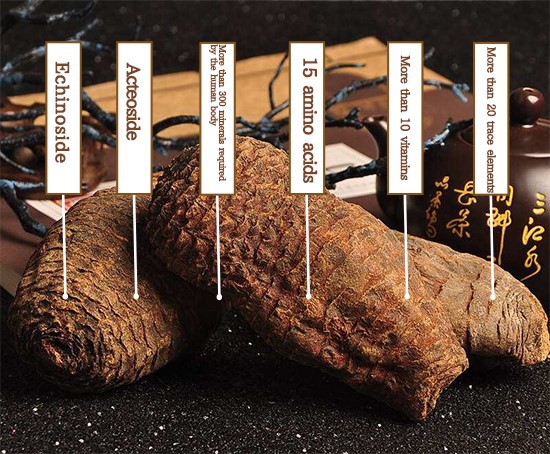
Main Chemical Constituents of Cistanche deserticola
Not only that, but Cbut istanche deserticola can also regulate immune function, enhance the body's resistance, and help the body better resist the invasion of external bacteria on the liver; It also has anti-inflammatory effects, which can reduce the inflammatory response of the liver and safeguard its health.
Complete strategy for nourishing the liver with Cistanche deserticola
Insight into Cistanche: The Secret to Selecting High Quality Cistanche
After understanding the many benefits of Cistanche deserticola for the liver, selecting high-quality Cistanche deserticola has become the key. There is a wide variety of Cistanche products on the market, with varying levels of quality. If you are not careful, you may buy inferior products. Below, I will share with you some methods for selecting high-quality Cistanche deserticola:
• Look at the place of origin: Cistanche deserticola is mainly distributed in Xinjiang, Gansu, Inner Mongolia, and other places, and the quality of Cistanche deserticola from different places varies greatly. Among them, Alxa in Inner Mongolia is known as the "hometown of Cistanche deserticola in China". The unique geographical environment here, such as vast deserts, abundant sunshine, suitable temperature differences, and mineral-rich sandy soil, provides unique conditions for the growth of Cistanche deserticola. The content of Cistanche deserticola polysaccharides and phenylethanolic glycosides produced is higher than that of ordinary production areas, and the quality is excellent.
Appearance: High-quality Cistanche deserticola usually presents a plump and robust shape, with a length generally between 10 and 30 centimeters and a diameter of up to 2 and 8 centimeters. Its surface should be free of mold, insect damage, and other defects, with a soft texture and a certain degree of elasticity. It should be gently bent by hand and not easily broken. The color is mostly dark brown or black. If the color is too light, it may indicate insufficient growth years or poor quality. However, those Cistanche deserticola that have a dry and thin appearance, a hard texture that is easy to break, and abnormal or dull colors often have poor quality.

Cistanche tubulosa and Cistanche deserticola
Check the testing report: If conditions permit, you can also check the product's testing report to understand the content of active ingredients (such as polysaccharides, phenylethanolic glycosides, etc.) in Cistanche deserticola. The higher the content, the better the quality of Cistanche deserticola.
Fancy Eating Cistanche: A Liver Nourishing and Delicious Eating Method
After selecting high-quality Cistanche deserticola, how to eat it to maximize its liver-nourishing effects? Below, I will recommend several simple and delicious ways to consume Cistanche deserticola:
Soaking Cistanche deserticola in water: This is the simplest way to consume it. Cut the Cistanche deserticola into thin slices, take 5-10 grams, brew with boiling water, and let it steep for 15-20 minutes before drinking. It can be brewed repeatedly until the water taste becomes lighter. After soaking in water, Cistanche deserticola has a rich and mellow taste with a hint of sweetness, which not only provides deliciousness but also easily nourishes the liver.
• Congee cooked with cistanche: Congee cooked with cistanche is nutritious and delicious. Prepare 10-15 grams of Cistanche deserticola and 100 grams of japonica rice. Wash and slice the Cistanche deserticola and put it together with the japonica rice in a pot. Add an appropriate amount of water and cook until the japonica rice is cooked to perfection. You can also add a proper amount of jujube, wolfberry, and other ingredients according to your taste to increase the nourishing effect of Congee. Drinking a bowl of Cistanche Congee in the morning can not only warm the intestines and stomach, but also supplement nutrition for the liver, opening a day full of vitality.
• Cistanche stew soup: Cistanche is stewed with ingredients such as lamb and chicken, making it a nutritious and health-preserving soup. Put 15-20 grams of Cistanche deserticola and an appropriate amount of lamb or chicken, ginger slices, scallions, and other seasonings into a stew pot, add enough water, and simmer for 2-3 hours until the ingredients are cooked to perfection. This soup not only has a delicious taste, but also has good effects on nourishing the liver, kidney, q, i and blood. It is suitable for consumption in cold seasons, as it can nourish the body and resist the cold.

Stewed Cistanche deserticola soup
Nourishing the liver does not rely solely on Cistanche deserticola
Nourishing and protecting the liver is a "long-lasting battle" that requires long-term persistence. Although Cistanche deserticola is a powerful assistant in nourishing the liver, it cannot be relied on alone. We also need to start from all aspects of life and develop good habits.
Regular sleep schedule: Traditional Chinese medicine believes that the time fro11 pmpm to 3 am is the optimal time for the liver meridian to clear toxins and self-repair. If you don't sleep at this time, it will affect the normal function of the liver, and staying up late for a long time may also lead to poor qi and blood circulation in the liver, thereby damaging the liver. Therefore, we should try to fall asleep before 11 pm to ensure sufficient sleep time and allow the liver to rest adequately, so as to better perform its physiological functions.
Balanced diet: Diet is closely related to liver health, and a reasonable dietary structure can provide sufficient nutrition for the liver and enhance its resistance. We should eat more fresh vegetables and fruits, such as spinach, broccoli, apples, oranges, etc. These foods are rich in vitamins, minerals, and dietary fiber, which help promote liver metabolism and detoxification function; Moderate intake of high-quality protein, such as lean meat, fish, beans, eggs, dairy products, etc., can help repair and regenerate liver cells; Reduce the intake of high-fat, high sugar, and high salt foods, and avoid consuming moldy and spoiled foods, as these foods may contain harmful substances such as aflatoxins, which can cause serious damage to the liver.

Total glycosides of Cistanche deserticola can inhibit liver cancer cells at the early stage of liver cancer.r
Moderate exercise: Life lies in exercise. Moderate exercise can promote blood circulation, enhance the body's metabolism, and reduce the burden on the liver. Aerobic exercises such as jogging, swimming, Tai Chi, yoga, et,c. are all good choices. Persist in exercising 3-5 times a week for at least 30 minutes each time. Long term persistence can help us enhance our physical fitness, improve liver function, and make the liver healthier.
• Avoid excessive drinking: After alcohol enters the body, it is mainly metabolized in the liver. Long term heavy alcohol consumption can place an excessive burden on the liver, causing damage to liver cells and leading to alcoholic liver diseases such as alcoholic fatty liver, alcoholic hepatitis, and alcoholic cirrhosis. For the health of the liver, we must control our alcohol consumption and ideally avoid drinking altogether.
• Prevention of hepatitis virus infection: hepatitis virus is one of the important causes of liver disease, among which viral hepatitis, such as hepatitis B and hepatitis C, is highly infectious. We can prevent hepatitis virus infection through vaccination, suchas thes hepatitis B vaccine. In daily life, it is also important to pay attention to personal hygiene, avoid sharing toothbrushes, razors, and other items that may come into contact with blood with others, and reduce the risk of infection.
• Avoid drug abuse: It is a three-part poison, and many drugs need to be metabolized by the liver. Drug abuse can increase the burden on the liver and may even lead to drug-induced liver damage. Therefore, when using medication, it is necessary to strictly follow the doctor's advice and not increase or decrease the dosage or change medication at will. If multiple medications need to be taken at the same time, consult a doctor to avoid drug interactions and damage to the liver.