Dynamic Memory To Alleviate Catastrophic Forgetting in Continual Learning With Medical Imaging
Mar 29, 2022
Contact: Audrey Hu Whatsapp/hp: 0086 13880143964 Email: audrey.hu@wecistanche.com
Matthias Perkonigg1, Johannes Hofmanninger1, Christian J. Herold1, James A. Brink2, Oleg Pianykh2, Helmut Prosch1 & Georg Langs1✉
Medical imaging is a central part of clinical diagnosis and treatment guidance. Machine learning has increasingly gained relevance because it captures features of disease and treatment responses that are relevant for therapeutic decision-making. In clinical practice, the continuous progress of image acquisition technology or diagnostic procedures, the diversity of scanners, and evolving imaging protocols hamper the utility of machine learning, as pre-diction accuracy on new data deteriorates, or models become outdated due to these domain shifts. We propose a continual learning approach to deal with such domain shifts occurring at unknown time points. We adapt models to emerging variations in a continuous data stream while counteracting catastrophic forgetting. A dynamic memory enables rehearsal on a subset of diverse training data to mitigate forgetting while enabling models to expand to new domains. The technique balances memory by detecting pseudo-domains, representing different style clusters within the data stream. Evaluation of two different tasks, cardiac segmentation in magnetic resonance imaging and lung nodule detection in computed tomography, demonstrate a consistent advantage of the method.

Deep learning (DL) algorithms are rapidly gaining relevance in medical imaging, enabling computational segmentation1,2, classification or detection3 of anatomical structures and anomalies4 relevant for diagnosis, prediction, or prognosis. In some cases, their capabilities surpass even those of human experts5,6, making them a central tool in the advancement of using imaging data for diagnosis, and for supporting treatment decisions.
However, clinical imaging technology, diagnostic workflows, and even imaging markers of diseases are not static. Instead, they are subject to an ever-evolving environment in which DL algorithms have to adapt in order to remain relevant. Currently, DL models are trained once, yielding an impressive performance on images comparable to their training experience. Yet, their sustainability is limited, as they become outdated while technology advances7. This inability to adapt to new data that is different from the training data in some aspects (dataset shifts) severely hampers their utility and adoption in clinical practice.
Dataset shifts occur when the training data distribution differs from the distribution of data at model inference8,9. One type of such shift, domain shift (or acquisition shift) might occur due to technical progress in scanner technology. In clinical practice, and consequently, in studies involving medical imaging data, acquired data frequently originate from different scanners, scanner generations, manufacturers, or imaging protocols. To successfully adapt deployed deep learning models to the changing environment, it is crucial to develop and advance methods that consider these domain shifts.
Here, we focus on accounting for domain shifts occurring at unknown times in a continuous data stream, reflecting clinical practice. A DL model is trained on a set of images acquired by a single scanner (base training) and subsequently updated continuously to changes in image appearance that occur in a data stream as new scanners are added. At the same time, knowledge about previously seen domains should not be forgotten as new domain information is incorporated into the model. Figure 1 illustrates the general setting of this work. The model is trained to convergence on a base training set of domain A data; afterward, it is exposed to a continuous data stream in which, after some time, domain B, C, and D data appear. Without updating the model after base training (static deep learning), accuracy on later domains suffers, since they leave the distribution of the training data. See below for an example, where the base model failed to segment images from subsequent scanners. Continual learning methods counter this effect.
The focus of continual learning (also referred to as lifelong learning) is machine learning techniques for accumulating the ability to handle new tasks (or, in the context of this work, new domains) in a model10,11. A major undesired effect counteracted by continual learning methods is catastrophic forgetting, when updating a model to learn a new task would lead to a deterioration of performance on previous tasks12. Ideally, continual learning could yield improvements in performance on previous tasks when training on subsequent tasks, a desirable effect known as positive backward transfer resulting from the increased variety of training examples to the model is exposed to13.
We propose dynamic memory (DM) as a continual learning method, to deal with the emergence of new data sources at unknown time points in a continuous stream of medical images (Fig. 1). DM is a rehearsal method, which keeps a small, diverse subset of the data stream in memory to alleviate catastrophic forgetting. DM diversifies the memory using a style metric to maintain images with a variety of styles observed in the continuous data stream. As an optional module, we utilize a pseudo-domain (PD) model to detect clusters of a similar style from the continuous stream. Those pseudo-domains can be seen as proxies for the unknown, real domains and are used to balance the memory and training process (DM-PD). To demonstrate the generalizability of our method, we apply it to two different tasks with different imaging modalities. First, we perform cardiac segmentation in magnetic resonance imaging (MRI), and second, we apply our approach to lung nodule detection in computed tomography (CT). We show that on both tasks, our method outperforms continual learning baseline methods. Note that we are not focusing on the development of a new single scanner state-of-the-art method for either of the tasks, but rather we want to show how a continual learning method can be applied to adapt a model to a continuous stream of imaging data, including domain shifts, without explicit domain knowledge.

cistanche supplement: improve memory
Results
Data sets
Cardiac segmentation. Experiments were performed on data from multi-center, multi-vendor challenge data set14. The data set included data from four different vendors Siemens, General Electric, Philips, and Canon. We considered each of those vendors as one domain. We split the data into Base training, Continual training, validation, and test set on a patient level. Table 1a shows the number of individual slices for each domain in those data set splits.
Lung nodule detection. For lung nodule detection we used data extracted from the LIDC-database15, with the annotations as provided for the LUNA16-challenge16. In addition, we used the LNDb challenge data set17. For all lung nodule annotations, we constructed bounding boxes around the annotated lesion and extracted 2D slices with lesions. To demonstrate our continual learning with shifting domains, we constructed a data set of the three most common domains, in terms of scanner vendor and reconstruction kernel, in LIDC and as a fourth domain, the LNDb data set. For LIDC, the most commonly used settings including lesions were GE Medical Systems with low-frequency reconstruction algorithm (GE/L, n = 527), GE Medical Systems with high-frequency reconstruction algorithm (GE/H, n = 215), and Siemens with B30f kernel (Siemens, n = 130). The IMDb data set used multiple Siemens scanners. To match the nodule definition in the LIDC database we excluded nodules with a diameter < 3 mm, resulting in a total of 625 images. Those images were split into base training, continual training, validation, and test data set according to Table 1b analogous to the cardiac segmentation experiment.
Dynamic memory alleviates catastrophic forgetting for cardiac segmentation. To evaluate the ability of dynamic memory to achieve good performance while counteracting catastrophic for- getting, we performed cardiac segmentation on 2D MRI slices as multi-label segmentation with three labels: Left ventricle (LV), right ventricle (RV), and left ventricular myocardium (MYO). Images were acquired with scanners of four different vendors, in order of their appearance in the data stream: Siemens (A), GE (B), Philips (C), and Canon (D). We refer to them as Scanner A–D to facilitate understanding of the order. Base training was done on Scanner A data only; subsequently, the model was trained on a continuous data stream in which the image domains gradually changed from Scanner A to D (Fig. 1). We compared different continual learning strategies: (1) the DM method, (2) the DM method with pseudo-domain detection (DM-PD), (3) a random memory replacement strategy, in which every new sample replaced a randomly chosen sample currently in memory (Random) and (4) a naive approach of learning on a data stream without counteracting catastrophic forgetting (Naive). In addition, we compared results with state-of-the-art continual learning methods: (5) Elastic Weight Consolidation (EWC)18, and two methods that require domain knowledge (6) Gradient Episodic Memory (GEM)19 and (7) experience replay with Maximally Inferred Retrieval (ER-MIR)20. Note that DM and DM-PD operate without domain knowledge, representing a more realistic assumption in clinical practice. For comparison, we also trained two baseline models: First, a joint model (JModel) with all training data that treated the entire data set as a single hypo- thetical static data set; and second, domain-specific models (DSM) trained in a static training scheme on each of the domains, separately. Finally, we report results for a static base model (Base) trained on Scanner A, and applied to scanners A to D. All methods used the same backbone convolutional neural network (CNN) for segmentation, an FC-ResNet5021.
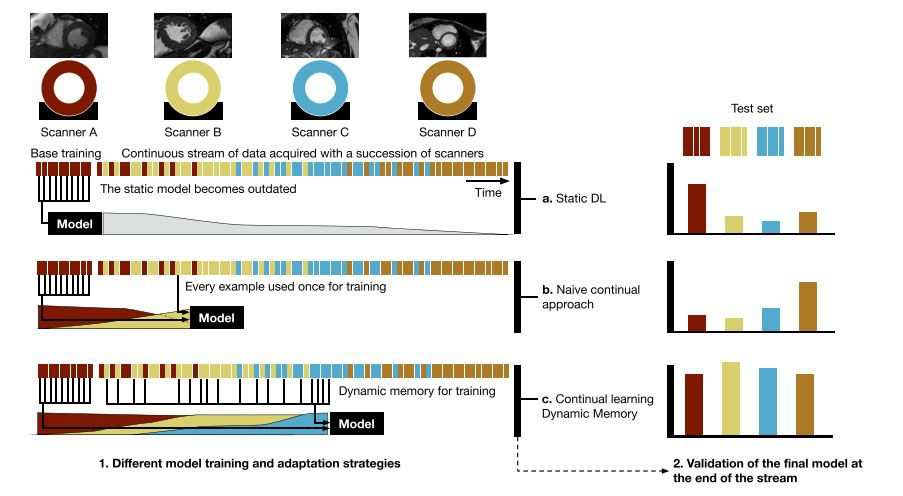
Fig. 1 Different model training and adaptation strategies. 1 Continual DL for image analysis adapts to new data properties and, at the same time, retains the capability to work with older data. a Static DL: after training and deploying a DL model, technology changes and the accuracy of the model decreases. b A naive continual learning approach to solve this limitation is to continue training a model on a stream of data. However, this leads to forgetting of old data properties, and a corresponding decrease in performance on these data. c As a continual learning approach, dynamic memory recognizes new emerging domains, and samples data in a continuous stream accordingly. The ML model adapts to new technology but stays accurate on the diverse set of scanners previously seen. This is important to ensure backward compatibility of the model and to build a more stable model that adapts to new scanners faster. 2 Validation on a separate test set evaluates the DL model performance at the end of the period.

We compared the segmentation accuracy of all approaches on a separate test set that contained data from all four scanners after training had finished. Furthermore, we specifically assessed whether model accuracy on one scanner benefits from model training on other scanners by evaluating backward transfer (BWT) and forward transfer (FWT)19.
In Table 2, the approaches are compared in terms of the average Dice score over LV, RV, and MYO for a memory size of M = 128. An evaluation of LV, RV, and MYO segmentation separately showed similar trends (see Supplementary Tables 1–3). DM and DM-PD performed similarly and outperformed all other continual learning strategies for which no information about domain membership is required (Naive, Random, and EWC). For images of the last domain (Scanner D), EWC had the highest mean Dice score (0.850 ± 0.003) but at the cost of a high negative BWT value ( − 0.014 ± 0.007), showing that catastrophic forget- ting occurred. DM and DM-PD exhibited no forgetting, as indicated by the neutral BWTs of 0.000 and 0.003, respectively. GEM and ER-MIR showed a similar performance to DM-PD but needed information about domain membership of the individual samples, which is not feasible in clinical practice. Comparing a memory with a random replacement strategy to DM and DM-PD showed that the style metric used for DM was effective to choose samples to form a diverse memory. Random replacement resulted in forgetting previous domains during the course of continual training (BWT of −0.011), while DM and DM-PD kept a good performance on all scanners.
On data from Scanner B, for which a relatively small sample size of 720 images was used for training, DM and DM-PD were able to achieve good performance without domain membership information. Learning with random replacement, EWC, and naive training resulted in a significant performance drop for Scanner B. This demonstrated that by using a Gram matrix-based style metric, DM was less sensitive to the number of samples per scanner vendor than other continual learning strategies.
J Model was the upper bound of what the training can achieve, especially for domains with few samples, i.e., for Scanner B, the performance gap between continual learning and hypothetical static batch training accessing all data was high (0.763 ± 0.004 vs. 0.798 ± 0.016). This was due to the fact that in continual learning, underrepresented samples were less often seen than in static training. In Supplementary Table 4, different memory sizes of M = 〈64, 128, 256, 512, 1024〉 for DM and DM-PD were compared. Adding more memory resulted in better performance but due to differences in the training dynamics (JModel trains batch-wise and thus can see more batches than in continual learning settings), the performance of JModel was not achievable. DM with a smaller memory ofM = 64 was not able to accurately capture the diversity of the training data distribution and thus resulted in forgetting (BWT = − 0.005).

what is cistanche used for: improve memory
Figure 2 shows how the mean DSC changed in the course of continual training. For EWC and naive continual learning, catastrophic forgetting was observed, and accuracy on previous domains declined as new domains entered model training. For DM and DM-PD, accuracy was more stable across all domains as continual training proceeded.
The qualitative assessment of semantic segmentation in Fig. 3 showed comparable performance results for the different continual learning approaches. However, while naive continual learning showed better results for Scanner D, DM and DM-PD performed well on all scanners including previously seen domains. The comparison with the base model (trained on Scanner A data only) showed that we need a continual learning method to adapt the model to changing visual appearance. The base model failed to perform accurate segmentation for scanners B–D, resulting in a high number of false negatives.
Dynamic memory alleviates catastrophic forgetting for lung nodule detection. Lung nodule detection was performed as bounding box detection on 2D CT slices and measured in average precision (AP), as defined in the evaluation section. Four image domains were included in the data stream: GE with a low-frequency reconstruction algorithm (GE/L); GE with a high-frequency reconstruction algorithm (GE/H); Siemens; and LNDb (see the ‘Data sets’ section for details), in the following Scanners E–H. Base training was performed on data from Scanner E. Due to the definition of EWC, a direct comparison was not possible for detection tasks. DM and DM-PD were compared to a random replacement memory and a naive continual learning approach.
Analogously to segmentation, two state-of-the-art methods requiring domain labels (which is not required by DM and DM- PD), GEM19 and ER-MIR20 were evaluated as reference. As baseline models, a joint model (JModel) and domain-specific models (DSM) were compared, and the results for the static base model (Base) were evaluated analogously to the segmentation experiment. As a task network, Faster R-CNN with a ResNet-50 backbone was used22.
Overall, DM-PD and DM performed better in terms of AP than the naive approach, as seen in Table 3. Both outperformed the naive method and effectively counteracted catastrophic forgetting. For all domains extracted from LIDC (Scanners E, F, and G), DM performed well. However, we observed a drop in performance for Scanner H for all methods. This drop was caused by a population shift in addition to the large domain shift. In LIDC data, lung nodules had a mean diameter of 8.29 mm, while Scanner H data (extracted from LNDb) included smaller lesions with a mean diameter of 5.99 mm. By design, DM does not detect population shifts (i.e., the change of lesion characteristics as opposed to imaging characteristics), and thus, could not adapt to Scanner H data quickly. The random replacement strategy struggled with learning domains that were present less frequently in the training (Scanner F and G) as they were replaced over time by Scanner H data, resulting in forgetting on those scanners. This effect was less severe for Scanner E data since the base training was performed on data of this scanner. DM and DM-PD counteracted this forgetting by using a style-based metric to diversify the memory and thus kept samples of all scanners in memory. DM-PD performed better than DM without pseudo-domain detection, demonstrating that balancing the training process was an important step for our continual learning method. DM-PD showed the best performance in terms of AP and outperformed the naive approach by around 0.05 AP for Scanners E, F and G. Furthermore, the best backward and forward transferability was observed for DM-PD/128. Thus, it was the preferable model for lung nodule detection.
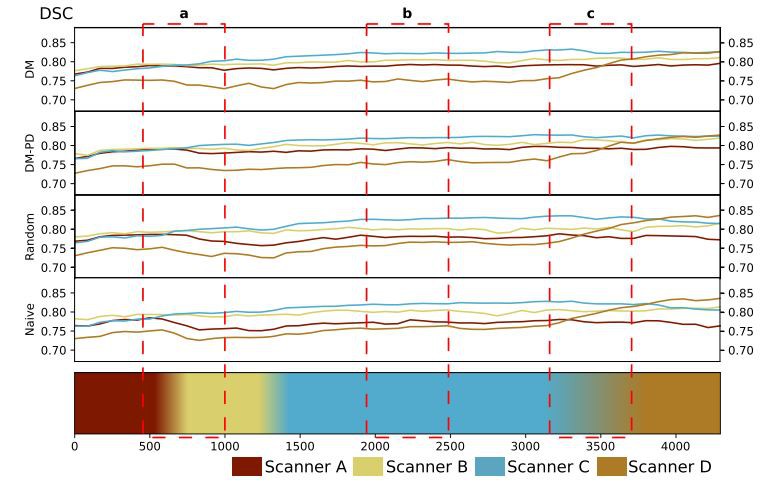
Fig. 2 Cardiac MR segmentation. Dice score (DSC) on the validation set during training for M = 128 for DM and DM-PD, compared to random replacement and naive continual learning. The timeline at the bottom represents a continuous data stream and the change of domains in the stream. A drop of DSC for Scanner A can be observed when Scanner B occurs in the stream, DM and DM-PD were able to recover from this drop using the memory; b all methods are stable during training with Scanner C, and c as soon as Scanner D data flows in, we see a quick rise of DSC for Scanner D validation samples. Naive and random replacement lose some DSC points during that period, while DM remains stable. This significant and rapid change shows that Scanner D is different compared to the others and not as closely related as Scanner B and C.
Supplementary Table 5 shows results of comparing different memory sizes M = 〈64, 128, 256, 512, 883〉 (883 corresponds to storing all samples of the continuous stream to memory). For DM, a larger memory size was beneficial compared to smaller memory size. For DM-PD, the results showed that the smaller the memory (M = 64 and M = 128) the more performance gain was achieved by pseudo-domain (PD) detection compared to mere DM. For larger memory sizes, the benefit of PDs vanished. Due to differences in the training sequence, the performance DM with M = 883 was different from those of JModel. While DM/883 performed better on Scanner E and F, JModel showed higher AP values for Scanner G and H.
In Fig. 4, the change in validation performance during training is depicted for DM and DM-PD with M = 128 compared to random replacement memory and naive continual learning. While the random replacement and naive strategy showed forgetting, especially for Scanner G, DM and DM-PD kept the performance high without catastrophic forgetting.
To analyze the performance of DM in lung nodule detection in detail, precision-recall curves for DM and DM-PD with M = 128 were compared to naive continual learning and a base model trained on data from the first scanner E only (Fig. 5a). The base model performed worse than continual learning approaches for all domains, even on test data from the domain on which the model was trained on. This showed that knowledge from subsequent scanners can improve final model performance on Scanner E. As expected, the base model’s performance deteriorated for the subsequent scanners. The precision-recall curves of the naive continual learning approach showed improvement over the base model. Compared to DM and DM-PD, it exhibited a worse performance for scanners E–G and slightly better performance for scanner H. This illustrates how naive continual learning could adapt to new scanners but—in contrast to DM and DM-PD—suffered from forgetting, while updating the model to scanner H data.
In Fig. 5b bounding box detections for all four domains are shown. Overall, a higher number of false positives occurred for the naive approach compared to DM and DM-PD. Given the fact that we performed detection on 2D slices only, DM and DM-PD showed a good overall performance. For lung nodule detection, we showed a clear benefit using rehearsal with our DM method in continual learning settings with unknown domain shifts.
Pseudo-domain detection maintains a more balanced memory.
For lung nodule detection, we analyzed differences between training DM with the pseudo-domain module versus training without the pseudo-domain module for M = 128. First, we evaluated how the samples in memory at the end of training were distributed compared to the whole training corpus by embedding the Gram matrices of all training samples to an embedding space using t-distributed stochastic neighbor embedding (TSNE)23.
Figure 6a shows a clear distinction between the domains of Scanner F, Scanner H, and Scanners E and G. Scanners E and G were close according to their style due to the similar reconstruction kernel used for those domains. The markers in the figure indicate the samples in memory at the end of continual training. For DM-PD, those were more equally distributed over the whole training set.
This observation was confirmed by data depicted in Fig. 6c where we observed a clear over-representation of the first domain (Scanner E) overall subsequent domains for training with DM only, compared to balancing with pseudo-domains (DM-PD).
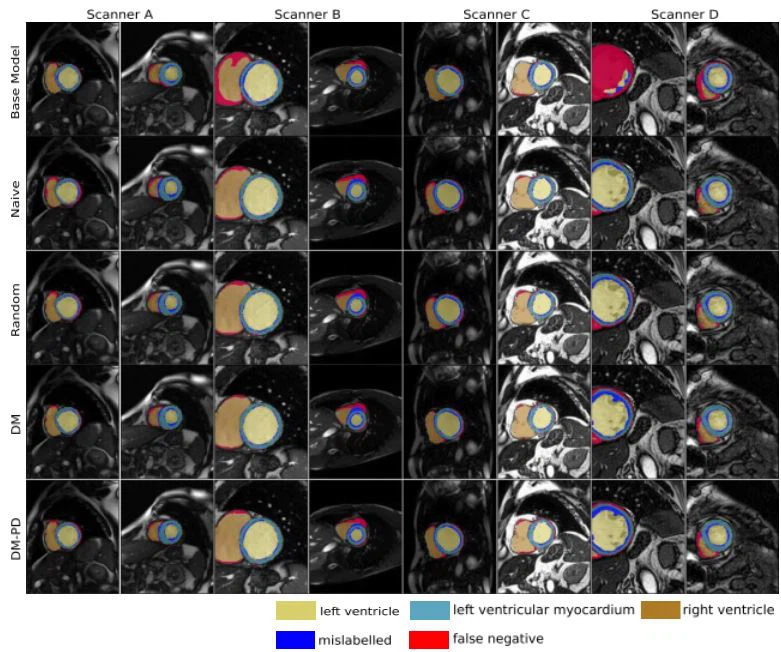
Fig. 3 Qualitative examples for cardiac segmentation. Results for DM and DM-PD with M = 128 compared to naive continual learning and random memory replacement. Mislabelled refers to pixels that were labeled, but the class membership was confused by the model. The base model was trained in a static training approach on data from Scanner A only.

Figure 6b shows an analysis of the number of domain elements assigned to pseudo-domains. For the example of a single training run, five pseudo-domains were detected. PD-1 represented the real domain of Scanner E. PD-4 and PD-5 represented samples from two scanners, F and G. In PD-2 and PD-3, no clear distinction of domains were represented. Overall, we observed
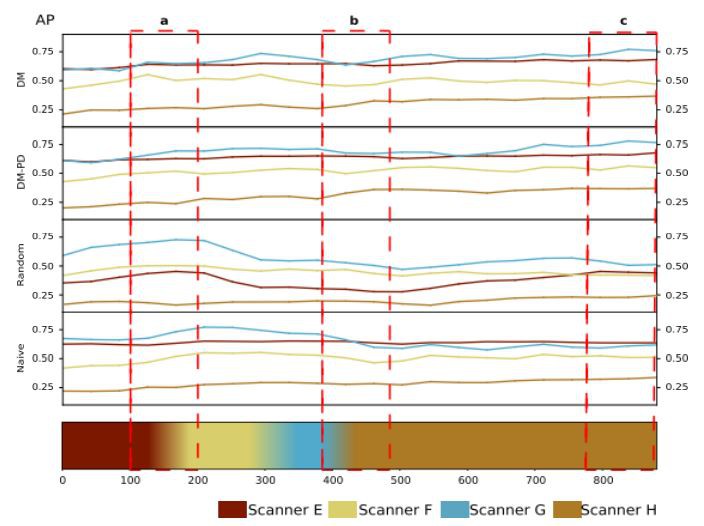
Fig. 4 Lung nodule detection. Average precision (AP) was measured on the validation set during training for DM and DM-PD with M = 128 as well as a random replacement memory and naive continual learning approach. The timeline at the bottom represents the changes in domains in the data stream. As soon as Scanner F data occurred in the stream, the validation performed on the Scanner F (and also Scanner G) domain increased for all approaches. b A clear drop in performance (AP) occurred for the naive and random replacement approach for Scanner E, F, and G, after some steps of training on Scanner H data, which marked catastrophic forgetting. For DM, the performance first dropped slightly, but recovered after some training steps, because samples from the memory are used for training. The DM-PD performance remained stable for Scanners E, F, and G. c At the end of continual training, a better performance was achieved for Scanners E, F, and G, when dynamic memory was utilized. For Scanner H, the performance for all three approaches was similar. d The performance for Scanner E was stable during the entire continual training process for all approaches, showing a base training that was saturated for scanner E.that using the pseudo-domain module was beneficial to maintain a balanced memory, which was representative of the whole training set distribution.

cistanche reviews: improve memory
Discussion
Machine learning is expanding the use of medical imaging data for diagnosis and prognosis. Advances in deep learning enable the computational detection, segmentation, and classification of entities associated with disease, thus informing individual treatment decisions. After the first iteration of static DL, models have been proven to be effective, the challenge is now to make them sustainable in an environment of continuous advances in image acquisition technology, protocols, or even treatment options. Here, we show that an approach that maintains a diverse dynamic memory could adapt models to changing imaging technology, as it coped with domain shifts. Importantly, while the model learned from new data, it retained the diversity of a rehearsal memory, to remain accurate and reliable across the entire repertoire of imaging sources it had seen. Furthermore, we observed that model knowledge was successfully transferred across scanners. Including training data from other scanners yielded benefits for model accuracy on an individual scanner.
Domain shifts due to scanner variability and their detrimental effects on machine learning (ML) algorithms have been observed in different image modalities, such as computed tomography (CT) and magnetic resonance imaging (MRI). For CT, the influence of scanners and reconstruction parameters on ML predictions as well as on human annotations, have been studied for chest CT examinations. Demonstrating that scanner variability has a negative influence on radiomics24,25 and other imaging features26, this needs to be considered when designing ML models. In ref. 27, the effect of using multiple MRI scanners on ML algorithms for brain MRI was empirically evaluated. To reduce the effect of scanner variability in longitudinal, multi- scanner MRI studies, harmonization28,29 has been applied. However, different from our work, those methods assume that all data is available at once, which is not the case for a model deployed in clinical practice.
Previously, various methods have been proposed to alleviate catastrophic forgetting10,11 in continual learning settings. These approaches can be divided broadly into three categories: rehearsal and pseudo-rehearsal methods19,30–33, regularization-based approaches18,34,35, and parameter isolation methods36,37. For a detailed review, see refs. 10,11. The majority of those approaches are incremental task learning methods. They focus on learning new tasks incrementally without forgetting the knowledge required for previous tasks. Lately, methods that have focused on accounting for domain shifts have been proposed38–40. Domain adaptation (DA) is a related area of research dealing with domain shifts41–43. DA focuses on


Fig. 5 Quantitative and qualitative results for lung nodule detection. a Precision–recall curves of the final naive, DM, and DM-PD trained model compared to a base model trained on only scanner E data. Shaded areas represent confidence intervals for n = 5 independent training runs. b Samples of lung nodule detection of the final naive, DM, and DM-PD trained model compared to a base model trained on only scanner E data on all four domains. Green boxes indicate true-positives, yellow boxes false-negatives, and red boxes false-positives.
adapting the knowledge learned on one or multiple source domains to a target domain. In medical imaging, DA is used to adapt between different imaging modalities or different image acquisition settings44. It assumes access to the source and target domain at once, which is not applicable to a setting using a continuous data stream. Furthermore, DA requires the knowledge of a domain- or task membership for each sample. This assumption is not realistic in real-world medical imaging. There the variability of metadata encoding image acquisition information does not directly map to the comparability of imaging characteristics13. Since we do not assume to have access to this knowledge, these methods are not applicable for continual learning in the clinical routine. Hence, to date, they have not been adopted in practice. A third related area is transfer learning45. Here, an existing model is transferred to a new task or domain by fine- tuning on new data. The sole aim is a model performing well there, regardless of its capability to work well on the initial domain. During fine-tuning no data from the initial domain is necessary.
Our results show that the capacity of static models to segment and detect is limited when data is acquired with image acquisition machines outside the initial training distribution. At the same time, naive approaches that continuously train on new scanners forget old imaging characteristics, losing their ability to process data with previous acquisition characteristics. By continuously including new training data, while maintaining a diverse rehearsal set, dynamic memory yields good performance across the entire set of observed scanners. The detection of pseudo-domains, representing sub-cohorts that exhibit similar style or imaging characteristics, yields groups of images that correspond to scanners, or groups of scanners that share similar appearance properties. Their detection and injection into the training process for
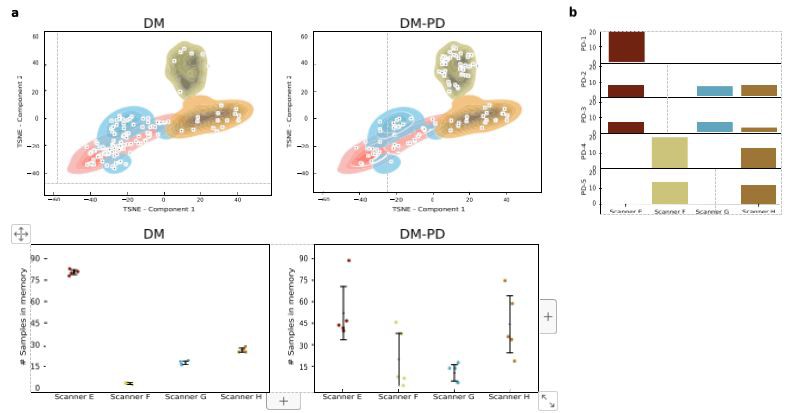
Fig. 6 Enhancing memory diversity. Comparison of memory composition for DM vs. DM-PD for M = 128. a TSNE over the Gram matrices of the training set shows a distinction of the domains. Markers show positions of memory elements at the end of training for one run. DM-PD shows a more equal distribution over the whole training set. b Five pseudo-domains detected were detected for a single training run of DM-PD; bars show the number of domain elements assigned to the pseudo-domains. c Amount of domain elements in memory after training for DM and DM-PD. Error bars represent standard deviation and mean (middle line), n = 5 independent runs.
DM further improves model performance. Importantly, these pseudo-domains can span multiple scanners if they share imaging characteristics. The usage of a style-based metric alleviates the need for domain membership knowledge and demonstrates similar performance to state-of-the-art continual learning methods that use this information.
A further benefit of the approach compared to the training of scanner-specific models, is that model performance on a particular scanner typically benefits from training on other scanners. Feature representations of the model obtain better generalizability from training on related but different data. This leads to the processing of new scanner data that profits from training on older scanners (forward transfer), and vice versa (backward transfer). Results were consistent across different imaging modalities (MRI, CT) and image analysis tasks (segmentation, detection).
Results from our cardiac MRI segmentation proved that DM is beneficial compared to naive continual learning, exhibiting less catastrophic forgetting and reaching results comparable to models trained on a static training set which consisted of data from all domains. Similar effects occurred in lung nodule detection in CT, and results showed that using pseudo-domains (DM-PD) led to fewer false-positive detections, than standard dynamic memory.

desert cistanche dragon herbs
Our approach is a step toward the design of a strategy to learn on a continuous data stream of medical images that can potentially be deployed in clinical practice. Nevertheless, the method has several limitations. First, more research is needed to demonstrate that we can design systems that guarantee that there is no catastrophic forgetting in the future when the number of scanners is scaled up substantially. Proving that the performance of DL models will not decline with future domains is challenging. Second, DM requires storing a subset of the images for rehearsal during training. While this rehearsal set is substantially smaller than the entire data set, privacy concerns or storage limitations may become relevant. Finally, we do not take the cost of annotating cases into account, assuming that there are target labels or bounding boxes for training available for each sample in the data stream. In clinical practice, this assumption does not hold, and a human-in-the-loop concept7 such as active learning46 is needed to collect new annotations for unknown domains economically.