Exploring The Mechanism Of Action Of Cistanche Total Glycosides On Inflammatory Bowel Disease Based On Network Pharmacology And Animal Experiments Ⅱ
Mar 29, 2024
2 Test methods
2.1 Network pharmacology analysis
2.1.1 Active ingredients of Cistanche deserticola
On the basis of existing studies [7, 22], "Echinacoside", "Verbascoside", "Cistanoside A", "Tubuloside A", "Isoacteoside", "2-Acetylacteoside" and "Tubuloside B" were selected as the bioactive components for analysis. Find the three-dimensional chemical structure data of the above seven ingredients through Pubchem (https://pubchem.ncbi.nlm.nih.gov/) and save them in sdf format.
2.1.2 Prediction and screening of potential targets
Import the three-dimensional structure files of the active ingredients into the PharmMapper database (http://lilab-ecust.cn/pharmmapper/index.html). Select "human protein targets only" as the target species, and keep the other options as default to obtain the corresponding data of different ingredients. Corresponding target target.
The UniProt database (https://www.uniprot.org/) was used to obtain the protein name and gene name information corresponding to each target. Merge the target points corresponding to the 7 components.
In the GeneCards database (https://www.genecards.org/), use "inflammatory bowel disease" as the keyword to search for genes related to inflammatory bowel disease, and organize the search results.
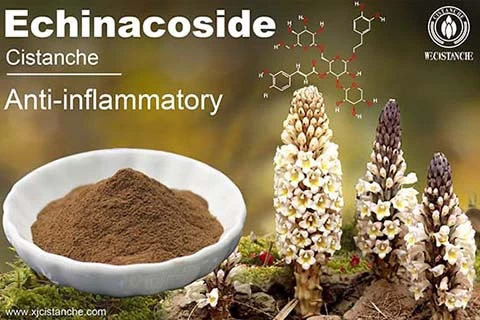

Cistanche supplement Anti-Inflammatory support supplement PhGs75% Ech 30% Act 12%
2.1.3 Protein-protein interaction (PPI)
Network construction Use jvenn (https:/jvenn.toulouse.inrae.fr/app/example.html) to draw a Venn diagram online to obtain the intersection of Cistanche deserticola active ingredient targets and IBD targets. Upload the obtained intersection targets to the String database for PPI screening analysis. Download the TSV file of the PPI network, import it into Cytoscape 3.8.0, calculate the degree value of the protein interaction network, and then beautify the PPI network diagram based on the degree value.
2.1.4 Gene Ontology (GO)
Functional enrichment and Kyoto Encyclopedia of Genes and Genomes (KEGG) pathway enrichment analysis were performed using the DAVID database (https://david.ncifcrf.gov/) to identify the targets of the protective effects of Cistanche deserticola active ingredients on IBD. GO analysis was performed on the points, and then the DAVID database was used to conduct KEGG pathway enrichment analysis on the targets where the active ingredients of Cistanche deserticola play a protective role in IBD.
2.1.5 Construction of Cistanche deserticola "active ingredient-target-pathway" network
The active ingredients of Cistanche deserticola, the intersection targets of Cistanche deserticola active ingredients and IBD and the pathways enriched by KEGG were used to construct an active ingredient-target-pathway network.
2.2 Animal model validation
2.2.1 Establishment of animal model
SPF grade male BALB/c mice (5~8 weeks, 18~21 g) were used, provided by the Health Food Testing Center of the School of Applied Arts and Sciences, Beijing Union University [Experimental Animal Use License Number: SYXK (Beijing) 2017-0038], They were kept in an SPF-grade animal room with a temperature of (23±2)°C, a relative humidity of 50% to 70%, and 12 h of fluorescent light exposure alternating day and night. The animal experiment protocols were all approved by the Animal Laboratory of the Health Food Testing Center, School of Applied Arts and Sciences, Beijing Union University. After adaptive feeding for 3 days, 20 mice were randomly divided into 4 groups according to body weight, with 5 mice in each group. ①Control group (CZ): drink sterile water freely and gavage sterile water for 7 consecutive days; ②DSS control group
(DZ): Free to drink 3% DSS solution prepared daily for 7 consecutive days; ③ Low-dose group of total glycosides of Cistanche deserticola (LZ) (liquid concentration: 0.1 g/mL): Free to drink 3% DSS solution prepared daily for 7 days; , gavage liquid for 7 consecutive days; ④ Cistanche deserticola total glycosides high-dose group (HZ) (liquid concentration 0.4 g/
mL): Drink the freshly prepared 3% DSS solution every day freely, and give the solution by gavage for 7 consecutive days. After 7 days of continuous modeling, they were fasted for 12 hours and then sacrificed by cervical dislocation. Chicken red blood cells were injected intraperitoneally 4 hours before execution. Immediately after execution, the eyeballs were removed to collect blood. The peritoneal fluid was extracted and the abdominal cavity was opened. The length of the colon was measured, and the mouse spleen, Peyer's knot and other organs were removed.
Cistanche supplement Anti-Inflammatory support supplement
2.2.2 Disease activity index (DAI)
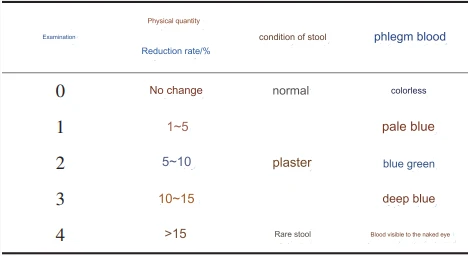
The mice were weighed before intragastric administration at a fixed time every day, and the mental state and fecal properties of the mice were observed. Fecal occult blood was measured and scored accordingly. The scoring standards are shown in Table 1. DAI score = (body weight score + fecal character score + fecal occult blood score)/3 (1)
Table 1 Scoring criteria of DAI
2.2.3 Real-time fluorescence quantitative PCR detection immune signal pathway (qRT-PCR) detection
Mouse spleens were collected, cut into 0.5 cm tissue blocks, and soaked in tissue RNA stabilizing solution for storage. Remove the tissue and cut it into pieces, add RNA extraction solution and grind to pieces to extract the total RNA. After reverse transcription and PCR amplification, the activation of two key immune signaling pathways, mTOR and TGF-β, in mouse spleens was detected. The primer sequences used in qRT-PCR are shown in Table 2.

Table 2 Primer sequence table