Kidney Function in Acromegaly
Mar 14, 2022
Contact: Audrey Hu Whatsapp/hp: 0086 13880143964 Email: audrey.hu@wecistanche.com
P. C. Eskildsen et al
ABSTRACT
Creatinine clearance and daily urinary albumin and P2-microglobulin excretion rates (radioimmunoassays) were measured several times in 14 patients with acromegaly. Eleven patients were treated with bromocriptine, 5 to 55 mg/day. The activity of the disease was assessed by measuring urinary growth hormone excretion (radio-immunoassay).

Cistanche for improving kidney function
Click to Cistanche for kidney disease
In agreement with previous investigations, we found the creatinine clearance elevated. However, no correlation was found between this variable and the urinary growth hormone excretion. Urinary albumin and /I2-microglobulin excretion rates were not significantly different from our previous results in 27 adults control subjects. There was no correlation between urinary growth hormone excretion and urinary albumin or &-microglobulin excretion rates. Bromocriptine treatment reduced urinary growth hormone excretion from 220 to 91 ng/24 hours, p<0.0l, but no significant alterations were induced in the above-mentioned kidney function variables.
It is well known that glomerular filtration rate (GFR), renal plasma flow (RPF), and kidney size are increased in acromegaly (5, 9). Unfortunately, no information is available concerning a relationship between those alterations and the degree of growth hormone elevation. But the administration of a large dose of growth hormone (10 mg/day) for 4 days induces an increase in GFR and RPF (1). These findings and the demonstration of elevated plasma growth hormone concentration in poorly controlled short-term juvenile diabetics ( 7 ), led Mogensen (12, 13) to suggest that growth hormone is an important factor for the increase in kidney size and function typically found in poorly controlled juvenile diabetics.
To elucidate the relationship between growth hormone and kidney function, creatinine clearance, urinary albumin, and fi2-microglobulin excretion rates were measured in acromegalic patients with highly different urinary growth hormone excretion rates.
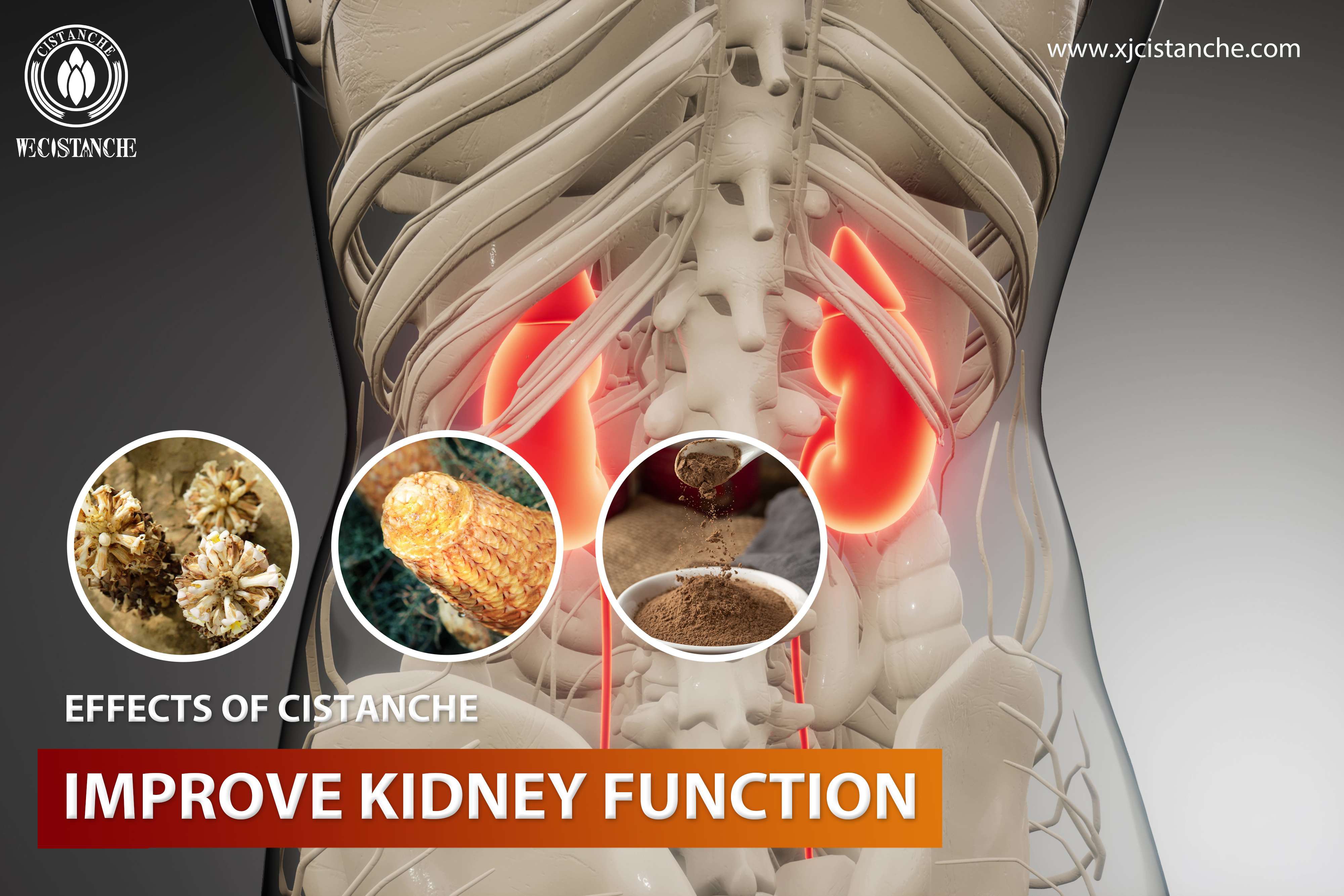
Benefit of cistanche: improve kidney function
MATERIAL AND METHODS
Fourteen acromegalic patients, 9 females and 5 males aged 32-75 years (mean 55 years) were investigated several times during a 7 months period. The diagnosis was based on the criteria previously described (3). Eleven patients were treated with bromocriptine (Parlodel) in doses of 5 to 55 mg per day (mean 20 mg per day). In 7 patients the treatment was either not yet started or discontinued at one or two of the investigations. Three patients were not treated during the investigation period. Five of the patients had a non-insulin-dependent diabetes mellitus in good metabolic control (fasting blood glucose < 10.5 mmo/l, glucosuria < 3 g/24 h). Three patients had arterial hypertension treated with thiazide and propranolol or methyldopa, 160-130/105-90 mmHg).
At least twice during the observation period, the urine was collected for one 24 hour period and stored deep-frozen until analysis. Albumin, µglobulin, and growth hormone were measured by means of sensitive radio-immunoassays (4, 8, 11). Creatinine was measured with conventional laboratory techniques. The intraindividual variation in urinary excretion of creatinine was on average 7 O/o, range 4-17 percent.
The results were compared with those obtained in 27 adult control subjects (mean age 45 years), using identical techniques (13). Statistical analysis was performed using Wilcoxon's test for unpaired and paired observations.

Cistanche improves kidney function
RESULTS
Fig. I shows the urinary excretion rate of albumin and &-microglobulin plotted against the urinary excretion rate of growth hormone in all urine samples collected from the 14 acromegalic patients. l t clearly appears that no correlation exists between these variables. In spite of an abnormal high urinary growth hormone excretion rate (>100 ng/24 hours) at more than half of the investigations, the urinary albumin excretion rate was within the normal range in nearly all cases. The highest albumin excretion rate was found in a female diabetic with a urinary GH excretion rate close to the normal range. The urinary &-microglobulin excretion was within the normal range in all cases.

Fig. 1. Urinary excretion of albumin and β2-microglobulin plotted against urinary growth hormone excretion in 14 patients with acromegaly, investigated from 2 to 4 times. The upper normal range is shown by the dotted line. ▲=acromegalic patients with diabetes mellitus
Fig. 2 demonstrates the lack of correlation between creatinine clearance and urinary growth hormone excretion rate. In spite of the patient's mean age of 55 years, a creatinine clearance of 2 120 ml/min/1.73 m* was found in nearly half of the investigations.
Table I shows kidney function and urinary GH excretion in seven patients before and during bromocriptine treatment. Additional 3 patients treated with different doses of bromocriptine are included in the table. The interval between the two measurements ranged from 0.5 to 7 months, mean of 3.3 months. The treatment induced a significant reduction in urinary growth hormone excretion, a mean of 91 ng/24 hours, compared to a mean of 220 ng/24 hours before starting or increasing the bromocriptine therapy. A small insignificant reduction was found in both urinary albumin and µglobulin excretion rates during bromocriptine treatment. Urinary albumin and 82-microglobulin excretion rates did not differ significantly from our previous control values. Creatinine clearance was elevated to nearly the same extent before and after bromocriptine treatment.

Fig. 2. Creatinine clearance plotted against urinary growth hormone excretion in 14 patients with acromegaly, investigated from 2 to 4 times. ▲= acromegalic patients with diabetes mellitus.

DISCUSSION
The present investigation was designed to study the relationship between kidney function and growth hormone secretion rate. Our results in acromegaly do not indicate any relationship between kidney function and urinary growth hormone excretion. The urinary albumin and β2-microglobulin excretion rates were not statistically significant from our previous control values (14). In agreement with several previous studies, we found GFR elevated (5, 9). The mechanisms of the elevated GFR and RPF (filtration fraction unchanged) in acromegaly are not fully understood. Enlargement of extracellular fluid volume (ECV) and increased kid new mass have been suggested as the cause (5, 6, 9). GFR and RPF are closely correlated to ECV in normal man and acromegalic patients (5, 9). Growth hormone administration in man for several days increases ECV (10) and GFR and RPF (1). Kidney function is unchanged during short-term growth hormone elevation in men (15). The enhancing effect of growth hormone on kidney function in dogs can be eliminated if the animals were put on low salt intake (2). The authors suggested that sodium retention and increased ECV are of crucial importance for the effect to be present. It should be mentioned that the decrease in GFR and RPF following hypophysectomy in man is not associated with any significant alterations in ECV (6). Furthermore, the decrease in GFR and RPF was found to occur at a much faster rate than the reduction in kidney mass, suggesting that the alterations are essentially functional rather than due to a reduced kidney mass (6).
From the above-mentioned studies, it appears, that neither the characteristic finding of an elevated filtration fraction (GFR/RPF) nor the increased urinary excretion of albumin and p2-microglobulin is typically found in poorly controlled short-term juvenile diabetics (12, 13), can be explained as a growth hormone effect.

Improve Kidney function-Cistanche
ACKNOWLEDGEMENT
We wish to express our gratitude to Sandoz, Copenhagen, for supplying the bromocriptine (Parlodel)
REFERENCE
1, Corvilain, J., Abramov, M. & Bergans, A.: Some effects of human growth hormones on renal hemodynamics and on tubular phosphate transport in man. J Clin Invest 41: 1230, 1962.
2, Corvilain, J.: Efftct de I’hormonc de croissance sur I’cxcretion rCrde de phosphates. Acta Clin Vet suppl. 3: 1 , 1966.
3, Ikkildsen, P. C., Svendsen, P. Aa., Vang, L. & Nerup, J.: Long-term treatment of acromegaly with bromocriptine. Acta Endocr 87: 687, 1978.
4, Evrin, P.-E., Peterson, P. A., Wide, L. & Berggsrd, J.: Radioiminunoassay of j32-microglobulin in human biological fluids. Scand J Clin Lab Invest 28: 439, 1971.
5, Falkheden, T. & Sjogren, B.: Extracellular fluid volume and renal function in pituitary insufficiency and acromegaly. Acta Endocr 4G: 80, 1964.
6, Falkheden, T. k Wickbom, J.: Renal function and kidney size following hypophysectomy in man. Acta Endocr 45: 348, 1965.
7, Hansen, Aa. P.: Serum growth hormone patterns in juvenile diabetes. Dan Med Bull 19, suppl. I, 1972.
8, Hanssen, K. F.: Inimunoreactive growth hormone in human urine. Acta Endocr 7 1 : 665, 1978.
9, Ikkos, D., Ljunggren, H. & Luft, R.: Glomerular filtration rate and renal plasma flow in acromegaly. Acta Endocr 21: 226, 1956.
10, Ikkos, D., Luft, R. k Gemzell, C. A: The effect of human growth hormone in man. Acta Endocr 32: 341, 1959.
11, Miles, D. W., Mogensen, C. E. & Gundersen, H. J. G.: Radioimmunoassay for urinary albumin using a single antibody. Scand J Clin Lab Invest 26: 5, 1970.
12, Mogensen. C. E.: Kidney function and glomerular permeability to macromolecules in juvenile diabetes. Dan Med Bull 19, suppl. 3, 1972.
13, Mogensen, C. E.: Renal function changes in diabetes. Diabetes 25: 872, 1976.
14, Parving, H.-H., Worm, A. M., Knudsen. I,., Mogensen, C. E. & Rossing, N.: Urinary albumin and j3n-microglobulin excretion rates in patients with extensive skin disease. Acta Dermatoven 57: 305, 1977
15, Parving, H.-H., Noer. I., Mogensen, C. E. k Svendsen, P. Aa.: Kidney function in normal man during short-term growth hormone infusion. Acta Endocr 89: 796. 1978.