Licorice (Glycyrrhiza Glabra, G. Uralensis, And G. Inflata) And Their Constituents As Active Cosmeceutical Ingredients Part 2
Jul 08, 2022
Please contact oscar.xiao@wecistanche.com for more information
4. Skin Anti-Aging
The thinning epidermal layer and the loss of collagen and elastic fiber lead to wrinkle formation and cause aging. Aging occurs due to intrinsic factors like genetics, cellular metabolism, hormone, and metabolic processes, or extrinsic factors like sun exposure, smoking, diet, and pollution [30]. Many people have chosen natural herbs rather than plastic surgery or laser therapy to look younger and reduce complications in the last few years. Plants supply nutrients required for healthy skin, helping the biological functioning of the skin. In addition, phytochemicals derived from plants showed skin beneficial properties related to UV protection, anti-oxidant action, matrix protection, and skin hydration [31,32].
4.1. Anti-Tyrosinase Activity and Hyperpigmentation Diseases
Glycyrrhiza extracts and their compounds have shown beneficial effects to improve skin pigmentation. Melanin, synthesized in melanocyte cells by the melanogenesis process, is responsible for the color of the skin. Different factors play a role in the production and expression of melanin in the skin, such as exposure to UV radiation, genetic predisposition, melanocyte size leading to a difference in the amount of melanin produced per cell, as well as several diseases, including albinism, a genetic inability to produce melanin, and vitiligo, a progressive loss of melanocytes [33]. flavonoids Alteration in melanin could bring hyperpigmentation or hypopigmentation; in particular, a low quantity of melanin can cause local vitiligo and post-traumatic hypopigmentation. Abnormal amounts of melanin deposits in specific sites of the skin cause abnormal skin-colored patches like solar lentigos, chloasma, freckles, and post-inflammatory hyperpigmentation [34,35].
Please click here to know more
Although different mechanisms are involved in the melanogenesis process, key enzymes responsible for melanin biosynthesis are the polyphenolic oxidase tyrosinases. Melanogenesis is the physiological process of melanin formation in which tyrosinase, a copper-dependent enzyme, initiates the first step 36]. hesperidin uses In detail, melanogenesis is directly regulated by three enzymes: tyrosinase, tyrosinase-related protein TRP-1, and TRP-2. Tyrosinase catalyzes the conversion of L-tyrosine to L-DOPA and then to dopachrome, which is subsequently polymerized spontaneously to melanin via a series of reactions [37]; consequently, tyrosinase is responsible for skin hyperpigmentation. In the last few years, this enzyme became an essential target for skin-whitening effects and therapeutic interventions associated with melanin hyperpigmentation [38]. Thus, molecules acting as tyrosinase inhibitors play an important role in cosmetic products as skin-whitening agents and in the treatment of various dermatological disorders. Flavonoids are the most representative class among natural phenolic compounds acting as tyrosinase inhibitors [35]. Numerous plants, among which are Glycyrrhiza spp. and natural compounds, have been reported for tyrosinase inhibitory activity, and they are used in the treatment of skin pigmentation [34](Figure 3). Among Glycyrrhiza spp., the most investigated species is represented by G. glabra. The extract of G.glabra roots is reported for its strong anti-melanogenic activity, tested by reduction of intracellular tyrosinase and melanin content in B16F10 melanoma cells. Methanol and ethyl-acetate extracts of licorice roots exhibited significant activity with low IC50 values(2.1 and 4.7 ug/mL)[38]. Glycyrrhiza glabra extract was also compared to kojic acid, a molecule currently used as a tyrosinase inhibitor, commercially available. The extract inhibited tyrosinase activity by78.45% while kojic acid inhibited it by 99.67%. Unfortunately, koi acid has the disadvantage of being unstable during storage; G.glabra did not show any disadvantages during tyrosinase inhibition, suggesting a possible use of licorice extract in cosmetic formulations [10]. Along with the effects shown by the licorice extracts, secondary metabolites isolated from G.glabra leaves and roots showed anti-melanogenesis activity. Flavonoids occurring in Glycyrrhiza are reported for their anti-tyrosinase activity.

Glabridin showed anti melanogenesis activity due to its tyrosinase inhibitory activity. The structure-activity relationship study highlighted how the hydroxyl groups at 2 and 4 positions seem responsible for the activity. Glabridin inhibited tyrosinase activity in cultured B16 murine melanoma cells at 0.1 to 1.0 μg/mL, without affecting DNA synthesis [39]. It quenched the intrinsic fluorescence of tyrosinase mainly through a static quenching procedure, suggesting a generation of a stable glabridin-tyrosinase complex. Molecular docking calculations were performed to establish the interaction of glabridin with the tyrosinase enzyme. The results indicated that glabridin did not directly bind to the active site of tyrosinase[40]. To increase the glabridin water solubility, Hespeler et al reported the use of smart pearl technology, aimed at improving dissolution velocity in the formulations. Glabridin smart pearl displayed a promising perspective if compared to glabridin raw drug powder, for creating skin products with improved dermal bioavailability [41]. All the features of glabridin smart pearl make it promising for skincare products with improved glabridin efficacy by simultaneously reducing production costs [41].
Other active compounds, such as glabrate, isoliquiritigenin, licuraside, isoliquiritin, and licochalcone A, isolated from licorice extracts, were also shown to inhibit tyrosinase activity [39]. In particular, glabrate and isoliquiritigenin inhibited both mono-and di-phenolase tyrosinase activities. The ICs0 values for glabrate and isoliquiritigenin were 3.5 and 8.1 μM, respectively, when tyrosine was used as substrate. The effects of glabrate and isoliquiritigenin on tyrosinase activity were dose-dependent and correlated to their ability to inhibit melanin formation in melanocytes [42]. Pinocembrin, the main compound in G.glabra leaves, is reported to have a moderate inhibitory effect on mushroom tyrosinase [43].
Cistanche can anti-aging
Lin and coworkers reported semilicoisoflavone B, allolicoisoflavone B, and glabridin for their noticeable tyrosinase inhibitory activities with IC50 of 0.25, 0.80, 0.10 μM, respectively [44]. Successively, Liu et al. developed a method using tyrosinase immobilized magnetic fishing coupled with high-performance liquid chromatography-diode array detector-tandem mass spectrometry (IMF-HPLC-DAD-MS/MS) to screen and identify tyrosinase binders from G.uralensis root without isolation of secondary metabolites by the complex extract. Secondary metabolites of G, uralensis root such as Ligurian apposite,neroli-curbside, liquiritigenin, licorice saponin G2, chrysoberyl, dihydrodaidzein, formononetin, glycyrrhisoflavanone, glycyrrhizinic acid, licoarylcoumarin, and pretense in showed the capacity to inhibit tyrosinase activity [45].
Literature reports how dehydroglyasperin C could be considered a whitening ingredient against hyperpigmentation in the skin. Dehydroglyasperin C decreased in a dose-dependent manner intracellular tyrosinase activity and expression of proteins related to melanin synthesis (TYR and TRP-1)in keratinocytes treated with α-MSH (melanocyte-stimulating hormone) to induce melanogenesis [46]. A series of licochalcones, consisting of licochalcone A, B, C, and E, normally isolated from the roots of G.inflata, showed tyrosine phosphatase 1B (PTP1B) inhibitory activities [11].
Multiple signaling pathways involved in melanogenesis were extensively described by Maddalena et al., specifically in the regulation of the microphthalmia-associated transcription factor (MITF)[47]. MITF is a basic helix-loop-helix leucine zipper that regulates the expression of melanogenic enzymes(tyrosinase, TYRP1, and TYRP2) and melanosome structural proteins (MART-1 and PMEL17) [5].
Dehydroglyasperin C also reduced the downregulation of MITF (melanocyte-specific transcription factor)through suppression of the cAMP-CREB pathway. Phosphorylation of extracellular signal-regulated kinase(ERK) also decreased MITF by dehydroglyasperin C treatment [46]. Licochalcone A inhibited melanogenesis through MAPK/ERK pathway by activating ERK. The MAP kinase family also regulates melanogenesis; phosphorylated p38 can activate microphthalmia-associated transcription factor(MITF), promoting melanin synthesis, whereas phosphorylated ERK can inhibit the activation of MITF.
A formulation of liquidity cream (20% of liquidity) applied at 1 g/day for 4 weeks showed therapeutical effectiveness in melasma disease. However, this study suggests that liquidity probably did not affect tyrosinase, which caused depigmentation by other mechanisms [48].
4.2. Skin Lightening Activity
Disorders of hyperpigmentation, including post-inflammatory hyperpigmentation, skin problems such as freckles, age spots, acne scars, discoloration related to hormones, and skin exposure to sunlight, could induce skin pigmentation disorders. These pigmentary skin disorders, such as melasma, can have a consequent psychosocial impact. Skin lightening creams represent the products that work on skin by reducing melanin. Skin lightening products are also known as whiteners for naturally dark skin and skin brighteners (Figure 4) [49].

Ishi et al.reported different types of oil in water(O/W) herbal creams using herbal extracts such as Curcuma longa, with excellent potential for anti-aging, and G.glabra, known for the therapeutic effects in skin whitening, plus stearic acid and cetyl alcohol, and other excipients. The evaluation of formulations highlighted how they were safe to be used for the skin and could be used as skin lightening and anti-oxidant agents [50].
At the same time, other researchers evaluated the skin lightening capacity of G.glabra root extracts in cream preparation. In particular, Kirubakaran et al. highlighted the skin-lightening properties of cream prepared using G.glabra root extracts and G. India bark extracts and physical sun-protecting agents such as titanium dioxide. lost empire cistanche Synergism between selected extracts generated the melanin inhibition effect through the cellular melanin inhibition pathway. Consequently, the preparation mentioned above could be used for skin-whitening for better skin aesthetics [33].

A herbal face cream, in which G. glabra was combined with other herbal extracts, showed multipurpose effects such as whitening, antiwrinkle, anti-aging, and sunscreen effect, due to a synergistic effect between all the extracts [51]. In addition to the ex-tracts, the skin-whitening properties were also reported for the bioactive compounds glycyrrhisoflavone, kaempferol, glycerin C, and glycerin D [52,53]. 4.3. Anticorinkle Activity
Among the most frequent phenotypic manifestations of intrinsic and extrinsic aging is the onset of wrinkles at different depth levels, due to the progressive loss of structural integrity and physiological function of the skin [54]. The inevitable intrinsic skin aging is due to physiological aging characterized by the decline of collagen, elastin, and hyaluronic acid levels, leading to a loss of strength and flexibility in the skin, which results in visible wrinkles associated with the thickened epidermis, mottled discoloration, laxity, dullness, and roughness of the skin. Extrinsic skin aging is due to diverse determinants such as sun exposure, external pollutants, smoking, and diet [55].
Exposure of human skin to ROS (reactive oxygen species)through several factors, including UV, has been reported to enhance matrix metalloproteinases (MMPs) activity associated with a notable breakdown of collagen fibers. MMPs, in particular gelatinases (MMP-2 and-9) that cleave soluble type-IV and type-I collagen, represent the major enzymes responsible for the degradation of the extracellular matrix which contains diverse biomolecules including collagen and gelatin (Figure 4)[56].
Ryu et al. reported how 1,3-butylene glycol extract of G. uralensis reduced ROS production by inhibition of MMP-2 activity along with the consequent increase of collagen production. Furthermore, the results suggested the use of G. uralensis extract as a cosmetic ingredient with antiwrinkle and anti-oxidant effects [55]. micronized purified flavonoid fraction 1000 mg uses Antiwrinkle activity by anti-oxidant mechanism has been proved for G.glabra extract at the dose of 150 mg/kg/day [57]Moreover, Ciganovic et al. highlighted for G.glabra extract, obtained by a green ultrasound-assisted extraction method using glycerol/water mixtures, a good anti-oxidant activity tyrosinase, and elastase inhibitory activity as well as anti-inflammatory activity, leading to excellent anti-aging properties [58]. Prenylflavonoids dehydroglyasperin C, dehydroglyasperin D, and isoangustone A showed a superoxide scavenger activity as a mechanism to prevent wrinkles [59].
Moreover, eicosanyl caffeate and docosyl caffeate, two long-chain caffeoyl esters isolated by ethyl acetate extract of G. glabra roots displayed by a spectrophotometric assay a potent elastase inhibitory activity, an additional target to prevent aging and wrinkles formation 【60】, with ICso values of 0.99 μg/mL and 1.4 μg/mL, respectively【61】.
5. Photoprotective Activity
Ultraviolet (UV) irradiation causes several areas of damage to the skin. Together with immune suppression, cancer, tanning, and sunburn, it provokes injuries called photoaging consisting of connective tissue degradation [62](Figure 4). UV-B rays are the most dangerous, producing physiological responses connected with oxidative stress, resulting in cell death at high dosage. On the other hand, minor UV-B irradiation induces oxidative stress and activates intracellular signal transduction pathways. Several anti-oxidants extracted from plants are involved in reduced incidence of photocarcinogenesis and photoaging, and, for these reasons, the relative extracts can be considered for their skin photoprotective effects[63].
5.1. Anti-Photoaging Effects
Photoaging is the macroscopic and microscopic modification caused by persistent sun exposure. Most effectors involved in skin photoaging are pro-inflammatory cytokines, ROS, and effector molecules like MMP-1. Their generation is controlled by NF-kappa B, produced due to UV exposition (Figure 4)[64].
Afnan et al. in 2012 evaluated the effect of glycyrrhizinic acid on UV-B photoaging induced by irradiation with a sub-toxic dose of UV-B (10 MJ/cm2) of human dermal fibroblasts (HDFs) and its possible mechanism of action. The involvement of glycyrrhizinic acid on cell viability, matrix metalloproteinase 1 (MP1), pro-collagen 1, cellular and nuclear morphology, cell cycle, intracellular ROS, caspase 3, and hyaluronidase inhibition assays was evaluated. The principal mechanism appeared to be connected with the block of MMP1 activation by modulating NF-kB signaling [65].

Based on the involvement of MMP in photoaging, a study published in 2017 by Xuan et al. assessed the anti-photoaging effects of dehydroglyasperin Con MMPs levels in HaCaT human keratinocytes and tried to elucidate the biological mechanism. Dehydro-glyasperin C noticeably repressed UV-B-mediated expression of collagenase (MP-1) and gelatinase (MMP-9) by inhibiting ROS generation. Dehydroglyasperin C treatment also decreased the UV-B irradiation-mediated activation of mitogen-activated protein kinase (MAPK),c-Jun phosphorylation, and c-fos expression. In addition, the down-regulation of UV-B-induced c-Jun phosphorylation caused by dehydroglyasperin C treatment was more intense than the down-regulation of c-fos expression. In conclusion, it appeared that dehydroglyasperin C may work as a potential anti-photoaging agent by inhibiting UV-B mediated MMPs expression via suppression of MAPK and AP-1 signaling (Figure 4) [66]
Other phytochemicals extracted from Glycyrrhiza spp. appeared to be involved against photoaging caused by UV-B. Puri and coworkers 2017 published a paper on the development of microemulsions of dibenzoyl methane for the treatment of UV-induced photoag-ing[67]. Dibenzoylmethane exerted sunscreen activity, preventing the damage caused by UV rays. It acted as a UV-A screen that prevented the penetration of the UV radiation in the vital cells and blocked the overproduction of ROS. The authors evaluated in vivo photoprotection in a mice model of UV-radiation-induced photodamage [67]. Another compound evaluated for its contribution to reducing photoaging was licoricidin. Its effects were assessed on photoaging of human dermal fibroblasts (HDFs)submitted to irradiation with UV-A. Licoricidin blocked UV-A-induced photoaging acting as a ROS scavenger. This activity is connected with the modulation of MMP-1 [68].
5.2. Photoprotectioe Effect against UV-B and Visible Radiation
In addition to the UV protection, Mann et al. 2020 investigated ROS production induced by visible radiation and the mechanism of photoprotection of licochalcone A. The mechanism appeared to involve the stimulation of the Nrf2/ARE signaling pathway, as preliminarily presented in a previous study [69,70]. Randomized clinical trials were carried out to assess the anti-irritative potential of formulation with licochalcone A on UV-induced erythema formation. The formulation caused a highly noteworthy reduction in UV-induced erythema tests, resulting in a powerful inhibition of pro-inflammatory in vitro reactions, including UV-B-induced PGE2 release by keratinocytes [71]. The activity of licochalcone A on UV-B-induced erythema was also tested and confirmed on patients with rosacea and red facial skin, for whom skin tolerance, efficacy, and quality of life were evaluated [72].
Melatonin (N-acetyl-5-methoxytryptamine) is synthesized and secreted by the pineal gland in vertebrates. The occurrence of melatonin in roots of G.uralensis and the response of this plant to different light (red, blue, and white) and UV-B irradiation (280-315 nm)for the synthesis of melatonin were investigated. oteflavonoid Production of melatonin in G. uralensis plants is connected with protection against oxidative damage initiated as a response to UV irradiation [73].
In a more specific cosmetic approach, a moisturizing cream (oil in water)-based formulation containing an extract of Beta-vulgaris (1%o) and an extract of G.glabra(1%)was developed to provide UV-A/UV-Bprotective moisture to be used for post-laser therapy. In addition, this cream facilitated re-pigmentation by stimulating melanocytic proliferation and removing stubborn scars and wrinkles [74].
5.3.Anti-Oxidant Effects
Anti-oxidant activity of the functional ingredients in cosmetic products is of great importance. Functional cosmeceutical ingredients with anti-oxidant activity may have a more active role in such products [31]. They also offer protection against oxidative damage of skin macromolecules associated with the effects of free radicals and UV radiation on the skin [58,75]. The anti-oxidant activity of G.glabra is one of the reasons for its uses in cosmetics and generally is connected with other activities like photoprotection. The phenolic content is probably responsible for the observed antioxidant activity attributed to flavonoids, isoflavones, methylated isoflavones, and chalcones [76,77].
The anti-oxidant potential of glabridin was reviewed in a specific paper on the potential of glabridin and its biological properties [17].
Licochalcones B and D showed a strong scavenging activity in the DPPH assay and the ability to inhibit microsomal lipid peroxidation. These phenolic compounds appeared to be effective in protecting biological systems against oxidative stress, being able to inhibit skin damage [78,79].
The anti-oxidant potential of licorice to be used for preserving cosmetic formulations was evaluated. The extract was tested for anti-oxidative activity in comparison with antioxidants (sodium metabisulfite and BHT) at 0.1%, 0.5%, 1.0%, and 2.0% wt./wt. in a cream formulation with 2%wt./wt. of hydroquinone. The results suggested the use of licorice extracts at 0.5 and 1.0% as an effective natural anti-oxidant able to preserve formulations that are susceptible to oxidation [80].
On the other hand, it appears that not only phenolic compounds are involved in the anti-oxidant effect of licorice extracts. In addition saponins from licorice showed anti-oxidant activity, suggesting their possible use in body wash cosmetic products [81]. Polysaccharides isolated from three varieties of G.glabra also exhibited antioxidant activity [82]. Due to their good anti-oxidant properties, licorice polysaccharides are suggested as an additive to delay skin aging and prevent the formation of chloasma in cosmetics [6].
Sometimes Glycyrrhiza extracts were used in polyherbal cosmetic formulations, and the anti-oxidant effects were generally improved for a synergistic effect [83].
6. Hair Care
Hair, a part of the body connected with the physical appeal, is recognized as a health indicator. Hair treatments and cosmetic products for hair care are continuously under research. The treatment of hair and scalp mainly involves the use of shampoo for cleansing; the shampoo is considered not only a cosmetic product having a purifying purpose, but also a formulation responsible for maintaining the health and beauty of the hair. Herbal shampoos can be used functionally, and among the different herbal extracts to be used for this purpose, an interesting position is occupied by licorice extracts as reported in a recent review [84]. 6.1.Hair Growth
Licorice extracts in hair care formulation present an interesting activity to promote hair growth. A recent investigation evaluated the safety, stability, and hair growth activity of an ethanol extract of licorice(G.glabra). The hair tonic solutions containing this extract showed hair growth activity similar to that of the positive control (minoxidil), good physical and chemical stability, and safe topical use [85].
The beneficial effects of an oriental herbal supplement containing G. uralensis in addition to Glycine max and Thuja orientalis were assessed on women's hair numbers, hair diameter, scalp moisture, sebum, and scalp conditions, finding a real benefit in improving hair and scalp conditions[68]. In addition, other formulations containing licorice showed beneficial effects as a remedy for hair fall [86,87].
The effect on the promotion of hair growth was previously confirmed by a study on cells, for a mixture composed of extracts of G.uralensis, Angelica Gigas, Acorus calamus, Cnidium Officinale, Panax ginseng, Camellia Sinensis, Salvia miltiorrhiza, Zanthoxylum Cecchini-folium, Carthamustinctorius, Prunus persica, and Scrophularia buergeriana. The study was performed in human hair dermal papilla cells and C57BL/6J cells of mice. The mixture significantly increased the proliferation of human hair dermal papilla cells in a dose- and time-dependent manner [88].
6.2. General Hair Care and Dandruff
In the review published in 2020 by Shivakant, the functional effects on scalp care were reported for a scalp tonic containing licorice [84]. Dandruff is a common scalp problem connected with flaky and inflamed skin. In a clinical trial 102 subjects (male 56 and 46 female) with moderate to very strong dandruff affliction used a combination of piroctone, olamine, and licochalcone A. In this study, a cytokine analysis was performed, and the results proved a significant decrease in pro-inflammatory dandruff markers after treatment with the tested products. Moreover, the anti-fungal activity of test products was detected, revealing a significant reduction of Malasseziacolony-forming units after treatment with the anti-dandruff shampoo. The benefit exerted by the combination was primarily based on the known anti-inflammatory effect of licochalcone A [89]. In a recent investigation, silver nanoparticles containing G.glabra extract showed antimicrobial effects against dandruff caused by pathogens. Protein leakage analysis revealed that this formulation disturbed the solidity of pathogens' membranes [90].
7. Anti-Acne Potential
Acne vulgaris is a widespread skin syndrome, which is also a chronic inflammatory disease of the pilosebaceous unit that includes the increase of sebum production by sebaceous glands and abnormal desquamation of hair follicles that happens in reaction to increased androgen levels with the beginning of puberty. Natural remedies are often more tolerable and related to minor side effects than synthetic ones [91,92].
Anti-Acne Activity
G.glabra seems to be an interesting remedy against acne. The anti-acne therapeutic effects of oriental herb extracts among which G.glabra were investigated in terms of antichemotactic effects on polymorphonuclear leucocytes, antilipogenic, and antibacterial effects against Propionibacterium acnes. G.glabra showed remarkable antibacterial activity against P. acnes with a negligible induction of resistance compared to marked development of resistance in bacteria treated with erythromycin [93]. In an overview of the plants used for skin diseases, the anti-acne effects of G.glabra were reviewed additionally to the activity of the plant extracts on atopic dermatitis [94].
The anti-acne activity of licorice can be the result of multifactorial effects. The anti-acne activity was connected with moisturizing action for several herbal extracts including G.glabra[95], but the most probable mechanism is the antimicrobial action against acne bacteria [96,97], although the anti-androgenic activity was proposed as a mechanism of action connected with the anti-acne final effect [98].To clarify the plural activities of licorice on dermatological disorders, a pharmacological study on mice was conducted [99]. In this study licorice significantly increased epidermal thicknesses as compared to control animals. The volume of the sebaceous gland and the thickness were significantly increased in the disease model compared to the control animals and resulted reduced by licorice extract.
It is possible to find several papers reporting poly-herbal formulations in literature, including Glycyrrhiza with synergistic anti-acne activity. The most recent was proposed in 2020 by Keshri and Khare [91], but other synergistic formulations were proposed before [96,97,100-103].
Few studies are reported in the literature about the molecules involved in this activity. The anti-acne activity of licochocalcone A resulted in efficient suppression of the NLPR3 inflammasome [104]. Activation of the nucleotide-binding domain, leucine-rich-containing family, pyrin domain-containing-3(NLRP-3) inflammasome by P.acnes is a critical point for inducing inflammation and aggravating the development of acne lesions [104].
Controlled clinical studies on botanical extracts used in dermatology were reviewed in 2010 by Reuter and coworkers [94], focusing on clinical trials with botanicals in treating acne, inflammatory skin diseases, skin infections, and UV-induced skin damage, skin cancer, alopecia, vitiligo, and wounds. In acne therapy, Glycyrrhiza may have the potential to become a standard treatment [94].
8. Conclusions
In the last years, there has been a growing interest in using extracts and natural compounds from plants instead of synthetic compounds in the cosmetic field. The application of Glycyrrhiza extracts and natural compounds from licorice, mainly flavonoid compounds, for their skin anti-aging, photoprotective activity, hair care, and anti-acne activity, is more and more diffused.
Root extracts are mainly used in cosmetics for the whitening effects. A commercial formulation containing glabridin is claimed to have a 1000 times stronger whitening effect than vitamin C. Due to this property, glabridin is known as"whitening gold" and is quite popular as a whitening ingredient in internationally standard cosmetics [12].
This review has shown a wide array of activities of Glycvrrhiza extracts and their constituents potentially valuable for cosmetic and dermatologic products.
Glycyrrhiza extracts and flavonoid compounds from licorice exert their whitening effect as inhibitors of tyrosinase, the central enzymatic system of melanogenesis, and become one of the most important targets for the control of hyperpigmentary disorders (Figure 3). This review confirmed that despite the diversity of natural inhibitors, many tyrosinase inhibitors belong to the phenolic class [35], thus along with the most cited glabridin, other flavonoids from licorice may contribute to skin depigmentation.
Interestingly, these molecules are mainly represented by isoflavonoids characterized by the occurrence of prenyl moieties on the A ring or B ring. Along with the effects on skin depigmentation, licorice extract-based formulations may be of value in innovative dermal and cosmetic products as they counteract oxidative stress damage, maintaining skin homeostasis due to their high antioxidant content. In this review, it is evident that several investigations were carried out on G.glabra and G.uralensis, but very few reports account for G.inflata. Therefore, based on the chemistry of this latter characterized by the presence not only of licochalcone A, further researches also have to be performed to assess its cosmeceutical value.
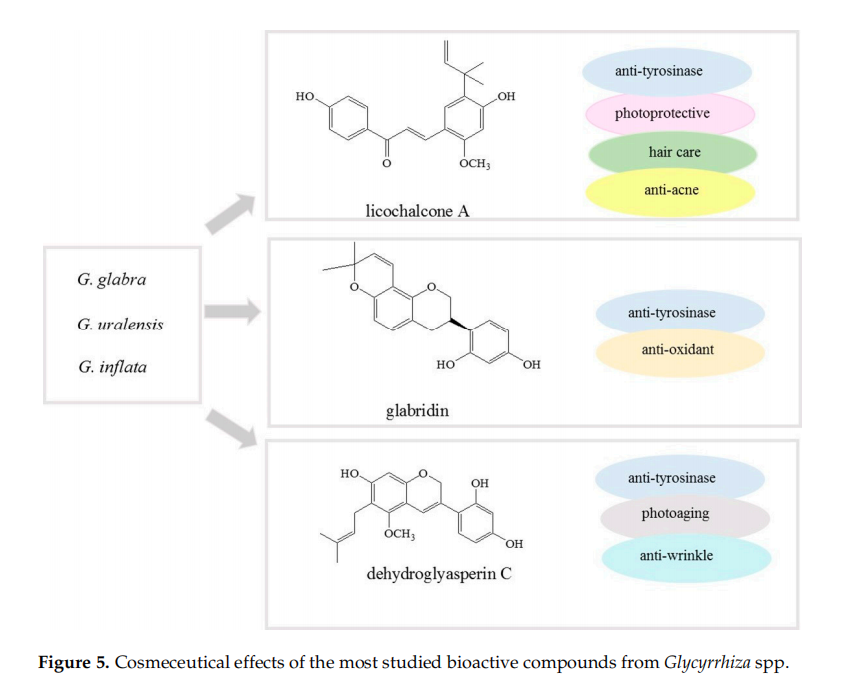
As evident from the literature, licochalcone A, glabridin, and dehydroglyasperin C are licorice's most investigated flavonoids, suggesting further development and application in cosmetic industries in the future (Figure 5). Other constituents have also shown cosmeceutical properties but further investigations have to be performed to meet industrial purposes. The first goal could be the selection of Glycyrrhiza species taking into account the occurrence of the metabolites of interest. Additionally, the choice of the extraction and purification methods is crucial to obtaining a higher amount of the selected constituents. Regarding this topic, the research is increasingly oriented towards greener alternatives, many of which are still to be investigated.
A recent review describes the toxicity effects of licorice and glycyrrhizin in acute, sub-acute, sub-chronic, and chronic states, highlighting their moderate toxicity and the need to be used with caution during pregnancy. However, their toxicity was mainly evaluated after oral administration and intraperitoneal, subcutaneous, intravenous, and intramuscular injection [105]. Therefore, additional investigations should be carried out to assess the toxicity of topical administration.
This article is extracted from Cosmetics 2022, 9, 7. https://doi.org/10.3390/cosmetics9010007 https://www.mdpi.com/journal/cosmetics