Mood Symptoms And Chronic Fatigue Syndrome Due To Relapsing-Remitting Multiple Sclerosis Are Associated With Immune Activation And Aberrations in The Erythron Part 2
Aug 16, 2023
3.1.2. Prediction of Disabilities and Severity of MS by Immune Biomarkers
Cistanche can act as an anti-fatigue and stamina enhancer, and experimental studies have shown that the decoction of Cistanche tubulosa could effectively protect the liver hepatocytes and endothelial cells damaged in weight-bearing swimming mice, upregulate the expression of NOS3, and promote hepatic glycogen synthesis, thus exerting anti-fatigue efficacy. Phenylethanoid glycoside-rich Cistanche tubulosa extract could significantly reduce the serum creatine kinase, lactate dehydrogenase, and lactate levels, and increase the hemoglobin (HB) and glucose levels in ICR mice, and this could play an anti-fatigue role by decreasing the muscle damage and delaying the lactic acid enrichment for energy storage in mice. Compound Cistanche Tubulosa Tablets significantly prolonged the weight-bearing swimming time, increased the hepatic glycogen reserve, and decreased the serum urea level after exercise in mice, showing its anti-fatigue effect. The decoction of Cistanchis can improve endurance and accelerate the elimination of fatigue in exercising mice, and can also reduce the elevation of serum creatine kinase after load exercise and keep the ultrastructure of skeletal muscle of mice normal after exercise, which indicates that it has the effects of enhancing physical strength and anti-fatigue. Cistanchis also significantly prolonged the survival time of nitrite-poisoned mice and enhanced the tolerance against hypoxia and fatigue.

Click on Extreme Fatigue
【For more info:george.deng@wecistanche.com / WhatApp:8613632399501】
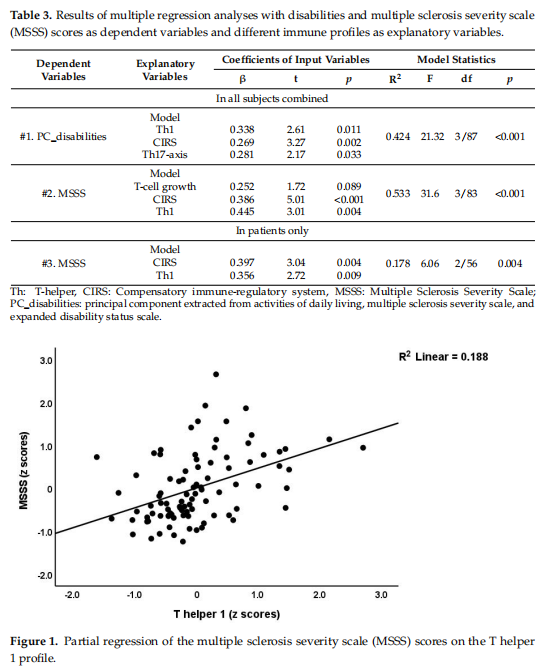
Regressions #1 and #2 were performed on all participants (Table 3) and show that a significant part of the variance (42.2%) in PC_disabilities could be explained by Th1, CIRS, and Th17-axis. Nevertheless, within the selected group of MS patients, no such correlations could be established. Regression #2 displays that T-cell growth, CIRS, and Th1 could explain a significant amount of the variance (53.3%) in MS, with all predictors being positively associated. Figure 1 shows the partial regression of the MS score on the Th1 profile. In the selected group of patients with MS, 17.8% of the variance in the MS score was predicted by Th1 and CIRS functions combined. In the combined study group, we found significant inverse correlations between PC_RBCs and PC_disabilities (r = −0.264, p = 0.011, n = 93) and PC_MSSS (r = −0.251, p = 0.015, n = 93). Nevertheless, these effects and PC_RBCindices were not significant in the multiple regression analyses shown in Table 3.
3.1.3. Prediction of Neuropsychiatric (NP) Symptoms by Erythron Variables and Immune Indices
We performed regression analysis with neuropsychiatric symptoms as the dependent variables and PC_RBCs, PC_RBC indices, and immune profiles as explanatory variables (Table 4). Regression #1 shows that a large part of the variance (50.6%) in PC_PP was explained by Th17-axis, white blood cells count (WBCs), CIRS (all positively associated), and PC_RBCs (inversely associated). The forced entry of sex into this regression analysis showed that sex was not significant (t = −0.52, p = 0.607) and that PC_RBC remained significant (t = −2.55, p = 0.013). Figures 2 and 3 show the partial regression of the PC_PP on the Th17-axis and PC_RBCs, respectively. In addition, the forced entry of MSSS into the analysis (regression #2) shows that 56.3% of the variance in PC_PP was explained by MSSS, WBCs, T-cell growth (positively associated), and sex. Regression #3 shows that when we included patients only, 17.1% of the variance in PC_PP could be explained by WBCs (positive association) and PC_RBCs (inverse association). These associations remained significant after entering sex, which was not significant (t = 0.52, p = 0.603). Regressions #4 to #9 show the regressions of the various subdomain scores on the cytokines and RBC profiles, while allowing for the effects of demographic data. The highest effect size was established for pure psychosomatic symptoms which showed that 50.3% of its variance could be explained by the Th17-axis, WBCs, CIRS (all positively associated), and sex (regression #4). PC_RBCs showed a significant effect on all subdomains except the pure psychosomatic, fatigue, and sleep domains. These effects remained significant even after the forced entry of sex into the regression analyses. A larger part of the variance in fatigue (41.7%) was explained by neurotoxicity, sex, and CIRS. Figure 4 shows the partial regression of fatigue on neurotoxicity.


3.2. Results of Automatic Linear Modeling Analyses with Overfifit Prevention
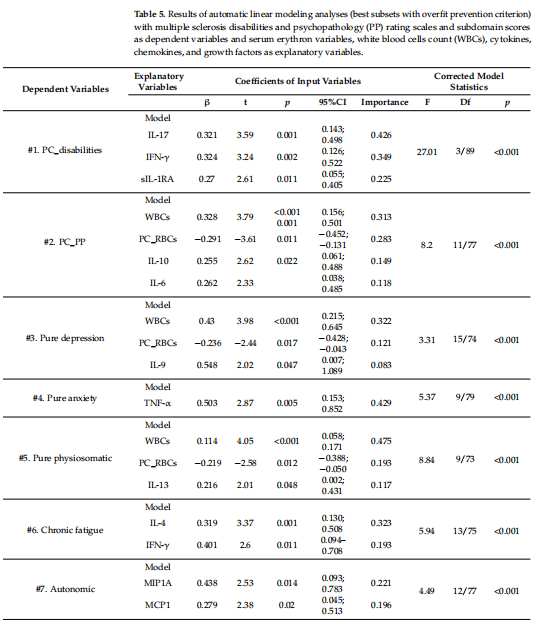
Table 5 shows the results of automatic linear modeling (best subsets with overfit prevention criterion) with PC_disabilities, PC_PP, and the subdomain scores as dependent variables, and the serum erythron variables, WBCs, cytokines, chemokines, and growth factors as explanatory variables, while allowing for age, sex, BMI, and smoking. Regression #1 shows that the best predictors of PC disabilities are IFN-γ, IL-17, and sIL-RA (all positively associated), which together explain 45.9% of the variance in PC disabilities. Regression #2 indicated that 47.4% of the variance in PC_PP score could be explained by WBCs, IL-10, IL-6 (positively), and PC_RBCs (inversely). The best predictors of the subdomain scores were WBCs and different cytokines including IFN-γ, IL-4, IL-9, IL-10, IL-13, TNF-α, MIP1A, MCP1 (all positively), and PC_RBCs and sIL-1RA (both inversely).

4. Discussion
4.1. Immune Profiles in the Remitted Phase
The first major finding of the present research is that a significant proportion (50.9%) of remitted RRMS patients show activated IRS and CIRS, M1, Th1, Th17, and T-cell growth factor profiles. Moreover, we established that a combination of Th1 and Th17-axis activation with increased IFN-γ and IL-17 and increased CIRS indicators are associated with MSrelated disabilities. As such, a proportion of the remitted patients shows an ongoing generalized immune-inflammatory process with increased neurotoxic capacity, indicating that the pathophysiological factors of RRMS are still active despite treatments with, for example, betapherone (IFN-1β) and natalizumab.
The current findings extend previous results reporting that significant elevations of central and peripheral Th-1/Th-2 cytokines, including TNF-α, IL-10, sIL-RA, and other components of the IRS/CIRS are observed in RRMS patients who are in the remission phase [51,52]. Kallaur et al. detected an imbalance between Th1, Th2, and Th17 cytokines in remitted MS patients [53]. Hollifield et al. reported a significantly lowered TGF-β and IFN-γ, IL-1β, T-cell mitogen (PHA), and myelin basic protein in peripheral blood mononuclear cells (PBMC) of remitted MS patients [54]. It was suggested that the active phase differs from the remission phase in terms of abnormal cytokine profiles [18]. For example, during the relapse phase of RRMS (defined as new or worsening symptoms persisting 24 h or more, appearing at least 30 days post previous relapse), TGF-β1 was significantly decreased while this cytokine was increased in the remission phase, indicating upregulated CIRS and Treg activities [55–58]. Moreover, Th17 is upregulated along with a significant increase in IFN-γ-expressing Th17 lymphocytes in the CSF of MS patients during the relapse phase [59,60]. Furthermore, increased Th17 is frequently observed in RRMS [61], and IL-17A and IL-17F are associated with the number of relapses [62].

The ongoing IRS/CIRS response with upregulated M1, Th1, and Th17-axis profiles and IFN-γ production during the remitted phase may contribute to the breakdown of the blood–brain barrier (BBB) and chronic neurotoxicity [63], and, thus, demyelination. CNS neuroinflammation may be aggravated by the migration of peripheral inflammatory mediators across the damaged brain endothelial cells of the BBB [64]. Moreover, immune activation, either IRS or CIRS, may cause viral reactivation, which may play a role in MS. For example, increased CIRS activity may lead to immunosuppression, which may reactivate latent viral infections. Following relapses, female, but not male, patients may display reactivation of Epstein–Barr virus (EBV) in B lymphocytes [65]. The higher relapse rate in RRMS is accompanied by increased expression of some human endogenous retroviruses (HERVs) [66]. Reactivation of MS-associated retrovirus (MSRV) from the HERV-W family may drive IRS activation via Toll-Like Receptor activation, although MSRV reactivation may also result from IRS activation [67]. It should be added that increased production of IFN-γ and IL-17, which is associated with increased disabilities during the remitted phase, may play a role in autoimmunity via different mechanisms [68].
Subsequent investigations ought to explore whether the cohort of patients who have achieved remission and display heightened immune reactions are predisposed to experiencing new relapses or manifesting an accelerated relapse or transitioning into SPMS. It is suggested that a drug target for preventing new relapses should involve a broader activation of the immune system, encompassing M1, Th1, IFN-γ, Th17-axis, IRS, and CIRS profiles, rather than targeting a singular aspect of the immune system.
4.2. Immune Profiles and Depression, Anxiety, and Physiosomatic Symptoms Due to MS
The second major finding of the current study is that fatigue, depression, and anxiety scores are significantly higher in remitted RRMS and SPMS patients as compared with healthy controls and that MS-related disabilities during the remitted phase are strongly associated with chronic fatigue, depression, and anxiety, psychosomatic and autonomic symptoms, and insomnia. Since we assessed HAMD, HAMA, and FF scales over the three months preceding the study, the results indicate that small increases in disabilities are accompanied by increased chronic fatigue and chronic affective symptoms. During relapses, depressive symptoms are more prominent than in the remission phase [69], although other reports show non-significant associations between depressive symptoms and different clinical phases [70].

Importantly, chronic fatigue and affective symptoms during the remission RRMS phase are largely predicted by the Th17-axis, and increased CIRS and WBC numbers, along with increased IL-10, IL-6, IL-9, IL-13, IL-4, and IFN-γ. As such, increased activation of the Th17-axis and CIRS during the remitted phase of RRMS may drive chronic fatigue and affective symptoms due to MS. Previous reports showed that IL-6 is positively associated with depressive symptoms due to RRMS [2,71,72] and PMS [73]. Chronic fatigue syndrome is considered to be an immune-inflammatory disease with many pathophysiological similarities to multiple sclerosis, including a variety of immunological and neurological abnormalities, such as immune activation, immunosuppression, mitochondrial dysfunctions, elevated synthesis of nuclear factor-κB, and autoimmunity, as well as increased oxidative damage and decreased antioxidant capacity [16]. Likewise, depression is characterized by activated IRS, CIRS, and oxidative stress pathways [27,74–76].
Previously, it was reported that increased IL-17, IL-6, and TNF-α (the components of the Th17-axis in the current study) contribute to major depressive disorder and chronic fatigue symptoms [16,27,33,49,77–82]. Interestingly, the first paper that reported increased TNF-α in major depression, found that the serum levels of this cytokine were higher in major depression than in MS [83]. Morris and Maes concluded that, in MS, immune activation, including activation of the Th17-axis components, may drive chronic fatigue and psychosomatic symptoms [16].

The neurotoxic effects of the Th17-axis components, which play a key role in MS and fatigue and affective symptoms due to MS, arise from their role in peripheral inflammation, gut barrier and BBB breakdown, microglial activation, neuroinflammation, and neurotoxicity to CNS circuits [49,77,81,84,85]. Activated immune-inflammatory pathways and consequent aberrations in brain structure and functions may render MS patients prone to develop mood symptoms and chronic fatigue syndrome [16,73,86]. It should be added that the increased fatigue and affective symptoms during acute relapses [87,88] may be ascribed to activated immune-inflammatory and nitro-oxidative stress pathways [19,75,81,89–91].
【For more info:george.deng@wecistanche.com / WhatApp:8613632399501】