Optical Coherence Tomography Findings in Parkinson’s And Alzheimer’s Disease –Retinal Changes in Neurodegenerative Disease
Apr 26, 2023
Introduction
Alzheimer’s disease (AD) is the most common form of dementia. It’s caused by senile plaque accumulation and decreased acetylcholine levels in the anterior cortex and hippocampal complex. Parkinson’s disease (PD) results mainly from the selective loss of dopaminergic neurons in substantia nigra pars compacta of the midbrain and basal ganglia. As a result of diminished dopamine and its metabolites in PD, the retina is thought to be in a neurodegenerative process (1, 2).

Click to cistanche beneficial for Alzheimer's disease & Parkinson's disease
Similarly, amyloid beta accumulation has been demonstrated in the retinal and visual pathways of Alzheimer’s patients. Acetylcholine is known to be crucial for retinal cells to function properly (3, 4). Some patients showed ganglion cell death and optic nerve degeneration without amyloid beta accumulation and neurofibrillary changes (5).
Disturbances in the visual system, such as difficulty in finding objects and reading, loss of depth perception, inability to follow moving objects, loss of spatial contrast sensitivity, and reduction in color perception are non-motor symptoms in both AD and PD (6). Optic nerve degeneration and loss of retinal ganglion cells are responsible for visual system impairment (3, 7).
Optical Coherence Tomography (OCT), a new imaging method that can provide cross-sectional images of retinal anatomy (8), has begun to be used to demonstrate thinning of the retinal nerve fiber layer (RNFL) and similar morphological changes in the retina (9, 10). Our purpose is to determine whether changes in the retina by OCT in early-stage Parkinson’s and Alzheimer’s disease are specific to diseases. The results are compared between the age-sex-matched control group and both disease groups.
METHODS
Fifteen patients for each group diagnosed with AD and PD, between the ages of 65–76 and followed up by the neurology outpatient clinic of Haydarpaşa Numune Training and Research Hospital between October 2012 and April 2017 were included in the study, which had been approved by the ethics committee of Haydarpaşa Numune Training and Research Hospital.
Our control group consists of 15 healthy participants admitted to the ophthalmology outpatient clinic. Evaluations were made by the same neurologist and ophthalmologist to avoid differences. Patients with PD in Hoehn Yahr stages 1–2 were included in the study. The clinical disability grade was evaluated with UPDRS which scores cognitive disturbances, activities of daily living, and motor features of PD.
SMMT and MOCA tests are used for neurocognitive evaluation of patients with AD. Patients with SMMT scores of >18 were enrolled in the study. History of visual acuity <5/10, refractive error higher ±3 spherical diopters, intraocular pressure of >21 mmHg, diabetic and hypertensive retinopathy, optic disc anomalies, age-related macular degeneration, optic neuropathy, corticosteroid use, etc. were exclusion criteria. RNFL, foveal, parafoveal, and macular thickness of the patients were measured by OCT.

Measurements were performed with Fourier Domain OCT (Rtvue OCT; Optivue INC, Toledo, OH). Each subject's eye underwent RNFL, foveal, parafoveal, and macular scan protocols. The RNFL thickness was circularly measured around the papilla (optic disc: 3.4 mm) and repeated three times per quadrant (Superior, inferior, temporal, nasal). The measurements were also recorded in two additional sections superior retina (superiorR) and inferior retina (inferiorR) by dividing the retina into two parts.
Macular scan protocol consisted of 6 consecutive 6 mm radial line scans centered on the macula. Macular retinal thickness data were displayed in three concentric circles. The central disc was the foveal region measuring 1.00 mm in diameter. Results were expressed in microns. 30 eyes of 15 patients for each group were compared with 30 eyes of 15 control subjects. Informed consent was received from all subjects involved in the study. OCT measurements were compared with test results.
Statistical evaluation
A case-control analysis was undertaken with the RNFL, foveal, parafoveal, and macular thickness collected with age-sex matched controls. Results are reported as mean values ± standard deviation (SD). All statistical analyses were performed using the SPSS software version 22. Pearson Correlation was checked whether a correlation exists between results. P<0.05 was considered significant.
RESULTS
The patients and control groups did not differ significantly in age and gender. There were no significant differences between the groups regarding age at diagnosis and duration of disease. Detailed demographic information of the patients and control group are shown in Table 1.
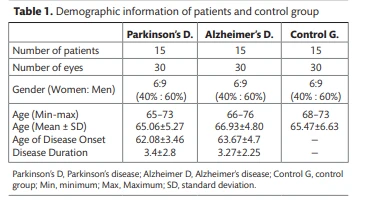
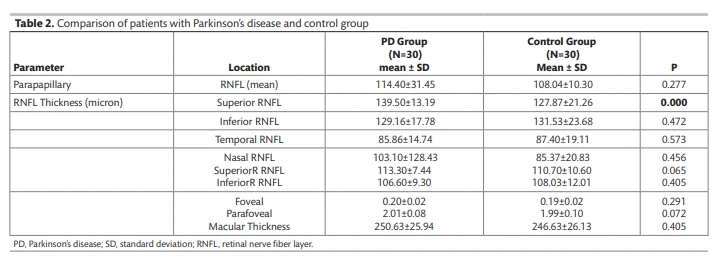
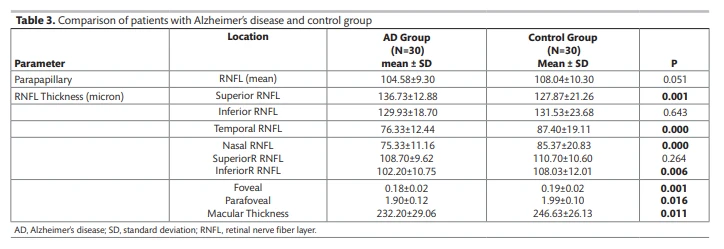
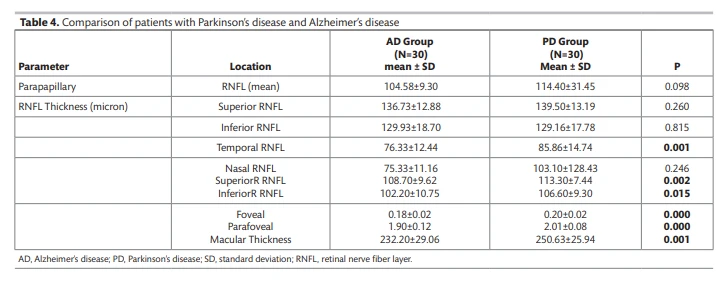
A comparison of OCT measurements of patients and the control group is shown in Tables 2, 3, and 4. The mean disease duration was 3.4±2.8 in the PD group, and 3.27±2.25 in the AD group. There was a 75.4% (p=0.001) and 68% (p=0.005) inverse correlation between disease duration and respectively superior, superior RNFL thickness in the PD group.
The superior and superior RNFL thickness decreased significantly in the PD group as the disease duration increased. In AD, there was an insignificant inverse relationship (44.1%) between the disease duration and the superior RNFL thickness. The mean UPDRS score of the patients was 24.47±3.30 (min10, max 44). Patients were between H-Y stages 1 and 2. Ten patients were evaluated as H-Y stage 1, 4 patients as H-Y stage 2, and 1 patient as H-Y stage 1.5.
There was no statistically significant relationship between OCT measurements and UPDRS or H-Y scores in PD (p>0.05). The mean SMMT score in patients with AD was 19.53±1.66 (min 18, max 23). The mean MOCA score was 18.53±2.42 (min 16, max 22). No correlation between disease duration, age of disease onset, MOCA/SMMT scores, and OCT measurements was noted (p>0.05).
Temporal, inferior, and inferior RNFL thickness was thinner in patients with PD than those in the control group. These differences were not statistically significant. The superior RNFL thickness was evaluated as significantly higher than in the control group (Table 2).
In patients with AD; temporal, nasal, inferior RNFL, foveal, parafoveal, and macular thickness was significantly decreased compared to the control group. Superior RNFL thickness was significantly higher in patients with AD than in the control group (p=0.001) (Table 3).
All quadrants and mean RNFL thicknesses of the three groups are shown in Figure 1. The comparison between patients with AD and PD revealed that the RNFL thicknesses in all quadrants of AD patients were thinner than patients with PD except the inferior quadrant. Temporal, superior, and inferior RNFL thickness, and macular, foveal, and parafoveal thickness were significantly lower in the AD group than in the PD group. This comparison is shown in Table 4.
DISCUSSION
Parkinson’s disease is a neurodegenerative disease affecting motor, sensorial and cognitive functions. The main pathology is the loss of dopaminergic neurons at the substantia nigra. Retinal ganglion cells and projection pathways of dopaminergic neurons to cholinergic Meynert’s basal cells and entorhinal cortex are other dopaminergic central regions (11). Progressive retinal dopamine deficiency causes loss of retinal amacrine cells (12).
The lateral geniculate nucleus and the visual cortex, which are the high cortical visual fields, are responsible for visual disturbances in PD which also contains dopamine (13, 14). Alzheimer’s disease patients may also have vision-related complaints. The accumulation of Aβ in AD patients has been responsible for the pathogenesis (15). The aggregates are toxic to cortical and retinal neurons.
Few studies have shown loss of retinal ganglion cells histopathologically without amyloid deposits and neurofibrillary changes (5, 16, 17). The decrease in RNFL thickness in PD has been shown by Inzelberg et al. for the first time (2004). In this study including 10 Parkinson’s patients, they showed a significant decrease in the inferior RNFL thickness (18). Several studies reported thinning in different RNFL thicknesses with new technological devices. On the contrary, Berisha et al. (2007) showed retinal thinning in the superior quadrant (3).
Altintas et al. determined a significant decrease in the mean RNFL thickness in 17 Parkinson’s patients by Time domain (TD) OCT. The macular thickness was found thinner in all quadrants. They also found a significant inverse correlation between UPDRS scores and foveal thickness (19).
No statistically significant correlation was found between the UPDRS score and RNFL thickness in the study. Garcia-Martin et al. found that the mean RNFL thickness of Parkinson’s patients was significantly lower than those of the control group by both Cirrus OCT and Spectral OCT.
This study also found no significant correlation between SMMT scores and RNFL or macular thickness (20). In a recent study by Pillai et al. (2016) that compares the OCT results of neurodegenerative diseases including PD, AD, non-AD dementia, amnestic mild cognitive impairment, and age-sex matched control group by Spectral Domain OCT, RNFL thickness and macular volume didn’t differ between diseases and control group.
Superior, temporal, nasal, and inferior RNFL thicknesses of patients in all diseases group were higher than the control group. They suggested that OCT studies were not very useful in the early diagnosis of dementias and PD. They also reported that they did not find any significant relationship between MOCA scores or other neurocognitive tests score and OCT results (21). Boeke et al, (2016) evaluated OCT results of patients with PD and AD. As a result of the study consisting of 13 Parkinson’s patients, 8 Alzheimer’s patients, and 14 controls, the average RNFL thickness in the PD group was found statistically significantly thinner than in both groups.
Similarly, macular volume was thinner in the patients with PD and AD than in the controls (22). We used Fourier-Domain (FD) OCT to evaluate whether changes were specific to AD or PD. It provides faster and higher-resolution retinal topography and minimizes motion artifacts. Early-stage patients with AD and PD were included in our study because differences may not be so obvious in the later stage of both diseases as RNFL thickness decreases with age.
No significant decrease was found in any quadrants of RNFL thickness of 15 Parkinson’s patients compared to the control group. Inferior, temporal, and inferior RNFL thickness were found thinner but these results were not statistically significant. Surprisingly, the superior RNFL thickness of both patients with PD and AD showed statistically significantly higher values than the control group. Measurements in all quadrants were found to be lower in AD than PD except for the similarity of inferior RNFL thickness.

Temporal, superior, and inferior RNFL thickness and foveal, parafoveal, and macular thicknesses were found to be significantly lower in Alzheimer’s disease than in the control group. RNFL thickness reduction may be linked to accompanying neuronal cell body loss and macular thickness reduction may be the result of ganglion cell damage. Also, no correlation was found between the RNFL or macular thickness and SMMT, MOCA, UPDRS, or H-Y scores in the current study.
Increased disease severity, was not correlated with a higher reduction in RNFL thickness. However, the superior and superior RNFL thickness decreased significantly in the PD group as the disease duration increased. Some studies reported a correlation between OCT measurements and test results. Iseri et al. recorded the results of 14 patients with AD (2006). Mean and temporal RNFL thickness, out of the 8 and 9 o’clock positions RNFL thickness and total macular volume were lower in the AD group than those of the control group by TD OCT.
They found a statistically significant correlation between total macular volume and SMMT scores (23). With a different perspective, to investigate the changes in RNFL thickness among dementias, Moreno Ramos et al. (2012) evaluated patients with PD dementia, dementia with Lewy Body (DLB), and AD dementia by OCT. The mean RNFL thicknesses of all patient groups were found to be thinner than the control group.
Although the results of patients with DLB were thinner than other dementias, differences were not significant. All changes in the retina were nonspecific for any type of dementia. Unlike our study, this study also concluded that there was a correlation between SMMT scores and mean RNFL thickness (24). Emerging technological methods and new devices can affect the OCT results.
Changes occurring as a result of device diversity and disease progression should be discriminated against carefully in patients. The reason why different results have been reported in several studies so far could be the use of various technological devices and disease stages. There are two studies including patients with MCI which have a significant reduction in RNFL thickness. Paquet et al. (2007) examined 23 MCI, 14 mild-stage AD, and 12 moderate-to-severe AD patients in their studies by TD OCT.
They found the mean RNFL thickness of MCI and AD patients to be statistically lower than the control group. But the results between MCI and the early-stage AD group did not make a significant difference. The moderate to severe AD group showed statistically significant thinning of RNFL thickness compared to the MCI group. They found no correlation between SMMT score and RNFL thickness (25). Subsequently, Kesler et al. (2011) analyzed a study with 30 AD and 24 MCI patients by TD OCT (7).
The RNFL thickness of patients with AD (the superior and inferior quadrants) and the MCI (the inferior quadrant) was found to be thinner than those of the control group and these differences were statistically significant. RNFL thickness in the AD group was found to be thinner than the MCI group, but this difference was not significant.
There was no correlation between SMMT scores and OCT results. These two studies suggested that RNFL thickness might be used even in patients with cognitive troubles because the MCI group showed a significant decrease in RNFL thickness compared to the control group. Further studies with larger sample sizes will be needed to evaluate the RNFL thickness of patients when they are in the MCI stage by new technological OCT measurements.
There are several limitations to our study. The major limitation is the small sample size. None of our patients with AD and PD diagnoses were confirmed by another laboratory test (BOS tau, phosphorylated tau, amyloid β42, etc.). Also, postmortem examinations of patients were not made. Early glaucoma can affect the results, although it is very unlikely because we did not include in our study the patients with optic neuropathy (DM, HT, ischemic, toxic, systemic), and patients with increased intraocular pressure (IOP>21 mm Hg). Likewise, the potential drug side effects on RNFL thickness were overlooked in previous studies.
CONCLUSION
We found that RNFL and macular thickness by FD OCT are unable to distinguish PD from normal controls in a clinically well-characterized sample. These results do not support a role for RNFL and macular volume for diagnostic purposes as biological markers in PD. RNFL loss in Alzheimer patients was important in temporal, nasal, inferior RNFL thickness and macular, foveal, and parafoveal thickness.
It might be thought that AD development occurs simultaneously with retinal nerve fiber degeneration. How the finding of neurodegeneration is seen as atrophy in cranial MRI, RNFL loss could be recorded by OCT as a reduction in RNFL thickness. However, there was no correlation between OCT results and UPDRS, SMMT, MOCA, or H-Y scores, as the same with most of the studies. Several previous studies have reported different results with different devices and patient populations.

These results indicated that the use of OCT in the early diagnosis and follow-up of the course of both diseases was not suitable until many studies pointed out the same result. Further studies with larger sample sizes will be needed to clear uncertainty for both diseases.
The mechanism of Cisanche anti-Alzheimer's disease and Parkinson's disease
Cistanche is a traditional Chinese herbal medicine that has been used for centuries to treat a variety of conditions, including Alzheimer's disease and Parkinson's disease. The mechanism of action of Cistanche in these diseases is not completely understood, but there are several potential ways in which it may be beneficial.
One of the main ways in which Cistanche may help with Alzheimer's disease is by reducing the production of beta-amyloid plaques in the brain. These plaques are thought to be a key contributor to the development of Alzheimer's disease, and reducing their production may help to slow or prevent the progression of the disease.
Cistanche may also have neuroprotective effects, helping to protect brain cells from damage and degeneration. This could be particularly helpful in Parkinson's disease, which is characterized by the degeneration of dopamine-producing neurons in the brain.
Additionally, Cistanche may have anti-inflammatory effects, which could help to reduce inflammation in the brain and improve cognitive function. Inflammation is believed to play a role in the development of Alzheimer's disease and Parkinson's disease.
REFERENCES
1. Harnois C. Di Paolo T. Decreased dopamine in the retinas of patients with Parkinson’s disease. Invest Ophthalmol Vis Sci 1990;31:2473–2475.
2. Djamgoz MBA. Hankins MW. Hirano J. Archer SN. Neurobiology of retinal dopamine about degenerative states of the tissue. Vision Res 1997;37:3509–3529. [CrossRef]
3. Berisha F, Feke GT, Trempe CL, McMeel JW, Schepens CL. Retinal Abnormalities in Early Alzheimer’s Disease. Invest Ophthalmol Vis Sci 2007;48:2285–2289. [CrossRef]
4. Guo L, Duggan J, Cordeiro MF. Alzheimer’s disease and retinal neurodegeneration. Curr Alzheimer Res 2010;7:3–14. [CrossRef] 5. Hinton DR, Sadun AA, Blanks JC, Miller CA. Optic-nerve degeneration in Alzheimer’s disease. N Engl J Med 1986;315:485–487. [CrossRef]
6. Krasodomska K, Lubinski W, Potemkowski A, Honczarenko K. Pattern electroretinogram (PERG) and pattern visual evoked potential (PVEP) in the early stages of Alzheimer’s disease. Doc Ophthalmol 2010;121:111–121. [CrossRef]
7. Kesler A, Vakhapova V, Korczyn AD, Naftalive E, Neudorfer M. Retinal thickness in patients with mild cognitive impairment and Alzheimer’s disease. Clin Neurol Neurosurg 2011;113:523–526. [CrossRef]
8. Fujimoto JG, Pitris C, Boppart SA, Brezinski ME. Optical coherence tomography: an emerging technology for biomedical imaging and optical biopsy. Neoplasia 2000;2:9–25. [CrossRef]
9. Bodis-Wollner I. Retinopathy in Parkinson’s Disease. J Neural Transm (Vienna) 2009;116:1493–1501. [CrossRef]
10. Brezinski ME, Tearney GJ, Bouma BE, Izatt JA, Hee MR, Swanson EA, Southern JF, Fujimoto JG. Optical coherence tomography for optical biopsy. Properties and demonstration of vascular pathology. Circulation 1996;93:1206–1213. [CrossRef]
11. Lang AE, Lozano AM. Parkinson’s disease. First of two parts. N Engl J Med 1998;339:1044–1053. [CrossRef]
12. Tatton WG, Kwan MM, Verrier MC, Seniuk NA, Theriault E. MPTP produces reversible disappearance of tyrosine hydroxylase-containing retinal amacrine cells. Brain Res 1990;527:21–31. [CrossRef] 13. Reader TA, Quesney LF. Dopamine in the visual cortex of the cat. Experientia 1986;42:1242–1244. [CrossRef]
14. Parkinson D. Evidence for a dopaminergic innervation of cat primary cortex. Neuroscience 1989;30:171–179. [CrossRef]
15. Oliveira LT, Louzada PR, de Mello FG, Ferreira ST. Amyloid-β decreases nitric oxide production in cultured retinal neurons: a possible mechanism for synaptic dysfunction in Alzheimer’s disease? Neurochem Res 2011;36:163– 169. [CrossRef]
16. Blanks JC, Schmidt SY, Torigoe Y, Porrello KV, Hinton DR, Blanks RH. Retinal pathology in Alzheimer’s disease. II. Regional neuron loss and glial changes in GCL. Neurobiol Aging 1996;17:385–395. [CrossRef]
17. Blanks JC, Torigoe Y, Hinton DR, Blanks RH. Retinal degeneration in the macula of patients with Alzheimer’s disease. Ann N Y Acad Sci 1991;640:44– 46. [CrossRef]
18. Inzelberg R, Ramirez JA, Nisipeanu P, Ophir A. Retinal nerve fiber layer thinning in Parkinson's disease. Vision Res 2004;44:2793–2797. [CrossRef]
19. Altintaş O, Işeri P, Ozkan B, Cağlar Y. Correlation between retinal morphological and functional findings and clinical severity in Parkinson’s disease. Doc Ophthalmol 2008;116:137–146. [CrossRef]
20. Garcia-Martin E, Satue M, Fuertes I, Otin S, Alarcia R, Herrero R, Bambo MP, Fernandez J, Pablo LE. Ability and reproducibility of Fourier-domain optical coherence tomography to detect retinal nerve fiber layer atrophy in Parkinson’s disease. Ophthalmology 2012;119:2161–2167. [CrossRef]
21. Pillai JA, Bermel R, Bonner-Jackson A, Rae-Grant A, Fernandez H, Bena J, Jones SE, Ehlers JP, Leverenz JB. Retinal Nerve Fiber Layer Thinning in Alzheimer’s Disease: A Case-Control Study in Comparison to Normal Aging, Parkinson’s Disease, and Non-Alzheimer’s Dementia. Am J Alzheimers Dis Other Demen 2016;31:430–436. [CrossRef]
22. Boeke A, Rosen D, Mastrianni J, Xie T, Bernard J. Optical Coherence Tomography as Potential Biomarker in Parkinson’s Disease and Alzheimer’s Disease (P5.177). Neurology 2016;86(16 Supplement):P5.177.
23. Iseri PK, Altinaş O, Tokay T, Yüksel N. Relationship between cognitive impairment and retinal morphological and visual functional abnormalities in Alzheimer's disease. J Neuroophthalmol 2006;26:18–24. [CrossRef]
24. Moreno-Ramos T, Benito-León J, Villarejo A, Bermejo-Pareja F. Retinal nerve fiber layer thinning in dementia associated with Parkinson’s disease, dementia with Lewy bodies, and Alzheimer’s disease. J Alzheimers Dis 2013;34:659–664. [CrossRef]
25. Paquet C, Boissonnot M, Roger F, Dighiero P, Gil R, Hugon J. Abnormal retinal thickness in patients with mild cognitive impairment and Alzheimer’s disease. Neurosci Lett 2007;420:97–99. [CrossRef]