PART 2 Antioxidation And Cytoprotection Of Acteoside And Its Derivatives: Comparison And Mechanistic Chemistry
Mar 08, 2022
Part 2 How does Cistanche Acteoside antioxidant protect cells?
Click here to part 1
For more information please contact: Joanna.jia@wecistanche.com
Cistanche deserticola has many effects, click here to know more
3. Discussion
The antioxidant action of natural phenolic compounds is known to be involved in electron transfer (ET) [18,19]. Thus, some ET-based metal-reducing assays have been widely used to assess antioxidant levels of phenolics, such as the FRAP and CUPRAC assays. The FRAP assay guidelines are to be fulfilled with a pH of less than 3.6. Such an acidic environment has successfully suppressed H+ ionization from phenolics; thus, the FRAP assay is considered a mere ET process [20,21]. The effectiveness of acteoside and its derivatives in the FRAP assay implies that, when acteoside and its derivatives act as antioxidants, they may use the ET pathway to exert their antioxidant action.
Besides, we also performed a CUPRAC assay in a pH 7.4 buffer. As seen in Suppl. 1, acteoside and its derivatives dose-dependently increased their Cu2+-reducing power percentages, indicating that they could remain ET potential at physiological pH. However, their ET potentials decreased in the following order: acteoside > forsythoside B > poliumoside (Table 1). This dynamic clearly suggests that apiosyl moiety in forsythoside B and rhamnosyl moiety in poliumoside lowered the ET potential.
To test the possibility that ET occurs during their radical-scavenging processes, an oxygen-centered free radical PTIO・ was introduced in the study. Cyclic voltammetry evidence revealed that PTIO・-scavenging below pH 5.0 is a single electron-redox reaction. The observation that acteoside and its derivatives could efficiently scavenge the PTIO・ radical at pH 4.5, suggests the possibility of ET during their radical-scavenging processes. Obviously, this finding further supports the aforementioned results from FRAP and CUPRAC assays, and previous results that a donating electron (e) is a feature of phenolic antioxidants [23].
At physiological pH 7.4, however, the PTIO・-scavenging essay is not merely an ET pathway but also includes a proton- (H+) transfer pathway. During the process, PTIO・ has been suggested to accept H+ from phenolics to produce the product peak ([PTIO-H]+). Because H+-transfer is always accompanied by ET in stepwise or synchronous mechanisms [24], the realistic (or final) product is a [PTIO-H] molecule [22]. The PTIO・-scavenging at pH 7.4 (Suppl. 1) implies that acteoside and its derivatives possess an H+-transfer potential as well. The IC50 values (Table 1) indicated that the relative H+-transfer potentials were in descending order of acteoside > forsythoside B > poliumoside. Clearly, the apiosyl and rhamnosyl moieties also weakened the H+-transfer potential during the antioxidant process.
As previously discussed, during the antioxidant process of phenolics, ET is usually accompanied by proton (H+) transfer to form several antioxidant mechanisms [24], such as hydrogen-atom transfer (HAT) [23,25-27], sequential electron-proton transfer (SEPT) [26,27], sequential proton loss single-electron transfer (SPLET) [26], and proton-coupled electron transfer (PCET) [24-26,28]. For example, ABTS+• -scavenging, a reaction dominated by single-electron transfer (SET) [29], has also been proven to be affected by H+ levels recently [30]. ABTS+ • -scavenging is therefore a multi-pathway-based antioxidant assay [21,31]. The fact that acteoside and its derivatives could scavenge ABTS+・ radicals indicates that their antioxidant action may also be mediated via multi-pathways. This hypothesis is further confirmed by the evidence from the DPPH・-scavenging assay, a reaction comprising HAT, ET, SEPT, and PCET multiple pathways [26,32]. However, the quantitative analysis based IC50 values (Table 1) revealed that in multi-pathway-based ABTS+ --scavenging and DPPH*-scavenging aspects, acteoside was superior to its apposite forsythoside B and rhamnoside poliumoside. Thus, it can be deduced that apiol and rhamnosyl moieties eventually hinder multi-pathway potentials (especially ET and H+-transfer) during the free-radical-scavenging process.
As noted by the authors and others [14,26], during the antioxidant process, an RAF reaction may also occur. To verify the RAF possibility, however, three phenylpropanoid glycosides along with caffeic acid were studied using UPLC-ESI-Q—TOF-MS/MS analysis. Caffeic acid was found to yield a dimer product, while three phenylpropanoid glycosides produced no peak of RAF product. This finding clearly suggests that three phenylpropanoid glycosides cannot undergo the RAF pathway to exert their antioxidant action. Since three phenylpropanoid glycosides can be regarded as the esters of caffeic acid (Figure 1), such a difference between caffeic acid and caffeic acid esters also indicates that huge moiety may hinder the generation of RAF.
Taken together, from a free-radical-scavenging aspect, acteoside and its derivatives may undergo multiple pathways to exert their antioxidant action. These antioxidant pathways at least are involved in ET and H+-transfer (but not RAF). Our findings are partly supported by the theoretical study that acteoside could exert antioxidant action via the SPLET pathway. In the process, acteoside might firstly deprotonate (H+-transfer) to yield anion. The deprotonation is thought to occur in the catechol moieties with weak acidity. Subsequently, the anion donated electrons to give rise to phenoxy radical form [33]. Phenoxy radicals with p-n conjugation however are stable to some extent. Of course, in this respect, further experimental work is needed in the future.
It is worth mentioning that cellular oxidative stress can also originate from transition metals (especially Fe2+). The Fe2+ ion, however, can transform the H2O2 molecule into a most harmful •OH radicals via the Fenton reaction (Fe2+ + H2O2 T Fe3+ + ・OH + OH-). Therefore, attenuation of Fe2+ levels can effectively inhibit ・OH radicals to release cellular oxidative stress. In fact, iron-chelating by natural phenolic antioxidants now has been developed into an effective therapy for some oxidative-stress diseases [34,35].
In the present study, acteoside and its derivatives were suggested as effective Fe2+-chelators by the changes in spectroscopy and solution colors (Figure 2). Nevertheless, acteoside is inferior to the two glucosides in chelating Fe2+ and forsythoside B with apiosyl moiety is inferior to poliumoside with rhamnosyl moiety. Based on the comparison of their preferential conformations (Figure 1, right), it is proposed that apiosyl (or rhamnosyl) moiety can aid the main ligand (phenylpropanoid group) in chelating Fe2+. Such a synergistic effect undoubtedly strengthens the Fe2+-chelating ability and enlarges the UV-vis peaks. However, rhamnosyl is more effective than apiosyl in its Fe2+-chelating ability. The difference can be attributed to the fact that rhamnosyl occurs in an exocyclic form (i.e., a-L-rhamnopyranosyl), while apiosyl is in a pentacyclic form (i.e., p-D-apiofuransyl). An exocyclic form is known to be larger and more stable. Hence, exocyclic rhamnosyl is more effective as compared to pentacyclic apiosyl in its Fe2+-chelating ability.
To test whether acteoside and its derivatives can scavenge ROS, we conducted a pyrogallol autoxidation assay. As seen in Suppl. 1, all could efficiently scavenge the — radical, a typical ROS occurring in cells. However, the relative bioactivity decreased in the order poliumoside > forsythoside B > acteoside. This order is also parallel to that of the cytoprotective effects (Table 2). This finding indicates that the general effect of rhamnosyl moiety or apiosyl moiety is to enhance ROS-scavenging or cytoprotective effects.

4. Materials and Methods
4.1. Chemicals and Animals
Acteoside (CAS number: 61276-17-3, 97%), forsythoside B (CAS number: 81525-13-5,97%) were obtained from BioBioPha (Kunming, China, Suppl. 3). Poliumoside (CAS number: 94079-81-9, 97%) was isolated by our team from the traditional Chinese herb Callicarpa peri H.T. Chang (Suppl. 3). The DPPH・,(±)-6-hydroxyl-2,5,7,8-tetramethlychromane-2-carboxylic acid (Trolox), 2,9-dimethyl-1,10-phenanthroline (neocuproine), 2,4,6-tripyridyltriazine (TPTZ), and pyrogallol were purchased from Sigma-Aldrich Shanghai Trading Co. (Shanghai, China). (NHq'ABTS [2,2‘-azino-bis (3-ethylbenzene-thiazoline-6-sulfonic acid diammonium salt)] was obtained from Amresco Chemical Co. (Solon, OH, USA). PTIO・ radical was purchased from TCI Development Co., Ltd. (Shanghai, China). Caffeic acid was purchased from the National Institute for the Control of Pharmaceutical and Biological Products (Beijing, China). Dulbecco's modified Eagle's medium (DMEM), fetal bovine serum (FBS), and trypsin were purchased from Gibco (Grand Island, NY, USA). AnnexinV/propidium iodide (PI) assay kit was purchased from Invitrogen (Carlsbad, CA, USA). All other reagents were of analytical grade.
Sprague-Dawley (SD) rats of 4 weeks of age were obtained from the Animal Center of Guangzhou University of Chinese Medicine. The protocol of this experiment was performed under the supervision of the Institutional Animal Ethics Committee in Guangzhou University of Chinese (Approval number 20170306A).
4.2. Metal-Reducing Assays (FRAP & CUPRAC)
Metal-reducing assays include the Fe3+-reducing power assay and Cu2+-reducing power assay. The Fe3+-reducing assay was established by Benzie and Strain and is formally named FRAP [20]. The experimental protocol of this assay was described in a previous report [9]. Briefly, the FRAP reagent was prepared freshly by mixing 10 mM TPTZ, 20 mM FeCl3, and 0.25 M acetate buffer at a ratio of 1:1:10 at pH 3.6. The test sample (x = 4-20 L, 0.05 mg/mL) was added to (20 — x) of 95% ethanol followed by 80 RL of FRAP reagent. After a 30-min incubation at ambient temperature, the absorbance was measured at 595 nm using a microplate reader (Multiskan FC, Thermo Scientific, Shanghai, China). The relative reducing power of the sample was calculated using the following formula:

where Amax was the maximum absorbance of the reaction mixture with the sample, and Amin is the minimum absorbance in the test. A is the absorbance of the sample.
Cu2+-reducing power can also characterize antioxidant level and thus is termed CUPRAC. This assay was carried out according to a previously published method [36]. Briefly, 12 RL of CuSOq aqueous solution (10 mmol/L), 12 RL of neocuproine ethanolic solution (7.5 mmol/L) and (75 — x) RL of CH3COONH4 buffer solution (0.1 mol/L, pH 7.5) were added to wells with different volumes of sample (0.05 mg/mL, 4-20 |^L). The absorbance at 450 nm after 30 min was measured using the aforementioned microplate reader. The relative CUPRAC power was calculated using the formula for FRAP. Amax was the maximum absorbance of the reaction mixture with the sample, and Amin is the minimum absorbance in the test. A is the absorbance of the sample.
4.3. PTI0・-ScavengingAssay
The PTIO*-scavenging assays (at pH 4.5 or pH 7.4) were conducted based on our method [16]. In brief, the test sample solution (x = 0-20 ^L, 1 mg/mL for pH 4.5 and 0.5 mg/mL for pH 7.4) was added to (20 — x) rL of 95% ethanol, followed by 80 RL of an aqueous PTIO* solution. The aqueous PTIO* solution was prepared using a phosphate-butter solution (0.1 mM, pH 4.5 or pH 7.4). The mixture was maintained at 37 °C for 2 h, and the absorbance was then measured at 560 nm using the aforementioned microplate reader. The PTIO* inhibition percentage was calculated as follows:

where A° is the absorbance of the control without the sample, and A is the absorbance of the reaction mixture with the sample.
4.4. ABTS+*-Scavenging and DPPH*-Scavenging Assays
The ABTS*+-scavenging activity was evaluated according to the method [37]. The ABTS+* was produced by mixing 0.2 mL of ABTS diammonium salt (7.4 mmol/L) with 0.2 mL of potassium persulfate (2.6 mmol/L). The mixture was kept in the dark at room temperature for 12 h to allow completion of the radical generation before being diluted with distilled water (at a ratio of approximately 1:20) so that its absorbance at 734 nm was 0.35 土 0.01 using the aforementioned microplate reader. To determine the scavenging activity, the test sample (x = 4-20 RL, 0.05 mg/mL) was added to (20 — x) RL of distilled water followed by 80 RL of ABTS+* reagent, and the absorbance at 734 nm was measured 3 min after initial mixing, using distilled water as the blank.
DPPH* radical-scavenging activity was determined as previously described [18]. Briefly, 75 RL of DPPH* solution (0.1 rM) was mixed with the indicated concentrations of the sample (0.025 mg/mL, 5-25 RL) dissolved in methanol. The mixture was maintained at room temperature for 30 min, and the absorbance was measured at 519 nm using the aforementioned microplate reader.
The percentages of ABTS+•-scavenging activity and DPPH*-scavenging activity were calculated based on the formula presented in Section 4.3.
4.5. UPLC—ESI—Q-TOF—MS/MS Analysis of PPH* Reaction Products
This method was based on our previous study [25]. The methanol solution of acteoside was mixed with a solution of DPPH* radicals in methanol at a molar ratio of 1:2, and the resulting mixture was incubated for 24 h at room temperature. The product mixture was then filtered through a 0.22-Rm filter and analyzed using a UPLC system equipped with a C18 column (2.0 mm i.d. x 100 mm, 1.6 Rm, Phenomenex, Torrance, CA, USA). The mobile phase was used for the elution of the system and consisted of a mixture of methanol (phase A) and water (phase B). The column was eluted at a flow rate of 0.3 mL/min with the following gradient elution program: 0-10 min, 60-100% A; 10-15 min, 100%A. The sample injection volume was set at 1 RL for the separation of the different components. ESI-Q-TOF-MS/MS analysis was performed using a Triple TOF 5600 plus Mass spectrometer (AB SCIEX, Framingham, MA, USA) equipped with an ESI source, which was run in the negative ionization mode. The scan range was set at 100-2000 Da. The system was run with the following parameters: ion spray voltage, —4500 V; ion source heater, 550 ° C; curtain gas (CUR, N2), 30 psi; nebulizing gas (GS1, Air), 50 psi; Tis gas (GS2, Air), 50 psi. The declustering potential (DP) was set at —100 V, whereas the collision energy (CE) was set at —40 V with a collision energy spread (CES) of 20 V. The RAF products
were quantified by extracting the corresponding molecular formula from the total ion chromatogram (Suppl. 2).
The aforementioned experiment was repeated using forsythoside B, podium side, and caffeic acid. The corresponding m/z peaks were extracted from the corresponding molecular formula from the total ion chromatogram (Suppl. 2).
4.6. UV-Vis-Spectra Analysis ofFe2+-Chelating Products
The Fe2+-chelating reaction products of acteoside-Fe2+ were evaluated using UV-Vis-spectroscopy [13]. For the experiment, 300 of a methanolic solution of acteoside (0.24 mM) was added to 700 rL of an aqueous solution of FeCl? 4H2O (168 mM). The solution was then mixed vigorously. Subsequently, the resulting mixture was scanned using a UV-Vis spectrophotometer after an hour (Unico 2600A, Shanghai, China) from 200-850 nm.
The aforementioned experiment was repeated using forsythoside B, or podium side, instead of acteoside.
4.7. Pyrogallol Autooxidation Assay for Superoxide Anion (•O2~) Scavenging
Measurement of superoxide anion (・。2-) scavenging activity was based on our method [17]. Briefly, the sample was dissolved in ethanol at 1 mg/mL. The sample solution (x rL) was mixed with Tris-HCl buffer (980 — x rL, 0.05 M, pH 7.4) containing EDTA (1 mM). When 20 RL pyrogallol (60 mM in 1 mM HCl) was added, the mixture was shaken at room temperature immediately. The absorbance at 325 nm of the mixture was measured (Unico 2100, Shanghai, China) against the Tris-HCl buffer as a blank every 30 s for 5 min. The — scavenging ability was calculated as follows:

4.8. Cytoprotective Effect Towards Oxidatively Stressed bmMSCs (MTT Assay)
The bmMSCs were cultured according to our previous reports [38] with slight modifications. In brief, bone marrow was obtained from the femur and tibia of a rat. The marrow samples were diluted with DMEM (low glucose) containing 10% FBS. The bmMSCs were prepared by gradient centrifugation at 900 g for 30 min at 1.073 g/mL Percoll. The prepared cells were detached by treatment with 0.25% trypsin and passed into cultural flasks at 1 x 10⁴/cm2. The bmMSCs at passage 3 were evaluated for cultured cell homogeneity using detection of CD44 using MTT assay [39].
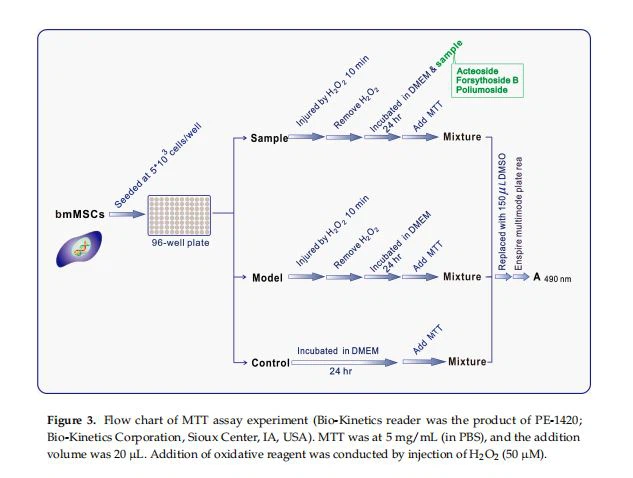
The MTT assay was used to evaluate the cytoprotective effect of acteoside and its derivatives towards bmMSCs [40]. The injury model was established based on the previous study [41]. The experimental protocol is briefly illustrated in Figure 3.
4.9. Statistical Analysis
Each experiment in Sections 4.2-4.4 and 4.7 were performed in triplicate, and the MTT assay experiment was performed in pentaplicate. Data were recorded as the mean 土 SD (standard deviation). The dose-response curves were plotted using Origin 6.0 professional software (OriginLab, Northampton, MA, USA). The IC50 value was defined as the final concentration of 50% radical inhibition (relative reducing power) [42]. Statistical comparisons were made by one-way ANOVA to detect significant differences using SPSS 13.0 (SPSS Inc., Chicago, IL, USA) for Windows. p < 0.05 was considered to be statistically significant.
5. Conclusions
Three natural phenylpropanoid glycosides, namely, acteoside, forsythoside B, and podium side, can be involved in multiple pathways to exert antioxidant action, including ET, H+-transfer; and Fe2+-chelating, but not RAF. The ET and H+-transfer pathways may be hindered by rhamnosyl moiety or apiosyl moiety; however, the Fe2+-chelating pathway can be enhanced by sugar residues (especially rhamnosyl moiety). The general effect of rhamnosyl moiety or apiosyl moiety is to enhance multiple-pathway-involved ROS-scavenging ability. Thus, forsythoside B and poliumoside are superior to acteoside in cytoprotective effects.
Supplementary Materials: Supplementary materials are available online. 1. Dose-response curves; 2. HPLC-MS spectra; 3. Analysis certificates of acteoside, forsythoside B, and poliumoside.
Acknowledgments: This work was supported by the National Science Foundation of China (81573558, 81603269), Guangdong Science and Technology Project (2017A050506043), and Natural Science Foundation of Guangdong Province (2 017A030312009, 2015A030310491).
Author Contributions: Xian Li and Dongfeng Chen conceived and designed the experiments; Aichi Wu prepared poliumoside; Yulu Xie, Qian Guo, and Penghui Xue performed the antioxidant experiments; Ke Li and Wei Zhao performed the MTT experiments; Hong Xie analyzed the data; Jiasong Guo conducted the experiment oi Figure 2D; Xian Li wrote the paper. All authors read and approved the final manuscript.
Conflicts of Interest: The authors declare no conflict of interest.

acteoside in cistanche
A abbreviations
ABTS+ • 2,2'-azino-bis (3-ethylbenzo-thiazoline-6-sulfonic acid) radical
bmMSCs bone marrow-derived mesenchymal stem cells
CUPRAC cupric reducing antioxidant capacity
dAMP 2'-deoxyadenosine-5'-monophosphate radical
DMEM Dulbecco's modified Eagle's medium
dGMP 2/-deoxyguanosine-5'-monophosphate radical
DPPHe 1,1-diphenyl-2-picryl-hydrazine radical
ET electron transfer; FBS: Fetal bovine serum
FRAP ferric ion reducing antioxidant power;
HAT hydrogen atom transfer
MTT 3-(4,5-dimethylthiazol-2-yl)-2,5-diphenyl
PCET proton-coupled electron transfer
PTIOe 2-phenyl-4,4,5,5-tetramethylimidazoline-1-oxyl 3-oxide radical
RAF radical adduct formation
ROS reactive oxygen species
SCNT somatic cell nuclear transfer
SEPT sequential electron-proton transfer
SPLET sequential proton loss single electron transfer
TPTZ 2,4,6-tripyridyl triazine
Trolox (±)-6-hydroxyl-2,5,7,8-tetramethlychromane-2-carboxylic acid
References
1. Kubica, P.; Szopa, A.; Ekiert, H. Production of verbascoside and phenolic acids in biomass of Verbena Officinalis L. (vervain) cultured under different in vitro conditions. Nat. Prod. Res. 2017, 31, 1663-1668.
2. Lee, J.H.; Chun, J.L.; Kim, K.J.; Kim, E.Y.; Kim, D.H.; Lee, B.M.; Han, K.W.; Park, K.S.; Lee, K.B.; Kim, M.K. Effect of Acteoside as a Cell Protector to Produce a Cloned Dog. PLoS ONE 2016,11, e0159330.
3. Wang, H.Q.; Xu, Y.X.; Yang, J.; Zhao, X.Y.; Sun, X.B.; Zhang, Y.P.; Guo, J.C.; Zhu, C.Q. Acteoside Protects Human Neuroblastoma SH-SY5Y Cells against |3-amyloid-induced Cell Injury. Brain Res. 2009,1283,139-147.
4. Yang, J.H.; Yan, Y.; Liu, H.B.; Wang, J.H.; Hu, J.P. Protective Effects of Acteoside against X-ray-induced Damage in Human Skin Fibroblasts. Mol. Med. Rep. 2015,12, 2301-2306.
5. Liu, C.H.; Liu, T.S.; Luo, C.Q.; Zhang, J.; Zeng, X.Y.; Cui, L.; Xie, L.J. Determination of forsythiaside B and poliumoside in different origin and parts from Callicarpa kwangtungensis. Zhongguo Zhong Yao Za Zhi 2013, 38, 3324-3326.
6. Jiang, W.L.; Tian, J.W.; Fu, F.H.; Zhu, H.B.; Hou, J. Neuroprotective Efficacy and Therapeutic Window of Forsythoside B: Ina Rat Model of Cerebral Ischemia and Reperfusion Injury. Eur. J. Pharmacol. 2010, 640, 75-81.
7. Pan, N.; Hori, H. Antioxidant Action of Acteoside and Its Analogs on Lipid Peroxidation. Redox Rep. 1996, 2, 149-154.
8. Zheng, R.L.; Shi, Y.M.; Jia, Z.J.; Zhao, C.Y.; Zhang, Q.; Tan, X.R. Fast Repair of DNA Radicals. Chem. Soc. Rev. 2010, 39, 2827-2834.
9. Li, X.C.; Mai, W.Q.; Chen, D.F. Chemical Study on Protective Effect Against Hydroxyl-induced DNA Damage and Antioxidant Mechanism of Myricitrin. J. Chin. Chem. Soc. 2014, 61, 383-390.
10. Shi, Y.M.; Wang, W.F.; Huang, C.Y.; Jia, Z.J.; Yao, S.; Zheng, R.L. Fast Repair of Oxidative DNA Damage by Phenylpropanoid Glycosides and Their Analogues. Mutagenesis 2008, 23, 19-26.
11. Jiang, Q.; Li, X.C.; Tian, Y.G.; Lin, Q.Q.; Xie, H.; Lu, W.B.; Chi, Y.G.; Chen, D.F. Lyophilized Aqueous Extracts of Mori Fructus and Mori Ramulus Protect Mesenchymal Stem Cells from eOH-Treated Damage: Bioassay and Antioxidant Mechanism. BMC Complement. Altern. Med. 2017,17, 242.
12. Wang, T.T.; Zeng, G.C.; Li, X.C.; Zeng, H.P. In Vitro Studies on the Antioxidant and Protective Effect of 2-Substituted-8-Hydroxyquinoline Derivatives Against H2O2-Induced Oxidative Stress in BMSCs. Chem. Biol. Drug Des. 2010, 75, 214-222.
13. Liu, J.J.; Li, X.C.; Lin, J.; Li, Y.R.; Wang, T.T.; Jiang, Q.; Chen, D.F. Sarcandra Glabra (Caoshanhu) Protects Mesenchymal Stem Cells from Oxidative Stress: A Bioevaluation and Mechanistic Chemistry. BMC Complement. Altern. Med. 2016, 16, 423.
14. Li, X.C.; Han, L.; Li, Y.R.; Zhang, J.; Chen, J.M.; Lu, W.B.; Zhao, X.J.; Lai, Y.T.; Chen, D.F.; Wei, G. Protective Effect of Sinapine against Hydroxyl radical-induced Damage to Mesenchymal Stem Cells and Possible Mechanisms. Chem. Pharm. Bull. 2016, 64, 319-325.
15. Bertolo, A.; Capossela, S.; Frankl, G.; Baur, M.; Potzel, T.; Stoyanov, J. Oxidative Status Predicts Quality in Human Mesenchymal Stem Cells. Stem Cell Res. Ther. 2017, 8, 3.
16. Li, X.C. 2-Phenyl-4,4,5,5-Tetramethylimidazoline-1-oxyl 3-Oxide (PTIOe) Radical Scavenging: A New and Simple Antioxidant Assay In Vitro. J. Agric. Food Chem. 2017, 65, 6288-6297.
17. Li, X. Improved Pyrogallol Autoxidation Method: A Reliable and Cheap Superoxide-Scavenging Assay Suitable for All Antioxidants. J. Agric. Food Chem. 2012, 60, 6418-6424.
18. Li, X.C.; Jiang, Q.; Wang, T.T.; Liu, J.J.; Chen, D.F. Comparison of the Antioxidant Effects of Quercitrin and Isoquercitrin: Understanding the Role of the 6〃-OH Group. Molecules 2016, 21,1246.
19. Leopoldini, M.; Marino, T.; Russo, N.; Toscano, M. Antioxidant Properties of Phenolic compounds: H-atom Versus Electron Transfer Mechanism. J. Phys. Chem. A 2004,108, 4916^922.
20. Benzie, I.F.F.; Strain, J.J. The Ferric Reducing Ability of Plasma (FRAP) as a Measure of “Antioxidant Power": The FRAP assay. Anal. Biochem. 1996, 239, 70-76.
21. Gulcin, I. Antioxidant Activity of Food Constituents: An Overview. Arch. Toxicol. 2012, 86, 345-391.
22. Goldstein, S.; Russo, A.; Samuni, A. Reactions of PTIO and Carboxy-PTIO with ・NO, ・NO2, and O2. J. Biol. Chem. 2003, 278, 50949-50955.
23. Li, X.; Han, W.J.; Mai, W.Q.; Wang, L. Antioxidant Activity and Mechanism of Tetrahydroamentoflavone in vitro. Nat. Prod. Commun. 2013, 8, 787-789.
24. Zhang, H.Y.; Wu, W.; Mo, Y.R. Study of Proton-Coupled Electron Transfer (PCET) with Four Explicit Diabatic States at the ab Initio Level. Comput. Theor. Chem. 2017, 1116, 50-58.
25. Lin, J.; Li, X.C.; Chen, L.; Lu, W.Z.; Chen, X.W.; Han, L.; Chen, D.F. Protective Effect Against Hydroxyl radical-induced DNA Damage and Antioxidant Mechanism of [6]-gingerol: A Chemical Study. Bull. Korean Chem. Soc. 2014, 35, 1633-1638.
26. Iuga, C.; Alvarez-Idaboy, J.R.; Russo, N. Antioxidant Activity of Trans-Resveratrol Toward Hydroxyl and Hydroperoxyl Radicals: A Quantum Chemical and Computational Kinetics Study. J. Org. Chem. 2012, 77, 3868-3877. [CrossRef] [PubMed]
27. Li, X.C.; Hu, Q.P.; Jiang, S.X.; Li, F.; Lin, J.; Han, L.; Hong, Y.L.; Lu, W.B.; Gao, Y.X.; Chen, D.F. Flos Chrysanthemi Indici Protects against Hydroxyl-induced Damages to DNA and MSCs via Antioxidant Mechanism. J. Saudi Chem. Soc. 2015,19, 454-460.
28. Amic, A.; Markovic, Z.; Markovic, J.M.D.; Stepanic, V.; Lucic, B.; Amic, D. Towards an Improved Prediction of the Free Radical Scavenging Potency of Flavonoids: The Significance of Double PCET Mechanisms. Food Chem. 2014, 152, 578-585.
29. Lee, C.H.; Yoon, J.Y. UV Direct Photolysis of 2,2'-and-bis(3-ethylbenzothiazoline-6-sulfonate) (ABTS) in Aqueous Solution: Kinetics and Mechanism. J. Photochem. Photobiol. A 2008, 197, 232-238.
30. Aliaga, C.; Lissi, E.A. Reaction of 2,2’-Azinobis(3-Ethylbenzothiazoline-6-Sulfonic Acid (ABTS) Derived Radicals with Hydroperoxides. Kinetics and Mechanism. Int. J. Chem. Kinet. 1998, 30, 565-570.
31. Osman, A.M.; Wong, K.K.Y; Fernyhough, A. ABTS Radical-Driven Oxidation of Polyphenols: Isolation and Structural Elucidation of Covalent Adducts. Biochem. Biophys. Res. Commun. 2006, 346, 321-329.
32. Osman, A.M. Multiple Pathways of the Reaction of 2,2-Diphenyl-1-Picrylhydrazyl Radical (DPPHe) with (+)-catechin: Evidence for the Formation of a Covalent Adduct between DPPHe and the Oxidized Form of the Polyphenol. Biochem. Biophys. Res. Commun. 2011, 412, 473-478.
33. Lopez-Munguia, A.; Hernandez-Romero, Y.; Pedraza-Chaverri, J.; Miranda-Molina, A.; Regla, I.; Martinez, A.; Castillo, E. Phenylpropanoid Glycoside Analogues: Enzymatic Synthesis, Antioxidant Activity and Theoretical Study of Their Free Radical Scavenger Mechanism. PLoS ONE 2011, 6, e20115.
34. Perron, N.R.; Brumaghim, J.L. A Review of the Antioxidant Mechanisms of Polyphenol Compounds Related to Iron Binding. Cell Biochem. Biophys. 2009, 53, 75-100.
35. Devos, D.; Moreau, C.; Devedjian, J.C.; Kluza, J.; Perrault, M.; Laloux, C.; Jonneaux, A.; Ryckewaert, G.; Garcon, G.; Rouaix, N.; et al. Targeting Chelatable Iron as a Therapeutic Modality in Parkinson's Disease. Antioxid. Redox Signal. 2014, 21,195-210.
36. Cekic, S.D.; Baskan, K.S.; Totem, E.; Apak, R. Modified Cupric Reducing Antioxidant Capacity (CUPRAC) Assay for Measuring the Antioxidant Capacities of Thiol-containing Proteins in Admixture with Polyphenols. Talanta 2009, 79, 344-351.
37. Li, X.C.; Chen, D.F.; Mai, Y.; Wen, B.; Wang, X.Z. Concordance between Antioxidant Activities in vitro and Chemical Components of Radix Astragali (Huangqi). Nat. Prod. Res. 2012, 26, 1050-1053.
38. Chen, D.F.; Li, X.C.; Xu, Z.W.; Liu, X.B.; Du, S.H.; Li, H.; Zhou, J.H.; Zeng, H.P.; Hua, Z.C. Hexadecanoic Acid from Buzhong Yiqi Decoction Induced Proliferation of Bone Marrow Mesenchymal Stem Cells. J. Med. Food 2010,13, 967-975.
39. Li, X.; Liu, J.J.; Lin, J.; Wang, T.T.; Huang, J.Y.; Lin, Y.Q.; Chen, D.F. Protective Effects of Dihydromyricetin against »OH-Induced Mesenchymal Stem Cells Damage and Mechanistic Chemistry. Molecules 2016,21, 604.
40. Wang, G.R.; Li, X.C.; Zeng, H.P. Synthesis, Antioxidation activity of (E)-9-p-Tolyl-3-2-(8-hydroxy-quinol- 2-yl)vinyl-carbazole and (E)-9-(p-Anisyl)-3-2-(8-hydroxy-quinol-2-yl)vinyl-carbazole and Their Induction Proliferation of Mesenchymal Stem Cells. Acta Chim. Sin. 2009, 67, 974-982.
41. Li, X.; Wei, G.; Wang, X.; Liu, D.; Deng, R.; Li, H.; Zhou, J.; Li, Y.; Zeng, H.; Chen, D. Targeting of the Shh Pathway by atractylenolides promotes chondrogenic differentiation of mesenchymal stem cells. Biol. Pharm. Bull. 2012, 35,1328-1335.
42. Li, X.C.; Gao, Y.X.; Li, F.; Liang, A.F.; Xu, Z.M.; Bai, Y.; Mai, W.Q.; Han, L.; Chen, D.F. Maclurin protects against hydroxyl radical-induced damages to mesenchymal stem cells: Antioxidant evaluation and mechanistic insight. Chem. Biol. Interact. 2014, 219, 221-228.
Sample Availability: A sample of the compound poliumoside is available from the authors.
© 2018 by the authors. Licensee MDPI, Basel, Switzerland. This article is an open-access article distributed under the terms and conditions of the Creative Commons Attribution (CC BY) license (http:ZZcreativecommons.org/licenses/byZ4.0Z).