Part 2 | Predicting Renal Recovery After Dialysis-Requiring Acute Kidney Injury Predicting Renal Recovery After Dialysis-Requiring Acute Kidney Injury
Mar 03, 2022
Predicting Renal Recovery After Dialysis-Requiring Acute Kidney Injury Predicting Renal Recovery After Dialysis-Requiring Acute Kidney Injury
Contact: emily.li@wecistanche.com
Benjamin J. Lee1,2,3, Chi-yuan Hsu1,4, Rishi Parikh4, Charles E. McCulloch5, Thida C. Tan4, Kathleen D. Liu1,6, Raymond K. Hsu1, Leonid Pravoverov7, Sijie Zheng4,7, and Alan S. Go1,4,5
1Division of Nephrology, Department of Medicine, University of California, San Francisco, San Francisco, California, USA; 2Houston Kidney Consultants, Houston, Texas, USA; 3Houston Methodist Institute for Academic Medicine, Houston, Texas, USA; 4Division of Research, Kaiser Permanente Northern California, Oakland, California, USA; 5Department of Epidemiology and Biostatistics, University of California, San Francisco, San Francisco, California, USA; 6Division of Critical Care, Department of Anesthesia, University of California, San Francisco, San Francisco, California, USA; and 7Department of Nephrology, Kaiser Permanente Oakland Medical Center, Oakland, California, USA
Keywords: dialysis, dialysis-requiring, kidney function, acute kidney injury, prediction model, renal recovery
For Part 1, please click here.
RESULTS
Cohort Assembly and Baseline Characteristics
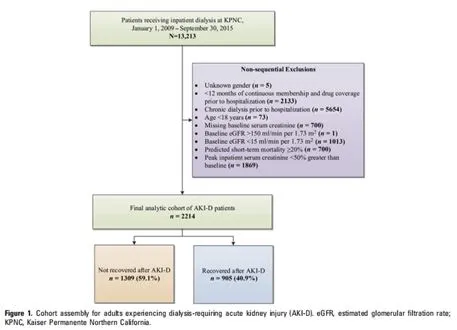
We initially identified 13,213 adult patients who received inpatient RRT. After excluding patients who received chronic dialysis before hospitalization, were of age <18 years, had unknown gender, had <12 consecutive months of membership or drug coverage before the index hospitalization had no baseline serum creatinine concentration, had baseline eGFR >150 or <15 ml/min per 1.73 m2, had a predicted probability of inpatient mortality ≥20%, or had <50% increase in peak inpatient serum creatinine concentration compared with preadmission baseline, we had a final analytic cohort of 2214 patients with AKI-D (Figure 1).
The mean age was 67.1 years, 40.8% were women, and 54.0% were white. Overall, 905 (40.9%) patients recovered within 90 days of RRT initiation. Of the patients who did not recover, 731 (55.8%) died while still dialysis-dependent. Selected candidate predictors are presented in Table 1; the remaining additional candidate predictors are reported in Supplementary Table S1. Compared with patients who did not recover, patients who recovered were younger and less likely to have a history of heart failure or chronic liver disease. Those who recovered had a higher body mass index, higher baseline eGFR, less proteinuria, and higher preadmission hemoglobin level (Table 1).
Logistic Regression
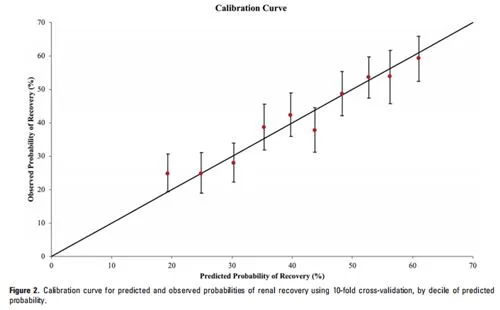
In 1000 bootstrap samples of the analytic cohort, 4 predictors were chosen by stepwise regression in >75% of samples: baseline (preadmission) eGFR (all 1000 samples), preadmission hemoglobin level (954 samples), history of chronic liver disease (863 samples), and age (802 samples). The c-index of a model with these predictors, obtained using observed and predicted values from 10-fold cross-validation, was 0.64. The correlation coefficient (R) between observed and predicted probabilities of recovery, plotted by decile of predicted probability of recovery, was high at 0.97 (Figure 2). Predicted recovery probabilities ranged from 9% to 22% in the lowest decile to 58% to 66% in the highest decile. Using the full analytic cohort, we obtained odds ratios for recovery for the 4 chosen predictors using logistic regression (Table 2).
In our sensitivity analysis that did not exclude patients with a predicted probability of inpatient mortality ≥ 20%, the same predictors were chosen using our bootstrapping and cross-validation approach, with no significant change in the c-index (0.645).
In an additional sensitivity analysis, results did not materially differ if serum creatinine concentration was used instead of eGFR (c-index 0.646), and the same predictors were selected.
CART Analysis
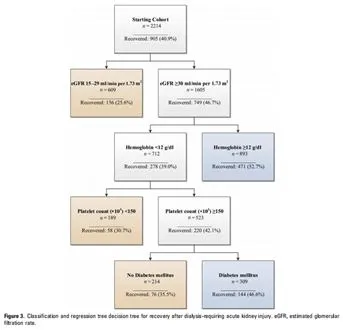
The final decision tree included 4 nodes: eGFR ≥ 30 ml/ min per 1.73 m2, preadmission hemoglobin <12.0 g/l, preadmission platelet count ≥150,000/ml, and history of diabetes mellitus (Figure 3). CART subdivided the cohort into 5 risk groups with recovery probabilities ranging from 25.6% to 52.7%. The c-index obtained from 10-fold cross-validation was 0.61.
CONCLUSION
We developed and cross-validated a parsimonious logistic regression model for recovery after AKI-D using variables that are routinely available in clinical practice. To our knowledge, our study is the first to develop a recovery prediction model that uses clinical data from a diverse, community-based cohort. Although novel, simple to use, and has excellent calibration (i.e., ability to predict absolute risk accurately), our model demonstrated only modest discrimination, which limits its clinical utility.

Cistanche protects kidneys and improves adrenal gland function
We believe that our model's disappointing discrimination highlights how very challenging it is to distinguish relatively between patients with higher versus lower chances of recovery in a real-world clinical setting using information currently available to physicians. This finding is entirely concordant with our recent report that approximately 1 in every 24 patients registered as having ESRD in the U.S. Renal Data System recovered to discontinue dialysis and likely had AKI-D misclassified as permanent kidney failure instead.43 This dilemma has population-level implications, particularly in the United States where reimbursement policies for dialysis services have historically differed depending on whether a patient is designated as having AKI-D or ESRD. The Centers for Medicare and Medicaid Services only reinstated reimbursement for dialysis provided to AKI-D outpatients in 2017, and payments for skilled nursing facility residents with AKI-D only started in 2018.44 Furthermore, there has been considerable debate regarding whether patients with AKI-D should be included in the ESRD Quality Incentive Program, which affects payments to ESRD facilities.45 Because optimal clinical management of patients with AKI-D and of patients with ESRD differ, the American Society of Nephrology46 and Renal Physicians Association47 have strongly advocated against including patients with AKI-D in the ESRD Quality Incentive Program. Our results argue that policies based on assuming that physicians are able to predict accurately whether a patient truly has ESRD or not at the time of RRT initiation may be unwise and unrealistic. A better approach may be to recognize this diagnostic uncertainty and modify policy accordingly, such as by asking physicians to certify patients as having ESRD or not only after a certain period has elapsed.
Our findings that younger age and higher baseline eGFR are strong predictors for recovery are consistent with prior studies.12–15 The fact that chronic liver disease is associated with reduced chances for recovery may be due to compromised renal perfusion in the setting of hepatorenal physiology.48 We speculate that our finding that higher preadmission hemoglobin level predicts recovery may reflect higher preadmission eGFR (because hemoglobin level and eGFR may be correlated, and our hemoglobin categories were narrower than our eGFR categories) or generally better health status overall.

Cistanche protects kidneys and is the adrenal fatigue supplement
Strengths of our study include the large, contemporary cohort of patients with AKI-D with broad demographic diversity. Although most other studies have included only patients in intensive care units,5,12,16,49,50 our cohort included both intensive care unit and medical ward patients in 21 medical centers across Northern California.23 KPNC’s integrated health care delivery system offers the advantage of being able to track recovery longitudinally both during the AKI-D hospitalization and in the outpatient setting after hospital discharge. In addition, it provides the unique opportunity to ascertain preadmission comorbidities, medication use, and laboratory values. In contrast, many AKI epidemiology studies2,51,52 have had limited ascertainment of key clinical covariates before hospitalization. We used rigorous criteria to identify AKI-D cases and were careful about requiring patient survival for≥4 weeks after dialysis discontinuation to avoid misclassification of withdrawal of care as recovery. Our approach of anchoring recovery from the time of dialysis initiation rather than the time of hospital discharge also enhances our results' generalizability compared with prior studies because the timing of hospital discharge may be affected by social and systems-based factors unrelated to the natural history of AKI-D. Finally, we used 2 modeling techniques to try to enhance our ability to predict renal recovery.

Cistanche protects kidneys and is the adrenal fatigue supplement
Several limitations should be noted. Because predicting recovery is clinically relevant only once patients are improving, typically in the denouement phase of acute illness, the ideal study population in which to derive a prediction rule should include only patients with AKI-D who reach this juncture in their hospitalizations. However, it is not possible to identify this stage of disease trajectory in large database studies such as ours. We, therefore, limited our study population to the subset of patients with AKI-D who could be readily identified clinically as not having excessively high predicted inpatient mortality risk. We did not want to limit our study population only to AKI-D survivors because such an approach would use retrospective conditioning. We required that all cases of AKI-D have a ≥50% increase in serum creatinine over the preadmission baseline value to reduce misclassifi- cation of progressive CKD as AKI. However, as a result, we may have excluded some cases of true AKI-D (e.g., a cardiac surgery patient who is anuric and volume- overloaded postoperatively may initiate RRT in the setting of true AKI but may not meet this threshold to be included in our analysis). We defined recovery as a dichotomous outcome based on RRT dependence and did not estimate the magnitude of recovery (e.g., full vs. partial recovery). Although functional recovery beyond RRT dependence is certainly important, definitions for recovery are variable,22 and serum creatinine levels may be affected by dilution from fluid accumulation53 and fluctuating creatinine production,54,55 which makes evaluating recovery as a change in serum creatinine concentration from before to after the acute illness less straightforward. Furthermore, in current practice, most physicians do not systematically ascertain recovery. Another limitation of our study was that not all clinical details related to the AKI-D hospitalizations were available. We were missing information regarding the etiology of preexisting CKD, indication for RRT initiation, initial RRT modality (e.g., intermittent vs. continuous therapy), physiologic variables at the time of RRT initiation including APACHE score and urine output, inpatient medication use, and setting of AKI (e.g., sepsis or postsurgery); however, there is no definitive evidence that dialysis duration,12,56 dialysis dose,57,58 choice of dialysis membrane,59 RRT modality,9,12,56,59–64 timing of dialysis initiation,65–68 or medications such as diuretics69–71 are associated with chances of recovery. Although the specific etiology of AKI-D was also unavailable in our dataset, prior chart review of KPNC medical records by a board-certified nephrologist of similar cases showed that almost all were due to acute tubular necrosis.13,15 We were not able to examine whether the Charlson comorbidity index and APACHE II score were predictive for recovery, as previously reported,18 because not all of the components were available. However, the vast majority of these scores' parameters are accounted for in the validated KPNC inpatient mortality score that was used instead.26 Finally, while we used a 10-fold cross-validation approach, our results should be further validated in other external patient populations that have similarly broad diversity in sociodemographic features and comorbidity burden.

Cistanche protects kidney
In conclusion, we have developed and cross-validated a prediction model for recovery after AKI-D, but our find- ings reiterate the need for better clinical prediction tools. Although our model demonstrates excellent calibration, its modest discrimination may reflect the complexity of factors affecting recovery. The addition of selected biomarkers to clinical parameters may prove useful in enhancing predictive models in the future.18,72,73 Future research is needed to enhance our predictive abilities as well as to examine potential treatments that may enhance or expedite recovery after AKI-D.
DISCLOSURE
All the authors declared no competing interests.
ACKNOWLEDGMENTS
This study was supported by the University of California, San Francisco–Kaiser Permanente Northern California Grants Program for Fellows (BJL, ASG, and CYH) and NIH- NIDDK Grants T32DK007219 (BJL), F32DK115030 (BJL), K24DK92291 (CYH), K24DK113381 (KDL), K23DK100468 (RKH), R03DK111881 (RKH), and R01DK101507 (ASG, CYH,
and KDL).
AUTHOR CONTRIBUTIONS
BJL, CYH, CEM, and ASG designed the study; RP, TCT, LP, SZ, and ASG acquired the data; BJL, CYH, RP, CEM, TCT, KDL, RKH, LP, SZ, and ASG analyzed and interpreted the data; BJL, CYH, and ASG drafted the paper; BJL, CYH, RP, CEM, TCT, KDL, RKH, LP, SZ, and ASG revised the paper; all authors approved the final version of the manuscript.
SUPPLEMENTARY MATERIAL
Table S1. Additional baseline characteristics of the study cohort, stratified by renal recovery status.
Appendix S1. List of hospitals in which the study population was treated.
Supplementary material is linked to the online version of the paper at www.kireports.org.
REFERENCES
1. Hoste EA, Bagshaw SM, Bellomo R, et al. Epidemiology of acute kidney injury in critically ill patients: the multinational AKI-EPI study. Intensive Care Med. 2015;41:1411–1423.
2. Uchino S, Kellum JA, Bellomo R, et al. Acute renal failure in critically ill patients: a multinational, multicenter study. JAMA. 2005;294:813–818.
3. Wald R, McArthur E, Adhikari NK, et al. Changing incidence and outcomes following dialysis-requiring acute kidney injury among critically ill adults: a population-based cohort study. Am J Kidney Dis. 2015;65:870–877.
4. Waikar SS, Curhan GC, Wald R, et al. Declining mortality in patients with acute renal failure, 1988 to 2002. J Am Soc Nephrol. 2006;17:1143–1150.
5. Chertow GM, Christiansen CL, Cleary PD, et al. Prognostic stratification in critically ill patients with acute renal failure requiring dialysis. Arch Intern Med. 1995;155:1505–1511.
6. Rennie TJ, Patton A, Dreischulte T, et al. Incidence and outcomes of acute kidney injury requiring renal replacement therapy: a retrospective cohort study. Nephron. 2016;133: 239–246.
7. Silversides JA, Pinto R, Kuint R, et al. Fluid balance, intra- dialytic hypotension, and outcomes in critically ill patients undergoing renal replacement therapy: a cohort study. Crit Care. 2014;18:624.
8. Prescott GJ, Metcalfe W, Baharani J, et al. A prospective national study of acute renal failure treated with RRT: incidence, etiology, and outcomes. Nephrol Dial Transplant. 2007;22: 2513–2519.
9. Cerda J, Liu KD, Cruz DN, et al. Promoting kidney function recovery in patients with AKI requiring RRT. Clin J Am Soc Nephrol. 2015;10:1859–1867.
10. Hickson LJ, Chaudhary S, Williams AW, et al. Predictors of outpatient kidney function recovery among patients who initiate hemodialysis in the hospital. Am J Kidney Dis. 2015;65:592–602.
11. Wald R, Quinn RR, Luo J, et al. Chronic dialysis and death among survivors of acute kidney injury requiring dialysis. JAMA. 2009;302:1179–1185.
12. Schiffl H. Renal recovery from acute tubular necrosis requiring renal replacement therapy: a prospective study in critically ill patients. Nephrol Dial Transplant. 2006;21:1248–1252.
13. Hsu CY, Chertow GM, McCulloch CE, et al. Nonrecovery of kidney function and death after acute on chronic renal failure. Clin J Am Soc Nephrol. 2009;4:891–898.
14. Lee BJ, Go AS, Parikh R, et al. Pre-admission proteinuria impacts the risk of non-recovery after dialysis-requiring acute kidney injury. Kidney Int. 2018;93:968–976.
15. Lo LJ, Go AS, Chertow GM, et al. Dialysis-requiring acute renal failure increases the risk of progressive chronic kidney disease. Kidney Int. 2009;76:893–899.
16. Bagshaw SM, Laupland KB, Doig CJ, et al. Prognosis for long-term survival and renal recovery in critically ill patients with severe acute renal failure: a population-based study. Crit Care. 2005;9:R700–R709.
17. Craven AM, Hawley CM, McDonald SP, et al. Predictors of renal recovery in Australian and New Zealand end-stage renal failure patients treated with peritoneal dialysis. Perit Dial Int. 2007;27:184–191.
18. Srisawat N, Wen X, Lee M, et al. Urinary biomarkers and renal recovery in critically ill patients with renal support. Clin J Am Soc Nephrol. 2011;6:1815–1823.
19. Crowley ST, Chertow GM, Vitale J, et al. Lessons for successful study enrollment from the Veterans Affairs/National Institutes of Health Acute Renal Failure Trial Network Study. Clin J Am Soc Nephrol. 2008;3:955–961.
20. Chertow GM, Pascual MT, Soroko S, et al. Reasons for non-enrollment in a cohort study of ARF: the Program to Improve Care in Acute Renal Disease (PICARD) experience and implications for a clinical trials network. Am J Kidney Dis. 2003;42:507–512.
21. Bellomo R, Ronco C, Kellum JA, et al. Acute renal failure— definition, outcome measures, animal models, fluid therapy and information technology needs: the Second International Consensus Conference of the Acute Dialysis Quality Initiative (ADQI) Group. Crit Care. 2004;8:R204–R212.
22. Chawla LS, Bellomo R, Bihorac A, et al. Acute kidney disease and renal recovery: consensus report of the Acute Disease Quality Initiative (ADQI) 16 Workgroup. Nat Rev Nephrol. 2017;13:241–257.
23. Gordon NP. Characteristics of Adult Health Plan Members in the Northern California Region Membership, as Estimated from the 2011 Member Health Survey. Oakland, CA: Division of Research, Kaiser Permanente Medical Care Program; 2013.
24. Hsu CY, Ordonez JD, Chertow GM, et al. The risk of acute renal failure in patients with chronic kidney disease. Kidney Int. 2008;74:101–107.
25. Karter AJ, Ferrara A, Liu JY, et al. Ethnic disparities in diabetic complications in an insured population. JAMA. 2002;287: 2519–2527.
26. Escobar GJ, Gardner MN, Greene JD, et al. Risk-adjusting hospital mortality using a comprehensive electronic record in an integrated health care delivery system. Med Care. 2013;51: 446–453.
27. Carretta HJ, Mick SS. Geocoding public health data. Am J Public Health. 2003;93:699.
28. Swallen KC, Glaser SL, Stewart SL, et al. Accuracy of racial classification of Vietnamese patients in a population-based cancer registry. Ethn Dis. 1998;8:218–227.
29. Stewart SL, Swallen KC, Glaser SL, et al. Comparison of methods for classifying Hispanic ethnicity in a population-based cancer registry. Am J Epidemiol. 1999;149:1063–1071.
30. Go AS, Hylek EM, Borowsky LH, et al. Warfarin use among ambulatory patients with nonvalvular atrial fibrillation: the anticoagulation and risk factors in atrial fibrillation (ATRIA) study. Ann Intern Med. 1999;131:927–934.
31. Go AS, Lee WY, Yang J, et al. Statin therapy and risks for death and hospitalization in chronic heart failure. JAMA. 2006;296:2105–2111.
32. Go AS, Iribarren C, Chandra M, et al. Statin and beta-blocker therapy and the initial presentation of coronary heart disease. Ann Intern Med. 2006;144:229–238.
33. Go AS, Yang J, Ackerson LM, et al. Hemoglobin level, chronic kidney disease, and the risks of death and hospitalization in adults with chronic heart failure: the Anemia in Chronic Heart Failure: Outcomes and Resource Utilization (ANCHOR) Study. Circulation. 2006;113:2713–2723.
34. Singer DE, Chang Y, Fang MC, et al. The net clinical benefit of warfarin anticoagulation in atrial fibrillation. Ann Intern Med. 2009;151:297–305.
35. Silverberg MJ, Leyden W, Hurley L, et al. Response to newly prescribed lipid-lowering therapy in patients with and without HIV infection. Ann Intern Med. 2009;150:301–313.
36. Go AS, Fang MC, Udaltsova N, et al. Impact of proteinuria and glomerular filtration rate on risk of thromboembolism in atrial fibrillation: the anticoagulation and risk factors in atrial fibrillation (ATRIA) study. Circulation. 2009;119:1363–1369.
37. Go AS, Yang J, Gurwitz JH, et al. Comparative effectiveness of different beta-adrenergic antagonists on mortality among adults with heart failure in clinical practice. Arch Intern Med. 2008;168:2415–2421.
38. Go AS, Magid DJ, Wells B, et al. The Cardiovascular Research Network: a new paradigm for cardiovascular quality and outcomes research. Circ Cardiovasc Qual Outcomes. 2008;1: 138–147.
39. Go AS, Chertow GM, Fan D, et al. Chronic kidney disease and the risks of death, cardiovascular events, and hospitalization. N Engl J Med. 2004;351:1296–1305.
40. Arellano MG, Petersen GR, Petitti DB, et al. The California Automated Mortality Linkage System (CAMLIS). Am J Public Health. 1984;74:1324–1330.
41. Levey AS, Stevens LA, Schmid CH, et al. A new equation to estimate glomerular filtration rate. Ann Intern Med. 2009;150: 604–612.
42. Muller R, Mockel M. Logistic regression and CART in the analysis of multimarker studies. Clin Chim Acta. 2008;394:1–6.
43. Lee BJ JK, McCulloch CE, Hsu CY. The potential impact of Medicare payment policy on misclassification of dialysis-requiring acute kidney injury as the end-stage renal disease: a national temporal trend analysis. Am J Kidney Dis, in press.
44. 2018 SNF Consolidated Billing Part B MAC Update. Baltimore, MD: Centers for Medicare & Medicaid Services; 2017.
45. Proposed Updates to Policies and Payment Rates for End-Stage Renal Disease Prospective Payment System, Quality Incentive Program, and Payment for Renal Dialysis Services Furnished to Individuals with Acute Kidney Injury (CMS 1674-P). Baltimore, MD: Centers for Medicare & Medicaid Services; 2017.
46. American Society of Nephrology. RE: CMS-1651-P Medicare Program; End-Stage Renal Disease Prospective Payment System, Quality Incentive Program, Coverage, and Payment for Renal Dialysis Services Furnished to Individuals With Acute Kidney Injury, End-Stage Renal Disease Quality Incentive Program. Available at: https://www.asn-online.org/policy/ webdocs/16.8.23FinalPPS.QIP.AKI.CKDCommentLetter.pdf. Published August 23, 2016. Accessed March 1, 2019.
47. Renal Physicians Association. RPA Comments on the 2017 ESRD PPS Proposed Rule Including AKI Policy. Available at: https://www.renalmd.org/page/ESRDPPSRuleComments?. Published August 23, 2016. Accessed March 1, 2019.
48. Meola M, Nalesso F, Petrucci I, et al. Clinical scenarios in acute kidney injury: hepatorenal syndrome. Contrib Nephrol. 2016;188:33–38.
49. Uchino S, Bellomo R, Morimatsu H, et al. Continuous renal replacement therapy: a worldwide practice survey. The beginning and ending of supportive therapy for the kidney (B.E.
S.T. kidney) investigators. Intensive Care Med. 2007;33:1563– 1570.
50. Cole L, Bellomo R, Silvester W, et al. A prospective, multi-center study of the epidemiology, management, and outcome of severe acute renal failure in a "closed" ICU system. Am J Respir Crit Care Med. 2000;162:191–196.
51. Ali T, Khan I, Simpson W, et al. Incidence and outcomes in acute kidney injury: a comprehensive population-based study. J Am Soc Nephrol. 2007;18:1292–1298.
52. Bagshaw SM, George C, Bellomo R, et al. A comparison of the RIFLE and AKIN criteria for acute kidney injury in critically ill patients. Nephrol Dial Transplant. 2008;23:1569–1574.
53. Liu KD, Thompson BT, Ancukiewicz M, et al. Acute kidney injury in patients with acute lung injury: impact of fluid accumulation on classification of acute kidney injury and associated outcomes. Crit Care Med. 2011;39:2665–2671.
54. Prowle JR, Kolic I, Purcell-Lewis J, et al. Serum creatinine changes associated with critical illness and detection of persistent renal dysfunction after AKI. Clin J Am Soc Nephrol. 2014;9:1015–1023.
55. Doi K, Yuen PS, Eisner C, et al. Reduced production of creatinine limits its use as a marker of kidney injury in sepsis. J Am Soc Nephrol. 2009;20:1217–1221.
56. Uehlinger DE, Jakob SM, Ferrari P, et al. Comparison of continuous and intermittent renal replacement therapy for acute renal failure. Nephrol Dial Transplant. 2005;20:1630–1637.
57. Park JT, Lee H, Kee YK, et al. High-dose versus conventional-dose continuous venovenous hemodiafiltration and patient and kidney survival and cytokine removal in sepsis-associated acute kidney injury: a randomized controlled trial. Am J Kidney Dis. 2016;68:599–608.
58. VA/NIH Acute Renal Failure Trial Network, Palevsky PM, Zhang JH, et al. Intensity of renal support in critically ill patients with acute kidney injury. N Engl J Med. 2008;359: 7–20.
59. Schneider AG, Bagshaw SM. Effects of renal replacement therapy on renal recovery after acute kidney injury. Nephron Clin Pract. 2014;127:35–41.
60. Augustine JJ, Sandy D, Seifert TH, et al. A randomized controlled trial comparing intermittent with continuous dialysis in patients with ARF. Am J Kidney Dis. 2004;44: 1000–1007.
61. Schneider AG, Bellomo R, Bagshaw SM, et al. Choice of renal replacement therapy modality and dialysis dependence after acute kidney injury: a systematic review and meta-analysis. Intensive Care Med. 2013;39:987–997.
62. Liang KV, Sileanu FE, Clermont G, et al. Modality of RRT and recovery of kidney function after AKI in patients surviving to hospital discharge. Clin J Am Soc Nephrol. 2016;11:30–38.
63. Vinsonneau C, Camus C, Combes A, et al. Continuous venovenous haemodiafiltration versus intermittent hemodialysis for acute renal failure in patients with multiple-organ dysfunction syndrome: a multicentre randomized trial. Lancet. 2006;368:379–385.
64. Schefold JC, von Haehling S, Pschowski R, et al. The effect of continuous versus intermittent renal replacement therapy on the outcome of critically ill patients with acute renal failure (CONVENT): a prospective randomized controlled trial. Crit Care. 2014;18:R11.
65. Gaudry S, Hajage D, Schortgen F, et al. Initiation strategies for renal-replacement therapy in the intensive care unit. N Engl J Med. 2016;375:122–133.
66. Zarbock A, Kellum JA, Schmidt C, et al. Effect of early vs delayed initiation of renal replacement therapy on mortality in critically ill patients with acute kidney injury: the ELAIN randomized clinical trial. JAMA. 2016;315:2190– 2199.
67. Oh HJ, Kim MH, Ahn JY, et al. Can early initiation of continuous renal replacement therapy improve patient survival with septic acute kidney injury when enrolled
in early goal-directed therapy? J Crit Care. 2016;35:51– 56.
68. Truche AS, Darmon M, Bailly S, et al. Continuous renal replacement therapy versus intermittent hemodialysis in intensive care patients: impact on mortality and renal recovery. Intensive Care Med. 2016;42:1523.
69. Shilliday IR, Quinn KJ, Allison ME. Loop diuretics in the management of acute renal failure: a prospective, double-blind, placebo-controlled, randomized study. Nephrol Dial Transplant. 1997;12:2592–2596.
70. Cantarovich F, Rangoonwala B, Lorenz H, et al. High-dose furosemide for established ARF: a prospective, randomized, double-blind, placebo-controlled, multicenter trial. Am J Kidney Dis. 2004;44:402–409.
71. van der Voort PH, Boerma EC, Koopmans M, et al. Furosemide does not improve renal recovery after hemofiltration for acute renal failure in critically ill patients: a double-blind randomized controlled trial. Crit Care Med. 2009;37:533–538.
72. Koraishy FM, Coca SG. Can we predict recovery from severe acute kidney injury with biomarkers? Semin Dial. 2014;27: 236–239.
Puthumana J, Hall IE, Reese PP, et al. YKL-40 associates with renal recovery in deceased donor kidney transplantation. J Am Soc Nephrol. 2017;28:661–670