(Part II) Prospective Pharmacological Potential Of Resveratrol in Delaying Kidney Aging
Mar 23, 2022
4.5.Autophagy Dysfunction Autophagy is crucial for protein homeostasis [121]. Though oxidative stress and autophagy dysfunction are intimately involved in kidney diseases, very little is known about the signaling processes that link them [131]. Autophagy is a degradation pathway of lysosomal proteins in a highly regulated manner, where ablation of protein aggregates and damaged organelles occurs to maintain intracellular homeostasis and cellular integrity, and therefore, an aberration of this pathway leads to the pathogenesis of a variety of kidney diseases and aging [132,133]. For instance, impairment /disturbances in autophagic flux may lead to pathogenesis of kidney lipotoxicity, kidney injury, lysosomal dysfunction, AKI, diabetic nephropathy, focal segmental glomerulosclerosis, polycystic kidney disease, and kidney aging[134-136]. However, the induction of autophagy during CKDin mice is responsible for the impairment of mitochondria and ATP production [137].
Activation of autophagy plays an important role against kidney diseases and the aging process, while sirtuins, mammalian target of rapamycin (m TOR), and AMP-activated protein kinase (AMPK) are the key regulators of autophagy [134,138]. Resveratrol inhibits the NLRP3 inflammasome pathway through induction of AMPK and SIRT1-mediated autophagy [139]. The effects of resveratrol on autophagy were shown against diabetic nephropathy, where this compound enhanced the LC3-II/LC3-I protein ratio and downregulated cleaved caspase-3 expression [8l]. Long-term use of resveratrol is reported to reduce type 2 diabetic nephropathy since it promotes SIRT1-mediated autophagy induction [82]. Additionally, in vitro and in vivo studies showed that resveratrol reduced oxalate-induced kidney inflammation and oxidative stress through autophagy activation [140]. Pterostilbene, an analog of resveratrol, has several health benefits through the activation of autophagy. Pterostilbene prevents kidney fifibrosis via activation of autophagy and attenuation of the NLRP3 inflammasome and EMT [49]. Additionally, resveratrol nanoparticles induce autophagy and inhibit CKD through inhibition of the NLRP3 inflammasome and IL-1β production [44].
Keywords: antioxidant; anti-aging; AKI; CKD; kidney aging; resveratrol

CISTANCHE WILL IMPROVE KIDNEY/RENAL DISEASE
4.6. Oxidatioe Stress and Inflammation Oxidative stress and inflammation are twocommon pathogenic factors that account for functional changes in the kidney during senescnce. Oxygen-free radicals and pro-oxidants serve as an exaggerating player in both CKD and AKI [141,142]. CKD/aging, exacerbated by both oxidative stress and inflammation, involves a significant decline in SOD and glutathione peroxidase (GSH-Px) and a sudden increment of several pro-inflammatory cy-tokines, for instance,IL-1,IL-6, and TNF-α, along with CRPand MDA [143,144]. Excessive production of NO is triggered by inflammation-incited NO synthase, which exaggerates highly reactive superoxide radical generation. Furthermore, the reaction between excess NO svnthase and SOD results in peroxvnitrite formation. Besides, increased ROS and RNS elicit more age-provoking factors, for example, angiotensin Il, chemokines, and so on [145]. The adverse effects exerted by reactive oxygen and nitrogen species (RONS) are obstructed by antioxidant defenses, and any inconsistency between them results in oxidative stress, and eyentually tissue damage with further age-related conplicacy l46].The prenature kidney aging phenotype incorporates muscle wasting, vascular calcification, depression, osteoporosis, and frailty, which are accelerated by systemic inflammation. On the other hand, uremic inflammation is engaged to alter the functional mechanism of the mitochon-dria, telomeres, and nutrient sensing [7J. The effects of oxidative stress and inflammation in the kidnev provoke higher lipid peroxidation, NF-KB activation, and glutathione depletion, leading to Nrf2 deactivation and impaired antioxidant defenses [147].
As a forthright antioxidant, resveratrol serves as a shield for cellular biomolecules against oxidative damage by scavenging diverse RONS and secondary radicals [148]. Resveratrol was found to lower oxidative stress by activating the Nrf2 pathway [83,149], alleviating kidney inflammation and injury, recuperating the antioxidant capacity by promoting glutathione-S-transferase (GST)activity, mitigating hypertension, reducing apoptosis, and suppressing the NF-kB pathway along with caspase cascades [7083,150]. Resveratrol treatment also exhibited its kidney protective effects by inhibiting inflamma-tory cvtokines [151l. Resveratrol was proyen to impede the manifestation of TNF-α and IL-1β in the hippocampus [152]. SIRT1 mRNA expression flourished, and age-related pro-inflammatory and pro-oxidant status was reduced in response to resveratrol treatment [70. Additionally, a straightforward suppression of pro-inflammatory cvtokines and. at the same time the promotion of anti-inflammatory cvtokine (ll-1O) release by resyeratrol were cnspicuously exhibited [153l. The simultaneous preyention of inflammation and the disruption of endothelial cell permeability of kidney tissues by resveratrol significantly improved kidney function [77]. The blockage of NF-kB reduces pro-inflammatory factors (MCP-1. TNF-α, and CFB), and resveratrol alleviated inflammation in polycystic kidney disease [85].Resveratrol can exert amazing renoprotection effects by inhibiting inflamma-tory responses and lowering oxidatiye stress via the Nrt27TLR4/NF-KB pathway]l5 Additionally, resveratrol stimulates the induction of SOD expression and increases the GSH leyel while downregulating MDA and TNF-α [78. Resveratrol treatment impedes high glucose-induced kidney oxidative stress by activating SIRT1 [113].

CISTANCHE WILL IMPROVE KIDNEY/RENAL FAILURE
4.7. Fibrosis Kidney aging is considerably associated with a reduced cortical mass and GFR, and with glomerulosclerosis, tubular atrophy, interstitial fibrosis, and arteriosclerosis [154,155]. EMT is the main mechanism of kidney fibrosis, while the TGFβ-1-SMAD pathway and hypoxia are known as the main modulator of EMT [156,157]. Kidney tubular EMT is a major contributing factor to age-related kidney fibrosis. Additionally, the activation of RAS causes kidney fibrosis. In particular, Ang ll and its corresponding receptors are responsible for mediating kidney injury, while angiotensin 1-7 has a protective role by counteracting the effects of Ang II [10]. Resveratrol is an effective therapeutic agent against diabetic kidney fibrosis [79]. Additionally, resveratrol restrains Ang ll expression and exaggerates Ang 1-7 with improved kidney histologic findings both in vivo and in vitro [10,158]. Anti-fibrotic or pro-fibrotic kidney effects with improved kidney function were demonstrated upon resveratrol administration in a dose-dependent manner [51l. As matrix metalloproteinase K (MMP) is a promotional player in aging, identifying an agent that can block its expression is worthwhile. Resveratrol may attenuate kidney injury and fibrosis through inhibition of EMT [51]. Additionally, pterostilbene prevents renal fibrosis and EMT in high adenine diet-induced CKD mice [49].By targeting both EMT and fibroblast-myofibroblast differentiation (FMD), resveratrol may successfully impede fibrosis formation and the myofibroblastic pheno-type by suppressing the activity of the proliferation-related signaling pathways, such as MAPK, PI3K/Akt,and SMAD2/3 [87]. Resveratrol also alleviates age-related EMT in aging kidneys [159].
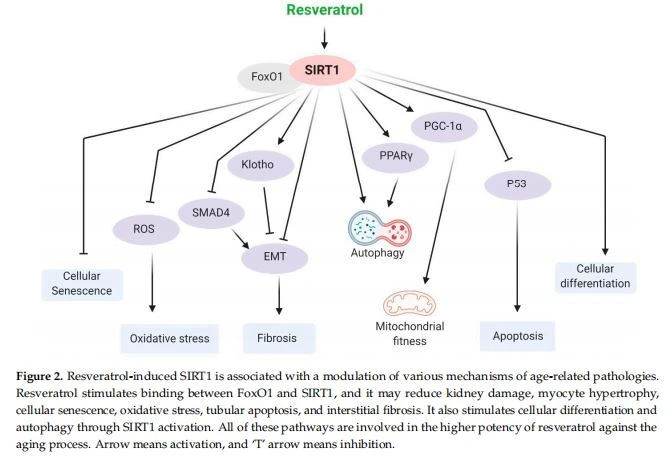
5. Effect of Resveratrol on Age-Related Mechanisms There are mainly three mechanisms involved in the anti-aging effects of resveratrol in the kidney, including SIRT1, AMPK, and the NF-kB pathways. These are discussed below and summarized in Figures 2-4.
5.1.SIRT1 SIRT2 overexpression may extend longevity in the yeast Saccharomyces cerevisiae by 30%, while suppression of the SIRT2 gene causes a reduction of its lifespan by almost half l60L. In mammals, CR induces SlRTl activation, which regulates various physiological processes, such as mitochondrial fitness, metabolism, and the aging process, leading to an extension of lifespan [161-163]. In zebrafish, resveratrol mediates the AMPKa-SIRT1-PPARγ pathway and lipid metabolism 【164】. In diet-induced obese mice, resveratrol improves metabolic phenotypes related to the aging process by downregulating cAMP and phosphodiesterases [165]. Thus, both resveratrol and CR have a beneficial effect in terms of metabolic regulation [166].
Several studies have suggested the beneficial effects of resveratrol on kidney aging. A recent study showed that resveratrol protects against glomerulosclerosis in aged mice, improving kidney oxidative stress via SIRT1-mediated klotho expression [167]. Another study showed that resveratrol increased the SIRT1 expression level, which ultimately improves EMT and Yin yang 1(YY1) acetylation induced by high glucose [168]. Resveratrol also reduces cadmium (Cd)-induced nephrotoxicity and mitochondria dysfunction through upregulation of VDACl, Cyt C, SIRT3. SIRT1. PGC-1α, Nrfl. and TFAM [169]The resveratrol-activated SIRT1 pathway plays a protective role by autophagy induction in I/R-induced AKI[170,171]. Resveratrol stimulates binding between forkhead box protein O(FoxO)1 and SIRT1; thus, it may reduce kidney damage, myocyte hypertrophy, and interstitial fibrosis in nephrectomized mice [172]. The deacetylating activity of the resveratrol-activated SIRT1 pathway results in alterations in various downstream regulators, such as PGC-1α [173]. Elevated levels of NAD induced SIRT1, which leads to enhanced PGC-1α transcriptional activity [174]. Evidence from both in vitro and in vivo experiments suggests that this polyphenol can act as a safeguard for the kidney through maintenance of the SIKT1-PGCla-FoxOpathway [88]. A recent study suggested that PGC-1α might be a potential therapeutic target against kidney aging [175]. Additionally, activation of SIRT1 by resveratrol treatment caused p53 deacetylation and thereby attenuated cisplatin-induced kidney injury and tubular apoptosis 52]. Resveratrol protects against Cd-induced nephrotoxicity by inhibiting IRE-1α and activating SIRT1 [129]. Kidney injury and fibrosis are attenuated by the resveratrol-induced SIRT1 signaling pathway through inhibition of EMT, where deacetylation of SMAD4 plays a vital role in inhibiting TGF-β and MMP7[51 86]. Resveratrol attenuates ROS-induced oxidative stress through activation of the SIRT1 pathway [119]. Additionally, resveratrol treatment impedes high-glucose-induced cell senescence in the kidney by activating SIRT1 [113]. SRT1720(an analog of resveratrol), an activator of SIRT1, reduces renal fibrosis by attenuating TGF-β1 and oxidative stress in UUO mice [176]. All of this evidence supports the fact that resveratrol may become a potential therapeutic against kidney aging through activation of SIRT1 and its target pathways (Figure 2).
5.2. AMPK A potential role of AMPK signaling in kidney diseases, including diabetic nephropathy, polycystic kidney disease, subtotal nephrectomy, lupus nephritis, and kidney fibrosis, has been reported [177.AMPK induces autophagy through upregulation of several antioxidants, such as SOD, uncoupling protein 2(UCP2), and Nrf2, while it downregulates nicotinamide adenine dinucleotide phosphate oxidase (NOX, a primary source of ROS), suggesting a role of AMPK in the inhibition of oxidative stress in kidney disease [178,179].
In the process of aging, AMPK is the main nutrient sensor. Pro-longevity interventions, such as dietary restriction, induce AMPKactivation to regulate cellular homeostasis [180-182]The anti-aging effect of resveratrol is strongly linked to the activation of AMPK. Activation of AMPK is involved in lowering blood pressure in hypertensive mice [183]. In vascular smooth muscle, resveratrol promotes cellular differentiation through activation of the AMPK-SIRTl pathway [184]. In primary human keratinocytes, resveratrol reduces oxidative stress-induced senescence by activating AMPK-FOXO3 [185]. AICAR, an activator of AMPK, increases the endogenous Sirte in mouse embryonic fibroblasts [186. Resveratrol is an effective therapeutic agent against diabetic kidney fibrosis via AMPK/NOX4/ROS signaling [79]. Additionally, resveratrol alleviates age-related EMT in aging kidneys yia AMPK-mTOR signaling[159]. All of this evidence suggests that resveratrol has significant effects on AMPK, which ultimately may help to fight against kidney aging (Figure 3).

5.3.NF-xB Increased activity of NF-kB has been implicated in the pathogenesis of AKI [187]. Additionally, NF-kB promotes inflammation and regulates apoptosis; these two factors are associated with the progression of CKD [188].In an in video study with mice. the upregulation of microRNA-382 in kidney epithelial cells was mediated by the activation of NF-kB signaling, which elevates pro-inflammatory cytokines [189]. Ang II and NF-xB play a vital role in podocyte injury via membrane protein (Tmem) 63c[190]. Furthermore, the pathogenic role of NF-xB in mediating chronic inflammation in tubular epithelial cells, podocytes, mesangial cells, and macrophages during CKD has been reviewed [191].
In a rat model of AKI, resveratrol increases the survival rate by promoting NF-kB-p65 deacetylation by upregulating SIRTl and it inhibits inflammatory responses[192]. Resveratrol attenuates ER stress through suppression of IREl and NF-KB in kidney tubular cell injury [35]. Skeletal muscle atrophy is an important clinical characteristic of CKD. Resveratrol reduces skeletal muscle atrophy through suppression of NF-KB activation in vivo models[42]. In addition, SRT1720 reduces vascular endothelial dysfunction by inhibiting aortic NF-kB activation and TNF-α levels in old mice [193]. In humans, resveratrol inhibits the signaling pathway of NF-kB, thereby inhibiting inflammation [194]. These studies suggest that through the modulation of NF-xB pathways, resveratrol may act as a protective agent against kidney aging (Figure 4).

6. Resveratrol as Epigenetic Modulator Modulation of epigenetics is a major mechanism in aging [195]. Resveratrol mediates modifications to epigenetic enzymes, such as DNA methyltransferases (DNMTs), the histones acetyltransferases family (HATs), and the histone deacetylases family (HDACs), which ultimately impact our overall health and longevity [196]. While resveratrol increases AMPK, leading to activation of the SIRTl pathway [164], SIRTl1 catalyzes the deacetylation of histones and several transcription factors [197]. Thus, the beneficial effects of resveratrol are mediated through epigenetic modification by upregulation of the AMPK/SIRT1 pathway. SRT1720, a specific SIRTl activator, mediates deacetylation and activation of PGC-1α, which restores tubular mitochondrial fitness, resulting in a decrease in I/ R injury [198]. site is suggested to deacetylate and inactivate the p65 subunit of NF-kB and STAT3, which reduces podocyte dysfunction in mice [199]. In addition, SIRT1 is found to deacetylate FoxO4 and it inhibits pro-apoptotic genes, such as Bcl2L1l, which leads to a reduction in podocyte apoptosis [199]. SIRT1 increases the deacetylation of SMAD7, leading to the inhibition of apoptosis in mesangial cells [200]. Resveratrol attenuates diabetic nephropathy through the activation of SIRT1 in rats. SIRT1 deficiency inhibits these effects [20l]. Resveratrol protects the kidney by maintaining the SIRT1-PGC1α-FoxO pathway [88l. Histone H3.1 is a protein encoded by the HISTH3E gene. In primary renal epithelial cells, epigenetic regulation of HIST1H3E has an overall effect on aging-related genes in humans. Additionally, resveratrol decreased HIST1H3E expression and increased SIRT5 in muscle cells [202]. A recent review suggests that resveratrol mediates neuroprotective effects against Alzheimer's disease pathology through epigenetic changes, including anti-aging effects in the brain [203]. Furthermore, another study has reviewed the epigenetic regulation of resveratrol against ocular diseases [204].

CISTANCHE WILL IMPROVE KIDNEY/RENAL INFECTION
7. Resveratrol as a Calorie Restriction Mimetic CR is an effective way of delaying the aging process and preventing chronic diseases, such as abdominal obesity, diabetes, hypertension, and cardiovascular diseases [205]. Glomerulosclerosis and kidney interstitial fibrosis occur in the aging kidney. It has been shown that long-term CR reduces aging-related kidney fibrosis by downregulating mi-croRNA21[206]. Short-term CR has potential in treating AKI [207]. Heat shock protein 47 (Hsp47) promotes kidney fibrosis and glomerulosclerosis in a rat model of CKD, while CR has been found to downregulate this protein, thus slowing the aging process of the kidney in mice [208,209]. Resveratrol mediates several mechanisms, such as activation of SIRT1, development of insulin sensitivity, and utilization of energy, which are closely related to the effects of CR. Resveratrol supplementation has exhibited beneficial effects by altering metabolic activities by improving insulin and glucose tolerance in old mice [166]. A randomized controlled trial revealed that among individuals with diabetes who take resveratrol it helped them to decrease their level of fasting glucose, reduce their insulin resistance, and reduce their glycated hemoglobin levels [210]. A double-blind crossover study showed that resveratrol supplementation for a month in 50-year-old men with obesity mediated CR-like effects by inducing some changes in metabolism by regulating the AMPK-SIRT1-PGC-lα axis [211]. Several studies have proposed that resveratrol and CR have the same impact on various targets, such as adiponectin, AMPK, Akt, MnSOD, and NF-KB, in the cardiovascular system in mammals [212]. Apart from these, resveratrol and CR mediate similar effects against the aging of neuromuscular junctions and muscle fibers in old mice [213]. Accordingly, CR significantly decreases urea nitrogen, creatinine, and urine protein in CKD rodents [214]. Resveratrol-induced CR-like effects might alleviate age-related EMT in aging kidneys via AMPK-mTOR signaling [159]. It has been observed in genetically obese animals that decreased food intake prevents or partially delays some specific degenerative lesions, more specifically glomerulonephritis associated with obesity and diabetes [215].In individuals suffering from type 2 diabetes with abdominal obesity, CR has shown improved glomerular hyperfiltration, and a similar effect has also been reported with the supplementation of resveratrol, suggesting that both CR and resveratrol can act as a protective agent against kidney aging [79.216l. Additionally, resveratrol has been shown to repress microRNA21 and NF-kBexpression, leading to a decrease in pro-inflammatory cytokines, such as TNF-α, IL-1β, IL-6, and IL-8, while it downregulates MAPK, JNK, and AP-1 [217-222]. This evidence indicates that resveratrol may become a potential CR mimetic for improving kidney disease and aging.
8. Resveratrol in Lifespan Expansion Resveratrol is reported to increase the lifespan of many organisms. In Saccharomyces cerevisiae, it almost doubled its lifespan by stimulating SIRT2 activity [223]. Resveratrol also increases the lifespan of Caenorhabditis Elegans(C. elegans)through SIRT2 activation without altering fertility [224]. Additionally, ad libitum addition of resveratrol to the diet may increase the lifespan of Apis mellifera [225]. Resveratrol extends the lifespan of N. furzeri along with a late decline in age-related brain action, particularly for motor and cognitive function[226].In mammals, due to a lack of evidence,it cannot be said that there is a clear effect of resveratrol on lifespan extension. According to three different studies, resveratrol increases survival and insulin sensitivity, increases the lifespan, and improves locomotor activity; thus, it might be a potential treatment option against neurodegenerative diseases, as well as lengthening the lifespan, and it improves the function of motor neuron SOD1(G93A)in mice [227-229]. Resveratrol has shown protective effects against age-related kidney diseases by activation of SIRT1, an NAD(+)-dependent deacetylase, which may be a useful supplemental treatment for preventing age-related kidney injury [230]. Thus, these data suggest that resveratrol may also extend lifespan in the kidney.
However, a few studies support the fact that resveratrol treatment only slightly extends the lifespan of C.elegans and D. melanogaster and it had absolutely no effect on the crustacean model Daphnia [231,232]. A study on D.melanogqaster also suggested that lifespan expansion solely depends on sex and diet [233]. Additionally, experiments with animal models showed that resveratrol administration for up to 1 year could not extend lifespan [234-236].In aged mice, treatment with resveratrol delays age-related deterioration, including inflammation and oxidative stress, in the vasculature and skeletal mus-ce [234,237]. A study found that resveratrol was associated with decreased survival rates in severe combined immunodeficiency in mice with prostate cancer xenografts [238].
9. Role of Resveratrol on Gut Dysbiosis and Associated CKD Pathobiology Gut microbiota plays a crucial role in immunity and inflammation [239]. Evidence for the existence of a gut-kidney axis suggests an intimate correlation between the abnormal gut microbiota and the development of CKD[240,241]. Dysbiosis in gut microbiota disrupts gut integrity and produces toxic metabolites, including urea and trimethylamine-N-oxide (TMAO), which lead to the aberrant activation of immune cells, excess production of inflammatory factors, and infiltration of inflammatory cells that can potentially contribute to CKDpathobiology [242].
Evidence shows that various polyphenols, including resveratrol, can promote gut microbiota by inhibiting various bacterial pathogens, namely E, coli, and Salmonella., and thereby can improve inflammation and mitigate kidney damage [243.. Oral administration of resveratrol ameliorates gut dysbiosis in db/db mice by increasing the intestinal bacterial population, such as Bacteroides, Alistipes, Rikenella, Odoribacter, Parabacteroides, and Alloprevotella. Moreover, transplantation of fecal microbiota derived from healthy resveratrol-treated db/m mice was found to attenuate the renal dysfunction, rebalance the gut microbiome, and improve intestinal permeability and inflammation in recipient db/db mice[244]. In a study by Hu and colleagues, resveratrol was also shown to promote Lactococcus lact is but inhibit Enterococcus faecalis [245].
Resveratrol also can help improve other CKD-related risk factors, such as obesity. dyslipidemia, atherosclerosis, and CVD [246]. For example, resveratrol can modify the relative Bacteroidetes: Firmicutes ratio and reverse the gut microbial dysbiosis caused by a high-fat diet, and thereby promote energy metabolism to produce anti-obesity effects in rodents [27l. High concentrations of TMAO,a gut microbe-dependent metabolite of dietary L-carnitine and choline, are indicative of the development of CVD and CKD [248]. Dietary supplementation with resveratrol increased the abundance of Lactobacillus, reduced the levels of TMAO, and abrogated the atherosclerosis phenotype of ApoE-/-mice fed a high-choline diet [249]. Together, these findings show that resveratrol modulates gut microbiota and thereby plays a pivotal role in maintaining gut homeostasis and the prevention of CKD.
10. Prospects, Limitations, and Conclusions Kidney function decreases with age, and aging-associated kidney complications proportionately increase. Existing drugs for treating kidney diseases are limited by their side effects, and therefore natural compounds with fewer side effects are being evaluated. The literature highlighted in this review clearly suggests that resveratrol may modulate several pathological factors that are implicated in kidney aging, including inflammation, oxidative stress, fibrosis, mitochondrial dysfunction, cellular senescence, telomere shortening, ER stress, and autophagy dysfunction, and thus it may delay the aging process in the kidney (Figure 5). Aging biomarkers, such as SIRT1, AMPK, and NF-kB, and their associated signaling pathways are primarily targeted in resveratrol-mediated kidney protection. Moreover, resveratrol may increase the lifespan of model organisms and generate calorie restriction-mediated health effects, such as activation of SIRTl, development of insulin sensitivity, and utilization of energy.

While the pharmacological benefits of resveratrol in kidney aging have been revealed, these findings were mostly based on preclinical studies. The digital applications of resveratrol are limited by its poor bioavailability and limited durability during delivery. Additionally, several studies have recognized resveratrol as a pro-oxidizing and cell-damaging agent [250,251].A range of formulation techniques has been employed to overcome these difficulties [252]. Several nanoparticle-loaded resveratrol and kidney biomarkers are currently being investigated for efficient and stable drug delivery with substantial efficacy, as mentioned earlier[31,253]. Intensified clinical trials must be conducted to further evaluate its efficacy followed by suitable strategies to achieve facile delivery in the human body. We anticipate that the points discussed in this review will direct future research to better understand how pharmacological interventions through natural products could modulate kidney aging and help develop resveratrol as a potential anti-aging agent to manage aging-associated kidney abnormalities.